ARTICLE
Personalized Retention Strategy: The 2026 Guide to Intelligent Revenue Protection
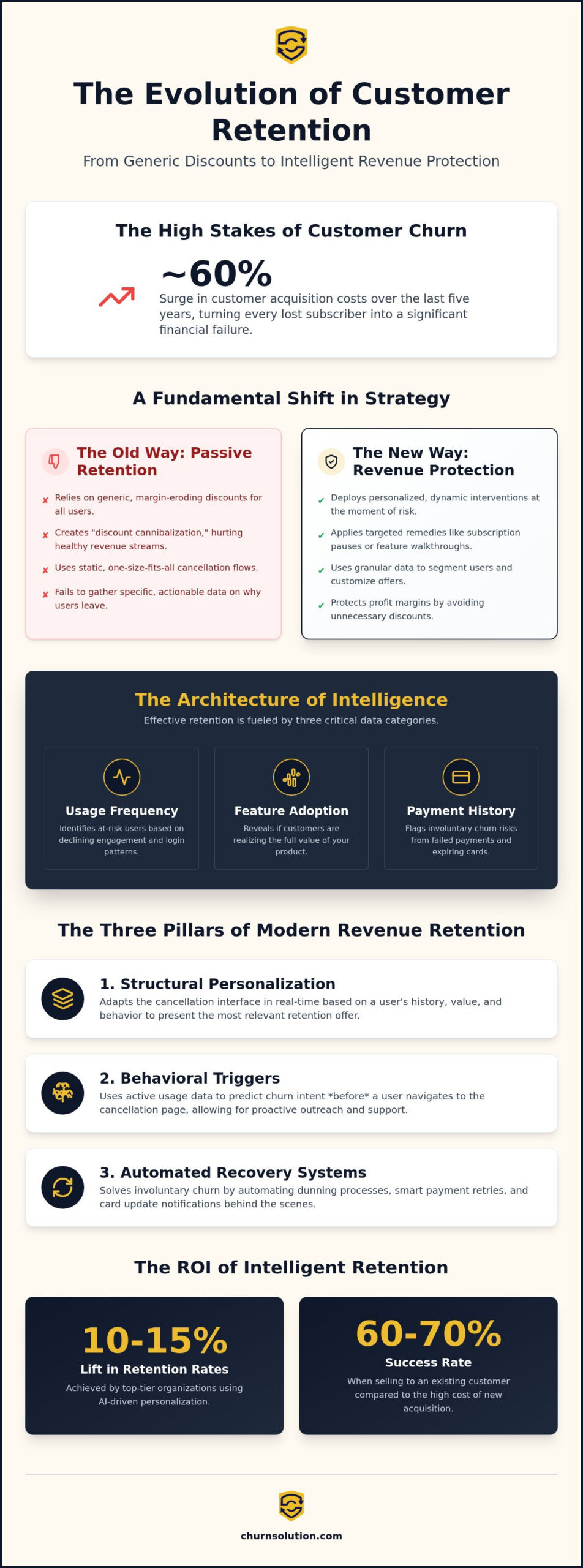
Customer acquisition costs have surged by approximately 60% over the last five years, turning every churn event into a high-stakes failure. If your current approach to saving subscribers relies on generic, margin-eroding discounts, you aren’t protecting revenue; you are merely subsidizing its exit. To secure your MRR in the 2026 economy, you must deploy a personalized retention strategy that treats every cancellation attempt as a unique data point. A high-performance system doesn’t just ask users to stay. It identifies the precise friction point and applies a targeted, automated remedy.
You understand that losing high-value customers to preventable churn is an avoidable drain on your growth. This guide will teach you how to transform passive exit surveys into a data-driven engine that minimizes churn and recovers revenue from failed payments. We will analyze the specific mechanisms of AI-powered feedback, dynamic offer segmentation, and smart retry logic to build an intelligent revenue protection framework that scales with your business.
Key Takeaways
- Transition from passive retention to proactive revenue protection by utilizing dynamic interventions triggered by specific user risk signals.
- Build a high-performance personalized retention strategy that uses granular data like usage frequency and payment history to segment and save high-value subscribers.
- Protect profit margins by replacing generic discounts with dynamic offers and subscription pauses that address the specific psychology of churn.
- Operationalize your defense with automated cancellation flows and exit surveys designed to capture intent and prevent churn at the “Moment of No Return.”
- Leverage specialized revenue protection tools to automate dunning and recovery processes, ensuring a high-performance system that operates independently of manual oversight.
Beyond Generic Save Rates: What is a Personalized Retention Strategy in 2026?
In 2026, the standard for customer retention has shifted from reactive damage control to proactive revenue protection. A personalized retention strategy is no longer defined by a simple follow-up email or a generic “don’t go” banner. It is a sophisticated, dynamic system of interventions triggered by granular user risk signals. While passive retention relies on static sequences, intelligent revenue protection utilizes real-time data to deploy targeted save flows at the exact moment a subscriber considers departure. This shift is essential. AI-driven personalization now accounts for a 10% to 15% lift in retention rates for top-tier subscription organizations. Selling to an existing customer has a 60% to 70% success rate. These systems provide undeniable cost-efficiency compared to the surging expense of acquisition.
The Three Pillars of Modern Revenue Retention
Success in the current subscription economy requires a framework built on three technical pillars. First, structural personalization adapts the user interface during the cancellation attempt, presenting options based on the user’s specific history. Second, behavioral triggers use active usage data to predict exit intent before the user even clicks “cancel.” Finally, automated recovery systems solve involuntary churn by managing failed payments behind the scenes. By integrating customer segmentation, brands move away from margin-eroding discounts toward value-based interventions that reinforce the product’s utility. You aren’t just begging for a stay; you’re solving the specific problem that caused the friction.
Why One-Size-Fits-All Retention is a Liability
Legacy retention tactics often create a hidden drain on profitability through “discount cannibalization.” This occurs when healthy, satisfied users encounter generic save offers and take unneeded deals, unnecessarily shrinking your margins. These blanket approaches ignore the reality of user intent. Missing features require a technical walkthrough or a product roadmap update. Budget constraints require a temporary pause. Generic exit surveys fail to provide the actionable data your product team needs to iterate effectively. Without specific insights into why high-value segments are leaving, your long-term Customer Lifetime Value (LTV) remains under constant threat. A high-performance personalized retention strategy eliminates this guesswork. It ensures that every save attempt is an optimized investment in your bottom line rather than a desperate, blanket concession. You gain control over your MRR by treating every departure attempt as a data-driven opportunity for optimization.
The Architecture of Intelligence: How Data Fuels Targeted Interventions
Personalization is often reduced to a cosmetic variable; however, a high-performance personalized retention strategy requires a deep architectural foundation. Most subscription businesses fail because they treat data as a historical record rather than a real-time fuel for intervention. McKinsey research highlights that the value of personalization is multiplying, yet many SaaS firms still ignore the behavioral signals that precede a cancellation. To stop churn, you must master Retention Intelligence. Retention Intelligence is the strategic intersection where granular behavioral data meets automated, real-time response.
Effective intervention depends on three critical data categories: usage frequency, feature adoption depth, and payment history. When these metrics are unified, you can deploy sophisticated customer segmentation to differentiate your save strategies. A high-value power user experiencing technical friction requires a different response than a low-engagement user who is price-sensitive. By segmenting users based on their specific risk profiles, you avoid the trap of generic responses that erode brand value and profit margins. You gain the ability to offer the right solution to the right user at the exact moment of decision.
Leveraging AI Feedback Analysis for Deep Insights
Multiple-choice surveys are insufficient for understanding the nuance of user departure. Move beyond rigid options and implement open-ended AI feedback analysis to capture the raw sentiment of your customers. This technology categorizes churn reasons into actionable buckets: price sensitivity, missing features, or technical friction. By analyzing qualitative feedback at scale, you identify systemic issues that quantitative data might miss. This intelligence allows you to refine your product roadmap and improve your core value proposition, ensuring your personalized retention strategy evolves alongside user needs.
Predictive Triggers: Acting Before the Cancel Button is Clicked
The most effective save is the one that happens before the user reaches the cancellation page. Identify “Quiet Churn” by monitoring declining engagement metrics and automating interventions when a user hits a specific low-usage threshold. Don’t wait for the exit intent to manifest. Data shows that a 10% increase in early, proactive intervention can lead to a 25% lift in Net Revenue Retention (NRR). By acting on predictive triggers, you stabilize your MRR and prevent the “Moment of No Return” from occurring. If you are ready to stop guessing and start saving, you can start building your automated defense today.
Strategic Save Mechanics: Why Dynamic Offers Outperform Blanket Discounts
Generic save attempts are a liability to your profit margins. Offering a flat 20% discount to every user who clicks “cancel” ignores the complexity of user intent and results in “discount cannibalization.” To protect your bottom line, you must deploy dynamic offers that respond to the specific reason for departure. This precision is the hallmark of a sophisticated personalized retention strategy. While general customer retention strategies focus on broad engagement, intelligent revenue protection requires surgical interventions that address the root cause of churn without unnecessarily eroding your pricing power.
The Psychology of the Pause Functionality
Churn is frequently a temporary response to external factors like seasonal budget shifts or project-based workloads. In these scenarios, a “Subscription Pause” is far more effective than a cancellation. Research indicates that offering a pause option saves 40% more users than a standard cancellation flow. This mechanism works by reducing the psychological and technical friction of “starting over.” By maintaining user data, configurations, and history, you make it easy for the customer to return when their circumstances change. Depending on the user’s history, you can automate offers for a 30-day or 90-day pause. Integrating this into a customer portal allows for self-service status management, providing the user with control while securing the long-term relationship.
Matching the Save Offer to the Churn Reason
Effectiveness is a product of alignment. If your data indicates a user is price-sensitive, a temporary discount or a “downgrade path” to a lower-tier plan is a logical intervention. However, if the user is leaving due to technical friction, a discount is an irrelevant distraction. In that instance, the correct response is a guided onboarding session or a free consultation to resolve the bottleneck. For users who report a lack of perceived value, your intervention should highlight specific, high-impact features they haven’t yet utilized. This value-based approach reinforces the product’s utility rather than just its cost.
Optimization requires constant iteration. You must utilize A/B experiments to identify which save triggers produce the highest recovery rates for specific segments. By testing “Extension Offers,” such as a free month of service, against structural changes like plan downgrades, you build a resilient retention engine. This data-driven methodology ensures that every intervention is optimized for maximum ROI, turning a potential loss into a reinforced commitment to your platform.
Operationalizing Retention: Building Automated Cancellation and Dunning Flows
Execution is the bridge between strategic intent and recovered revenue. To build a robust personalized retention strategy, you must translate high-level goals into automated, repeatable processes. This operational framework ensures that no customer departs without a targeted intervention. It starts with mapping the user journey to identify the “Moment of No Return,” which is the precise point where engagement drops and exit intent becomes a reality. Once identified, you can deploy exit surveys to capture immediate intent. This provides the qualitative data needed to trigger the dynamic offers discussed in previous sections. You don’t have time for manual outreach; you need a system that acts instantly.
A high-performance system follows a structured implementation path:
- Intent Capture: Use logic-based surveys to understand the specific “why” behind the exit attempt.
- Automated Dunning: Trigger specialized email sequences immediately after a payment failure to prevent involuntary churn.
- Recovery Logic: Implement smart retries that adapt to bank response codes and optimal processing windows.
- Performance Monitoring: Analyze churn metrics to identify which steps in the flow require further optimization.
Solving Involuntary Churn with Dunning Automation
Failed payments are a silent threat to your Net Revenue Retention (NRR). Expired cards, network timeouts, and bank declines account for a significant portion of churn, yet many businesses treat these as inevitable losses. You must design dunning emails that feel like proactive customer service rather than a cold debt collection notice. By integrating payment recovery directly into your billing stack, you solve the friction before the customer even notices a failure. This technical mastery ensures that healthy accounts remain active without manual intervention from your RevOps team. It’s about protecting the revenue you’ve already earned by removing technical barriers to payment.
Closing the Loop with Win-Back Campaigns
Retention doesn’t end at the point of cancellation. You must automate reactivation campaigns for users who have already departed. The timing of these sequences is critical. Deploy a structured 30, 60, and 90-day post-churn sequence to stay top-of-mind without becoming a nuisance. Use past usage data to personalize the message, reminding the user of the specific value they previously gained from your platform. If a user was a heavy user of a specific feature, highlight updates to that feature in your win-back. This data-driven approach turns your win-back efforts into a high-performance engine for long-term growth.
Securing Your Bottom Line: Implementing Churn Solution for Revenue Protection
General CRMs are built for relationship management, not revenue recovery. While a CRM provides a broad view of your customer database, it lacks the specialized triggers required to plug technical and behavioral revenue leaks. A high-performance personalized retention strategy requires a dedicated architecture that operates independently of manual oversight. By implementing a specialized revenue protection platform, you transition from reactive churn management to a “Set and Forget” automated defense. This system works in the background to identify exit intent, deploy dynamic save offers, and manage payment failures without taxing your internal resources. You shouldn’t view retention as a defensive tactic; it is your most cost-effective growth lever.
To begin, you must audit your current churn rate and identify the largest revenue leaks. Are you losing high-value subscribers to preventable technical failures? Are your profit margins being eroded by blanket discounts? Identifying these friction points allows you to deploy targeted interventions that produce immediate results. Research indicates that a 5% increase in customer retention can lead to a 25% to 95% increase in profits. Given that acquiring a new customer costs 5 to 25 times more than retaining an existing one, the financial logic for specialized revenue protection is undeniable.
The ROI of Automated Revenue Recovery
Implementing automated recovery flows directly impacts your long-term Customer Lifetime Value (LTV). When you eliminate involuntary churn through smart payment retries and dunning, you secure revenue that would otherwise be lost to simple administrative errors. Furthermore, AI feedback analysis reduces the burden on your customer success teams by identifying systemic product issues before they lead to mass departures. You gain the ability to scale your operations without a proportional increase in headcount. This structural efficiency allows your team to focus on high-level growth initiatives while the platform secures your existing MRR.
Next Steps: Launching Your Save Flow
Sophisticated implementation starts with precision. Don’t attempt to overhaul your entire retention framework at once. Instead, follow this structured path to optimization:
- Identify the High-Value Segment: Start with your high-value, low-engagement users who represent the highest risk of “Quiet Churn.”
- Deploy a Dynamic Offer: Test one targeted intervention, such as a subscription pause or a feature-specific extension, against your current baseline.
- Analyze the Delta: Use real-time metrics to measure the lift in recovery rates and iterate based on the data.
The subscription economy moves too fast for manual retention efforts. You need a system that matches the speed and intelligence of your market. Audit your current leaks, identify your risk segments, and deploy a defense that scales. Protect your subscription revenue with Churn Solution today.
Future-Proof Your Revenue with Intelligent Retention
Subscription growth in 2026 demands a shift from passive observation to proactive, technical intervention. You’ve seen how dynamic save offers and automated payment recovery transform a leaking funnel into a high-performance engine. A sophisticated personalized retention strategy isn’t a luxury; it’s the operational standard for protecting your bottom line against rising acquisition costs and surging churn rates. By moving beyond generic save attempts, you secure your MRR while maintaining the integrity of your brand value.
Integrating AI-driven feedback analysis and smart retry logic eliminates the guesswork that plagues legacy retention efforts. You gain total control over your revenue protection while freeing your RevOps team to focus on high-level strategy rather than manual recovery. Stop subsidizing churn with blanket discounts and start securing your profit margins with precision-engineered flows that address the root cause of every departure. The tools for total revenue control are within your reach.
Take the first step toward total revenue protection today. Your data holds the key to your next phase of sustainable growth.
Frequently Asked Questions
What is a personalized retention strategy?
A personalized retention strategy is a dynamic system of automated interventions triggered by specific user risk signals and behavioral data. Instead of sending generic emails, it uses real-time insights to present tailored solutions that address a customer’s unique friction points. This approach ensures that your save attempts are relevant, timely, and optimized to protect your recurring revenue.
How does a personalized cancellation flow differ from a standard one?
Standard flows are static sequences that present the same “Are you sure?” message to every user regardless of their history. A personalized flow utilizes conditional logic to adapt the experience based on usage frequency, plan type, and feedback. It presents specific alternatives like a subscription pause or a guided feature walkthrough, which are far more effective than a generic discount.
Can I reduce churn without offering deep discounts?
Yes, you can significantly lower churn by focusing on value-based interventions. Many users leave due to technical friction or temporary project shifts rather than price. Offering a 30-day pause or a downgrade to a lower-tier plan often saves the account while protecting your profit margins. These strategic mechanics address the root cause of the departure without devaluing your product.
What is the difference between voluntary and involuntary churn?
Voluntary churn occurs when a customer actively decides to cancel their subscription through your interface. Involuntary churn is a technical failure where a payment fails due to expired cards, network errors, or bank declines. Both require distinct automated processes, such as dunning sequences for payment failures and dynamic save flows for active cancellations, to ensure comprehensive revenue protection.
How do smart retries help with customer retention?
Smart retries use logic-based timing to re-attempt failed payments when they’re most likely to succeed. By analyzing bank response codes and optimal processing windows, this technology recovers revenue that would otherwise be lost to temporary technical issues. It stops involuntary churn before the customer even notices a problem, maintaining a seamless user experience.
Is it possible to automate the win-back process for lapsed subscribers?
Automation is the most efficient way to manage win-back campaigns for churned users. You can set up reactivation sequences that trigger at 30, 60, and 90-day intervals post-departure. These campaigns use historical usage data to personalize the “We Miss You” message, highlighting specific features or updates that align with the user’s past behavior on your platform.
How do I know if my retention strategy is actually working?
Success is measured by a verifiable lift in your Net Revenue Retention (NRR) and a reduction in your churn rate. You must establish a baseline performance metric before implementing your new flows. If your automated interventions are successfully recovering high-value accounts that were previously lost, your strategy is delivering a positive ROI.
What metrics should I track to measure the success of my save flows?
Focus on your Save Rate, MRR Recovered, and the performance of individual dynamic offers. Tracking these granular metrics allows you to identify which interventions are most effective for specific segments. Continuous monitoring ensures you can iterate on your personalized retention strategy to maximize its impact on your bottom line and long-term growth.
- Key Takeaways
- Table of Contents
- Beyond Generic Save Rates: What is a Personalized Retention Strategy in 2026?
- The Architecture of Intelligence: How Data Fuels Targeted Interventions
- Strategic Save Mechanics: Why Dynamic Offers Outperform Blanket Discounts
- Operationalizing Retention: Building Automated Cancellation and Dunning Flows
- Securing Your Bottom Line: Implementing Churn Solution for Revenue Protection
- Future-Proof Your Revenue with Intelligent Retention
- Frequently Asked Questions

Churn solution that turns your customers right around.
Related Articles
Membership Community Churn: The Members Who Quit Without Clicking Cancel
Quiet churn is the real leak: members who never clicked “cancel” at all. A card expires. A bank declines a...

Subscription Churn Dashboard: The 2026 Guide to Actionable Revenue Intelligence
Up to 40% of subscription churn is involuntary, meaning your customers aren't choosing to leave; they're being forced out by...
Dynamic Retention Offers: The 2026 Guide to Automated Revenue Recovery
Did you know that acquiring a new customer in 2026 costs up to 25 times more than retaining an existing...