ARTICLE
Dunning Letter Meaning: The Strategic Guide to Revenue Recovery in 2026

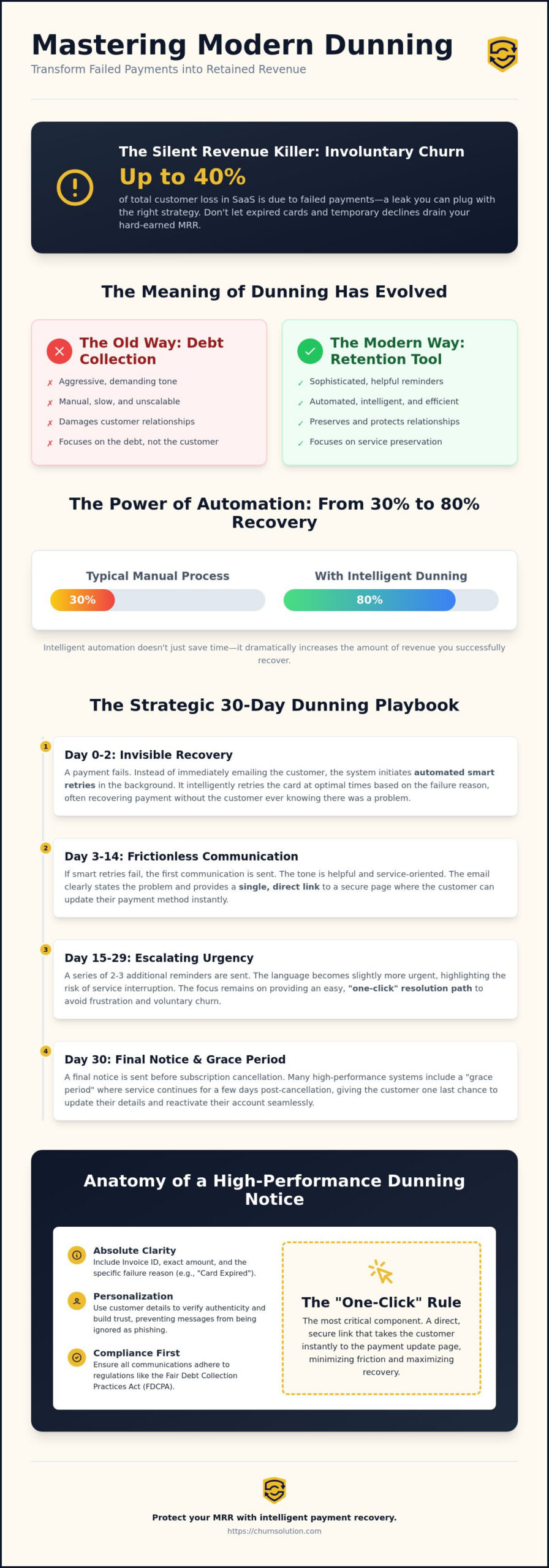
Failed payments account for up to 40% of total involuntary churn in the SaaS industry. For a scaling subscription business, this is a direct leak in your revenue bucket that manual processes cannot plug. You understand that losing hard-earned MRR to an expired credit card or a temporary bank decline is unacceptable. However, searching for the dunning letter meaning often leads to outdated advice that risks damaging customer relationships with an aggressive, debt-collection tone.
We agree that your recovery strategy must be as sophisticated as your product. This guide provides the framework to master the definition, mechanics, and strategic implementation of modern dunning sequences to protect your bottom line. You will learn how to move from 30% recovery rates to 80% through intelligent automation. We preview the 2026 regulatory environment, explore non-intrusive communication frameworks, and detail the automated workflows required to scale your revenue protection without increasing headcount.
Key Takeaways
- Redefine the dunning letter meaning as a sophisticated retention touchpoint that preserves customer relationships while securing overdue revenue.
- Deploy automated smart retries to recover failed payments invisibly before initiating any direct customer outreach.
- Implement a strategic 30-day recovery sequence that balances technical background retries with friction-reducing communication.
- Eliminate the manual overhead of traditional accounts receivable by integrating automated dunning flows into your subscription ecosystem.
- Prioritize the “One-Click” rule to allow customers to update payment methods instantly, maximizing recovery success through reduced friction.
What is a Dunning Letter? Defining Modern Revenue Recovery
A dunning letter is a methodical communication process designed to recover overdue accounts receivable. In the 2026 subscription economy, the dunning letter meaning has shifted from a manual collection notice to a sophisticated, automated retention mechanism. It’s the primary defense against involuntary churn, which currently accounts for 20% to 40% of total customer loss in the SaaS industry according to LedgerUp. When a credit card fails, your revenue stops. Dunning is the engine that starts it again.
The Etymology and Evolution of the ‘Dun’
Dunning traces its origins back to 17th-century debt demands. Historically, it was a blunt instrument of pressure. Digital transformation has refined this process. Modern systems replace aggressive demands with “service preservation” reminders. In a high-performance framework, the Problem is a failed transaction; the Mechanism is an automated sequence; the Outcome is recovered revenue and a protected customer relationship. Today, this process is almost entirely digital, moving away from physical mail toward high-frequency, automated dunning emails that trigger the moment a billing engine returns a failure code.
Dunning vs. Standard Payment Reminders
Clarity in terminology is essential for operational efficiency. Standard payment reminders are proactive notifications sent before a billing cycle ends. They aim to prevent friction. Conversely, dunning occurs exclusively after a payment failure has been recorded. The psychological profile of these messages differs. Reminders offer helpfulness, while dunning conveys urgency. Confusing the two risks irritating customers, which can trigger voluntary churn. High-growth firms use payment recovery automation to ensure the tone matches the specific stage of the failure lifecycle.
A high-performance dunning strategy addresses three core areas:
- Transactional Integrity: Identifying the specific reason the card failed to determine if a retry is viable.
- Communication Frequency: Determining how often to reach out without causing notification fatigue.
- Resolution Pathing: Providing a frictionless link for the customer to update their payment method instantly.
Manual intervention is no longer viable for high-volume subscription models. Relying on human accounts receivable staff to track down every failed invoice is a recipe for unscalable overhead. Automation allows you to execute these sequences at scale. It removes the human element of awkward collection calls. Instead, it replaces them with data-driven emails that offer immediate resolution paths. This shift ensures your recovery process remains consistent, compliant, and invisible to the teams that should be focused on product innovation rather than debt collection.
The Anatomy of a High-Performance Dunning Notice
A high-performance dunning notice isn’t a passive document. It’s a strategic conversion asset. While the traditional dunning letter meaning focused on a stern demand, the modern version operates as a frictionless bridge to account restoration. Every element must work to reduce cognitive load and facilitate immediate action. If your notice feels like a generic debt collection letter, you risk alienating high-value users. If it’s too vague, they’ll ignore it.
Your notices must provide absolute clarity to prevent customer confusion. Include the specific Invoice ID, the exact amount due, and the precise failure reason, such as an expired card or insufficient funds. This transparency builds trust and helps the customer identify the solution immediately. You can optimize your recovery notices now to ensure every email drives a resolution.
Critical Components for Maximum Conversion
The “One-Click” rule is your most powerful tool for recovery. If a customer has to log in, navigate a complex menu, and hunt for a billing tab, they’ll churn. Instead, provide direct links to a secure customer portal. This link should bypass unnecessary steps and land them directly on the payment update field. Personalized account details are also vital. They verify the message’s authenticity and prevent phishing fears, which often cause customers to ignore legitimate billing alerts. Subject lines must be direct and urgent to bypass promotions tabs and land in the primary inbox.
2026 Compliance and Legal Standards
Compliance is non-negotiable. In 2026, digital debt communications are governed by strict standards, primarily the Fair Debt Collection Practices Act and Regulation F. These rules require clear, simple methods for recipients to opt out of specific communication channels. You must provide a written debt validation notice within five days of the first communication. This notice must include the debt amount and the creditor’s name to remain compliant.
Modern dunning notices must also adhere to “compliance by design.” This means embedding these legal requirements directly into your software logic. For example, Regulation F establishes a “seven-in-seven” rule for calls. While email frequency is more flexible, maintaining a respectful cadence prevents your brand from being flagged as harassing. Transparency in your automated retry schedules is also a legal and strategic necessity. If you utilize smart retries, your communication must reflect the status of the account accurately so the customer isn’t confused by multiple transaction attempts.
Traditional AR vs. Automated Dunning Management
Manual intervention is the enemy of scale. In a high-volume subscription model, relying on a human accounts receivable (AR) team to track every failed transaction is inefficient and costly. Traditional AR processes are reactive; they wait for a report to be generated before action is taken. This delay is fatal. At 30 days past due, your recovery probability is 85% to 90%, but it drops to 55% to 60% by 90 days. Automation transforms the dunning letter meaning from a delayed administrative task into a real-time revenue protection event.
Real-time synchronization with billing engines ensures that no failure goes unnoticed. When a transaction declines, the system knows immediately. This eliminates the risk of human error and the awkward collection calls that damage customer relationships. By implementing payment recovery automation, you directly improve your Net Revenue Retention (NRR) by capturing revenue that would otherwise be lost to involuntary churn. It’s a shift from chasing debt to preserving growth.
The Cost of Manual Collections
Labor costs for manual collections often exceed the value of the recovered debt, especially for small-ticket delinquencies. In 2025, 40% of B2B invoices in North America were overdue. Tracking these manually requires significant headcount. Human teams often prioritize large invoices, leaving smaller, recurring payments to slip through the cracks. These forgotten delinquencies aggregate into a massive revenue leak. Delays in dunning increase the likelihood of permanent churn because the longer a service is interrupted, the more likely a customer is to seek an alternative.
The Power of Automated Sequences
Automated sequences operate with surgical precision. Trigger-based emails fire the millisecond a card is declined, ensuring the customer is notified while they’re still engaged with your service. These sequences follow a strict escalation logic. They begin with soft reminders that focus on service preservation and move toward hard suspension notices only when necessary. This approach adheres to the ethical guidelines for the collection of consumer debts by providing clear information without harassment.
The most effective defense isn’t just a letter; it’s a multi-layered strategy. Linking your dunning communication to smart retries allows you to attempt background recovery before the customer even knows there’s a problem. Traditional collection agencies recover only 15% to 25% of accounts. In contrast, AI-powered automation platforms can recover 40% to 60% on accounts less than 90 days past due. This efficiency ensures your dunning letter meaning remains focused on recovery rather than simple notification.
The Dunning Lifecycle: A Strategic 30-Day Playbook
A strategic recovery timeline ensures you maximize revenue without sacrificing the customer experience. While the foundational dunning letter meaning describes the communication itself, the lifecycle defines the execution. This 30-day playbook moves from invisible technical attempts to assertive service preservation. It’s a structured ecosystem designed to catch failures early and escalate only when necessary.
Day 0 is the “Invisible Recovery” phase. Before a single email is dispatched, your system should initiate smart retries. This technical layer attempts to process the transaction when banking systems are most likely to approve it, such as at the start of a business day or after typical payroll cycles. If successful, the customer never receives a notice. You’ve protected the revenue without any friction. If the retry fails, the communication sequence begins.
Phase 1: Proactive Outreach
Days 1 through 7 focus on “Service Preservation.” This is soft dunning. The initial “Update your payment method” email functions as a high-touch customer service gesture rather than a debt demand. Utilize customer segmentation to tailor this outreach. For example, a VIP account with a high lifetime value might receive a longer grace period or a personalized message from an account manager. A grace period is a strategic tool for retention that allows continued service access while the payment issue is resolved. This phase aims to solve the problem before the customer’s workflow is interrupted.
Start building your automated recovery playbook today
Phase 2: Escalation and Impact
Days 8 through 21 represent the “Urgency” phase. If the payment remains uncollected, the tone of the dunning letter meaning shifts toward hard dunning. At this stage, you must communicate the specific value loss. Clearly state what happens when the subscription stops, such as the loss of data access, feature locks, or service termination. This isn’t a threat; it’s a statement of operational fact. Digital-first strategies that use these assertive, transparent notifications have been shown to increase recoveries by 15% to 25% according to Prodigal.
Leveraging AI feedback analysis is critical during this escalation. If the AI identifies that the failure is due to a specific technical error rather than a lack of funds, you can adjust the messaging to be more technical and less urgent. By Day 30, you reach the “Final Call.” This notice balances firm authority with a clear path to reactivation. If recovery fails here, the account shouldn’t just be deleted. Instead, it should transition into a strategic win-back campaign to attempt a future return. This lifecycle ensures every failed payment is pursued with the appropriate level of intensity and intelligence.
Protecting MRR: Why Dunning is Your Best Retention Tool
Revenue retention is the most critical metric for any subscription business. While voluntary churn requires product improvements or marketing shifts, involuntary churn is a purely operational failure. It’s a hidden leak in your Monthly Recurring Revenue (MRR). If you don’t address failed payments with precision, you’re effectively throwing away customers who actually want your service. Mastering the dunning letter meaning within your organization allows you to transform these technical hurdles into high-performance retention touchpoints.
Effective dunning automation does more than just recover a single invoice; it compounds Lifetime Value (LTV). A recovered customer continues to generate revenue for months or years. Without a structured recovery flow, that relationship ends abruptly on the day of a card decline. You can further optimize this by integrating dynamic offers directly into your recovery sequence. For example, offering a small discount for switching to an annual plan during a payment update can secure long-term commitment while solving the immediate billing issue.
Quantifying the ROI of Recovery
You must treat ‘Recovered Revenue’ as a primary growth KPI. It’s often cheaper to recover an existing subscriber than to acquire a new one. The snowball effect is significant. Saving a small percentage of your subscriber base each month through automated dunning leads to a drastically higher valuation over time. Utilize comprehensive churn metrics to prove the efficacy of your strategy. Tracking the specific recovery rate of each email in your sequence allows you to see exactly where your revenue is being saved and where it’s still leaking.
Beyond Recovery: Reactivation Strategies
Every failed payment is a potential reactivation opportunity. It’s a moment of forced engagement where the customer must think about your value. Use this touchpoint to reinforce why they subscribed in the first place. High-growth teams utilize A/B testing on dunning subject lines and call-to-action placement to find the optimal balance between authority and helpfulness. This data-driven approach ensures your dunning letter meaning evolves based on actual customer behavior rather than assumptions.
Closing the loop on recovery requires a focus on long-term loyalty. Once a payment is secured, the transition back to a seamless service experience must be instantaneous. Churn Solution provides the specialized infrastructure required for sophisticated subscription revenue protection. We move beyond simple notifications to provide a comprehensive ecosystem of smart retries, AI analysis, and friction-free payment portals. Stop the leak and protect your growth with a recovery strategy built for the 2026 economy.
Secure Your Subscription Revenue
Involuntary churn is a solvable technical problem. By shifting your perspective on the dunning letter meaning, you move from passive debt collection to assertive revenue protection. You’ve seen how a strategic 30-day playbook combined with automated sequences can transform your bottom line. Success in the 2026 subscription economy requires more than just templates. It demands a sophisticated ecosystem that anticipates failure and reacts with surgical precision.
Churn Solution offers the exact tools needed to plug your revenue leaks. Our platform features AI-powered smart retries and seamless Stripe integration to ensure your recovery process is both invisible and effective. These mechanisms allow you to recover up to 40% of failed payments that traditional manual processes simply miss. Stop letting expired cards dictate your growth trajectory.
Empower your team to focus on innovation while our automation handles the friction of payment recovery. Your MRR deserves proactive defense.
Frequently Asked Questions
What is the difference between a dunning letter and a collection letter?
A dunning letter is a retention-focused notice sent immediately following a payment failure, whereas a collection letter is a formal demand for payment often issued by third-party agencies for aged debt. The dunning letter meaning is rooted in service preservation and maintaining the customer relationship. Collection letters typically signal the end of the customer lifecycle and the beginning of a recovery of last resort process.
How many dunning emails should I send before canceling a subscription?
You should send between three and five dunning emails over a 21 to 30-day lifecycle. Data-driven sequences typically start with a soft reminder on day one, followed by escalating urgency on days 7, 14, and 21. Sending fewer than three messages leaves revenue on the table, while exceeding five notifications often triggers notification fatigue and increases the risk of permanent brand alienation.
Are dunning letters legally required for subscription services?
Legally, you must comply with 2026 FDCPA standards and Regulation F, which require a written debt validation notice within five days of your first communication. While a letter isn’t strictly required for every SaaS transaction, clear digital documentation of the debt amount and creditor name is mandatory. Adhering to these transparency rules protects your business from litigation while ensuring the customer understands their obligations.
Can I automate dunning for Stripe or other billing platforms?
You can automate dunning by connecting specialized recovery software to Stripe or other billing engines through a seamless API integration. This allows for real-time synchronization between your billing state and your communication flow. Automation removes the need for manual CSV exports and ensures that sequences stop the millisecond a payment is successfully recovered.
What is ‘soft dunning’ versus ‘hard dunning’?
Soft dunning involves service-oriented outreach that assumes the payment failure was a technical oversight. It uses helpful language and friction-free links to update billing info. Hard dunning occurs later in the cycle, utilizing assertive language to communicate the consequences of non-payment, such as immediate service suspension or data access loss.
What should I do if a customer ignores all dunning notices?
Transition the account into a reactivation campaign once the final dunning notice expires without a resolution. Suspend service access to prevent providing free usage, but keep the customer’s data intact for a set period to facilitate a future win-back. This approach protects your margins while leaving a path open for the customer to return when their financial situation stabilizes.
How does dunning automation reduce involuntary churn?
Automation reduces involuntary churn by responding to transaction declines in milliseconds rather than days. By clarifying the dunning letter meaning as a critical retention touchpoint, businesses can use smart retries and automated emails to recover revenue before a user even notices a service interruption. This proactive mechanism captures up to 40% of failed payments that manual AR teams typically overlook.
Is there a specific time of day that dunning emails perform better?
Research indicates that dunning emails perform best when delivered between 8:00 AM and 10:00 AM in the recipient’s local time zone. Sending notices during this window places your request at the top of the inbox as users start their workday. This increases the probability of an immediate credit card update before the customer becomes immersed in other tasks.
- Key Takeaways
- Table of Contents
- What is a Dunning Letter? Defining Modern Revenue Recovery
- The Anatomy of a High-Performance Dunning Notice
- Traditional AR vs. Automated Dunning Management
- The Dunning Lifecycle: A Strategic 30-Day Playbook
- Protecting MRR: Why Dunning is Your Best Retention Tool
- Secure Your Subscription Revenue
- Frequently Asked Questions

Churn solution that turns your customers right around.
Related Articles
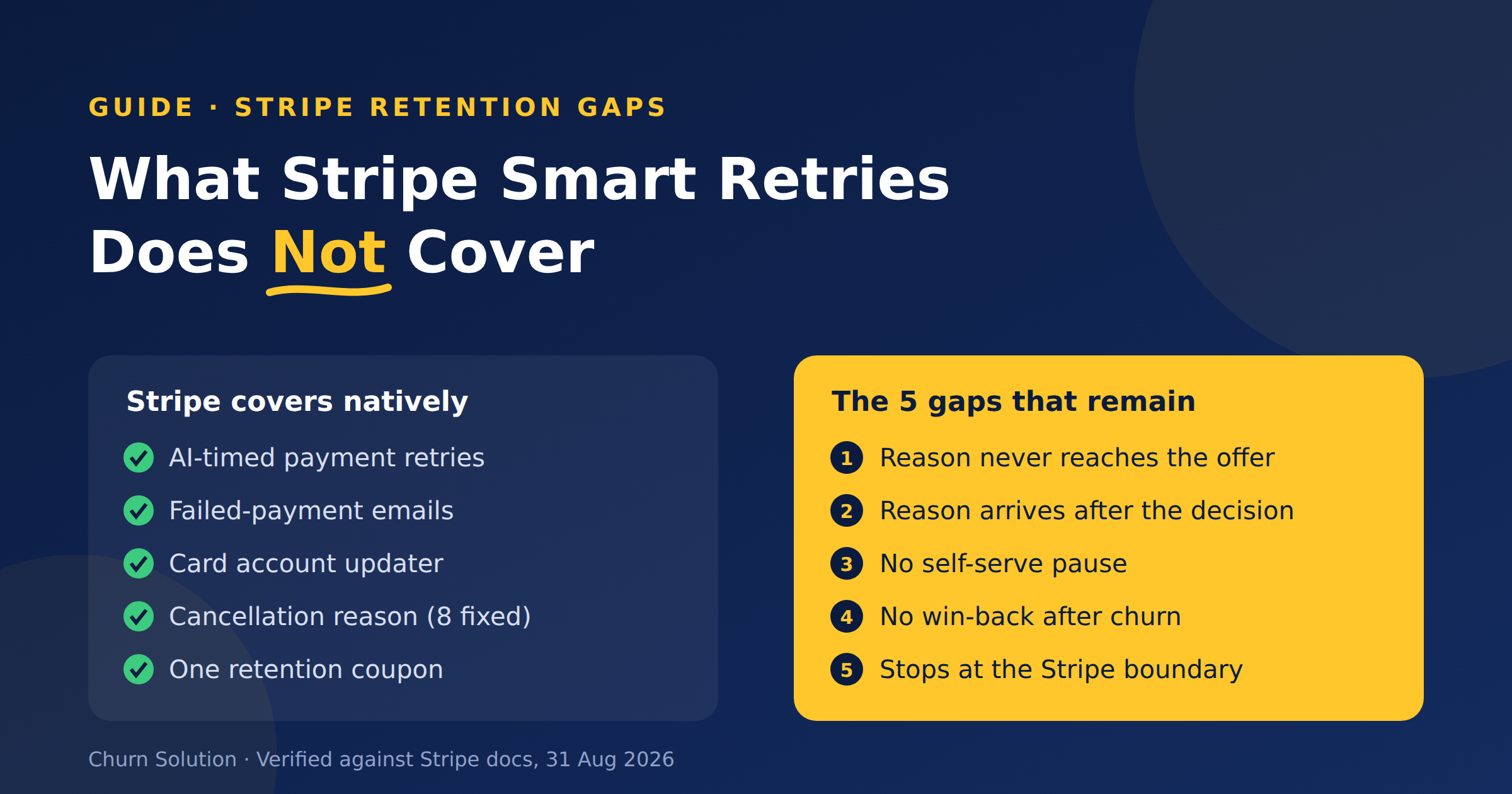
What Stripe Smart Retries Does Not Cover
Stripe Smart Retries recovers failed payments but doesn't run retention. Here are the five gaps that remain, sourced from Stripe's...


Membership Community Churn: The Members Who Quit Without Clicking Cancel
Quiet churn is the real leak: members who never clicked “cancel” at all. A card expires. A bank declines a...

Subscription Churn Dashboard: The 2026 Guide to Actionable Revenue Intelligence
Up to 40% of subscription churn is involuntary, meaning your customers aren't choosing to leave; they're being forced out by...