ARTICLE
Voluntary vs. Involuntary Churn: The 2026 Revenue Protection Playbook
Involuntary churn accounts for up to 40% of total revenue loss for B2B SaaS companies relying on basic dunning systems. While you focus on product-market fit, silent payment failures are likely eroding your MRR behind the scenes. Understanding the strategic divide between voluntary vs involuntary churn is no longer optional; it’s a survival requirement for the 2026 subscription economy. You recognize that losing a customer who proactively cancels is a product challenge, but losing a loyal user to an expired card or a technical glitch is a preventable tragedy.
You’ve worked hard to acquire every subscriber. This article promises to help you master the critical differences between active and passive subscriber loss so you can deploy automated recovery strategies that protect your bottom line. We’ll provide a clear framework for segmenting your churn data, utilizing smart retries, and leveraging AI feedback analysis to ensure your retention efforts deliver a maximum ROI. It’s time to stop the passive revenue leaks and gain total control over your business outcomes.
Key Takeaways
- Identify the dual leaks in your revenue stream by categorizing exits as either active subscriber decisions or passive payment failures.
- Optimize technical recovery by distinguishing between hard and soft declines to implement high-performance retry logic and dunning automation.
- Transform the cancellation process from a final loss into a strategic intervention using AI-driven feedback analysis and dynamic offers.
- Master the metrics of voluntary vs involuntary churn to gain a granular view of your subscriber health and true product-market fit.
- Secure your MRR through an automated revenue protection playbook that audits billing stacks and deploys intelligent customer portals.
Understanding Voluntary vs. Involuntary Churn: The Dual Leaks in Subscription Revenue
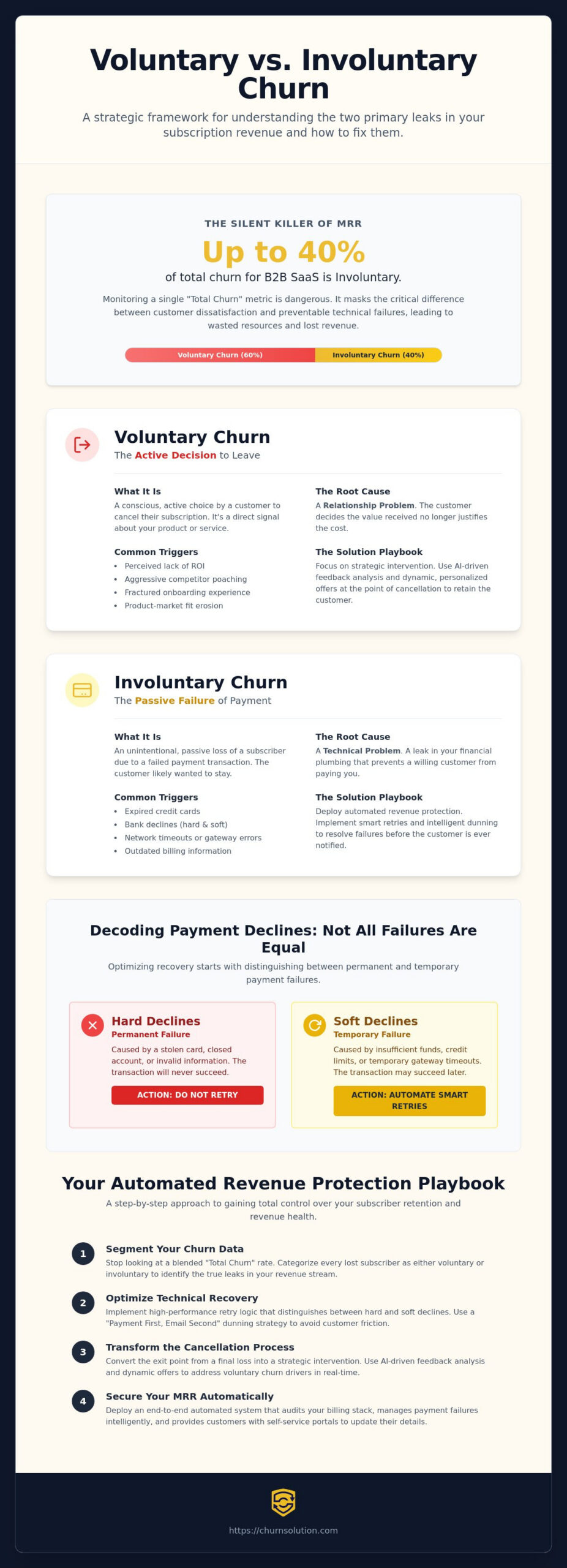
Many operators fall into the trap of monitoring a single “Total Churn” percentage. This is a dangerous fallacy. A generic number masks the underlying health of your business; it blends customer dissatisfaction with technical payment failures. To fix the leak, you must segment voluntary vs involuntary churn. Voluntary churn occurs when a user makes an active, conscious decision to cancel their subscription. Involuntary churn is a passive, unintentional loss triggered by payment failures. Distinguishing between these two is the cornerstone of modern RevOps. Without this clarity, your team will waste resources fighting technical bugs with marketing campaigns or ignoring product flaws because payment failures are high.
Segmenting your data via churn metrics dashboards allows you to apply the correct remedy to the specific problem. Treating these two issues as a monolith prevents you from identifying the true root causes of Customer attrition. You cannot optimize your product-market fit if 30% of your losses are actually caused by expired credit cards. Conversely, you cannot automate your way out of a product that fails to deliver value. Precision in categorization leads to precision in recovery.
The Psychology of Voluntary Churn
Voluntary churn is often a result of the “Moment of Friction.” This is where the user decides your tool’s value no longer justifies the recurring cost. Common drivers include a perceived lack of ROI, aggressive competitor poaching, or a fractured onboarding experience. We define the “Churn Trigger” as the specific event or lack of engagement that precedes a cancellation request. Identifying these triggers through AI feedback analysis allows you to intervene with dynamic offers before the relationship terminates.
The Mechanics of Involuntary Churn
Involuntary churn is not a relationship problem; it’s a technical pipe leak. It happens when a customer wants to pay, but the financial system fails them. Expired cards, network timeouts, and bank declines are the primary culprits. Research indicates that involuntary churn accounts for 20-40% of total subscriber loss for companies with basic billing systems. This revenue is completely recoverable. Implementing “Revenue Protection” through Smart Retries and automated dunning ensures that technical errors don’t destroy your LTV. You shouldn’t lose a loyal customer because of a bank’s server error.
The Silent Killer: Decoding the Mechanics of Involuntary Churn
Involuntary churn occurs when a transaction fails for reasons unrelated to customer intent. It is the silent killer of growth. While you might obsess over the voluntary vs involuntary churn split in your analytics, the mechanics of these failures are purely technical. Primary causes include expired credit cards, insufficient funds (NSF), and transient network errors. By November 2026, the global transition to the ISO 20022 standard means that unstructured address data will lead to even more rejected payments. Your system must be ready to handle these structured data requirements or face a surge in preventable losses.
Understanding the nature of the decline is critical for recovery. A “Hard Decline” is permanent; the card is reported stolen or the account is closed. Do not retry these. A “Soft Decline” is temporary, such as a temporary credit limit reach or a gateway timeout. This is where Smart Retries act as your first line of defense. Failing to recover these isn’t just a revenue loss. It damages your brand reputation. A loyal user who gets locked out of their account because your billing stack couldn’t handle a soft decline feels punished for a mistake they didn’t make. This friction erodes trust and often triggers a move toward a competitor.
Why Traditional Dunning Fails
Most companies rely on generic, repetitive dunning notices that lead to immediate email fatigue. Customers ignore automated “Payment Failed” subject lines after the first three occurrences. Effective recovery requires precision. Instead of fixed intervals, you must time retries to align with bank processing windows and local paydays. We advocate for a “Payment First, Email Second” strategy. Attempt to resolve the issue through invisible technical retries before bothering the user. If you can protect your revenue automatically, you preserve the customer relationship without unnecessary interruptions.
Automated Revenue Recovery Strategies
Sophisticated Payment Recovery systems automate the entire lifecycle of a failed transaction. They move beyond simple emails by integrating “In-App Dunning” notifications. This keeps the recovery conversation where the user is already active. For a deeper dive into crafting these messages, see our sibling resource on Mastering Dunning Email Automation. Transitioning from basic dunning to an intelligent, automated system can reduce involuntary churn from 40% to as low as 5% for high-performing SaaS organizations.
The Exit Psychology: Why Customers Voluntarily Leave and How to Stop Them
The “Cancel” button is rarely a final goodbye. For many subscribers, it’s a cry for help. A user who initiates a cancellation is signaling a value gap that hasn’t been met. While technical recovery handles the “silent killer” of payment failures, mastering the split between voluntary vs involuntary churn requires a deep dive into customer psychology. Voluntary churn represents a conscious choice, yet it remains highly influenceable through strategic intervention. If you treat every cancellation as inevitable, you’re leaving significant MRR on the table. It’s time to view the exit process as a final opportunity to demonstrate value and reclaim the relationship.
Exit surveys are the most undervalued data source in the SaaS industry. Most companies treat them as a compliance checkbox rather than a real-time intelligence feed. By understanding the specific reasons for departure, you can calculate your “Save Rate”—the percentage of users who can be realistically convinced to stay through a well-timed offer or alternative. Deploying automated cancellation flows allows you to intercept these users at the exact moment of friction, turning a potential exit into a successful retention event.
Leveraging AI Feedback Analysis
Manual review of cancellation reasons is impossible at scale. You must use Feedback Analysis to categorize qualitative exit data instantly. This technology distinguishes between “Saveable” reasons, such as temporary budget constraints, and “Non-Saveable” reasons, like a business shutting down. AI identifies sentiment patterns in exit surveys by processing natural language to distinguish between frustration with price and frustration with feature complexity. This allows your team to focus retention efforts where they will actually move the needle on your NRR.
Implementing Dynamic Offers and Save Flows
Generic discounts are a blunt instrument that can erode your brand value. The power of Dynamic Offers lies in matching the save attempt to the specific reason for leaving. If a user cites “too expensive,” a temporary discount or a move to a lower tier is appropriate. If they cite “lack of time,” suggest pausing the subscription instead. Offering a “Pause” alternative can save 15-30% of MRR that would otherwise be lost to permanent cancellation. Use Exit Surveys to trigger these personalized retention paths automatically, ensuring every departing customer receives a tailored reason to stay.
Benchmarking and Metrics: How to Measure and Segment Churn Types
Mastering your metrics is the difference between guessing and growing. To manage voluntary vs involuntary churn effectively, you must first quantify them as distinct data points. Standardize your reporting by calculating the Voluntary Churn Rate as the number of active cancellations divided by your total customer count at the start of the period. Conversely, the Involuntary Churn Rate measures subscribers lost specifically to payment failures. Tracking these within Churn Metrics dashboards provides the visibility required to identify where your revenue protection efforts are succeeding and where they are failing. In 2026, the median monthly churn rate for B2B SaaS is approximately 3.5%, but this figure is meaningless if you cannot see that 0.8% of it is entirely recoverable technical loss.
The most critical KPI for your involuntary churn efforts is the “Recovery Rate.” This metric tracks the percentage of failed transactions successfully captured through automated interventions. High-performance systems move beyond the basic 10-15% recovery offered by standard billing engines. By utilizing Customer Segmentation, you can prioritize recovery efforts for high-value accounts, ensuring that your most significant MRR contributors receive the most sophisticated retry logic and personalized dunning sequences. This granular approach transforms a generic loss metric into a strategic optimization tool.
The Churn Impact Matrix
Analyzing the cost of acquisition (CAC) against the cost of recovery reveals a stark reality: involuntary churn recovery offers the highest ROI in your business. While acquiring a new customer in 2026 requires significant marketing spend and sales overhead, recovering a failed payment through automation costs almost nothing. For a deeper dive into these data strategies, consult our guide on Customer Churn Analysis. Protecting existing revenue is always more efficient than chasing new leads to fill a leaky bucket.
A/B Testing Your Retention Strategies
Data-driven organizations do not rely on intuition. Use A/B Experiments to test every variable in your retention flow, from dunning email subject lines to the specific timing of your smart retries. Measure the long-term impact of a “save” on LTV to ensure your offers are actually retaining profitable customers rather than just delaying an inevitable exit. Statistical significance is mandatory here; small sample sizes lead to false positives that can skew your revenue projections for quarters to come.
Building an Automated Revenue Protection Playbook
Execution is the final frontier of revenue retention. Transitioning from understanding voluntary vs involuntary churn to actively preventing it requires a structured, multi-layered approach. You cannot rely on manual intervention to protect your MRR; you must build an ecosystem that identifies, intercepts, and resolves churn events in real time. This playbook provides the technical steps necessary to secure your subscriber base and optimize your long-term growth trajectory. Follow these four steps to implement a professional-grade recovery system.
- Step 1: Audit your billing stack. Analyze your current failure points for involuntary churn leaks. Check your retry success rates and ensure your system is compliant with the November 2026 ISO 20022 requirements for structured address data. If your billing engine rejects payments due to unstructured formats, you are losing revenue to a fixable data error.
- Step 2: Deploy an intelligent Customer Portal. Empower users with self-service management tools. A frictionless portal allows customers to update payment methods or pause their subscriptions without contacting support, directly reducing the friction that leads to both active and passive exits.
- Step 3: Integrate AI-driven exit surveys. Capture the “Why” behind every voluntary departure. By using Exit Surveys at the point of cancellation, you gather the qualitative data needed to refine your product and your save offers.
- Step 4: Launch Reactivation campaigns. Target lapsed users who have already churned. Use historical usage data to time your outreach when the user is most likely to need your solution again.
The Multi-Layered Retention Stack
Standard billing providers like Stripe or Braintree are excellent for processing transactions, but they are not specialized retention tools. They lack the sophisticated retry logic and psychological intervention layers required for advanced revenue protection. Relying solely on a billing engine leaves you vulnerable to the “silent killer” of payment failures. A true Subscription Revenue Protection strategy combines smart retries, dunning automation, and dynamic save flows into a single, cohesive ecosystem. This ensures that every churn threat, whether technical or behavioral, is met with a specific, automated response.
Win-Back Campaigns: Recovering the “Unsaveable”
Some churn is inevitable, but it doesn’t have to be permanent. For users who successfully navigate your save flows and finalize their cancellation, you must pivot to Subscription Win-Back Campaigns. Timing is the most critical variable here. Sending a win-back email too early feels desperate; sending it too late allows the user to become deeply embedded with a competitor. Offer “Welcome Back” incentives, such as a one-time credit or a feature preview, that provide immediate value without devaluing your core product pricing. By treating the end of a subscription as a temporary pause rather than a permanent loss, you maximize the lifetime value of every acquired user.
Secure Your MRR with Automated Revenue Protection
Effective revenue retention in 2026 requires more than just reactive customer support. It demands a sophisticated, automated ecosystem that addresses the dual leaks in your subscription funnel. Mastering the strategic divide between voluntary vs involuntary churn allows you to deploy precise interventions for both technical failures and behavioral exits. By automating your recovery processes, you eliminate the silent killer of payment failures and transform the cancellation experience into a retention opportunity.
Deploying these strategies ensures your business captures every possible dollar of MRR. You can recover up to 40% of failed payments automatically while using AI feedback analysis to identify the real reasons behind subscriber loss. Dynamic offers provide a logical alternative to cancellation, helping you reduce active subscriber loss by 15-30% without manual overhead. Stop letting preventable churn dictate your growth trajectory and take command of your business outcomes today.
Your data holds the roadmap to a more resilient subscription model. Start plugging the leaks and build the high-performance revenue engine your product deserves.
Frequently Asked Questions
What is the most common cause of involuntary churn in SaaS?
Expired credit cards remain the primary driver of involuntary churn in the subscription economy. These technical failures occur when a card reaches its end-of-life or when bank-side security protocols trigger a soft decline. Other significant factors include insufficient funds and technical network errors during the transaction handshake. By November 2026, unstructured address data will also become a major cause of failure due to new ISO 20022 requirements.
Can I completely eliminate involuntary churn?
You can’t completely eliminate involuntary churn because “Hard Declines” like stolen cards or closed accounts are permanent. However, you can recover up to 40% of failed payments by automating your response to “Soft Declines.” Implementing smart retries and intelligent dunning handles the technical failures that are within your control. High-performance systems can reduce this leak to as low as 5% of your total churn profile.
How much can a cancellation flow actually reduce voluntary churn?
A sophisticated cancellation flow can reduce voluntary churn by 15% to 30% by offering alternatives to a total exit. By presenting a “Pause” option or a tailored offer at the moment of friction, you intercept the user’s conscious decision to leave. This transforms a binary exit into a strategic conversation about value. It’s an essential layer for any business trying to manage the balance between voluntary vs involuntary churn.
Should I offer a discount to every customer who tries to cancel?
Don’t offer a blanket discount to every departing customer. Doing so devalues your product and trains users to threaten cancellation for a lower price. Instead, use dynamic offers that match the specific reason for leaving. If a user cites feature complexity, suggest a training session or a lower tier rather than a price cut. This approach protects your brand integrity while securing the account.
What is a good “Save Rate” for a subscription business?
A healthy “Save Rate” for most subscription businesses falls between 15% and 25%. This metric measures the percentage of users who start the cancellation process but choose to stay after seeing an intervention. Achieving this requires a deep understanding of your specific churn drivers and the ability to present the right offer at the right time. Tracking this KPI is vital for mastering the nuances of voluntary vs involuntary churn.
Is involuntary churn different for B2B vs. B2C companies?
Involuntary churn profiles differ significantly between B2B and B2C models. B2C companies often face higher card turnover and more frequent insufficient fund errors. B2B organizations usually deal with higher transaction values and corporate card expirations. B2B failures often require more structured dunning sequences to reach the correct department for payment updates, whereas B2C recovery relies on immediate, high-frequency technical retries.
How often should I retry a failed credit card payment?
Avoid using a fixed schedule for retries. Effective systems use smart retries that analyze bank processing windows and historical success data to time attempts perfectly. Typically, a sequence of four to six retries spread over 14 to 21 days yields the highest recovery rates without triggering excessive fraud alerts. This methodical approach ensures you aren’t harassing the customer while maximizing the chance of a successful handshake.
How does AI feedback analysis help with product development?
AI feedback analysis transforms raw cancellation text into actionable product insights. It identifies recurring complaints about specific features or UI friction points at scale. This allows your engineering team to prioritize updates that directly address the root causes of subscriber loss. By processing natural language, it identifies sentiment patterns that help you build a product that users don’t want to leave voluntarily.
- Key Takeaways
- Table of Contents
- Understanding Voluntary vs. Involuntary Churn: The Dual Leaks in Subscription Revenue
- The Silent Killer: Decoding the Mechanics of Involuntary Churn
- The Exit Psychology: Why Customers Voluntarily Leave and How to Stop Them
- Benchmarking and Metrics: How to Measure and Segment Churn Types
- Building an Automated Revenue Protection Playbook
- Secure Your MRR with Automated Revenue Protection
- Frequently Asked Questions

Churn solution that turns your customers right around.
Related Articles
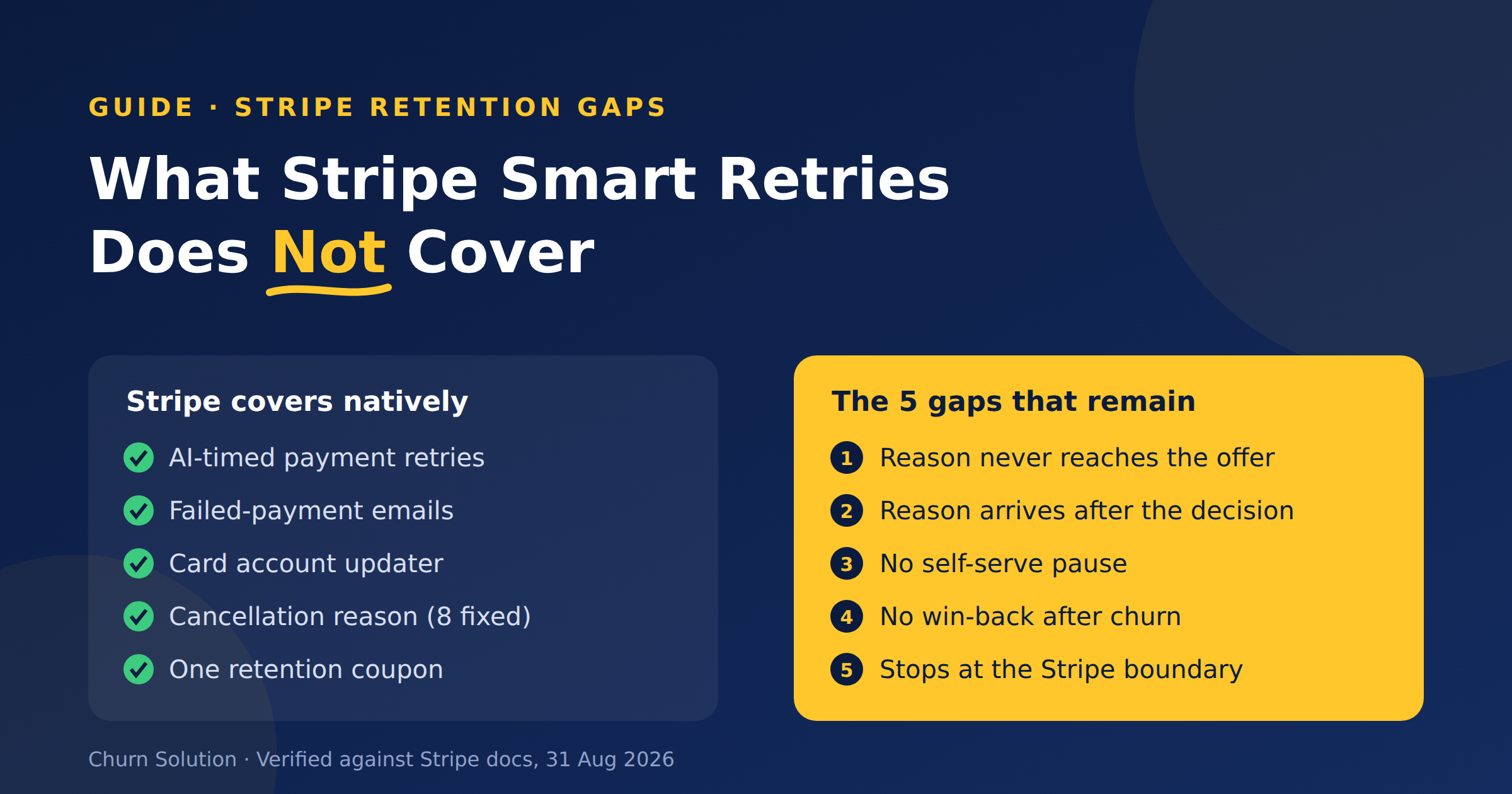
What Stripe Smart Retries Does Not Cover
Stripe Smart Retries recovers failed payments but doesn't run retention. Here are the five gaps that remain, sourced from Stripe's...

Membership Community Churn: The Members Who Quit Without Clicking Cancel
Quiet churn is the real leak: members who never clicked “cancel” at all. A card expires. A bank declines a...

Subscription Churn Dashboard: The 2026 Guide to Actionable Revenue Intelligence
Up to 40% of subscription churn is involuntary, meaning your customers aren't choosing to leave; they're being forced out by...