ARTICLE
Mastering Dunning Email Automation: The 2026 Guide to Revenue Recovery

Involuntary churn accounts for up to 40% of total revenue loss in the subscription economy, yet many leaders still treat failed payments as an unavoidable cost of doing business. You’ve invested significant resources into customer acquisition; letting an expired credit card or a temporary network error erase that effort is a strategic failure. Deploying sophisticated dunning email automation allows you to transform these friction points into recovery opportunities without the inconsistency of manual outreach.
You likely feel the tension between the need for aggressive revenue recovery and the fear of damaging customer relationships. It’s a high-stakes balance that requires technical precision and data-driven timing rather than generic templates. This guide will show you how to build a set-it-and-forget-it system that stops involuntary churn and increases your Net Revenue Retention. We’ll examine the specific mechanisms behind AI-powered retries, analyze the root causes of payment failures, and provide a framework for a high-performance recovery engine that secures your bottom line.
Key Takeaways
- Systematize your recovery process to ensure 100% coverage of all payment declines, effectively eliminating the inconsistency and high cost of manual outreach.
- Leverage the “Invisible Recovery” phase to resolve failed transactions through technical retries before they ever require customer intervention.
- Deploy a multi-stage dunning email automation framework that balances technical empathy with high-urgency triggers to preserve customer relationships.
- Establish a strategic 21-day recovery window and structured grace periods to maintain service access while securing outstanding revenue.
- Integrate automated dunning into a holistic retention strategy that proactively addresses cancellation intent during the payment recovery cycle.
What is Dunning Email Automation?
Dunning email automation is the systematic, technology-driven recovery of failed subscription payments. It transforms a chaotic manual task into a high-precision workflow that operates 24/7 without fatigue. Historically, dunning was a brute-force process of methodically communicating with customers to collect outstanding debts. In the modern subscription economy, it’s a sophisticated intervention that safeguards your most valuable asset: recurring revenue. Automation ensures 100% coverage of every decline, effectively removing the risk of human oversight or inconsistent follow-up that plagues manual processes.
Payment failures aren’t always a sign of a customer’s inability to pay. Most declines originate from technical friction or simple administrative lapses. The primary triggers include expired credit cards, insufficient funds, and bank-level security flags. Manual outreach simply cannot scale to manage these events across a growing user base. Modern, AI-enhanced workflows analyze these decline codes in real-time. They trigger specific recovery paths based on the failure reason, ensuring the right message reaches the right user at the optimal moment. This is the core of effective dunning email automation: precision over persistence.
The Cost of Involuntary Churn
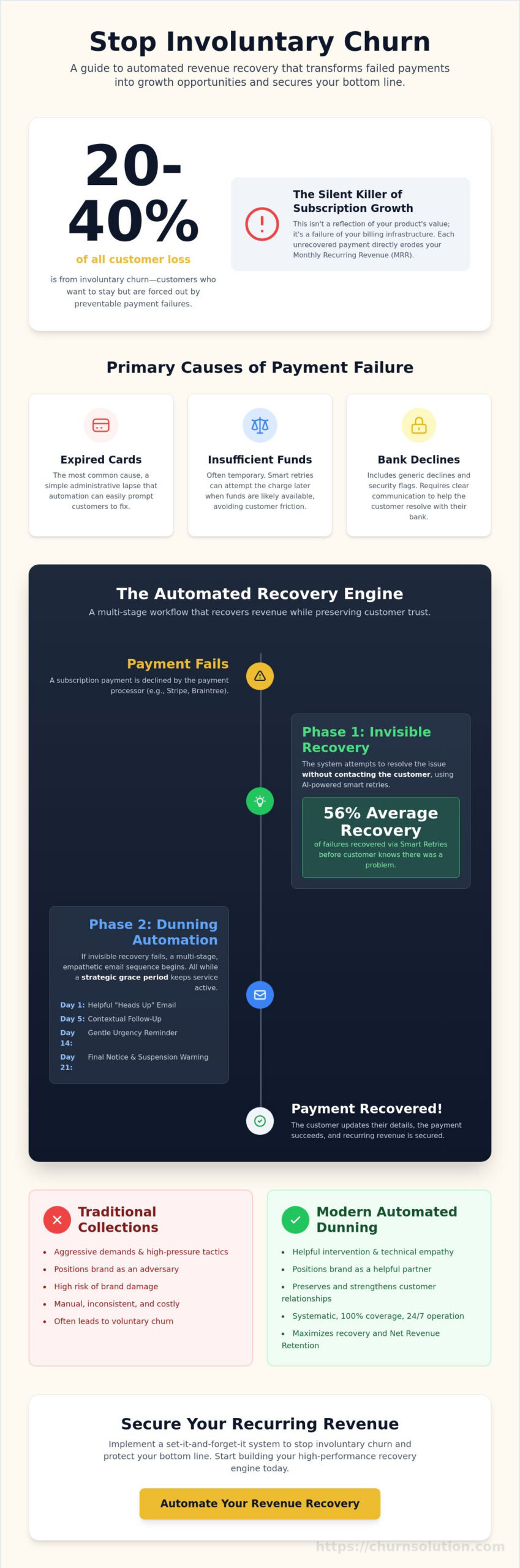
Involuntary churn is the silent killer of subscription growth. It occurs when a customer who intends to remain subscribed is forced out by technical payment failures. This is a massive leak in your revenue bucket. Industry data shows that involuntary churn accounts for 20-40% of total customer loss. This isn’t a reflection of your product’s value; it’s a failure of your billing infrastructure. Every failed transaction that goes unrecovered directly erodes your Monthly Recurring Revenue (MRR) and decreases Net Revenue Retention (NRR). Implementing automated dunning provides a direct shield for your bottom line, turning potential losses back into realized gains. To understand the full scope of revenue leakage across your subscriber base, a thorough customer churn analysis can help you distinguish between voluntary and involuntary loss and prioritize the right interventions.
Dunning vs. Traditional Collections
Traditional collections rely on aggressive demands and high-pressure tactics. Modern dunning flips this script. It positions the brand as a helpful partner resolving a technical glitch. Maintaining a positive customer experience during a payment failure is vital for long-term retention. Automation allows for a “gentle” start to the recovery process, often resolving issues through smart retries before the customer even knows an error occurred. This shift from “aggressive demand” to “helpful intervention” preserves the relationship. By using a sophisticated payment recovery system, you ensure that the first touchpoint is empathetic, reducing the risk of accidental brand damage while maximizing recovery rates.
The Mechanics of Automated Revenue Recovery
Your dunning email automation doesn’t exist in a vacuum. It functions as a sophisticated intelligence layer positioned between your billing engine and your customer base. When a transaction fails on platforms like Stripe or Braintree, the system doesn’t just trigger a generic alert. It intercepts the failure signal via real-time webhooks, allowing for an immediate, data-driven response. This integration ensures that your recovery efforts are perfectly synchronized with your actual billing state, preventing the embarrassment of sending a collection notice for a payment that has already been settled.
The most effective recovery systems prioritize the “Invisible Recovery” phase. This is the period immediately following a decline where the system attempts to resolve the issue without ever bothering the customer. By managing the technical handshake between the merchant account and the issuing bank, you can often secure funds before a single email is drafted. While optimizing these technical retries, businesses must remain cognizant of consumer rights in debt collection to ensure all automated outreach remains compliant with federal standards. To see how this layer integrates with your current stack, you can start building your recovery workflow today.
Smart Payment Retries
Smart retries replace rigid, fixed schedules with machine learning logic. Instead of retrying a card every 24 hours, the system analyzes decline codes and historical data to determine the optimal moment for success. For example, Stripe reports that its native smart retry logic recovers an average of 56% of failed recurring payments. By targeting specific windows when a bank is most likely to approve a transaction, you maximize dunning email automation efficiency. A successful retry eliminates the need for customer contact, preserving the user experience while securing your MRR. However, if you rely solely on native gateway settings, implementing advanced dunning management for Stripe can help you recapture the significant revenue gap that basic retry logic leaves behind. To fully leverage AI-driven timing and decline-reason-specific logic, exploring smart payment retries as a dedicated revenue recovery strategy can unlock significantly higher success rates beyond what standard gateway settings provide.
Real-Time Payment Method Updates
Modern recovery engines utilize card updater services to refresh expired or replaced credit card details automatically. This functionality communicates directly with major card networks to pull updated expiration dates or new card numbers. It’s a frictionless process that requires zero effort from your subscribers. By the time a customer realizes their old card has expired, the system has already updated the records and processed the payment. This proactive approach to payment recovery significantly reduces the volume of dunning emails you need to send, ensuring that your outreach is reserved only for cases that truly require human intervention.
The Psychology of Effective Dunning Sequences
Successful revenue recovery requires more than just technical triggers. It demands a sophisticated understanding of customer psychology. Every message in your dunning email automation sequence is a high-stakes touchpoint where timing and tone dictate the outcome. You must master the balance between urgency and empathy. If your copy is too aggressive, you risk permanent brand damage; if it’s too passive, your invoice remains unpaid. The goal is to guide the user toward a resolution while reinforcing the value of your service.
Your first email should always assume a technical error rather than a lack of funds. Most payment failures are administrative, not financial. By framing the initial outreach as a “helpful check-in” regarding a potential glitch, you avoid putting the customer on the defensive. This approach preserves the relationship while providing a clear path to resolution. Every email must feature a single, unmistakable Call to Action (CTA). Don’t clutter the message with links to support docs or feature updates. Direct them to the payment portal and nothing else. While your outreach must be persuasive, it must also remain ethically sound. Adhering to the standards set by the Fair Debt Collection Practices Act (FDCPA) ensures your recovery tactics don’t cross into harassment, which would toxicify the customer relationship.
A standard high-performance sequence typically follows a 3-5 email progression over 21 days:
- Day 1: The “Technical Glitch” notice. Soft tone, helpful intent.
- Day 4: The “Friendly Reminder.” Increased visibility, clear CTA.
- Day 10: The “Urgent Action Required.” Firm tone, mentions service disruption.
- Day 21: The “Final Notice.” High urgency, specifies exactly when access will be restricted.
Action-Oriented Subject Lines
Subject lines in 2026 must cut through inbox noise with immediate clarity. Generic phrases like “Payment Failed” can trigger anxiety or be ignored as spam. Use “Action Required” to signal a task that needs completion. Always include your brand name to establish trust. High-performing examples include:
- [Action Required] Update your payment method for [Brand Name]
- Important: Secure your [Brand Name] access
- Final Notice: Your [Brand Name] subscription is at risk
These subject lines prioritize the consequence of inaction over the failure itself, which drives higher open rates.
Segmented Outreach Strategies
One size does not fit all in revenue recovery. Utilizing customer segmentation allows you to tailor your tone based on user value and history. An enterprise account with a three-year history requires a “white-glove” touch, perhaps involving a personal note from an account manager. Conversely, low-tier self-serve users can be managed through standard automated paths. Segmenting by decline reason also pays dividends. A user with an expired card needs a different nudge than one facing a “blocked” transaction. Precision in segmentation ensures your dunning email automation feels personal and relevant, significantly boosting your recovery percentages.
Strategic Implementation: Building a Multi-Stage Workflow
Speed is critical. A standard 21-day recovery window provides the necessary runway to resolve complex payment issues without dragging out revenue uncertainty. Most SaaS models benefit from this timeframe because it aligns with bank processing cycles and user behavior. Your dunning email automation must orchestrate this timeline with surgical precision. It ensures that every failed transaction is pursued through a logical progression of escalations, moving from technical assistance to firm collection requirements.
Grace periods act as a strategic buffer for your user experience. You don’t want to cut off a loyal user over a temporary technicality, yet you must define the exact point where access is restricted to protect your intellectual property. Implementing in-app notifications alongside your email sequence creates a multi-channel safety net. It ensures the user sees the alert where they are most active. While an email might sit unread, an in-app banner is impossible to ignore during active product engagement. This dual-threat approach ensures your recovery messaging reaches the customer regardless of their communication habits. It’s about creating a unified front that prioritizes revenue continuity.
The Optimal Dunning Timeline
A high-performance recovery workflow follows a specific rhythmic progression. Day 0 starts with the invisible smart retry, resolving the issue silently whenever possible. If that fails, move to the Day 1-3 phase: send the first “Soft” notification. This message should contain a direct update link and emphasize the technical nature of the glitch. Between Day 7 and 14, transition to the “Urgent” reminder. At this stage, your dunning email automation should highlight the specific date service will be restricted to drive immediate action. This escalation creates a necessary sense of priority for the user.
Embedding the Payment Portal
Friction kills recovery. Customers shouldn’t have to navigate through login screens or complex menus to fix a billing error. Use a secure, one-click customer portal that allows for instant updates. This approach utilizes hosted payment pages to ensure total PCI compliance while maximizing conversion rates. By removing barriers, you turn a high-friction event into a seamless administrative update. Security is paramount; providing a dedicated, branded environment for payment updates reinforces trust and protects sensitive data. Deploy your multi-stage recovery workflow to capture revenue before it disappears.
The Final Notice and Suspension Phase
The “Final Notice” phase represents your last line of defense. This isn’t just another reminder. It’s a clear communication of the impending service suspension. You must clearly state the exact timestamp for account deactivation. This transparency forces a decision from the user and often triggers a recovery that earlier, softer messages could not achieve. Transitioning to suspension should be fully automated based on the outcome of your 21-day cycle. This ensures your team isn’t bogged down by manual account management while maintaining a firm stance on revenue collection.
Beyond Emails: Integrating Dunning with Holistic Retention
Treating dunning email automation as a standalone silo is a strategic error that limits your recovery potential. High-performance subscription models view dunning as the foundational layer of a comprehensive payment recovery strategy. It’s the first point of contact in a multi-stage ecosystem designed to maximize Subscriber Lifetime Value (LTV). By integrating these automated sequences with your broader retention stack, you transform a simple collection task into a sophisticated intelligence engine.
A payment failure often acts as a catalyst for a customer to re-evaluate their subscription. If your dunning outreach prompts a user to attempt a manual cancellation, your system must be prepared to intercept that intent. Instead of a dead-end account closure, use AI feedback analysis to identify the root cause of the churn threat. Understanding whether the friction is financial, technical, or value-based allows you to deploy the correct counter-measure in real time. This data-driven approach ensures that every failed transaction provides actionable insights into your customer health. Pairing these insights with a structured customer churn analysis framework enables you to move beyond reactive recovery and build proactive retention strategies grounded in behavioral data.
Connecting Dunning to Cancellation Flows
When recovery efforts reach their limit without success, your system should automatically trigger automated cancellation flows. This transition is critical. If a user cites financial hardship as the reason for non-payment, the flow can offer a “Pause” or a temporary “Discount” to keep them in the ecosystem. This proactive intervention is a core pillar of subscription revenue protection. You aren’t just chasing a past-due invoice; you are actively saving a relationship that would otherwise be lost to involuntary churn.
Automating the Win-Back Transition
Churn isn’t always permanent. If a lead remains unrecovered after the 21-day dunning cycle, move them directly into a reactivation campaign. The optimal timing for a “We want you back” offer is typically 30 days after the account is suspended. This allows the customer enough time to feel the absence of your service while the brand remains fresh in their mind. AI models analyze historical engagement patterns and previous payment behavior to assign a propensity score to every lapsed user, predicting exactly who is most likely to return with a targeted incentive. This ensures your dunning email automation efforts feed into a perpetual cycle of revenue optimization rather than a terminal loss.
Secure Your Revenue Future
Involuntary churn isn’t a technical inevitability; it’s a solvable operational leak. By shifting from manual collections to high-precision dunning email automation, you reclaim control over your Monthly Recurring Revenue. You’ve seen how AI-powered smart retries and structured 21-day workflows turn friction into recovery. These systems don’t just fix failed payments. They protect the long-term integrity of your customer relationships through technical empathy and data-driven timing.
Stop leaving your retention to chance. Implementing a sophisticated recovery engine ensures that every decline is met with an immediate, intelligent response. With the ability to recover up to 70% of failed payments automatically, you can focus on growth while your infrastructure secures the bottom line. Our tools offer seamless integration with Stripe, Chargebee, and Recurly, providing the technical mastery required for modern subscription success.
Stop losing revenue to failed payments—explore Churn Solution's automated recovery tools.
The tools to plug your revenue leaks are ready. It’s time to build a more resilient subscription business.
Frequently Asked Questions
What is the difference between dunning and collections?
Dunning is a proactive retention process used to resolve payment failures while the customer relationship is still active. It focuses on maintaining service continuity through automated reminders and technical fixes. Collections is a reactive effort to recover outstanding debt from accounts that have already been terminated. Dunning aims to save the subscriber; collections aims to recover the money after the subscriber is gone.
How many dunning emails should I send before cancelling a subscription?
A sequence of three to five emails deployed over a 21-day window is the industry standard for most SaaS models. This frequency provides enough touchpoints to resolve administrative errors without overwhelming the user. The final email must serve as a definitive notice, clearly stating the exact date and time that service access will be restricted if the payment is not settled.
Will dunning emails annoy my customers or increase churn?
Dunning emails don’t increase churn when they are framed as helpful technical support rather than aggressive collection demands. Most subscribers appreciate being alerted to a payment failure before their service is interrupted. By maintaining a professional and supportive tone, you reinforce the value of your brand while successfully resolving the underlying billing friction.
Can I automate dunning directly through Stripe or Braintree?
Native gateways like Stripe provide basic recovery features, but they often lack the sophisticated logic required for high-performance dunning email automation. Specialized platforms offer deeper segmentation, allowing you to trigger specific sequences based on decline codes or customer value. For businesses seeking to move beyond these baseline settings, exploring advanced dunning management strategies for Stripe can unlock significantly higher recovery rates. This level of technical control is essential for businesses that want to optimize every recovery opportunity beyond simple gateway retries.
What is a ‘smart retry’ and how does it work with dunning?
A smart retry is an invisible, data-driven attempt to process a failed transaction using machine learning to determine the optimal day and time for success. It functions as the first line of defense in your recovery strategy. By resolving failures at the bank level before an email is even triggered, you reduce unnecessary customer contact and preserve the user experience. Businesses looking to maximize this approach can benefit from implementing AI-driven smart payment retries that leverage decline-reason-specific timing and comply with the latest Visa and Mastercard retry limits.
How do I measure the success of my dunning email automation?
Measure success by tracking your overall recovery rate and its direct impact on Net Revenue Retention (NRR). You should specifically monitor the percentage of declines resolved in the “invisible” phase versus those requiring customer intervention. Analyzing the time-to-recovery provides critical insight into the efficiency of your automated workflows and the health of your subscription base.
Should I offer a discount in a dunning email to encourage payment?
Don’t offer discounts in your initial dunning outreach. Doing so can train customers to ignore your billing alerts in hopes of receiving a lower price. Incentives should be reserved for the cancellation flow stage, specifically for users who indicate that financial hardship is the primary reason for their inability to pay. This preserves your product’s perceived value.
How do I handle dunning for high-value B2B enterprise contracts?
High-value B2B contracts require a white-glove approach that balances automation with personal intervention. Automated emails should be supplemented by direct outreach from an account manager if the invoice remains unpaid after the first seven days. Longer grace periods are typically necessary to accommodate the complex procurement and approval cycles inherent in enterprise-level organizations.
- Key Takeaways
- Table of Contents
- What is Dunning Email Automation?
- The Mechanics of Automated Revenue Recovery
- The Psychology of Effective Dunning Sequences
- Strategic Implementation: Building a Multi-Stage Workflow
- Beyond Emails: Integrating Dunning with Holistic Retention
- Secure Your Revenue Future
- Frequently Asked Questions

Churn solution that turns your customers right around.
Related Articles
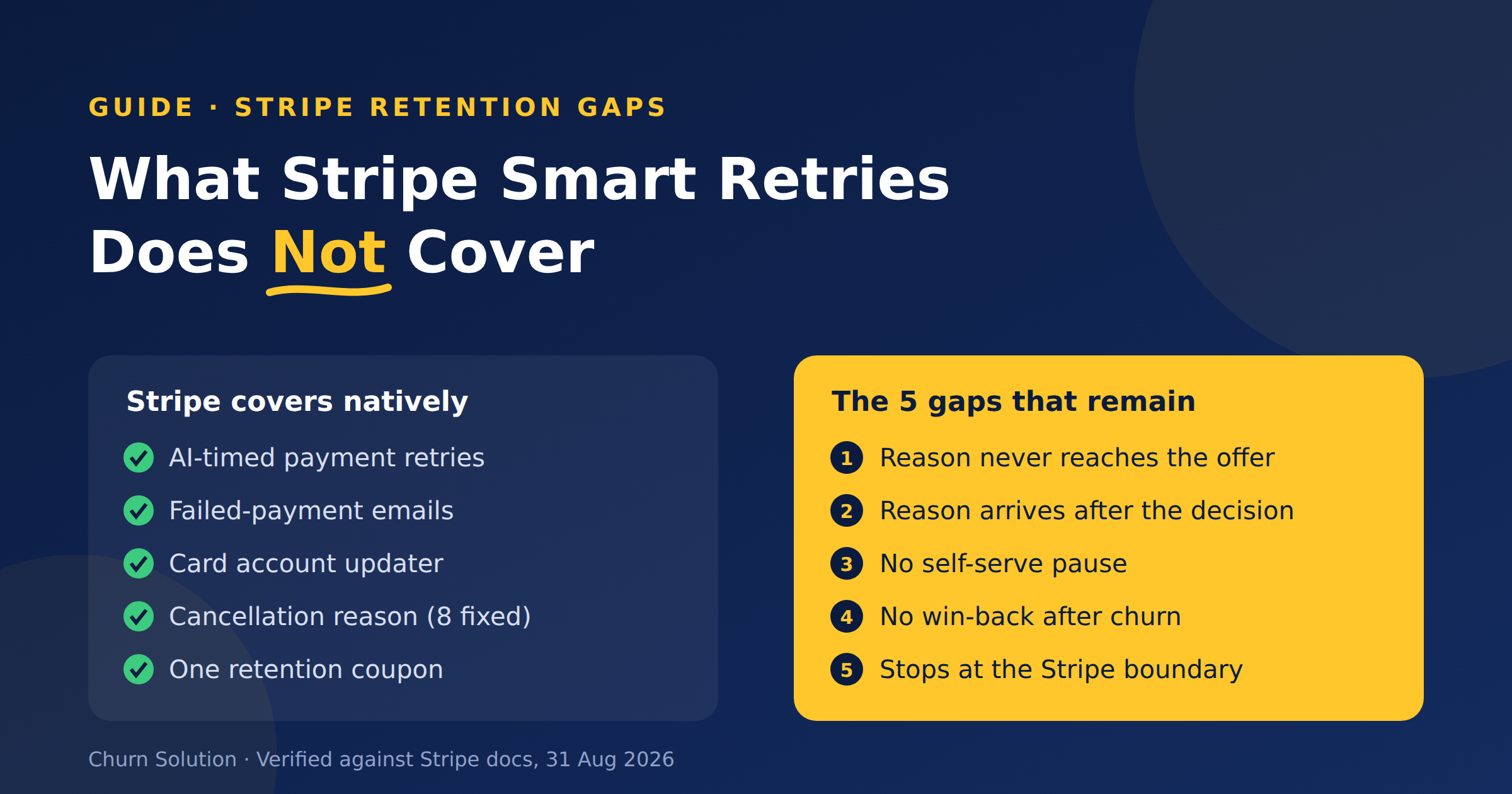
What Stripe Smart Retries Does Not Cover
Stripe Smart Retries recovers failed payments but doesn't run retention. Here are the five gaps that remain, sourced from Stripe's...

Membership Community Churn: The Members Who Quit Without Clicking Cancel
Quiet churn is the real leak: members who never clicked “cancel” at all. A card expires. A bank declines a...

Subscription Churn Dashboard: The 2026 Guide to Actionable Revenue Intelligence
Up to 40% of subscription churn is involuntary, meaning your customers aren't choosing to leave; they're being forced out by...