ARTICLE
Dunning Management for Stripe: Advanced Strategies to Recover Lost Revenue in 2026
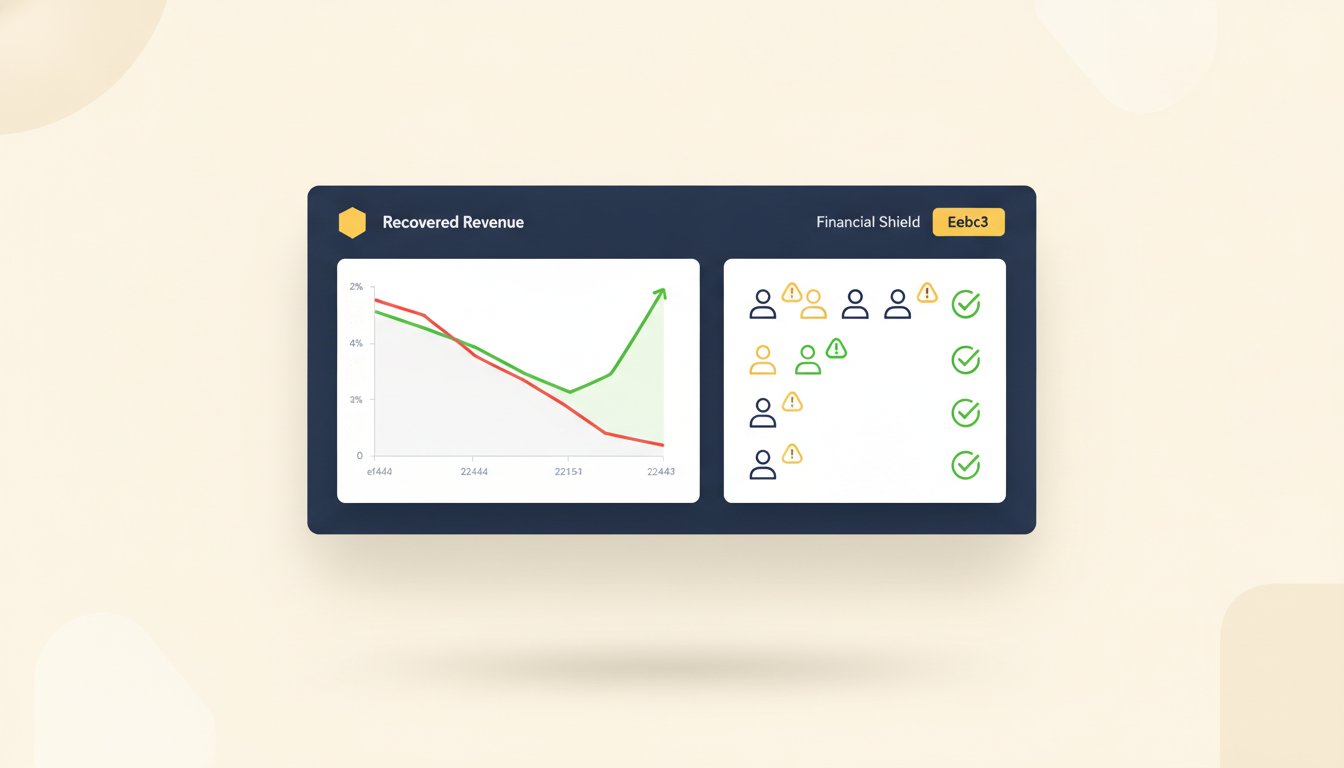
Did you know that standard recovery tools typically only capture 40% to 60% of failed payments, leaving a massive revenue gap in your subscription business? If you rely solely on native settings, you’re likely losing nearly a tenth of your growth to avoidable billing failures. Advanced dunning management for stripe has evolved into a specialized discipline that requires more than just basic retry logic. It’s about transforming a passive safety net into a proactive revenue multiplier that handles every failed transaction with surgical precision.
You recognize that involuntary churn is the primary obstacle to scaling your SaaS. It’s unacceptable to lose loyal customers to expired cards or rigid email templates that lack personalization. This article promises to show you how to move beyond baseline Stripe settings to build a high-performance dunning engine that recaptures up to 10% of your annual revenue. We’ll explore how to segment flows by customer value, leverage AI-driven retry timing, and create a seamless payment experience that protects both your cash flow and your brand reputation.
Key Takeaways
- Identify the “invisible leak” where involuntary churn erodes your compounding MRR and understand why baseline Stripe settings are insufficient for high-growth scaling.
- Leverage multi-channel orchestration and Smart Retries to navigate bank-specific decline codes, ensuring failed transactions are recovered with precision.
- Implement advanced dunning management for stripe to gain full control over email customization and customer segmentation, moving beyond the constraints of standard templates.
- Follow a structured audit and integration process to sync your billing data with a specialized performance layer for real-time recovery monitoring.
- Deploy a high-performance layer over your existing Stripe ecosystem to recapture up to 10% of annual revenue using a rapid, plug-and-play API integration.
The Limitations of Native Stripe Dunning: Why Baseline Protection Isn’t Enough
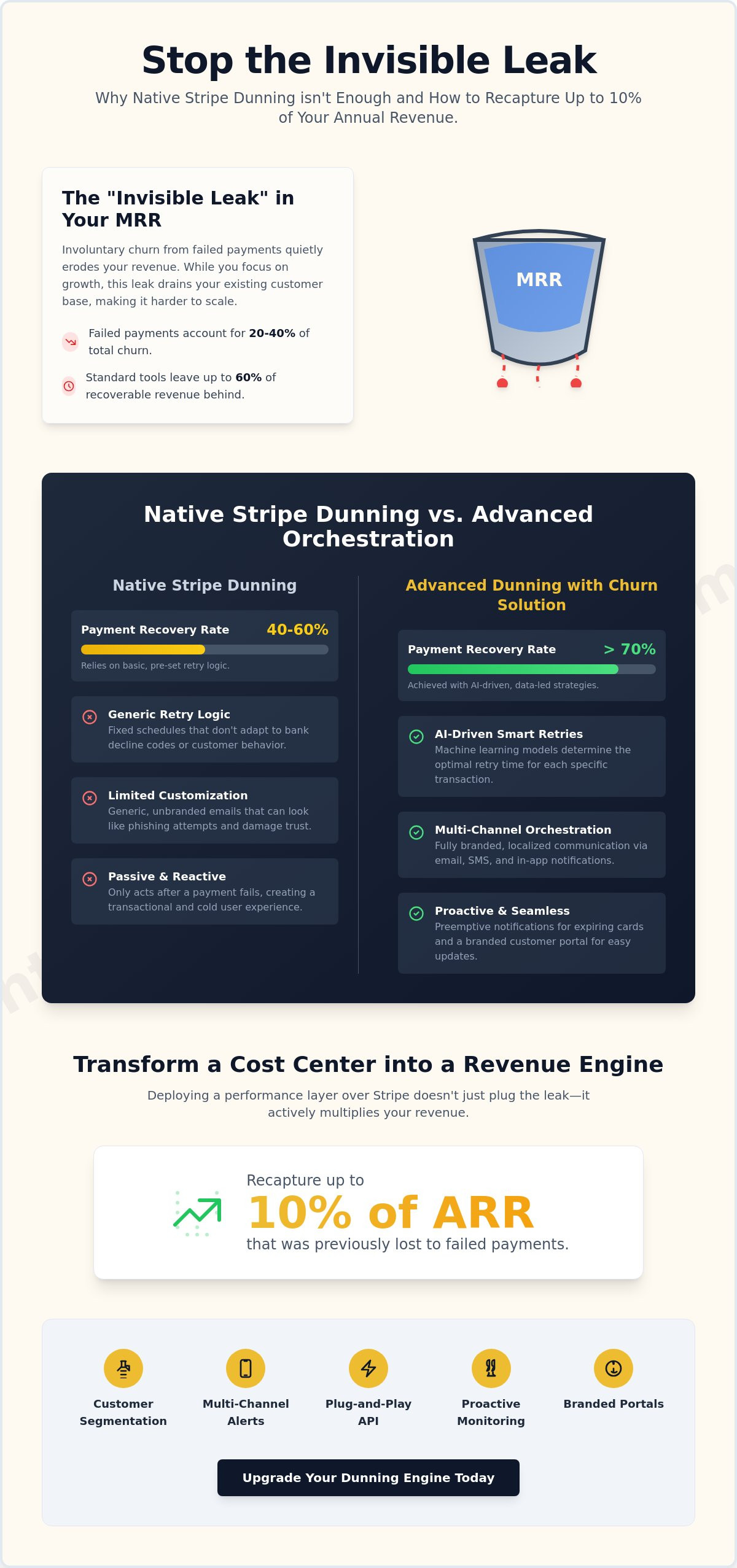
Effective dunning management for stripe is the strategic orchestration of payment recovery. It moves beyond the binary state of “paid” or “failed” to create a sophisticated workflow designed to protect your bottom line. Most subscription businesses treat failed payments as a technical glitch. This is a mistake. In reality, these failures represent an “invisible leak” that quietly erodes your MRR compounding. While you focus on acquisition, this leak drains your existing revenue pool. It makes reaching your growth milestones significantly harder by forcing you to replace lost revenue before you can even begin to grow.
Native Stripe tools provide a baseline safety net, but they often hit a performance ceiling. Passive recovery relies on basic logic and generic templates that lack the nuance required for high-value accounts. Relying on standard dunning management for stripe settings means you’re accepting a generic solution for a unique revenue problem. In contrast, active revenue protection allows you to intervene before the customer even realizes there’s a problem. By treating dunning as a performance-driven layer rather than a back-office utility, you transform a cost center into a revenue generator. You don’t just wait for Stripe to retry a card; you orchestrate a multi-channel response that secures the transaction.
Understanding Involuntary Churn in the Stripe Ecosystem
You must differentiate between voluntary cancellations and failed payment churn. Voluntary churn happens when a customer chooses to leave. Involuntary churn occurs when a legitimate customer wants to stay, but their payment fails due to technical or administrative issues. Industry standards indicate that failed payments account for 20-40% of total churn for SaaS businesses. If you’re looking for a comprehensive strategy to reduce involuntary churn through automated revenue recovery, moving beyond passive retries is essential. While Smart Retries utilize machine learning to optimize attempt timing, they cannot solve card expirations or complex bank declines that require direct customer action. Relying only on native retries means you’re leaving up to 60% of potentially recoverable revenue on the table.
The Branding and UX Gap in Native Tools
Generic Stripe emails often look like phishing attempts or low-priority notifications. This lack of customization damages customer trust and erodes brand authority at a critical moment in the customer lifecycle. Basic setups also lack localized, multi-language dunning support. This is a critical failure for global SaaS companies that need to communicate with users in their native tongues to resolve billing issues. Instead of a simple “update card” link that feels transactional and cold, high-performing businesses use a dedicated customer portal. This professional interface provides a seamless experience. It allows users to manage their billing details securely while reinforcing the value of your service during a moment of friction.
Advanced Dunning Orchestration: Beyond Simple Email Reminders
Effective dunning management for stripe requires a transition from linear email sequences to a synchronized multi-channel strategy. We call this “Dunning Orchestration.” It involves the simultaneous coordination of technical re-attempts, behavioral triggers, and cross-channel communication. Instead of waiting for a payment to fail, advanced systems monitor account health to identify risk factors. For instance, if a user’s card is set to expire and they haven’t logged in for 30 days, the system triggers a preemptive notification. This proactive intervention prevents the failure before it occurs; it ensures the billing cycle remains uninterrupted.
Timing is the most critical variable in payment recovery. AI-driven systems now determine the optimal time of day for card re-attempts by analyzing historical success rates across specific merchant category codes and geographical regions. A retry at 3:00 AM on a Tuesday might fail, while the same attempt at 10:00 AM on a Friday succeeds. Research shows that AI-driven dunning tools can achieve recovery rates above 70% by leveraging these data-driven windows. You maximize the probability of a successful charge without requiring any manual oversight.
Smart Retry Logic and Machine Learning
Modern machine learning models analyze millions of anonymized transactions to predict successful retry windows with high accuracy. This technology distinguishes between “soft declines” and “hard declines” to protect your merchant reputation. A soft decline, such as “insufficient funds,” suggests a temporary issue that a well-timed retry can resolve. A hard decline indicates a permanent failure where further retries will only damage your standing with the bank. By utilizing Smart Retries, you avoid card fatigue and prevent your account from being flagged by issuing banks. You can optimize your recovery logic today to stop losing revenue to basic technical errors. For a deeper dive into how AI-driven logic navigates decline codes and 2026 network retry limits, see our comprehensive guide to smart payment retries and AI-driven revenue recovery.
Integrating AI Feedback Analysis into Recovery
The most advanced dunning management for stripe setups don’t just recover funds; they gather intelligence. By integrating feedback analysis, you can identify systemic patterns in why payments fail. If a specific region shows a high rate of bank-related declines, it might indicate a need for a local payment method. This shifts the focus from simple recovery to proactive retention. AI Feedback Analysis is a specialized tool that converts raw failure data into actionable insights for product and billing improvements. This intelligence allows you to refine your offering and reduce future friction points.
Comparing Stripe Billing vs. Specialized Dunning Software
Stripe Billing provides the essential plumbing for subscription processing, yet it often fails to deliver the surgical precision required for high-growth recovery. Native tools focus on the transaction itself. In contrast, specialized dunning management for stripe focuses on the customer relationship. While Stripe’s native features offer a basic card account updater and automated retries, they lack the flexibility to adapt to complex business needs. Relying solely on a billing engine for recovery is like using a hammer for watch repair; it lacks the necessary finesse to maximize revenue retention.
Specialized recovery platforms outperform native settings across four critical pillars:
- Customization: Native Stripe templates are rigid and recognizable. Professional software provides full HTML/CSS control, allowing you to maintain brand authority and build trust during sensitive billing moments.
- Segmentation: You shouldn’t treat a legacy enterprise partner the same as a trial user. Specialized tools allow you to bifurcate flows based on plan type, lifetime value, or geography.
- Experimentation: Static sequences are a missed opportunity. High-performance setups enable you to run A/B experiments on copy, timing, and frequency to find the optimal path to recovery.
- Analytics: Basic reports tell you what failed. Advanced churn metrics tell you why it failed and how much revenue is at risk across specific cohorts.
The Power of Customer Segmentation
A $5,000/mo enterprise client needs a vastly different dunning flow than a $10/mo self-serve user. For high-tier accounts, an automated email is often insufficient. Advanced customer segmentation allows you to implement human-in-the-loop triggers. Instead of a generic reminder, the system can alert an account manager to reach out personally when a VIP payment fails. This strategic intervention prevents high-value churn by replacing automated noise with professional, high-touch communication. You protect your most valuable revenue streams while automating the recovery of smaller accounts.
A/B Testing Your Recovery Sequences
Optimization is impossible without testing. You must verify whether an “urgent” subject line outperforms a “helpful” tone for your specific audience. Testing different “from” names, such as a personal name versus a department name, can significantly impact open rates. Timing is equally critical. You might discover that a 3-day interval between the first and second reminder captures 15% more revenue than a standard 5-day gap. By constantly refining these variables, you move from a “set it and forget it” mentality to a state of continuous revenue optimization. Small gains in each stage of the sequence compound into substantial annual recovery figures.
Implementing a High-Performance Dunning Workflow for Stripe
Execution is where strategy meets revenue. To optimize your dunning management for stripe, you must move beyond passive acceptance of default settings and build a structured, data-driven workflow. This process transforms a technical necessity into a competitive advantage. Follow these five steps to secure your subscription revenue:
- Step 1: Audit your current performance. Analyze your existing Stripe “Smart Retry” data to establish a baseline for involuntary churn. You can’t improve what you don’t measure; identify exactly where transactions are dropping off.
- Step 2: Connect your infrastructure. Integrate Churn Solution via Stripe’s secure API. This connection enables real-time data syncing and allows for immediate, automated responses to every billing event.
- Step 3: Design a 5-touchpoint sequence. Build a flow that balances escalating urgency with professional empathy. Start with a soft notification and end with a firm notice of service suspension to maximize recovery without damaging the relationship.
- Step 4: Deploy dynamic offers. Payment failures often trigger a customer to re-evaluate their subscription. Intercept these users with targeted discounts or plan alternatives to keep them in your ecosystem.
- Step 5: Monitor and iterate. Use AI-driven insights to track your recovery rates daily. Small adjustments to your timing or messaging can lead to significant gains in annual revenue retention.
You can implement your Stripe recovery strategy today to stop losing revenue to avoidable billing errors.
The Pre-Dunning Phase: Expiring Card Reminders
Prevention is more efficient than recovery. Send “pre-dunning” emails 30 days before a card expires to prompt action before the transaction fails. These notices should be value-first. Remind the user of the specific benefits they’ll lose if their service is interrupted. Direct them to a branded payment recovery page. This secure, professional interface allows them to update details quickly without the friction of a full account login. It maintains the momentum of their subscription while removing the risk of a future decline.
Win-back Campaigns and Reactivation
Even the most sophisticated dunning sequences won’t recover every failure. When your primary recovery efforts fail, transition these accounts into specialized reactivation flows. Use win-back emails to target lapsed subscribers after a strategic cooling-off period. Offer a time-sensitive discount or a “welcome back” incentive to restart their subscription. The cost of reactivating a previous customer is significantly lower than the expense required to acquire a completely new lead from cold traffic.
Churn Solution: The Performance Layer for Your Stripe Ecosystem
Churn Solution functions as the specialist performance layer for your existing billing infrastructure. It doesn’t replace Stripe Billing; it optimizes it. While Stripe handles the ledger and the raw transaction data, Churn Solution provides the intelligence layer required for advanced dunning management for stripe. The integration is entirely plug-and-play. By connecting through Stripe’s secure API, you bypass months of custom engineering and gain immediate access to a high-performance recovery engine. You maintain your existing billing setup while layering on a sophisticated orchestration tool that focuses exclusively on revenue retention.
The primary benefits of this performance layer are measurable and immediate. You achieve higher recovery rates through precise, data-driven orchestration. You provide a superior customer experience via branded portals that reinforce trust. You gain actionable AI insights that pinpoint exactly why revenue is leaking from your subscription cohorts. This system allows you to stop guessing and start recovering. We invite you to calculate your potential savings by conducting a professional dunning audit to see exactly how much revenue you’re currently leaving on the table.
Why 2026 Requires More Than Static Logic
The payment landscape in 2026 is increasingly hostile to static, “set and forget” logic. Global banks have implemented stricter fraud filters and more rigorous Strong Customer Authentication (SCA) requirements that often block legitimate subscription renewals. Churn Solution stays ahead of these shifts by constantly updating its logic to reflect real-time regulatory changes and banking trends. You need a partner that specializes exclusively in subscription revenue protection to ensure your billing remains resilient against these external pressures. Relying on outdated retry patterns is no longer a viable strategy for maintaining a healthy MRR.
Getting Started with Your Revenue Recovery Audit
Stop treating payment failures as an unavoidable cost of doing business. A data-first approach identifies the specific friction points in your “leaky bucket” and provides the exact tools needed to plug them. The transition from native Stripe emails to Churn Solution orchestration is seamless; it requires no downtime and zero engineering overhead. You can begin seeing measurable improvements in your recovery metrics within the first billing cycle. It’s time to take control of your revenue and protect the growth you’ve worked hard to build. Stop losing revenue to failed payments—see Churn Solution in action.
Maximize Your Revenue Retention Potential
Passive recovery is a luxury your growth-stage business cannot afford. You’ve identified the invisible leak where involuntary churn erodes your compounding MRR; now you have the strategic framework to stop it. High-performance dunning management for stripe requires a shift from generic notifications to a data-driven orchestration layer that prioritizes customer value and technical precision. By moving beyond baseline settings, you reclaim control over your cash flow and protect the customer relationships you’ve worked hard to build.
Success in the 2026 subscription economy demands more than simple retries. It requires a sophisticated approach that leverages AI-powered smart payment retries and rigorous A/B testing for dunning sequences to find the optimal path to recovery. Our SOC2 compliant and Stripe-certified integration provides the security and reliability your enterprise requires. You don’t have to settle for industry average recovery rates when a specialized performance layer is within reach. Take the definitive step toward total revenue protection today.
Recover your lost Stripe revenue with Churn Solution and transform your billing failures into a predictable engine for growth.
Frequently Asked Questions
How does dunning management for Stripe differ from native Stripe Billing?
Advanced dunning management for stripe provides a specialized performance layer that extends beyond Stripe’s basic billing engine. While Stripe focuses on the transaction ledger, specialized management tools offer deep customization, multi-channel orchestration, and granular segmentation. This allows you to treat recovery as a strategic retention effort rather than a technical background process, leading to significantly higher success rates than native settings alone.
Can I customize the HTML of my Stripe dunning emails?
Native Stripe dunning emails are restricted to basic branding and standard templates, but specialized software gives you complete HTML and CSS control. This flexibility is essential for maintaining brand authority and trust during sensitive billing interactions. You can design professional, high-converting emails that match your product’s aesthetic perfectly, which reduces the likelihood of your recovery notices being ignored or flagged as phishing.
What is a “Smart Retry” and how does it improve recovery rates?
A Smart Retry is an AI-driven mechanism that uses machine learning to determine the optimal time to re-attempt a failed payment. It analyzes millions of data points, such as bank response codes and geographical success patterns, to avoid card fatigue and maximize the probability of a successful charge. This data-driven approach typically achieves recovery rates above 70% for soft declines, outperforming rigid, calendar-based retry schedules.
Will using a third-party dunning tool affect my Stripe security or compliance?
Professional dunning tools integrate directly with Stripe via secure APIs and don’t compromise your PCI compliance or security posture. High-end providers maintain SOC2 compliance and are Stripe-certified, ensuring that sensitive customer data is handled with the same rigor as Stripe itself. You retain full control over your billing data while gaining an advanced orchestration layer that works within Stripe’s existing security framework.
How much revenue can I realistically recover with professional dunning management?
Growth-stage B2B SaaS companies typically recapture up to 10% of their annual revenue by implementing a specialized dunning engine. While most native tools recover only 40% to 60% of failed payments, AI-driven platforms often push those recovery rates toward 70% or 80%. These gains compound over time, directly increasing your MRR and extending the lifetime value of your customer base.
What is involuntary churn and why is it so dangerous for SaaS?
Involuntary churn occurs when a customer’s subscription is canceled due to a failed payment rather than a conscious decision to leave. It’s dangerous because it erodes your compounding growth by removing loyal, happy customers for purely technical reasons. Since it typically accounts for 20% to 40% of total churn, failing to address it creates a massive “invisible leak” in your revenue bucket. Learn how to reduce involuntary churn with automated recovery strategies to systematically eliminate these failures before they compound.
Does Churn Solution support multi-currency and international Stripe accounts?
Churn Solution fully supports multi-currency and international accounts, allowing you to manage global recovery efforts from a single dashboard. You can localize your dunning communication into multiple languages and adapt your retry logic to specific regional banking regulations. This global capability is critical for SaaS businesses that serve international markets and need to navigate varying bank filters and SCA requirements.
How do I handle dunning for high-value enterprise customers differently?
Enterprise customers require a high-touch approach that prioritizes the relationship over automated logic. Instead of standard email sequences, you should use human-in-the-loop triggers that alert account managers when a high-value payment fails. This allows for personal outreach and flexible payment arrangements, preventing high-LTV churn and ensuring that your most valuable partners receive the professional attention their account size warrants.
- Key Takeaways
- Table of Contents
- The Limitations of Native Stripe Dunning: Why Baseline Protection Isn't Enough
- Advanced Dunning Orchestration: Beyond Simple Email Reminders
- Comparing Stripe Billing vs. Specialized Dunning Software
- Implementing a High-Performance Dunning Workflow for Stripe
- Churn Solution: The Performance Layer for Your Stripe Ecosystem
- Maximize Your Revenue Retention Potential
- Frequently Asked Questions

Churn solution that turns your customers right around.
Related Articles
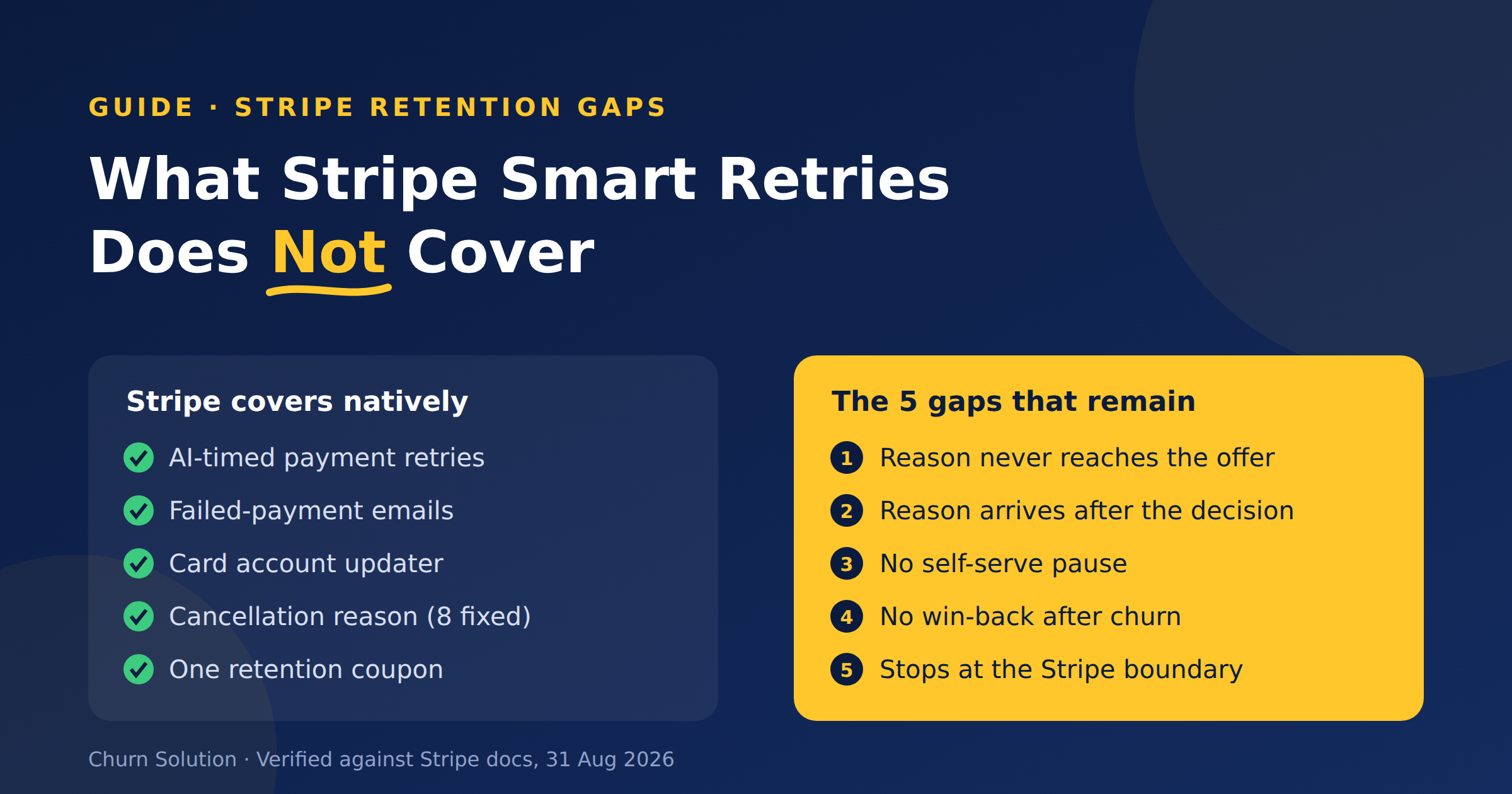
What Stripe Smart Retries Does Not Cover
Stripe Smart Retries recovers failed payments but doesn't run retention. Here are the five gaps that remain, sourced from Stripe's...


Membership Community Churn: The Members Who Quit Without Clicking Cancel
Quiet churn is the real leak: members who never clicked “cancel” at all. A card expires. A bank declines a...


Subscription Churn Dashboard: The 2026 Guide to Actionable Revenue Intelligence
Up to 40% of subscription churn is involuntary, meaning your customers aren't choosing to leave; they're being forced out by...