ARTICLE
Subscription Revenue Protection: The 2026 Guide to Automated Retention

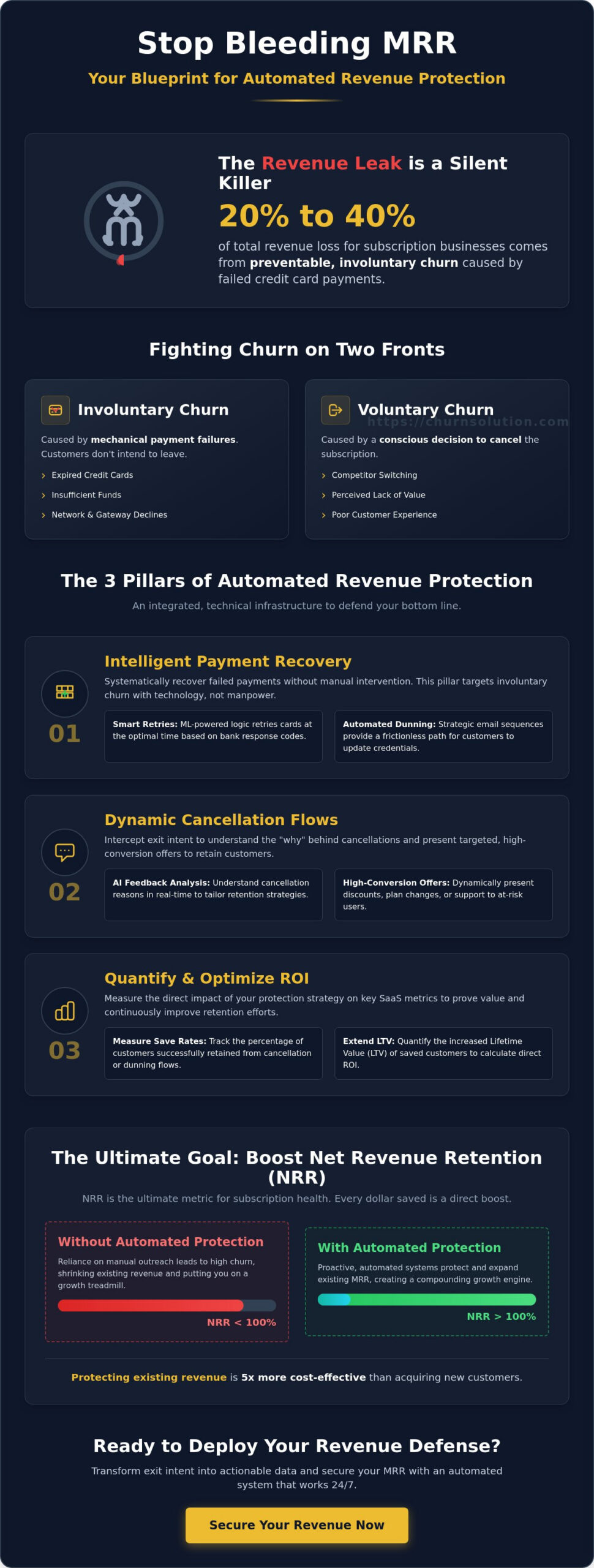
Involuntary churn from failed credit cards accounts for 20% to 40% of total revenue loss for subscription businesses. If you’re still relying on manual outreach to save these accounts, you’re bleeding MRR that should be secured. True subscription revenue protection isn’t an accounting concept; it’s a technical infrastructure designed to intercept churn before it hits your balance sheet. Just as physical construction relies on the precision of BIM and VDC modeling—you can check out CRAYDL for industry-leading examples—your revenue recovery engine requires a robust architectural foundation to prevent failed acquisitions from hitting your Net Revenue Retention.
You’ve likely seen high-value users vanish due to preventable payment failures or a total lack of visibility into why they’re actually leaving. This article provides the blueprint to stop these leaks using automated cancellation flows and intelligent payment recovery systems that operate without manual intervention. We’ll examine the deployment of AI feedback analysis, smart retries, and dynamic offers to protect your bottom line. You’ll learn to transform exit intent into actionable data while maintaining compliance with the latest 2026 regulatory standards.
Key Takeaways
- Differentiate active subscription revenue protection from static accounting compliance to build a resilient, automated defense against MRR loss.
- Utilize smart retries and automated dunning sequences to systematically recover involuntary churn from failed credit card transactions.
- Integrate dynamic cancellation flows that leverage AI feedback analysis to present high-conversion save offers at the moment of exit intent.
- Quantify success by measuring Save Rates and LTV extension to prove the direct ROI of your automated recovery infrastructure.
- Audit current churn vulnerabilities to design a deployment blueprint that focuses on high-impact win-back campaigns and retention triggers.
What is Subscription Revenue Protection? (Beyond the Accounting Jargon)
Subscription revenue protection is often mischaracterized as a back-office accounting task. Legacy platforms like Sage focus heavily on ASC 606 compliance; they ensure your revenue is reported correctly to satisfy auditors. While accurate reporting is necessary, it doesn’t stop money from leaving your bank account. Real-world subscription revenue protection is an active, operational defense. It’s the technical infrastructure used to intercept both voluntary and involuntary churn before they impact your bottom line.
This distinction between static accounting and active revenue management applies across many industries. For construction professionals dealing with rigid billing requirements, the ability to explore AIA-Style G702 & G703 Document Generation offers a similar shift from manual paperwork to automated financial operations.
The “Revenue Leak” is a silent killer for scaling SaaS companies. There’s a massive difference between the revenue your billing engine attempts to charge and the actual cash you collect. When you rely on manual intervention to bridge this gap, you’re fighting a losing battle. Automation allows you to scale retention efforts without inflating your support headcount. By deploying systems that handle recovery in the background, you ensure that your growth isn’t offset by preventable losses within the Subscription business model.
Voluntary vs. Involuntary Churn: The Two Fronts of Protection
You’re fighting a war on two fronts. Involuntary churn is the result of mechanical failures: expired credit cards, network declines, or insufficient funds. Research indicates that involuntary churn accounts for 20% to 40% of total subscriber loss. You can’t solve this with better marketing; you solve it with payment recovery systems and smart retries that bypass temporary gateway friction.
Voluntary churn is a different beast. It occurs when a user makes a conscious decision to leave. This is where exit intent and competitor switching happen. To protect this revenue, you must deploy sophisticated cancellation flows that utilize feedback analysis to understand the “why” behind the exit. A comprehensive strategy addresses both fronts simultaneously. If you only fix payment failures but ignore active cancellations, your bucket still has a hole in it.
The Impact on Net Revenue Retention (NRR)
Net Revenue Retention (NRR) is the ultimate metric for subscription health in 2026. It measures the percentage of recurring revenue retained from existing customers over a set period. High NRR indicates a compounding growth engine; low NRR indicates you’re on a treadmill. Protecting existing revenue is five times more cost-effective than acquiring new users. Every dollar you save through automated retention flows has a 100% margin. When you prioritize revenue protection, you’re not just saving a customer; you’re extending the Lifetime Value (LTV) and ensuring the long-term stability of your enterprise.
The Three Pillars of an Automated Revenue Protection System
Effective subscription revenue protection requires more than a patchwork of disconnected tools. To build a resilient defense, you must integrate three core pillars directly into your billing infrastructure, such as Stripe or Braintree. This integration ensures that data flows seamlessly between your payment gateway and your retention logic. Without this closed-loop system, you’re forced to rely on manual exports and reactive spreadsheets, which cannot keep pace with the speed of modern customer churn.
Intelligent Payment Recovery and Smart Retries
The first pillar focuses on the mechanical side of revenue loss. Generic “card declined” notifications are ineffective; they often trigger immediate cancellations because they lack context and timing. Instead, high-performance systems utilize smart retries. These tools leverage machine learning to analyze transaction metadata and determine the optimal window for a second attempt. By timing retries based on specific bank response codes, you bypass temporary network friction without bothering the user.
When retries fail, dunning email automation takes over. This isn’t just a single reminder. It’s a strategic sequence that provides a frictionless path for users to update their credentials. Modern dunning sequences treat the payment failure as a technical glitch rather than a customer fault, which preserves the brand relationship while securing the MRR.
Dynamic Cancellation Flows: Intercepting Exit Intent
Pillar two addresses the moment a user clicks “cancel.” This shouldn’t be a dead end. By deploying dynamic offers, you can present tailored alternatives based on the user’s specific tenure or plan level. Common save tactics include:
- Subscription pauses for temporary absences.
- One-time discounts to offset price sensitivity.
- Plan downgrades for users who aren’t utilizing full feature sets.
These interventions transform a departure into a “save” opportunity. To see how these flows operate at scale, refer to The Definitive Guide to Automated Cancellation Flows in 2026.
AI Feedback Analysis: Understanding the “Why”
The final pillar is the intelligence layer. Most businesses suffer from a lack of data on why users leave, often settling for a generic “Other” category in exit surveys. Utilizing AI feedback analysis allows you to move beyond surface-level metrics. AI categorizes open-ended churn reasons into actionable business insights by detecting patterns in qualitative text that humans might miss. This data doesn’t just save the current account; it informs your entire product roadmap to prevent future departures. You can start analyzing your exit intent data today to identify these hidden revenue leaks.
Evaluating Subscription Revenue Protection Software: A Buying Guide
Selecting a subscription revenue protection platform is a strategic decision that impacts your long-term scalability. You don’t need a surface-level plugin; you need a sophisticated engine that integrates deeply with your current financial stack. When evaluating vendors, prioritize four key criteria: integration depth with your billing engine, the level of “hands-off” automation, the ability to maintain brand consistency through customization, and the granularity of the provided analytics. A tool that fails to sync in real-time with your database will create data silos and reconciliation nightmares.
Native Billing Features vs. Specialized Retention Tools
Many founders mistakenly believe that the native dunning features in standard billing engines like Stripe are sufficient. While these platforms handle basic payment retries, they often lack the intelligence required for high-scale SaaS growth. Specialized tools offer significantly higher “Save Rates” because they move beyond generic messaging. By utilizing advanced churn metrics, these systems identify high-risk accounts before they churn. While a basic billing engine might recover some revenue, specialized protection software is designed to maximize Customer Lifetime Value by treating every failed transaction as a unique recovery opportunity. Research indicates that a well-structured dunning email automation process can recover 60% to 80% of failed payments, a benchmark that basic native tools rarely achieve.
Technical Must-Haves: Segmentation and Experiments
A static cancellation page is a liability. To optimize your recovery, you must deploy subscription revenue protection that supports granular customer segmentation. This allows you to offer a different save incentive to a three-year enterprise client than you would to a first-month trial user. Without this level of detail, your offers are either too generous, hurting your margins, or too weak, failing to stop the departure. You need the ability to bucket users by behavior, plan type, and lifetime value to ensure your interventions are both relevant and profitable.
Continuous optimization is equally vital. Your platform should facilitate A/B experiments to test different copy, offer types, and layouts on your “cancel” page. Data-driven decisions outperform intuition every time. Finally, ensure any tool you integrate maintains strict PCI compliance and stays ahead of evolving regulations. With the FTC’s 2026 “Click-to-Cancel” rulemaking and new B2B mandates in states like Colorado effective February 2026, your recovery infrastructure must be as legally compliant as it is technically robust.
Calculating the ROI of Your Revenue Protection Strategy
The core of any subscription revenue protection strategy is the Save Rate. You measure this by dividing the number of saved subscriptions by the total number of cancellation attempts over a specific period. This metric provides an immediate look at how effectively your automated flows are performing. While the Save Rate offers a snapshot, the true financial impact is found in Lifetime Value (LTV) extension. Every month you retain a subscriber who intended to leave adds directly to your cumulative revenue without any additional acquisition cost. If your automated systems recover an average of four extra months per saved user, the compounding effect on your annual recurring revenue is substantial.
The cost of inaction is a silent drain on your enterprise value. With the average monthly churn rate across all subscription types sitting at 5.3%, a business that fails to intervene will lose more than half of its original customer base within a single year. This attrition creates a growth ceiling that no amount of new customer acquisition can break. Conversely, implementing a system that achieves even a 10% save rate can dramatically alter your trajectory. In high-growth SaaS environments, this level of retention improvement can effectively double a company’s valuation over a 24-month period by accelerating Net Revenue Retention and stabilizing cash flow. As detailed in the 2026 guide to customer retention automation, a 5% increase in retention can lead to a 25-95% increase in profits, making proactive intervention one of the highest-leverage investments available.
Recovered Revenue vs. Implementation Cost
Determining the break-even point for your protection software is a straightforward calculation. The ROI of retention is defined as the ratio of recovered MRR to the total cost of the software. Industry analysis suggests that a 1% improvement in retention can lead to a 20% increase in bottom-line profit depending on your operating margins. Because the infrastructure for automated dunning and cancellation flows is highly scalable, the marginal cost of saving the thousandth customer is virtually zero. This makes subscription revenue protection one of the highest-leverage investments available to a subscription business.
The Hidden Value of Win-Back Campaigns
Revenue protection doesn’t end when a customer finally leaves. Utilizing reactivation tools allows you to target former subscribers with precision. Win-back campaigns typically see significantly higher conversion rates than cold outbound marketing because the brand trust and product familiarity already exist. By using the data gathered during the initial cancellation flow, you can tailor win-back offers that address the specific reason the user left. This creates a secondary layer of protection that continues to recover value long after the initial departure. You can calculate your potential revenue recovery by starting a trial of our automated retention engine today.
Deploying Churn Solution: Your Blueprint for Revenue Recovery
Executing a subscription revenue protection strategy requires a methodical deployment of technical interventions. You cannot optimize what you do not measure. Begin by auditing your existing churn points and identifying the specific failure codes associated with your involuntary losses. Once you understand where the leaks occur, design your first exit survey to capture real-time intent data. This baseline information is essential for moving from reactive support to proactive retention. Performing a rigorous customer churn analysis at this stage transforms raw behavioral signals into a prioritized map of your highest-impact revenue leaks.
Immediate recovery starts with the technical layer. Implement smart retries and automated dunning sequences to capture failed payments without human intervention. These systems work in the background to stabilize your MRR while you focus on the voluntary side of the equation. Success in retention is iterative. Use A/B experiments to test different messaging and offer structures. By constantly refining your approach, you maximize your save rate and ensure your defense remains effective against evolving market conditions. For mobile-first businesses, implementing effective churn prevention for apps requires an additional layer of strategy given that iOS apps face a 96.3% churn rate within the first 30 days.
Setting Up Your Automated Cancellation Flow
Your subscription revenue protection infrastructure must include a dedicated customer portal. This interface should provide a seamless user experience while strategically placing hurdles in the path of a cancellation. Balance is critical. You want to offer value-driven alternatives, such as automated “pause” functionality, which allows users to suspend their billing without severing the relationship entirely. Segment your audience to ensure that high-value enterprise accounts receive different save offers than self-serve users; this maintains your margins while protecting your most critical revenue streams.
Start Protecting Your Revenue Today
Every hour your business operates without an automated protection system is an hour of unrecovered revenue. Revenue leaks compound over time. A small percentage lost today becomes a significant deficit in your long-term growth trajectory. Deploying a data-driven defense is no longer optional for scaling SaaS companies. It’s the difference between a business that struggles with a growth ceiling and one that compounds its success through superior retention. Protect your bottom line – sign up for Churn Solution now.
Secure Your Growth with Automated Infrastructure
Sustainable growth in the subscription economy requires a shift from reactive customer support to proactive, automated defense. You’ve identified the critical pillars of subscription revenue protection: intelligent payment recovery, dynamic cancellation flows, and AI-driven feedback analysis. By integrating these systems directly with your billing engine, you eliminate the manual friction that leads to preventable MRR loss. The data is clear; every saved account extends LTV and accelerates your Net Revenue Retention.
Implementation is the final step toward stabilizing your balance sheet. Our platform offers seamless Stripe integration and proven save rates for high-growth SaaS companies. You can now transform qualitative exit intent into actionable product roadmaps while recovering failed payments in the background. Don’t let preventable churn cap your enterprise value. Stop the leak and protect your MRR with Churn Solution. You’re now equipped to build a more resilient, data-driven business.
Frequently Asked Questions
What is the difference between revenue protection and revenue recognition?
Revenue protection is an operational strategy designed to prevent churn and recover failed payments before they impact your bank account. Revenue recognition is a financial accounting process, often dictated by ASC 606, that determines when earned revenue is officially recorded on the balance sheet. While recognition ensures audit compliance, protection focuses on the active, technical defense of your recurring cash flow.
How much revenue can I realistically recover with automated dunning?
A well-structured dunning process can recover 60% to 80% of failed payments according to industry research. This recovery rate depends on the sophistication of your email sequences and the precision of your retry timing. By automating this communication, you capture revenue that would otherwise be lost to involuntary churn without requiring manual intervention from your billing or support teams.
Will an automated cancellation flow annoy my customers?
Automated cancellation flows improve the user experience by providing immediate alternatives to a total departure. Instead of forcing a support ticket or a phone call, these flows offer tailored solutions like account pauses or plan downgrades. When executed correctly, they give customers more control over their subscription status while gathering the vital feedback your product team needs to reduce future churn.
Can I use subscription revenue protection software with Stripe?
High-performance subscription revenue protection software is designed to integrate seamlessly with billing engines like Stripe. This connection allows for real-time data synchronization between your payment gateway and your retention tools. It ensures that dunning emails and smart retries are triggered the moment a transaction fails, maintaining a closed-loop system that protects your MRR without data silos.
How does smart retry logic differ from standard payment retries?
Standard retries occur at fixed intervals regardless of the specific failure reason. Smart retry logic uses machine learning to analyze transaction metadata and bank response codes to determine the optimal moment for a second attempt. This data-driven approach avoids unnecessary gateway fees and increases the probability of a successful transaction by timing attempts when the issuing bank is most likely to approve.
What is a “good” save rate for a SaaS cancellation flow?
A save rate between 10% and 15% is considered a strong benchmark for B2B SaaS cancellation flows. While results vary based on your industry and specific customer segments, achieving a double-digit save rate has a compounding effect on your Net Revenue Retention. You should focus on continuous optimization through A/B testing to refine your offers and improve this performance metric over time.
Is it better to offer a discount or a pause to a canceling user?
The optimal offer depends entirely on the customer’s specific reason for leaving. A pause is highly effective for users facing temporary budget constraints or seasonal usage patterns. Discounts are better suited for price-sensitive users who still derive value from the product. Utilizing AI feedback analysis allows you to identify these intent patterns and deploy the right offer to the right segment automatically.
How do I measure the ROI of my revenue protection efforts?
You measure ROI by calculating the ratio of recovered MRR to the total cost of your retention infrastructure. This calculation should include revenue saved through subscription revenue protection flows and payments recovered via dunning automation. A secondary metric is LTV extension, which quantifies the additional months of revenue generated by customers who were successfully retained by your automated systems.
- Key Takeaways
- Table of Contents
- What is Subscription Revenue Protection? (Beyond the Accounting Jargon)
- The Three Pillars of an Automated Revenue Protection System
- Evaluating Subscription Revenue Protection Software: A Buying Guide
- Calculating the ROI of Your Revenue Protection Strategy
- Deploying Churn Solution: Your Blueprint for Revenue Recovery
- Secure Your Growth with Automated Infrastructure
- Frequently Asked Questions

Churn solution that turns your customers right around.
Related Articles
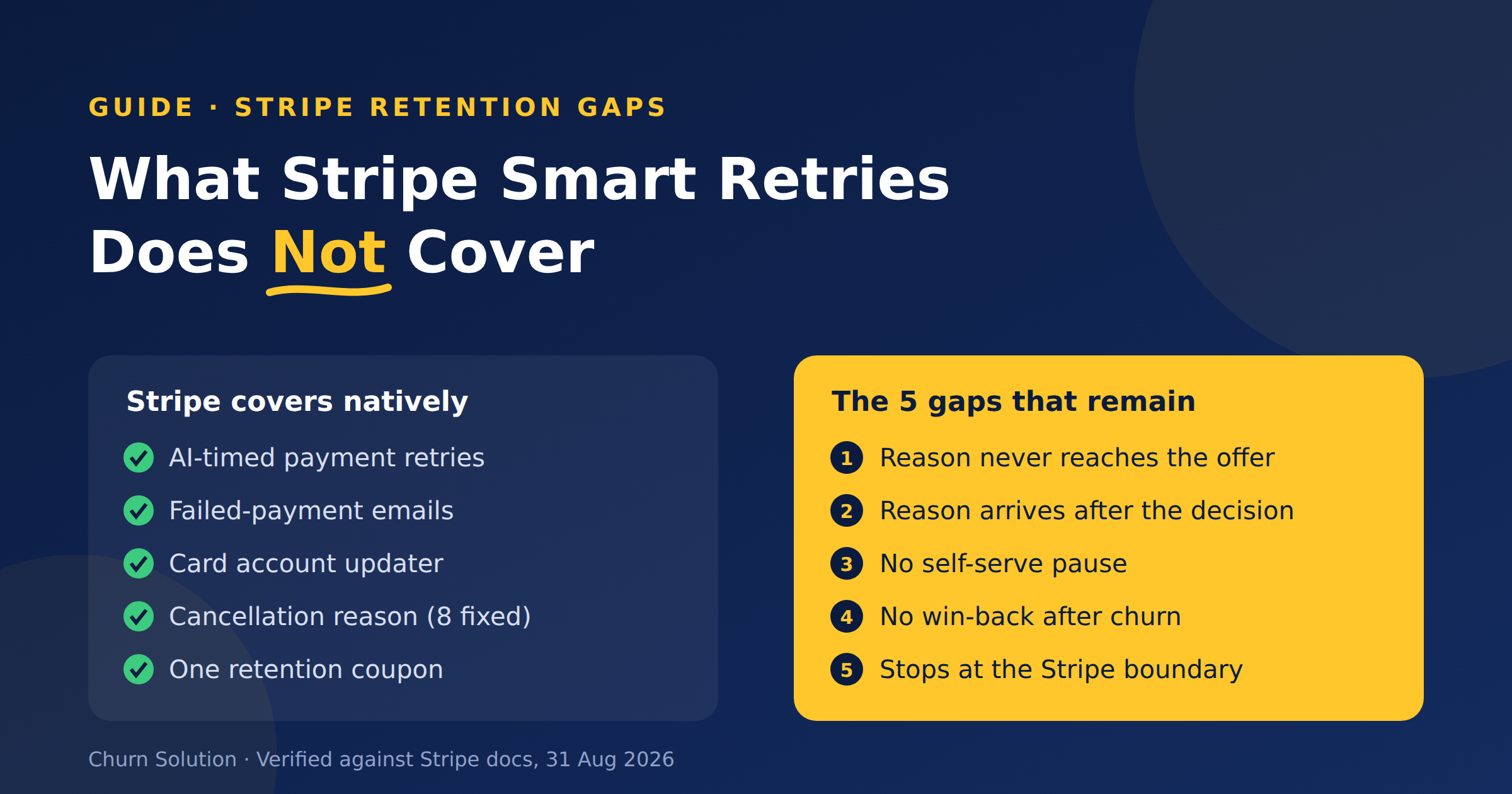
What Stripe Smart Retries Does Not Cover
Stripe Smart Retries recovers failed payments but doesn't run retention. Here are the five gaps that remain, sourced from Stripe's...

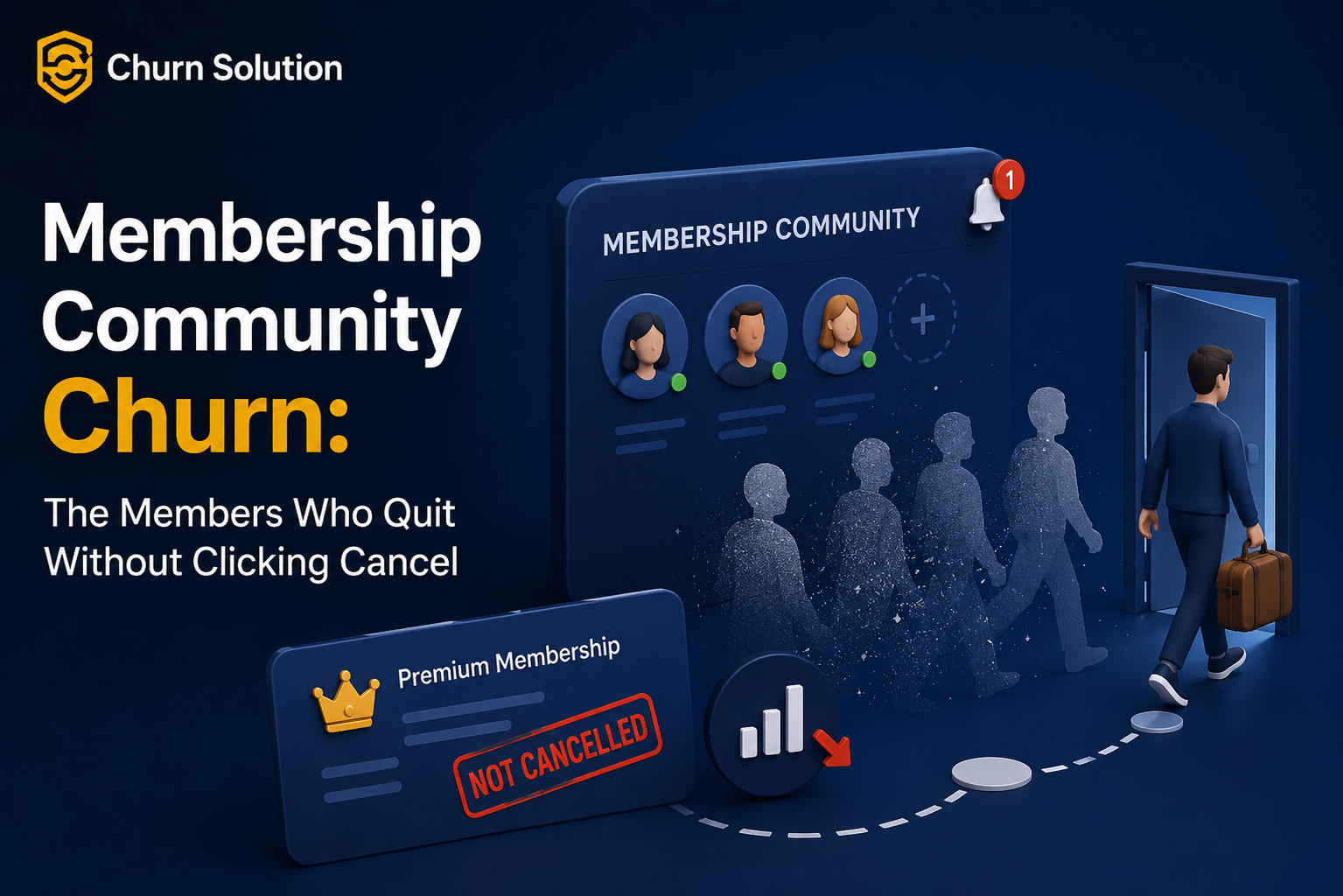
Membership Community Churn: The Members Who Quit Without Clicking Cancel
Quiet churn is the real leak: members who never clicked “cancel” at all. A card expires. A bank declines a...

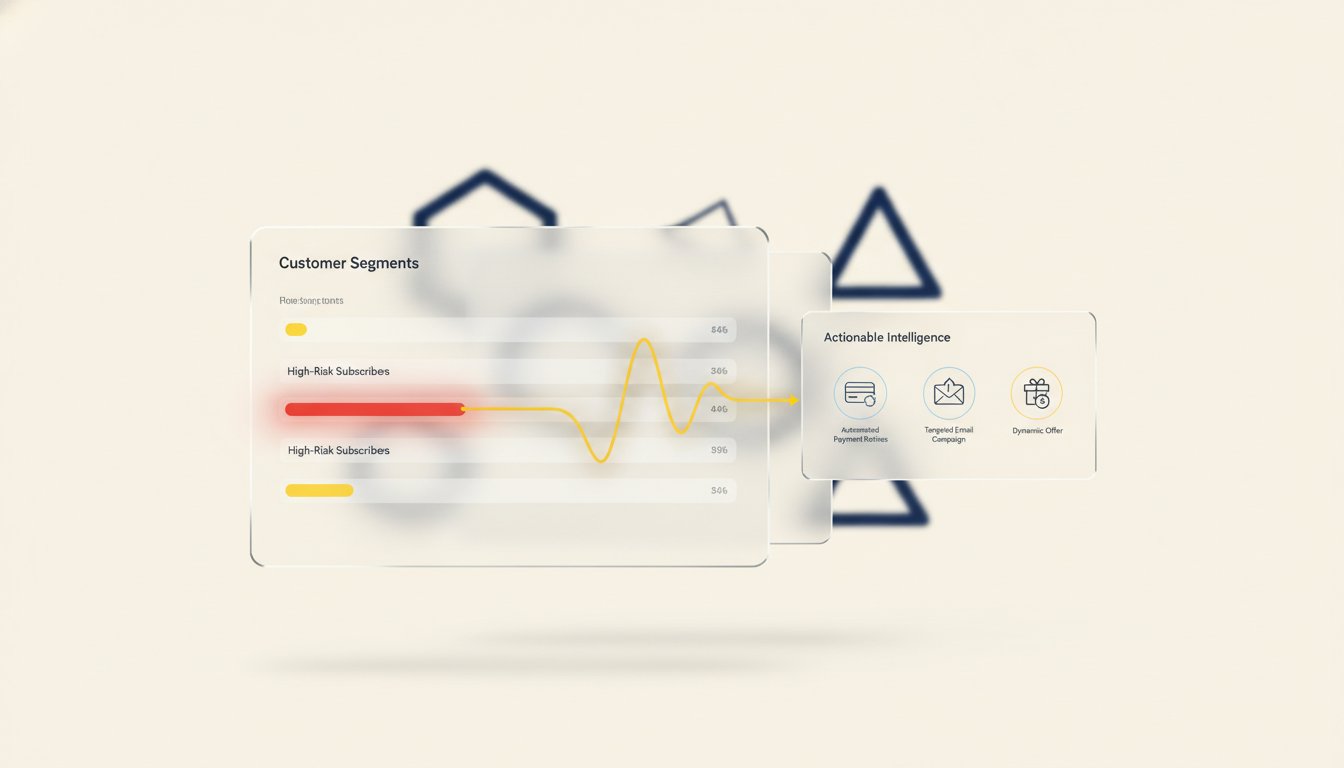
Subscription Churn Dashboard: The 2026 Guide to Actionable Revenue Intelligence
Up to 40% of subscription churn is involuntary, meaning your customers aren't choosing to leave; they're being forced out by...