ARTICLE
25+ High-Impact Customer Exit Interview Questions to Stop SaaS Churn
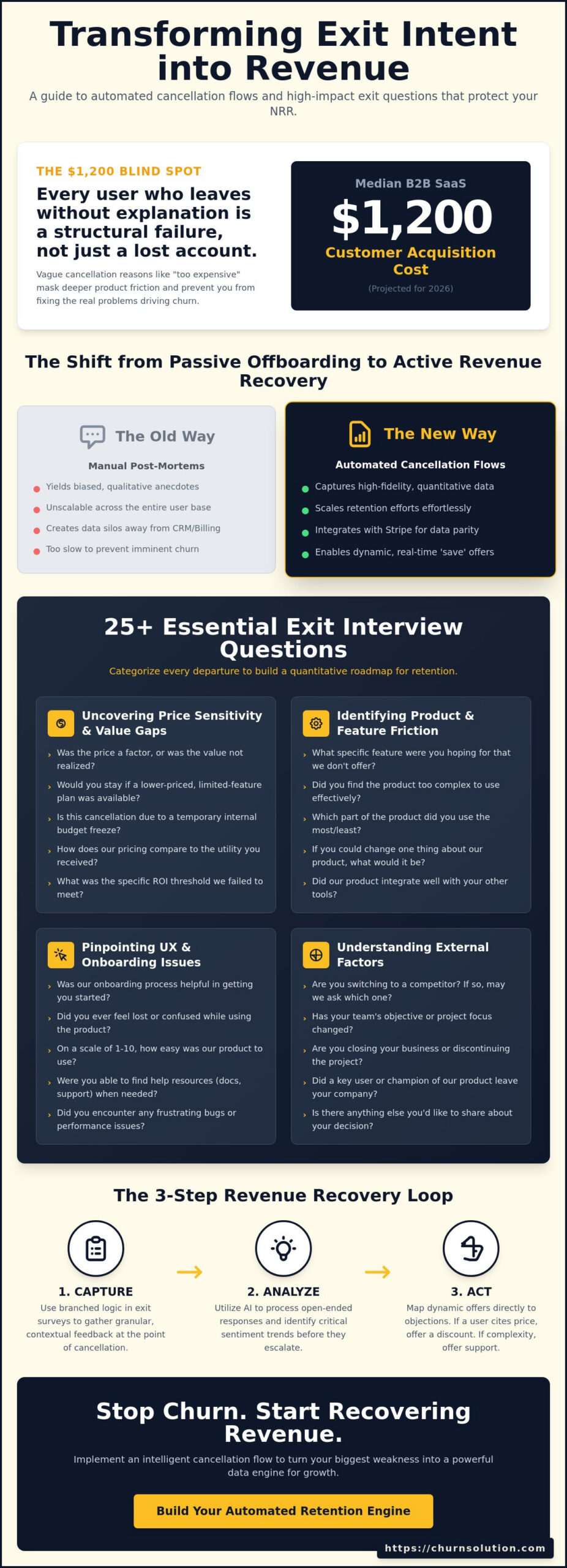
With the median Customer Acquisition Cost (CAC) for B2B SaaS climbing to $1,200 in 2026, letting a user walk away without a fight isn’t just a loss; it’s a structural failure. Most teams accept “too expensive” as a valid cancellation reason, yet this vague feedback often masks deeper product friction or poor onboarding. You know that understanding the “why” behind a departure is the only way to protect your Net Revenue Retention (NRR), but manual outreach doesn’t scale. You need a system that captures high-fidelity data while the user is still on the page.
This guide delivers the 25+ high-impact customer exit interview questions and automated frameworks required to extract actionable intelligence and transform exit intent into recovered revenue. You’ll learn how to implement sophisticated cancellation flows that move beyond static surveys to deliver dynamic offers and AI-driven insights. We will break down the exact mechanisms needed to categorize churn drivers and deploy win-back campaigns that turn departing users into retained assets.
Key Takeaways
- Transition from manual post-mortems to automated cancellation flows that use branched logic to scale retention efforts across your entire subscriber base.
- Deploy 25+ high-impact customer exit interview questions to capture the granular, quantitative data required to differentiate between price sensitivity and product friction.
- Recover lost revenue by mapping dynamic offers directly to customer objections, ensuring every “save” attempt is relevant and data-driven.
- Utilize AI feedback analysis to process open-ended responses at scale, identifying critical sentiment trends before they escalate into significant churn events.
The Strategic Role of Customer Exit Interview Questions in SaaS
In the high-stakes environment of the 2026 subscription economy, losing a customer without capturing the underlying cause is a direct hit to your company’s valuation. While HR departments use exit interviews to manage personnel turnover, SaaS leaders must view the customer exit interview as an automated, high-fidelity data gathering event embedded directly within the cancellation flow. It isn’t a courtesy call; it’s a critical diagnostic tool designed to stop “silent churn.” When users leave without providing feedback, they create a blind spot that prevents you from identifying systemic product or pricing failures. This lack of visibility erodes MRR stability and makes it impossible to deploy effective interventions.
The 2026 shift in retention strategy has moved from passive “offboarding” to active Revenue Recovery Engineering. Manual 1-on-1 interviews are unscalable and often yield biased, qualitative anecdotes that don’t translate into strategy. Automated flows provide the speed and data parity required to analyze churn at scale. By using structured customer exit interview questions, you transform a lost account into a data point that informs your entire growth engine. You gain the ability to categorize every departure by its root cause, allowing your team to move with the precision of a specialist rather than guessing why your churn rate is spiking.
Why Traditional Exit Surveys Fail Modern SaaS
Most SaaS companies sabotage their own retention efforts with “Too Long; Didn’t Read” (TL;DR) surveys that users simply ignore. If your cancel path feels like a chore, users will rush through it, selecting generic “Other” categories just to reach the end. This destroys your analytics. You cannot build a recovery strategy on “Other.” Effective customer exit interview questions must be concise and targeted to close the “Exit Intent Gap.” This gap represents the critical window between a user clicking the initial cancel button and the final account closure. If you don’t extract intelligence in these seconds, the opportunity to save the revenue or learn from the loss is gone forever.
Data Parity: Connecting Exit Feedback to CRM and Billing
Feedback is only actionable when it exists in context. Your exit data must live alongside billing events from platforms like Stripe and other leading billing solutions to provide a complete picture of the customer lifecycle. By integrating churn metrics with qualitative survey responses, you can validate what users say against what they actually do. For example, if a high-usage enterprise client cites “complexity,” that feedback carries more weight than a trial user who never logged in. This segmented data informs the Product Roadmap more effectively than any sales call or support ticket. It ensures your engineering team solves the problems that actually drive revenue out the door, rather than chasing feature requests from users who were never going to stay.
25 Essential Customer Exit Interview Questions by Category
To fix a leaking bucket, you must first identify the exact location of the holes. Extracting actionable intelligence requires a structured taxonomy; you cannot build a recovery strategy on vague feedback. Effective customer exit interview questions force a choice that reveals a specific business lever. By categorizing these questions into Price, Product, UX, and External Factors, you transform anecdotal complaints into a quantitative roadmap for your product and success teams. This methodical approach ensures that every departure serves as a diagnostic event for your revenue engine.
Uncovering Price Sensitivity and Value Gaps
Price is rarely the root cause of churn; it is usually a proxy for low perceived value. You must distinguish between a hard budget constraint and a failure to demonstrate ROI. Utilizing targeted exit surveys allows you to identify users who find the tool useful but the current tier inaccessible. Consider these questions:
- Was the price a factor, or was the value not realized?
- Would you stay if a lower-priced, limited-feature plan was available?
- Is this cancellation due to a temporary internal budget freeze?
- How does our pricing compare to the utility you received?
- What was the specific ROI threshold we failed to meet?
Identifying Product and Feature Friction
Feature gaps are roadmap gold. If multiple high-value users cite the same missing tool, your engineering priorities are set. Complexity questions reveal if your product is powerful but unusable, which is a common driver of “silent churn.” Use these questions to map friction points:
- What one specific feature would have kept you as a subscriber?
- Did you find the platform difficult to integrate with your existing stack?
- Was there a core task you found impossible to complete?
- How often did technical bugs interfere with your workflow?
- Did our product roadmap fail to align with your business goals?
- Was the learning curve too steep for your team to adopt the tool?
- Which specific functionality did you use the least?
The Competition and Market Landscape Questions
You need to know which rival is stealing your market share. Industry benchmarks indicate that a majority of churners migrate to a direct competitor within 30 days of cancellation. If you don’t ask where they are going, you are flying blind. These customer exit interview questions expose your market vulnerabilities:
- Which specific tool are you moving to?
- What does the new solution provide that our platform lacks?
- Is the competitor’s pricing structure more attractive for your use case?
- Did a specific promotion or discount influence your decision to switch?
- What was the primary “aha” moment you experienced with the new solution?
- How long have you been evaluating our competitor?
- Would you have stayed if we matched their core offering?
Stop guessing why your MRR is fluctuating. You can start building your automated cancellation flow today to capture this data in real-time. By implementing these questions, you move from reactive support to proactive revenue engineering, ensuring every exit provides the data needed to prevent the next one.
Transitioning from Manual Interviews to Automated Cancellation Flows
Manual 1-on-1 outreach is a luxury that disappears once your user base exceeds 500 subscribers. At this scale, the overhead of scheduling and conducting calls outweighs the qualitative benefits. You need a system that functions without human intervention. Transitioning to an automated cancellation flow allows you to capture data from every departing user, not just the vocal minority. This shift ensures that your customer exit interview questions are delivered consistently and at the exact moment of exit intent, providing a comprehensive dataset for analysis.
Efficiency requires a balance between data depth and user friction. If your flow is too cumbersome, users will bypass it or flood your support desk with tickets. Limit your primary flow to three or four logical steps. This provides enough room for diagnostic questions without causing the frustration that leads to “dark churn,” where users cancel through their banks to avoid a complex offboarding process. By automating the collection of feedback, you maintain a high-performance revenue protection engine that works around the clock.
The Power of Branched Survey Logic
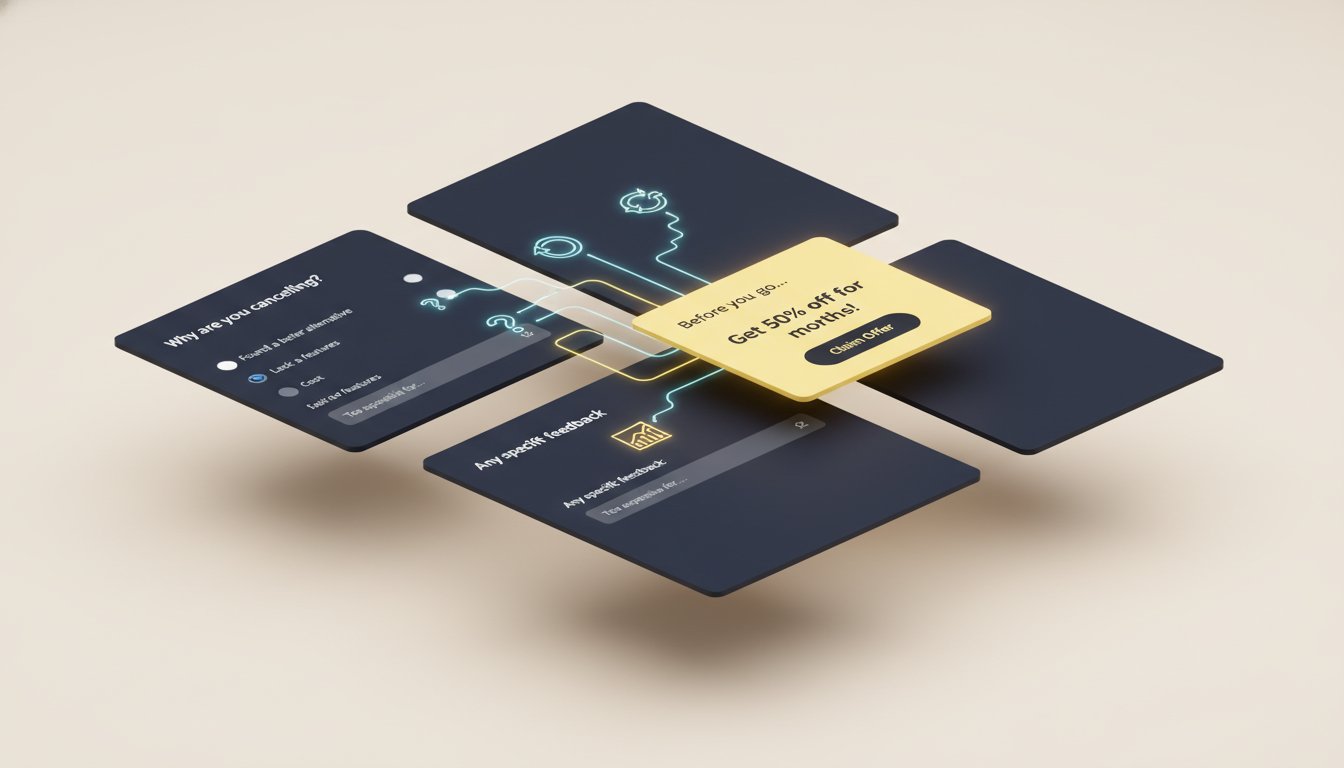
Static surveys are a relic of the past. Modern retention engineering relies on branched logic to deliver relevant interventions based on user input. If a user identifies “Price” as their primary driver, the system should immediately pivot to a discount offer or a plan downgrade. Conversely, if they cite “UX Complexity,” the flow should trigger a link to a demo or a specialized help article. This conditional approach ensures that your customer exit interview questions drill down into the root cause of churn rather than settling for surface-level answers.
For example, if a user selects “Product was too hard to use,” the next branch should ask, “Which specific feature was most confusing?” This granular data allows you to automate the “Save” attempt based on the specific branch the user takes. By matching the remedy to the specific ailment, you significantly increase the probability of a reversal and recover revenue that would otherwise be lost.
Integrating Exit Intent with the Customer Portal
The customer portal is the optimal environment for this exchange. It is where users naturally go to manage their accounts, making it the logical place to intercept a cancellation request. By embedding the exit interview within the portal, you reduce friction while maintaining total control over the narrative. You can present alternatives to cancellation in a familiar, branded interface that reinforces the value of your service.
Integration also allows for real-time notifications when a high-value account enters the cancellation path. If an enterprise-tier user starts the flow, your success team can be alerted instantly to intervene manually if the automated save fails. This hybrid approach combines the efficiency of automation with the precision of high-touch management for your most critical revenue segments, ensuring that no high-impact churn event goes unaddressed.
Converting Exit Feedback into Dynamic Save Offers
Capturing feedback is only half the battle. If your customer exit interview questions reveal a specific pain point but your system fails to address it instantly, you’ve wasted a high-intent opportunity. The psychology of the “save” depends on precision. A generic discount offered to a user who is frustrated by product complexity feels desperate and irrelevant. Instead, you must deploy dynamic offers that correlate directly to the user’s stated objection. This approach preserves your brand’s perceived value while aggressively protecting your Net Revenue Retention (NRR).
Effective revenue recovery requires a library of targeted incentives. When a user selects “Price” as their reason for leaving, a 2-month discount or a plan downgrade is the logical counter-measure. If the driver is “UX Complexity,” a discount won’t help; instead, offer a free 15-minute “Success Session” with an expert to resolve their friction. For those citing a “Feature Gap,” providing exclusive “Beta Access” to an upcoming release can transform a departure into an early-adopter relationship. This mechanism ensures the remedy matches the ailment every time.
The ‘Pause vs. Cancel’ Strategy
Data indicates that approximately 40% of users who intend to cancel will choose a 30-day break if given the option. A “Subscription Pause” is the highest-ROI retention lever in 2026 because it maintains the customer’s data and configuration while removing the immediate financial commitment. It bypasses the friction of a full reactivation later. Your system should set automated reminders to “Unpause” and resume billing, ensuring the account doesn’t stay dormant indefinitely. This preserves the relationship without requiring a new sales cycle.
A/B Testing Save Offers
Don’t guess which offers work. Use A/B testing to identify the “Minimum Effective Discount.” This is the lowest possible incentive that still triggers a save. This optimization prevents you from over-discounting and unnecessarily diluting your MRR. By systematically testing different offer values against specific churn reasons, you build a high-performance engine that maximizes recovery while protecting your margins. You can configure your first dynamic offer logic today to start testing these interventions in real-time and stop revenue leaks immediately.
Scaling Retention with AI Feedback Analysis and Revenue Protection
Collecting data through customer exit interview questions is the first step toward stability, but raw data requires processing to become actionable. For SaaS companies scaling beyond the initial growth phase, manual review of open-ended feedback is impossible. You need a mechanism to synthesize thousands of qualitative comments into strategic priorities. Utilizing AI feedback analysis allows you to identify sentiment trends before they escalate into mass churn events. This technology transforms fragmented complaints into a clear, prioritized list of product and service improvements, ensuring your roadmap is driven by revenue protection rather than guesswork.
The future of revenue engineering lies in predictive churn prevention. By analyzing patterns within exit interview responses, AI can identify at-risk segments before they ever click the cancel button. This proactive stance allows you to intervene earlier in the customer lifecycle with targeted education or feature highlights. Closing the loop also means automating win-back campaigns based on solved feedback. When a specific bug is fixed or a requested feature is launched, your system should automatically reach out to the cohort that cited those issues, turning past losses into future gains.
Leveraging AI for Qualitative Scale
AI excels at categorizing unstructured text into actionable categories such as “Product Requests” or “Service Complaints.” It moves your analysis beyond surface-level observations. For instance, it can turn a vague comment like “I hate the UI” into a precise data point: “80% of churners find the Dashboard navigation confusing.” This level of granularity allows your engineering team to focus on high-impact friction points. Furthermore, these insights fuel reactivation strategies. By targeting users who left due to specific, now-resolved issues, you lower your effective CAC and recover established accounts with high LTV potential.
Measuring the ROI of Your Churn Solution
Every saved account is a victory for your bottom line. To measure the efficacy of your retention engine, you must track three core KPIs: Save Rate, Recovery Rate, and Net Revenue Retention (NRR). In 2026, the median NRR for B2B SaaS is 106%, while top performers exceed 130%. If your metrics fall below these benchmarks, your exit intent logic requires optimization. Consider the financial impact: a 5% increase in customer retention can lead to a 25% to 95% increase in profits. With the median CAC rising to $1,200, the cost of replacing a single user far outweighs the cost of a sophisticated retention system.
Stop letting silent churn erode your valuation. You have the tools to extract intelligence from every departure and transform objections into opportunities for growth. Ready to transform your exit intent into recovered revenue? Sign up for Churn Solution.
Engineering a Resilient Revenue Stream
Protecting your Net Revenue Retention (NRR) requires more than just acknowledging churn; it demands a systematic extraction of intelligence. The strategic deployment of customer exit interview questions transforms vague cancellations into a precise roadmap for product optimization. By moving away from manual post-mortems and toward automated, branched cancellation flows, you ensure that every departure provides the data needed to prevent the next one. This isn’t just about understanding loss. It’s about engineering a product that users cannot afford to leave.
The transition to automated revenue protection allows you to process thousands of feedback points through AI-powered sentiment analysis. With direct integrations for Stripe, Recurly, and Paddle, you can automate 100% of your cancellation feedback and deploy dynamic offers that match user objections in real-time. Don’t let valuable data walk out the door. Start saving subscribers today with Churn Solution's automated flows. You have the tools to turn exit intent into a catalyst for long-term growth.
Frequently Asked Questions
What is the single most important exit interview question to ask?
The primary reason for cancellation is the most critical question because it dictates the entire recovery logic. By forcing users to select a high-level category like price, product friction, or external factors, you establish the foundation for your branched survey logic. This single data point allows you to deploy targeted interventions instantly based on the user’s specific pain point.
How many questions should be in an automated customer exit survey?
Limit your automated survey to three to five customer exit interview questions to maximize completion rates. High friction in the cancellation path leads to “dark churn” where users bypass your feedback loop entirely. Focus on one primary reason followed by a single qualifying question to maintain data quality without exhausting the user during their exit.
Should I offer a discount to every customer who tries to cancel?
Never offer a universal discount as it unnecessarily dilutes your MRR and devalues your product. Instead, reserve discounts for price-sensitive segments identified through your survey. Users leaving due to technical complexity or missing features require success sessions or roadmap updates rather than a lower price point to remain active subscribers.
How do I analyze open-ended feedback from thousands of canceling users?
Deploy AI feedback analysis to categorize and quantify open-ended responses at scale. Manual review is unscalable once you exceed a few hundred monthly churn events. AI identifies recurring sentiment trends and specific product complaints, transforming thousands of comments into a prioritized list of actionable insights. This ensures your product roadmap is guided by revenue protection.
Is it better to ask exit questions before or after the cancellation is confirmed?
Always present customer exit interview questions before the cancellation is finalized to exploit the “Exit Intent Gap.” This sequence allows you to present dynamic save offers based on the user’s feedback. Asking questions after the account is closed yields data but misses the opportunity for immediate revenue recovery. It’s the difference between post-mortem analysis and real-time intervention.
What is the difference between an exit survey and an exit interview?
An exit survey is an automated, scalable data collection tool embedded in a digital cancellation flow, whereas an exit interview is a manual, one-on-one conversation. Surveys are essential for high-volume SaaS companies to maintain data parity. Interviews are best reserved for high-value enterprise accounts where the qualitative depth justifies the manual effort of a success manager.
How can I use exit feedback to improve my product roadmap?
Aggregate feedback into specific categories like “Feature Gaps” or “UX Friction” to drive evidence-based product decisions. When a significant percentage of churners cite a specific missing integration, that data point carries more weight than anecdotal sales requests. This ensures your development sprints focus on the issues most likely to impact your Net Revenue Retention (NRR).
Can I automate the ‘Save’ process without a customer success team?
You can fully automate the save process by integrating cancellation flows with dynamic offers. This system triggers specific incentives, such as subscription pauses or discounts, based on the user’s survey responses. This eliminates the need for manual intervention by a success team while maintaining a high recovery rate for your most common churn drivers. It’s a high-performance solution for protecting MRR at scale.
- Key Takeaways
- Table of Contents
- The Strategic Role of Customer Exit Interview Questions in SaaS
- 25 Essential Customer Exit Interview Questions by Category
- Transitioning from Manual Interviews to Automated Cancellation Flows
- Converting Exit Feedback into Dynamic Save Offers
- Scaling Retention with AI Feedback Analysis and Revenue Protection
- Engineering a Resilient Revenue Stream
- Frequently Asked Questions

Churn solution that turns your customers right around.
Related Articles
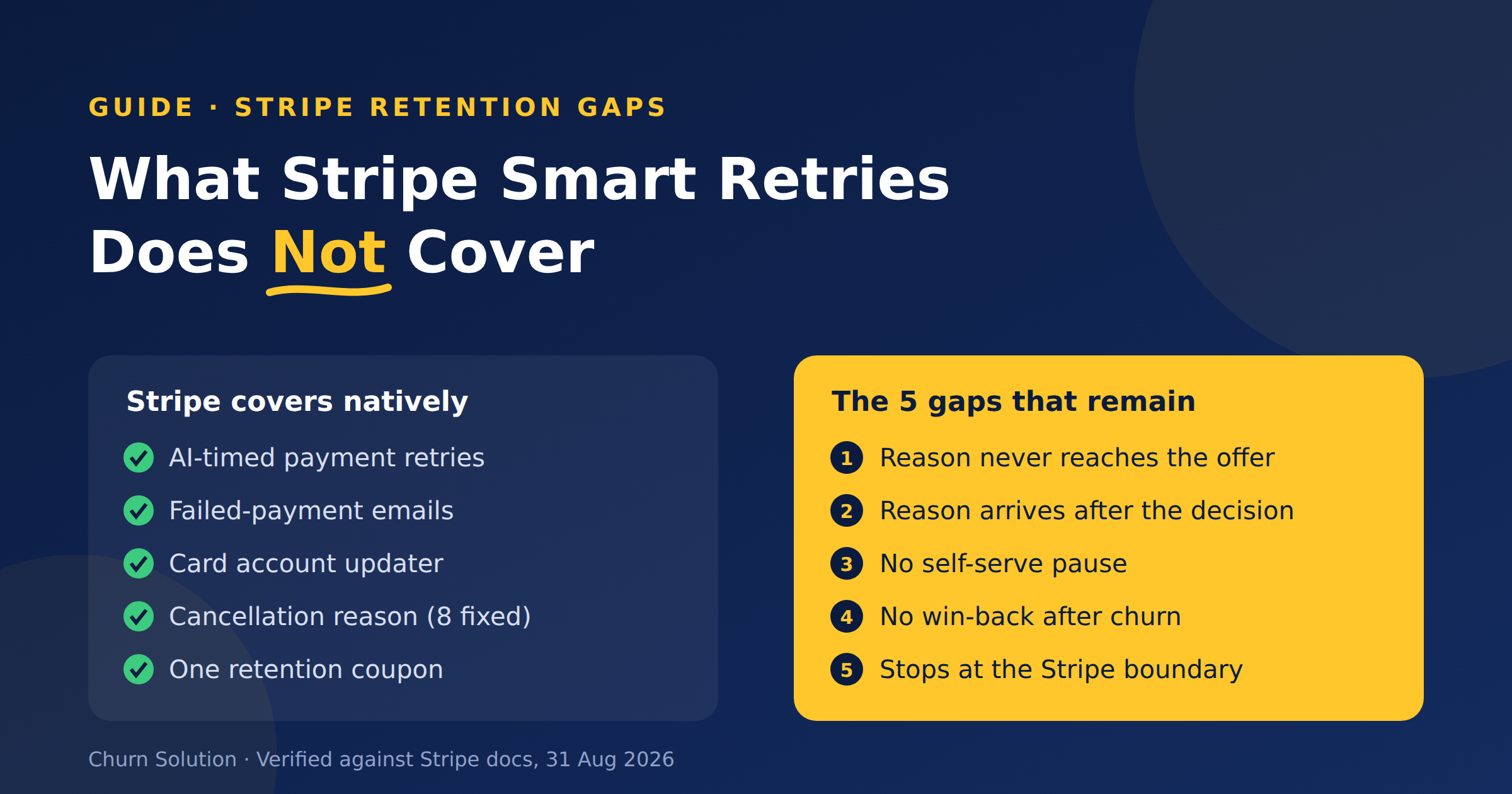
What Stripe Smart Retries Does Not Cover
Stripe Smart Retries recovers failed payments but doesn't run retention. Here are the five gaps that remain, sourced from Stripe's...

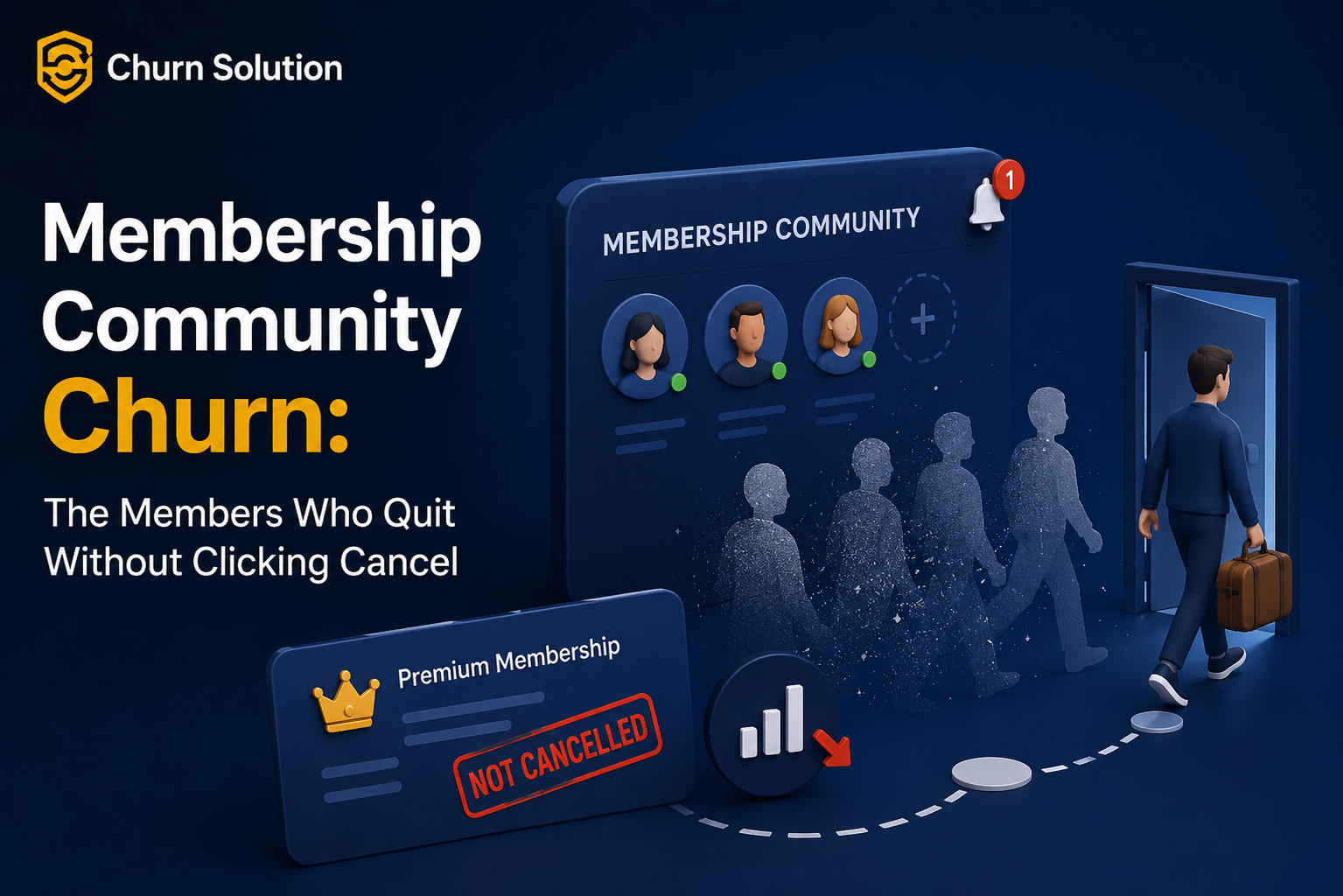
Membership Community Churn: The Members Who Quit Without Clicking Cancel
Quiet churn is the real leak: members who never clicked “cancel” at all. A card expires. A bank declines a...

Subscription Churn Dashboard: The 2026 Guide to Actionable Revenue Intelligence
Up to 40% of subscription churn is involuntary, meaning your customers aren't choosing to leave; they're being forced out by...