ARTICLE
Mastering Customer Churn Metrics: The 2026 Data-Driven Retention Playbook

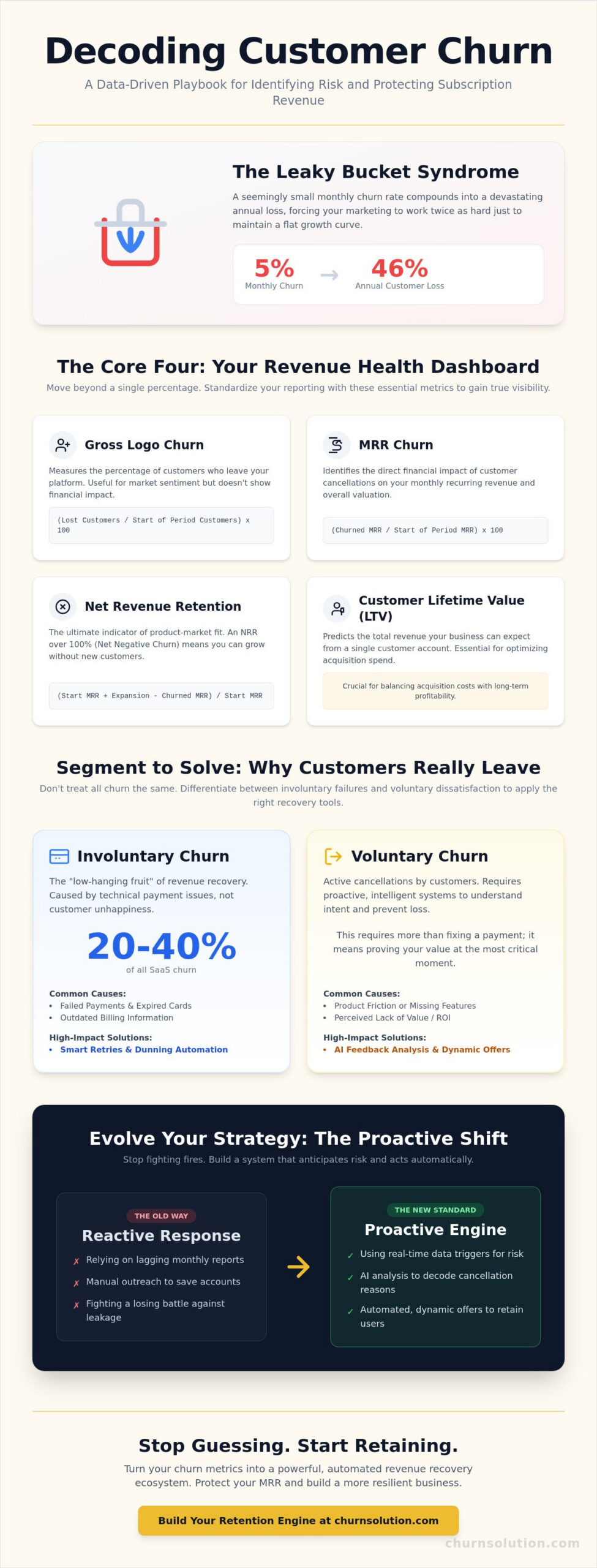
A 5% monthly churn rate might look manageable on a weekly report, but it compounds into a staggering 46% loss of your customer base every single year. If your team is still relying on manual outreach to save accounts, you’re fighting a losing battle against revenue leakage. You already know that visibility is your biggest hurdle. Without precise customer churn metrics, identifying whether a cancellation stems from a failed payment or a specific product friction point is nearly impossible at scale.
You deserve a retention strategy that functions with the same technical precision as your core product. This playbook reveals the high-performance metrics and automated frameworks required to identify risk and recover lost subscription revenue instantly. We’ll examine how to deploy smart retries for involuntary churn, utilize AI feedback analysis to decode cancellation reasons, and implement dynamic offers that retain high-value accounts before they disappear. It’s time to move beyond reactive reporting and build a data-driven engine that protects your bottom line.
Key Takeaways
- Identify why a single percentage is a lagging indicator and how to use granular customer churn metrics to uncover hidden growth opportunities.
- Standardize your reporting by mastering the precise formulas for the “Core Four” metrics: Gross Churn, Net Churn, MRR Churn, and LTV.
- Segment your losses between voluntary dissatisfaction and involuntary payment failures to apply high-impact recovery tools like smart retries and dunning automation.
- Transition from reactive manual outreach to a proactive ecosystem using AI feedback analysis and dynamic cancellation flows to protect your MRR.
Beyond the Churn Rate: Why Modern SaaS Needs Granular Metrics
Stop viewing churn as a single, static percentage. In the high-stakes environment of subscription software, high-level percentages are lagging indicators that describe what happened last month, not what will happen tomorrow. Effective customer churn metrics function as the diagnostic pulse of your entire subscription architecture. They reveal the specific points where revenue leaks from your system, allowing you to move from passive observation to aggressive revenue protection. When you master these numbers, you stop guessing why users leave and start deploying surgical interventions that protect your bottom line.
The industry is shifting. Leading organizations no longer treat customer attrition as an inevitable cost of doing business. Instead, they view it as a solvable data problem. By breaking down the broad “churn” category into granular segments, you can identify which losses are truly natural and which are recoverable through automated systems. This precision is the foundation of a high-performance retention engine. It’s the difference between a business that survives and one that dominates its vertical through superior unit economics.
The High Cost of Metric Blindness
Operating without granular data creates a dangerous “leaky bucket” syndrome. You spend thousands on customer acquisition only to lose that value through unmonitored exit points. According to data from culta.ai, a 5% monthly churn rate results in a staggering 46% annual loss of your customer base. This compounding effect destroys long-term valuation and forces your marketing team to work twice as hard just to maintain a flat growth curve.
Metric blindness prevents you from distinguishing between “natural” attrition, such as a business closing down, and “recoverable” revenue. Research indicates that involuntary churn, often caused by failed payments or expired cards, accounts for 20% to 40% of all customer loss in B2B SaaS. If you aren’t tracking these specific customer churn metrics, you’re likely ignoring a massive opportunity to recover revenue through automated dunning and smart retries.
SaaS Evolution: Metrics in 2026
By 2026, monthly reporting has been replaced by real-time data streaming. Sophisticated platforms now ingest behavioral signals to predict risk before a cancellation request is ever submitted. This evolution relies heavily on cohort analysis, which allows you to identify high-risk segments based on sign-up date, plan type, or feature usage. Metric-Driven Intervention is the standard for 2026 SaaS; it is the process of using real-time data triggers to launch automated cancellation flows or dynamic offers the moment a risk threshold is met. This proactive stance ensures that your retention efforts scale as fast as your user base.
The Core Four: Essential Customer Churn Metrics for Analysis
Standardizing your customer churn metrics is the first step toward reclaiming lost revenue. You cannot optimize what you do not measure with mathematical precision. While many teams focus solely on logo churn, sophisticated SaaS leaders prioritize revenue-based indicators to understand the actual health of their business. This requires a transition from simple headcounts to a multi-dimensional analysis of how money moves through your ecosystem. By mastering these four pillars, you gain the clarity needed to deploy effective interventions.
Gross Logo Churn measures the percentage of customers who leave your platform entirely. Calculate it as: (Customers Lost in Period / Total Customers at Start of Period) x 100. While useful for understanding market sentiment, it fails to differentiate between a low-value user and a high-tier enterprise account. To solve this, you must track MRR Churn: (MRR Lost from Cancellations / Starting MRR) x 100. This identifies the direct financial impact of customer churn on your monthly performance and valuation.
Net negative churn represents the peak of SaaS efficiency. This occurs when your expansion revenue from upsells and cross-sells outweighs the revenue lost to cancellations. It’s the only way to grow without adding a single new customer. Achieving this state requires more than just a good product; it requires a systematic approach to retention that includes win-back campaigns and targeted dynamic offers.
Gross vs. Net Revenue Churn
Revenue retention is the ultimate indicator of product-market fit. Net Revenue Retention (NRR) is the metric investors prioritize above almost all others. The formula is: (Starting MRR + Expansion MRR – Churned MRR) / Starting MRR. As of 2026, the median NRR for public SaaS companies sits at 114%. Best-in-class organizations aim for 120% or higher. If your Net Churn is positive, your bucket is leaking faster than your expansion efforts can fill it. Transitioning from manual tracking to automated recovery systems allows you to impact these metrics in real-time rather than just reporting on them post-mortem.
Customer Lifetime Value (LTV) and CAC Ratios
LTV predicts the total revenue a customer generates before churning. Calculate it by dividing your Average Revenue Per Account (ARPA) by your logo churn rate. To scale safely, your LTV to Customer Acquisition Cost (CAC) ratio should be at least 3:1. This ensures you aren’t overspending to acquire users who won’t stay long enough to be profitable. Monitor your “payback period” closely; this is the number of months required to recover the initial CAC. In the current market, a payback period under 12 months is the benchmark for high-performance capital efficiency.
Voluntary vs. Involuntary Churn: Segmenting for Recovery
Grouping all lost customers into a single bucket is a strategic error that masks the true nature of your revenue leakage. To build a high-performance retention engine, you must segment your customer churn metrics by intent. This distinction is critical because voluntary and involuntary churn represent two entirely different business problems. One is a failure of product value or customer experience; the other is a technical breakdown in the payment lifecycle. Treating them with the same set of tools is inefficient and results in lower recovery rates.
Voluntary churn occurs when a customer makes the conscious decision to end their subscription. This is often driven by dissatisfaction, changing business needs, or aggressive competitor moves. Conversely, involuntary churn is a passive loss. It happens when a customer’s payment fails due to expired cards, insufficient funds, or network declines. Because the customer hasn’t necessarily lost interest in your product, the recovery potential is significantly higher. You must track your Passive Recovery Rate as a primary indicator of health for this segment. This metric measures the percentage of revenue you recover through automated systems without requiring any manual intervention from your support team.
Tracking Voluntary Exit Intent
Measuring voluntary churn requires a deep dive into the cancellation journey. You need to track exactly who enters your exit process versus who completes it. This visibility allows you to calculate your Save Rate, which is the percentage of customers who intended to cancel but were retained through Cancellation Flows. By analyzing this metric, you can determine the efficacy of your dynamic offers. If your save rate is low, your offers likely don’t align with the specific friction points causing customers to leave. High-performance teams use this data to iterate on their retention logic in real-time, ensuring that every exit attempt is met with a relevant, high-value alternative.
Measuring Involuntary Payment Failures
Involuntary churn is a technical leak that requires a technological remedy. Verified industry data shows that involuntary churn often accounts for 20% to 40% of all customer churn in B2B SaaS. To combat this, you must monitor your Dunning Effectiveness. This metric quantifies the revenue recovered through automated email sequences designed to prompt a payment update. Additionally, you should track your Smart Retry Success Rate. This measures the impact of AI-timed payment attempts that occur behind the scenes. Optimizing these customer churn metrics ensures that you aren’t losing customers simply because of a legacy payment processor or a clerical error. It’s the most direct way to increase Net Revenue Retention without needing to change your core product.
Predictive Metrics and AI Feedback: The Proactive Edge
Reactive reporting is a legacy strategy that no longer suffices in a competitive SaaS market. High-performance subscription models in 2026 rely on leading indicators to intercept risk before the billing cycle ends. The Customer Health Score serves as your primary predictive tool, aggregating behavioral signals like login frequency, feature depth, and API usage into a single, actionable value. By monitoring these customer churn metrics in real-time, you can identify accounts sliding toward “Engagement Decay” long before they reach your cancellation flow. This allows your team to shift from damage control to strategic revenue preservation.
AI-powered analysis has transformed how we handle qualitative data. Historically, exit surveys were a graveyard for unstructured text that few teams had the resources to analyze. Modern systems now use AI churn feedback analysis to categorize reasons like price sensitivity, UX friction, or changing business needs into quantitative charts. This turns subjective complaints into statistically significant trends. You can finally see the exact percentage of your churn attributed to a specific feature gap or a competitor’s aggressive pricing, allowing for data-backed product roadmap decisions.
The AI Feedback Metric
Sentiment analysis adds a critical layer of severity to your risk modeling. It’s not enough to know the reason a customer is leaving; you must understand the intensity of their dissatisfaction. By weighting risk scores based on the sentiment of support tickets and exit surveys, you can prioritize high-value saves. This process converts vague statements like “I don’t use it enough” into a specific engagement metric that triggers automated win-back campaigns or personalized training offers. It’s about turning words into numbers that your retention engine can actually process.
Usage Intensity and Retention Triggers
Retention begins during the initial onboarding phase. You must track Time to First Value (TTFV) to ensure users reach their “Aha! Moment” before the first renewal period arrives. If a user’s Feature Adoption Rate remains stagnant or declines during the first 30 days, they’re a high-risk candidate for early-stage churn. Implementing automated triggers allows you to intervene the moment a user’s health score drops below a critical threshold. Use AI Feedback Analysis to refine these triggers and ensure your proactive outreach is always relevant to the user’s specific context. This automated approach ensures that no at-risk account falls through the cracks due to manual oversight.
Turning Metrics into MRR: Implementing an Automated Recovery Ecosystem
Identifying your customer churn metrics is a diagnostic exercise; recovering that revenue is an operational one. Data without action is just overhead. To maximize Net Revenue Retention, you must bridge the gap between analysis and intervention with an automated recovery ecosystem. Manual retention efforts don’t scale and often arrive too late to make an impact. By the time a human agent reviews a churn report, the customer has already moved on. Automated systems solve this by executing recovery protocols the millisecond a risk signal is detected.
Moving from manual dunning to AI-powered recovery provides an immediate ROI by capturing revenue that would otherwise be lost to technical friction. This isn’t just about sending emails. It’s about a sophisticated, multi-layered approach that addresses both the psychological and technical reasons for churn. When your metrics inform your automation, you stop treating every customer the same and start delivering the exact intervention required to keep them active. This precision transforms your retention department from a cost center into a primary driver of expansion revenue.
Automating the Dunning Cycle
Involuntary churn is a technical leak that requires a technical plug. Churn Solution automates the recovery of failed payments by deploying intelligent sequences that go beyond simple “card declined” notifications. By using Smart Retries, the system analyzes the specific decline code and attempts the transaction at the optimal time to ensure success. This process directly improves your involuntary customer churn metrics without requiring your team to lift a finger. Integrating these metrics directly with Stripe or your preferred billing engine ensures your financial data remains the single source of truth for your entire organization. You gain total control over the payment lifecycle while reducing the friction that leads to passive churn.
Optimizing the Cancellation Flow
Voluntary churn requires a different strategic approach. When a user clicks “cancel,” they’re providing a final data point that your system must act upon instantly. High-performance flows use your historical metrics to trigger the right offer at the right time. For example, a user with high historical engagement but low recent usage might benefit more from a “Pause” button than a discount. The psychology of the pause is powerful; it allows the user to step away without severing the relationship, maintaining the account for a future win-back campaign. If you’re ready to recover your revenue? Deploy Churn Solution today. Stop the leak with automated precision and turn your churn data into a roadmap for sustained growth.
Secure Your Subscription Future with Automated Precision
Data is only as powerful as the systems it triggers. You’ve seen how granular customer churn metrics differentiate between technical payment failures and product friction. By moving beyond basic percentages and into real-time behavioral analysis, you position your business to intercept risk before it impacts your MRR. High-performance retention in 2026 requires an ecosystem where data and intervention are inseparable. It’s time to stop simply reporting on losses and start preventing them through technological mastery.
Don’t let your growth be undermined by preventable revenue leakage. Leverage AI-powered feedback analysis to decode customer sentiment and deploy automated dunning with smart retries to eliminate payment failures. With customizable cancellation flows, you can present the right offer at the exact moment of exit. Start Reducing Your Churn Automatically with Churn Solution today. You now have the strategic framework and the technical tools required to turn every churn risk into a recovery opportunity. Build a more resilient, high-performance business today.
Frequently Asked Questions
What is the most important customer churn metric for SaaS?
Net Revenue Retention (NRR) is the most critical metric because it measures the total financial health of your existing base. Investors prioritize NRR over logo churn as it accounts for expansion revenue. A median NRR of 114% is currently the public SaaS benchmark. If your NRR exceeds 100%, your growth from existing accounts is outpacing your losses. This makes it the ultimate indicator of long-term business viability and product-market fit.
How do you calculate churn rate for a subscription business?
You calculate logo churn by dividing the number of customers lost during a period by the total customers at the start of that period. To measure revenue impact, calculate MRR churn by dividing lost revenue by starting revenue. Standardizing these customer churn metrics across your organization ensures consistent reporting. Use these formulas to identify where your acquisition efforts are being negated by retention failures during the subscription lifecycle.
What is a “good” churn rate in 2026 for B2B SaaS?
A “good” churn rate depends heavily on your specific market segment. As of June 2026, the blended average monthly churn rate for B2B SaaS is between 3.5% and 3.9%. Enterprise-level companies should target a significantly lower rate of 0.5% to 1.0%. Small-to-medium business segments typically see higher rates between 3.0% and 5.0%. Compare your performance against these specific benchmarks to determine your relative market standing and operational efficiency.
How does involuntary churn differ from voluntary churn in my metrics?
Voluntary churn represents intentional cancellations driven by customer dissatisfaction or changing needs. Involuntary churn is a technical loss caused by failed payments or card declines. It’s critical to separate these because involuntary churn accounts for 20% to 40% of all customer loss in B2B SaaS. While voluntary churn requires better cancellation flows, involuntary churn is best solved through automated dunning and smart retries that recover revenue without manual intervention.
Can AI feedback analysis really be measured as a metric?
AI feedback analysis converts unstructured qualitative data into measurable quantitative metrics. By categorizing exit survey text and support tickets, you can generate specific “Save Rates” for different cancellation reasons. This allows you to track the efficacy of dynamic offers and identify which product friction points cause the most revenue leakage. It turns subjective feedback into a hard customer churn metrics dashboard that informs your product roadmap and retention strategy.
What is the difference between Gross Churn and Net Churn?
Gross churn measures the total percentage of revenue or customers lost without considering any gains. Net churn accounts for expansion revenue, such as upsells and cross-sells, which can offset those losses. Achieving net negative churn is the peak of SaaS efficiency. It signifies that your existing customer base is growing in value even if some individual accounts are lost. This distinction helps you identify if your expansion strategy is effectively neutralizing attrition.
How often should I be analyzing my customer churn metrics?
You should analyze your metrics in real-time rather than relying on monthly batch reports. The 2026 industry standard has shifted toward real-time AI-powered alerts that detect behavioral changes within minutes. Waiting until the end of the month to review your data means you’ve already lost the opportunity to intervene. Continuous monitoring allows you to launch automated win-back campaigns the moment a user’s health score drops below a critical threshold.
What tools are best for tracking and reducing SaaS churn automatically?
The best tools for reducing churn are those that bridge the gap between data and automated action. You need a system that offers customizable cancellation flows to capture voluntary exits and dunning email automation to recover failed payments. Look for platforms that utilize smart retries and AI feedback analysis to optimize every recovery attempt. These technologies ensure your retention strategy scales efficiently without requiring constant manual oversight from your customer success team.
- Key Takeaways
- Table of Contents
- Beyond the Churn Rate: Why Modern SaaS Needs Granular Metrics
- The Core Four: Essential Customer Churn Metrics for Analysis
- Voluntary vs. Involuntary Churn: Segmenting for Recovery
- Predictive Metrics and AI Feedback: The Proactive Edge
- Turning Metrics into MRR: Implementing an Automated Recovery Ecosystem
- Secure Your Subscription Future with Automated Precision
- Frequently Asked Questions

Churn solution that turns your customers right around.
Related Articles
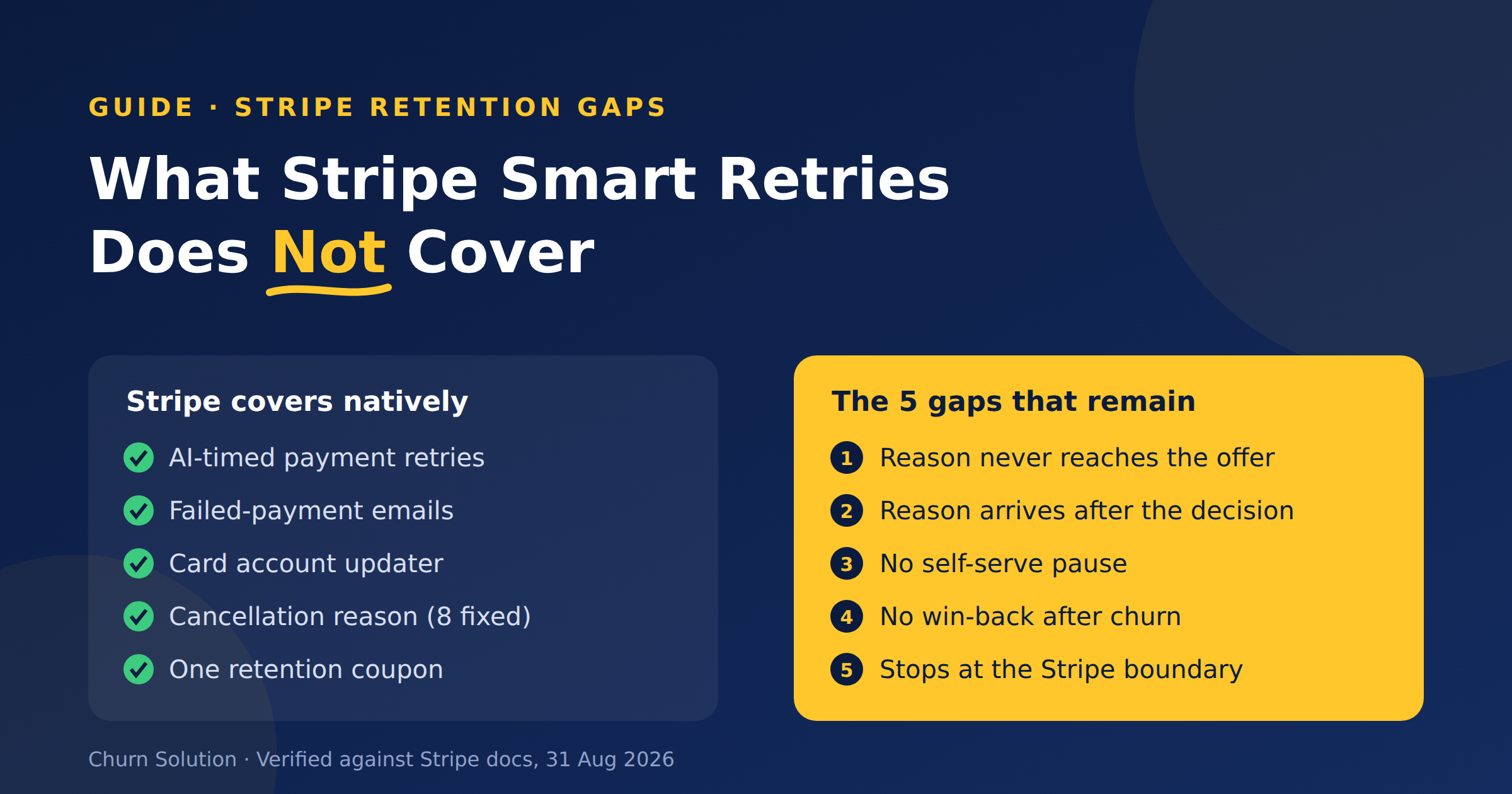
What Stripe Smart Retries Does Not Cover
Stripe Smart Retries recovers failed payments but doesn't run retention. Here are the five gaps that remain, sourced from Stripe's...


Membership Community Churn: The Members Who Quit Without Clicking Cancel
Quiet churn is the real leak: members who never clicked “cancel” at all. A card expires. A bank declines a...

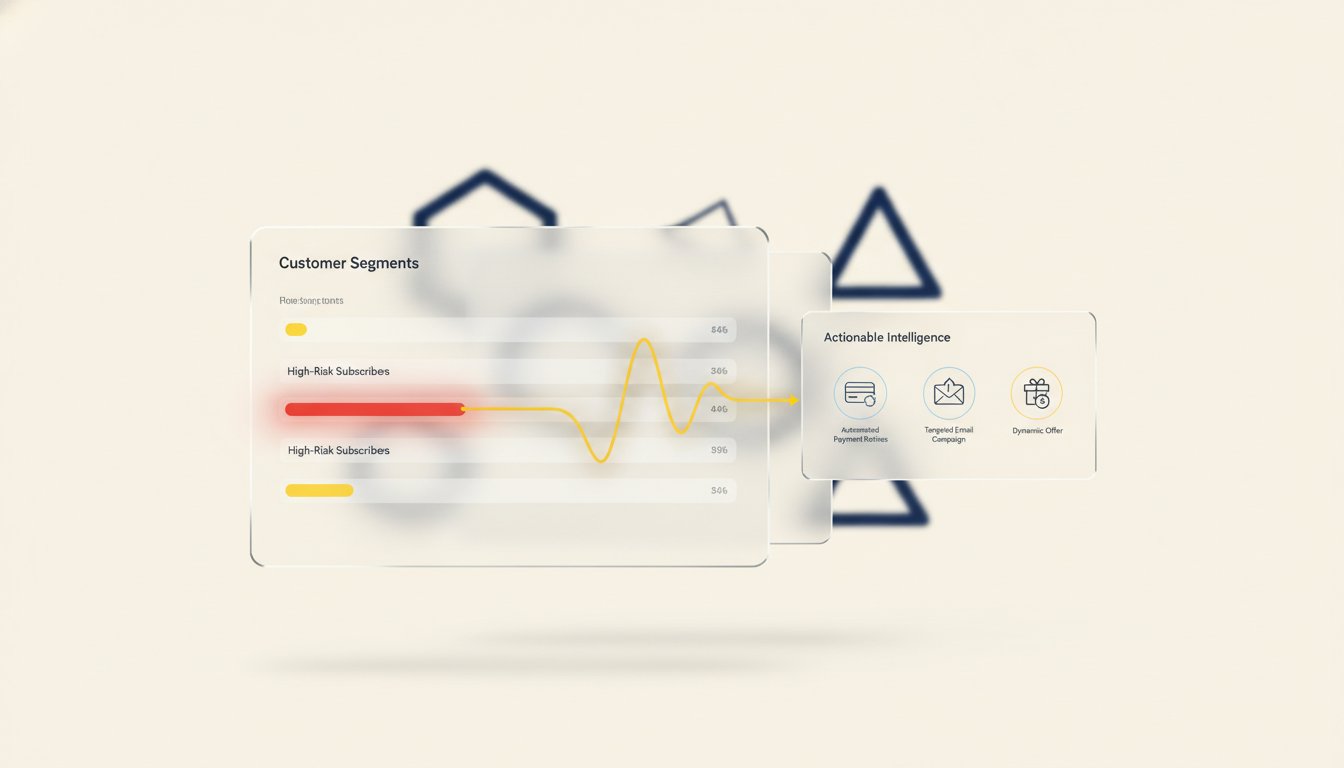
Subscription Churn Dashboard: The 2026 Guide to Actionable Revenue Intelligence
Up to 40% of subscription churn is involuntary, meaning your customers aren't choosing to leave; they're being forced out by...