ARTICLE
AI Churn Feedback Analysis: Turning Qualitative Exit Data into Revenue Recovery

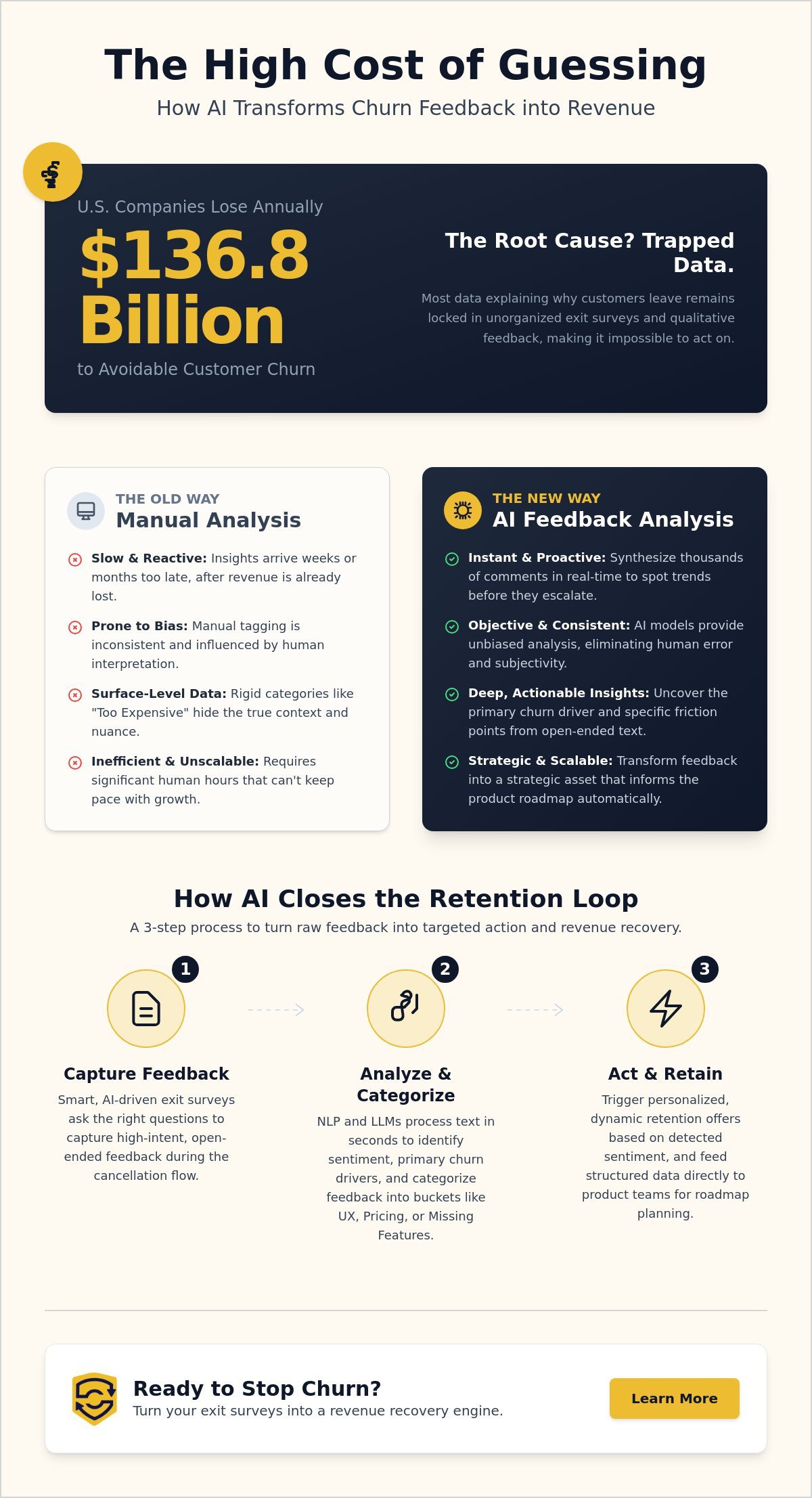
U.S. companies lose an estimated $136.8 billion every year to avoidable customer churn; yet, most of the data explaining why customers leave remains trapped in unorganized exit surveys. You likely recognize the frustration of watching churn rates climb while your team struggles to manually categorize thousands of qualitative complaints. Manual analysis is too slow to be actionable. It’s a reactive process that fails to keep pace with the digital economy. Implementing ai churn feedback analysis changes this dynamic by instantly transforming raw sentiment into a strategic asset for revenue recovery.
You know that “good” features aren’t enough if you can’t identify the specific friction points driving users away. This article shows you how to leverage AI to build a scalable roadmap for reducing churn and protecting your bottom line. We’ll examine how to categorize churn reasons automatically, use real-time sentiment tracking to trigger win-back campaigns, and turn qualitative data into actionable product insights. Discover how to stop guessing and start using data-driven automation to secure your subscription revenue.
Key Takeaways
- Bridge the gap between quantitative metrics and the nuanced reality of user frustration to identify the actual root causes of revenue loss.
- Implement ai churn feedback analysis to automatically categorize qualitative exit data into strategic buckets like UX friction or pricing sensitivities.
- Transition from delayed monthly reporting to real-time synthesis, enabling your team to respond to emerging trends before they impact your net revenue retention.
- Enhance your cancellation flows with smart exit surveys designed to capture high-intent feedback that informs your long-term product roadmap.
- Close the retention loop by triggering personalized, dynamic offers based on the specific sentiment detected during the cancellation process.
The Qualitative Data Gap: Why Traditional Churn Metrics Fail in 2026
Quantitative metrics provide the pulse of your business, but they don’t provide the diagnosis. Monitoring Net Revenue Retention (NRR) and Monthly Recurring Revenue (MRR) tells you exactly how much capital is leaking from your ecosystem; however, these figures are trailing indicators. They confirm that a customer has left, but they fail to explain the underlying friction that caused the departure. Relying solely on a dashboard of percentages creates a visibility gap that prevents strategic recovery. You see the exit, but you remain blind to the intent.
Static dropdown menus in traditional cancellation flows exacerbate this problem. When a user selects “Too Expensive” or “Missing Features” from a pre-defined list, you receive a surface-level data point devoid of context. These rigid categories miss the nuance of user frustration. A customer might select “Too Expensive” because they failed to find value in a specific module, not because your base price is high. Without ai churn feedback analysis, these critical distinctions are lost, leaving your product team to guess which roadmap adjustments will actually move the needle on retention.
Modern feedback intelligence requires more than just counting clicks. It demands an automated process using Natural Language Processing (NLP) to extract semantic meaning from open-ended text. This technology identifies the sentiment, urgency, and specific pain points buried in raw customer comments. It transforms unorganized qualitative data into a structured, actionable dataset. By synthesizing this information in real time, you shift from reactive support to proactive retention, allowing you to address systemic issues before they trigger a mass exodus.
The High Cost of “Silent Churn”
Every customer who leaves without providing detailed feedback represents a catastrophic loss of intelligence. In the 2026 SaaS landscape, where U.S. companies lose an estimated $136.8 billion annually due to avoidable customer attrition, capturing exit intent is a financial necessity. A high customer churn rate often stems from “silent churners” who feel your brand is indifferent to their experience. Implementing sophisticated exit surveys ensures that every departure becomes a lesson in product iteration rather than just a line item on a loss report.
Why Manual Feedback Tagging Is Obsolete
Human analysis cannot scale at the speed of modern subscription growth. Tasking a Customer Success team with manually categorizing thousands of survey responses is inefficient and prone to significant bias. Humans often project their own interpretations onto customer sentiment, leading to skewed data. Large Language Models (LLMs) eliminate this risk by providing objective, high-speed feedback analysis. These systems process vast quantities of text in seconds, identifying complex patterns that a manual reviewer would inevitably overlook. Speed is the ultimate lever in revenue recovery; the faster you identify a trend, the faster you can deploy a fix.
The Mechanics of AI Feedback Analysis: Sentiment, Intent, and Categorization
Legacy sentiment analysis often fails because it treats customer emotions as a binary toggle. A user is either “happy” or “unhappy.” In the high-stakes subscription economy, this oversimplification is a liability. Sophisticated ai churn feedback analysis moves beyond these surface-level labels to detect the specific psychological state of a departing user. It distinguishes between a customer expressing mild indifference and one exhibiting high-intensity frustration. This distinction is critical; a frustrated user might be saved with an immediate technical intervention, whereas an indifferent user likely requires a value-based re-engagement strategy.
Identifying the “Primary Churn Driver” is the most significant mechanical advantage of modern AI. When a customer provides a laundry list of complaints, humans often struggle to identify the single catalyst that triggered the cancellation. AI models use weighted intent detection to determine which factor actually killed the deal. If a user says, “The UI is a bit cluttered, and I couldn’t find the export button, so I’m switching to a tool that fits my budget,” the AI recognizes that while UX was a friction point, pricing was the ultimate driver. This level of granularity allows your product team to prioritize fixes that have the highest direct impact on revenue recovery.
NLP and Sentiment Mining in 2026
Modern Natural Language Processing identifies emotional cues that indicate a high probability of win-back success. It’s no longer just about keywords. It’s about context. For instance, “The price is too high” suggests a hard budget constraint, while “I love the tool but can’t justify the cost right now” signals an opportunity for a temporary discount or a lower-tier plan. Recent industry analysis confirms that using Generative AI to analyze customer feedback enables companies to uncover these nuanced linguistic shifts at scale. You can explore the technical architecture of these systems in our deep dive on Feedback Analysis.
Categorization: From Noise to Actionable Clusters
The transition from raw data to a strategic roadmap requires “semantic clustering.” This process groups thousands of individual complaints into actionable product requirements. AI filters out the “noise”—one-off complaints that don’t represent systemic issues—and highlights “critical” churn risks that affect high-value customer segments. By mapping feedback to specific user personas, you can see if your UX issues are concentrated among enterprise clients or small business owners. This precision ensures your engineering resources are never wasted on low-impact updates. To see how these insights look in a live environment, you can start building your own feedback clusters today.
Effective categorization also involves intent detection. The AI determines if a user is genuinely exiting, making a desperate plea for help, or simply providing a suggestion for future iterations. Identifying a “help request” hidden within an exit survey allows your support team to intervene instantly, potentially reversing the cancellation before the subscription period ends. This proactive mechanism transforms a standard exit survey into a real-time revenue protection tool.
Trend Analysis: The Evolution of Feedback Intelligence in the Subscription Economy
The landscape of retention is shifting from reactive observation to real-time intervention. In the 2026 subscription economy, waiting for a monthly report to analyze customer sentiment is a strategic failure. By the time you review last month’s data, the churn has already crystallized into permanent revenue loss. The most advanced systems now utilize ai churn feedback analysis to synthesize qualitative data the moment it’s submitted. This immediate processing allows for instant course correction, transforming a standard exit survey into a live intelligence feed.
Cross-channel integration represents the next phase of this evolution. Leading enterprises no longer isolate exit data from other signals. Instead, they merge feedback from cancellation flows with support tickets, call transcripts, and social signals to create a 360-degree view of the customer journey. This unified approach identifies friction points that a single survey might miss. When you understand the full context of a user’s frustration, your ability to mitigate customer churn increases exponentially.
We’re also seeing the emergence of predictive feedback. AI models now analyze user behavior patterns, such as declining login frequency or reduced feature usage, to anticipate the reason for cancellation before the user even begins the exit flow. This foresight enables Feedback-Led Growth, where product roadmaps are dictated by verified user intent rather than executive intuition. In a saturated SaaS market, this capacity to listen and adapt faster than the competition is your most significant advantage. Building a robust system for customer departure insights is what separates retention leaders from those still reacting to last quarter’s churn data.
The Rise of the Automated Retention Loop
2026 leaders are closing the gap between identifying a problem and deploying a solution through automated retention loops. This involves using A/B Experiments to test hypotheses generated by AI insights. For example, if feedback indicates a specific UI element is confusing, you can instantly test two different layouts to see which one improves retention. This agile methodology is a core component of modern Customer Churn Analysis, ensuring that every piece of feedback leads to a measurable product optimization. Pairing these insights with automated retention triggers allows your system to act on behavioral signals with machine-speed precision, closing the loop between data and intervention before revenue is lost.
Data Privacy and Ethical AI in Feedback
Scale must not come at the expense of security. As regulatory bodies tighten control over consumer data, PII masking in feedback analysis has become a non-negotiable requirement for GDPR and CCPA compliance. Companies must maintain transparency when using AI to interpret customer emotions. Churn Solution provides an enterprise-ready framework that prioritizes data sensitivity, ensuring that your ai churn feedback analysis remains both powerful and compliant. We act as a secure partner, alongside cybersecurity experts like CyberOne, allowing you to extract strategic value from feedback without compromising user privacy or ethical standards.
Strategic Implementation: Optimizing Cancellation Flows with AI-Driven Exit Surveys
Execution is the bridge between raw data and recovered revenue. To move beyond passive observation, you must transform your cancellation flow into an active intelligence hub. This process requires a structured approach to data collection and model training. Implementing ai churn feedback analysis effectively involves five critical steps designed to capture, interpret, and act on user intent before the customer relationship officially terminates.
- Step 1: Deploy smart Exit Surveys that prioritize open-ended responses over restrictive dropdown menus.
- Step 2: Train the AI model on your specific industry jargon and unique product features to ensure high-precision categorization.
- Step 3: Integrate feedback data with Customer Segmentation to trigger immediate alerts for high-value user departures.
- Step 4: Establish real-time triggers that identify “At-Risk” sentiment patterns, allowing for automated intervention.
- Step 5: Utilize the Insight Dashboard to visualize trends and prioritize your product roadmap based on verified churn drivers.
Designing Surveys for Maximum AI Utility
The most valuable field in any cancellation flow is the “Other” text box. While dropdowns provide clean quantitative data, they stifle the qualitative nuance required for deep analysis. You must find the optimal balance between friction and data quality. Asking for feedback adds a layer of friction, but it yields the high-intent text that AI needs to thrive. Modern systems can summarize thousands of these text entries into three key takeaways, providing a clarity that manual review cannot match. This summarization capability ensures that your team focuses on systemic issues rather than getting lost in individual anecdotes.
Mapping Feedback to Financial Impact
Intelligence is only valuable if it’s tied to the bottom line. You must correlate specific feedback categories with your core Customer Churn Metrics to identify which “reasons” are costing the most in terms of Lifetime Value (LTV). For example, if “UX Friction” is cited by your enterprise segment more often than your prosumer segment, the financial stakes are significantly higher. We define “feedback ROI” as the ratio of recovered revenue to the total cost of analysis and implementation. This metric provides the justification for continued investment in automated retention systems. To start quantifying your own feedback ROI, create your free Churn Solution account and begin analyzing your exit intent today.
By mapping qualitative complaints to financial loss, you empower your product team to make data-driven decisions. If the AI identifies that 25% of your churn is driven by a missing integration, you can calculate the exact revenue gain expected from building that feature. This turns the product roadmap into a strategic tool for revenue protection rather than a wishlist of features.
Closing the Loop: Converting AI Insights into Dynamic Retention Offers
Analysis without intervention is merely an autopsy of lost revenue. To truly recover capital, you must bridge the gap between understanding why a customer is leaving and deploying a solution to stop them. Integrating ai churn feedback analysis directly into your cancellation logic enables the “Immediate Save.” This mechanism uses real-time intent detection to trigger a surgical response the moment a user provides a reason for their departure. You aren’t just collecting data; you’re automating a defense against attrition. Configuring automated retention triggers based on these AI-detected signals ensures your system responds with the right offer at the right moment, without requiring manual oversight.
Consider the impact of intent-based logic. If a user types “The price is too high for my current budget,” the system identifies financial friction and immediately presents Dynamic Offers such as a three-month discount or a temporary account pause. Conversely, if the AI detects a sentiment of confusion, such as “I can’t figure out how to set up the API,” it bypasses financial incentives. Instead, it triggers a direct link to a specialized onboarding webinar or a high-priority support ticket. This precision ensures you don’t waste margin on users who simply need education.
Personalization at Scale
AI facilitates 1-to-1 retention tactics that were previously impossible to manage manually. When a user feels “heard” during the cancellation process, the psychological friction of leaving increases. They see that your platform understands their specific pain point. Position your Customer Portal as the central hub for these interventions. By embedding AI-driven logic into the portal, you create a seamless experience where the solution to a customer’s problem is presented before they can finalize their exit. This proactive approach reinforces the value of your service at the exact moment of highest risk.
Reactivating the “Unsaveable” User
Some churn is inevitable, but it doesn’t have to be permanent. Long-term feedback trends allow you to fuel sophisticated Win-back campaigns months after a user departs. Your ai churn feedback analysis identifies when a previously cited “missing feature” has finally been added to your product roadmap. This triggers an automated Reactivation sequence that speaks directly to that user’s historical objection. You aren’t sending generic marketing emails; you’re offering a concrete reason to return. Stop letting qualitative data sit idle in spreadsheets. Schedule a demo of Churn Solution’s Feedback Analysis and turn your exit data into a permanent revenue recovery engine.
Secure Your Revenue with Feedback-Led Intelligence
The era of guessing why customers leave is over. By bridging the qualitative data gap, you transform unorganized complaints into a high-performance roadmap for retention. We’ve explored how ai churn feedback analysis identifies the primary drivers of attrition, allowing your product and success teams to act with surgical precision. This isn’t just about data collection; it’s about building an automated defense system that protects your bottom line in real time.
Churn Solution empowers you to take control of your subscription revenue. Our platform identifies 90% of churn reasons automatically and integrates directly with Stripe to ensure seamless operations across your billing ecosystem. By powering dynamic save offers in real-time, you can intervene at the exact moment of highest risk. Don’t let valuable insights vanish into unread exit surveys. You have the tools to turn every exit intent into a recovery opportunity.
Stop guessing why your customers leave. Unlock AI Feedback Analysis with Churn Solution.
Frequently Asked Questions
How does AI feedback analysis differ from simple keyword searching?
AI feedback analysis utilizes Natural Language Processing (NLP) to understand the semantic meaning and context of a response. Keyword searching relies on rigid, exact matches that often miss the underlying sentiment. In contrast, AI identifies intent even when users use varied terminology or indirect language. This allows you to capture nuanced feedback that a standard search query would inevitably overlook.
Can AI accurately detect sarcasm or nuanced frustration in customer exit surveys?
Modern Large Language Models (LLMs) are highly effective at detecting sarcasm and nuanced frustration by analyzing linguistic patterns and sentence structure. They identify emotional intensity and urgency, distinguishing between a casual suggestion and a critical failure point. This capability ensures that your ai churn feedback analysis accurately reflects the true sentiment of your departing users, preventing misinterpretation of complex qualitative data.
What is the minimum amount of feedback data needed for AI analysis to be effective?
AI analysis is effective from the very first response because it processes each entry for individual intent and sentiment. However, to identify statistically significant trends or “clusters” of complaints, a baseline of approximately 50 to 100 responses is typically recommended. This volume allows the system to distinguish between isolated incidents and systemic product issues that require immediate engineering attention.
How do you integrate AI feedback insights into a product roadmap?
You integrate these insights by mapping qualitative feedback to the financial value of the customers providing it. By quantifying the MRR at risk for specific categories like “UX Friction” or “Missing Integrations,” you can prioritize your product roadmap based on potential revenue recovery. This data-driven approach replaces subjective intuition with verified customer intent, ensuring your development resources are allocated to high-impact fixes.
Is AI feedback analysis compliant with global data privacy regulations like GDPR?
Yes, enterprise-grade AI analysis platforms are designed to comply with GDPR and CCPA through automated PII masking and data encryption. These systems strip sensitive personal identifiers from the text before analysis, ensuring that your strategic insights don’t compromise user privacy. Maintaining this compliance is essential for any subscription business operating in a fragmented global regulatory environment.
Can I use AI churn analysis to trigger real-time retention offers?
Absolutely. Triggering real-time retention offers is one of the most powerful applications of this technology. By identifying the specific reason for cancellation in milliseconds, the system can instantly present a tailored offer to that user’s pain point. This immediate intervention significantly increases the probability of a “save” before the user completes the cancellation flow.
What are the most common “intent categories” AI identifies in SaaS cancellations?
The most common categories include Pricing Sensitivity, UX/UI Friction, Missing Features, Technical Reliability, and External Factors such as business restructuring. AI identifies these by analyzing the semantic intent of open-ended responses, grouping them into buckets that inform specific business strategies. Understanding these categories is the first step in moving from reactive observation to proactive revenue recovery.
How much does implementing AI feedback analysis improve Net Revenue Retention (NRR)?
Implementing ai churn feedback analysis directly impacts NRR by reducing voluntary churn and improving win-back success rates. Research indicates that AI-driven personalization can lead to a 10-15% lift in customer retention. By identifying and resolving the root causes of customer dissatisfaction faster than manual methods, you create a measurable improvement in your long-term revenue stability.
- Key Takeaways
- Table of Contents
- The Qualitative Data Gap: Why Traditional Churn Metrics Fail in 2026
- The Mechanics of AI Feedback Analysis: Sentiment, Intent, and Categorization
- Trend Analysis: The Evolution of Feedback Intelligence in the Subscription Economy
- Strategic Implementation: Optimizing Cancellation Flows with AI-Driven Exit Surveys
- Closing the Loop: Converting AI Insights into Dynamic Retention Offers
- Secure Your Revenue with Feedback-Led Intelligence
- Frequently Asked Questions

Churn solution that turns your customers right around.
Related Articles
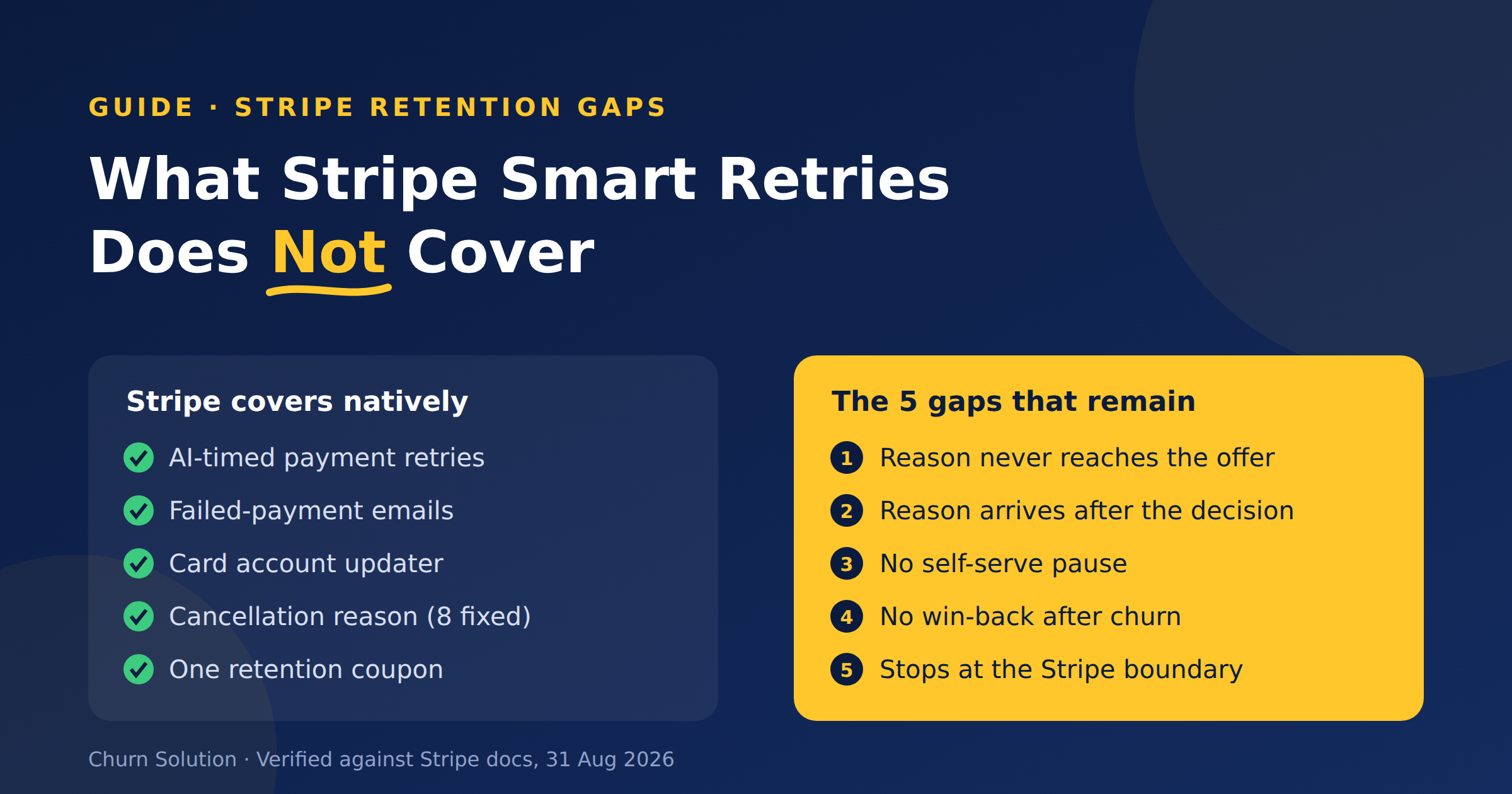
What Stripe Smart Retries Does Not Cover
Stripe Smart Retries recovers failed payments but doesn't run retention. Here are the five gaps that remain, sourced from Stripe's...

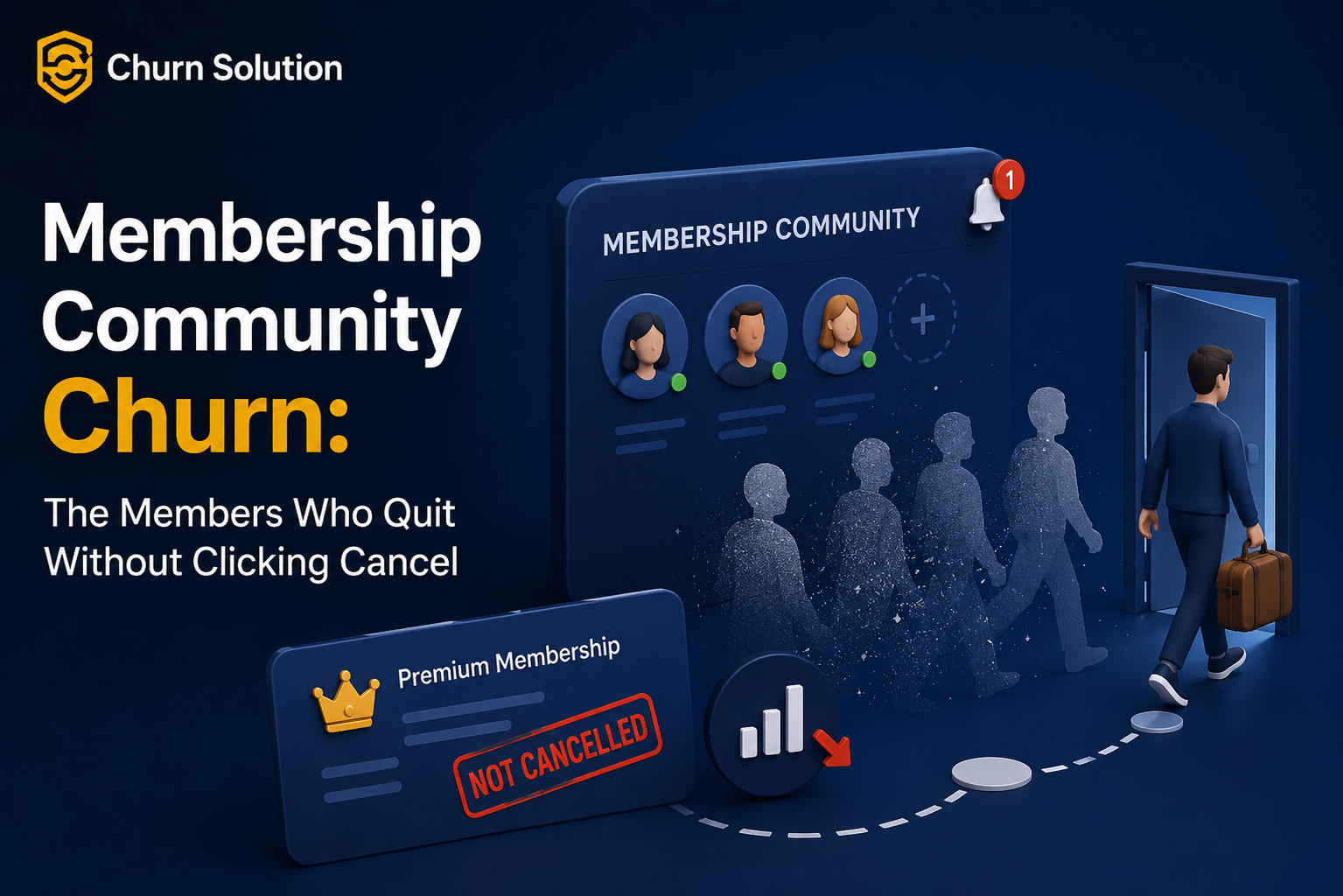
Membership Community Churn: The Members Who Quit Without Clicking Cancel
Quiet churn is the real leak: members who never clicked “cancel” at all. A card expires. A bank declines a...

Subscription Churn Dashboard: The 2026 Guide to Actionable Revenue Intelligence
Up to 40% of subscription churn is involuntary, meaning your customers aren't choosing to leave; they're being forced out by...