ARTICLE
Automated Retention Triggers: The 2026 Guide to Proactive Revenue Recovery

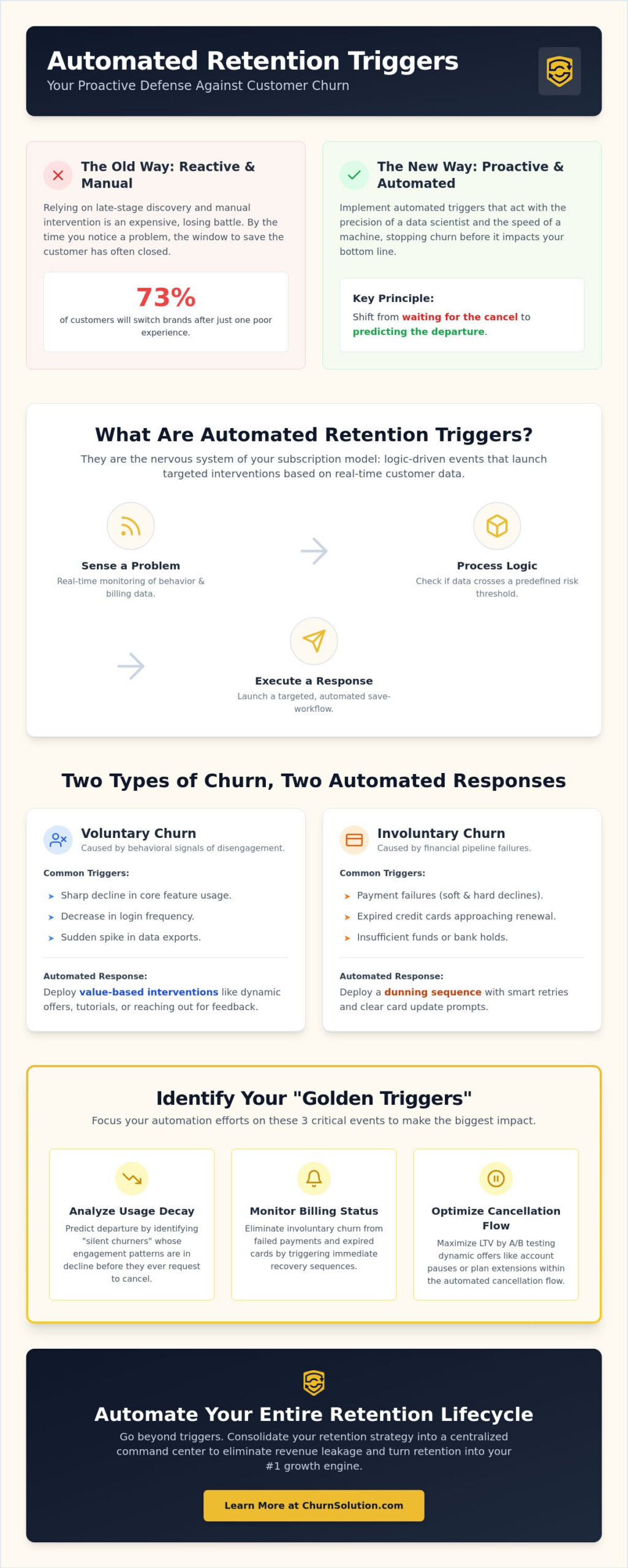
Effective retention isn’t about stopping a cancellation; it’s about automating the intervention the moment a user’s behavior deviates from success. You’ve likely felt the sting of discovering a high-value account has gone dark, only to realize the window to save them closed weeks ago. Manual churn management is an expensive, losing battle, and generic offers rarely convert when 73% of customers will switch brands after just one poor experience. Relying on late-stage realizations leads to preventable revenue leakage and wasted acquisition costs.
Implementing sophisticated automated retention triggers allows your system to act with the precision of a data scientist and the speed of a machine. This guide teaches you how to identify, configure, and deploy these triggers to stop churn before it impacts your bottom line. We will analyze the mechanics of behavioral alerts, failed payment recovery, and the deployment of dynamic offers to transform your retention strategy into a proactive growth engine. By the end of this article, you’ll have a roadmap for building a self-correcting ecosystem that secures your recurring revenue in a high-stakes market.
Key Takeaways
- Define automated retention triggers as logic-driven events that launch targeted interventions based on real-time customer behavior and billing data.
- Identify “golden triggers” by analyzing usage decay and billing status to predict customer departure before the cancellation request is ever made.
- Configure precise logic thresholds to ensure your save-workflows activate at the exact moment a user’s engagement patterns signal significant risk.
- Optimize your recovery strategy by A/B testing dynamic offers, such as account pauses or extensions, within automated cancellation flows to maximize lifetime value.
- Consolidate your retention lifecycle into a centralized command center to eliminate revenue leakage from failed payments and involuntary churn.
What Are Automated Retention Triggers? Redefining SaaS Churn Prevention
In the high-velocity world of SaaS, the term “retention” often suffers from a split identity. IT departments view it through the lens of compliance and data archival; however, for revenue leaders, it’s the bedrock of survival. Automated retention triggers are logic-based events that initiate specific save-workflows based on real-time customer data. Unlike document retention, which is a passive regulatory requirement, revenue-focused customer retention is an active, technological defense against churn. These triggers act as the nervous system of your subscription model. They sense a problem and execute a response before the customer even realizes they’re slipping away.
The industry is moving away from reactive post-mortems. Traditional churn analysis tells you why a customer left last month. That information arrives too late to protect your current quarter. Manual intervention is equally flawed. It lacks the scale required for high-growth models and relies on human teams to spot patterns in massive datasets. Automated triggers bridge this gap by transforming raw behavioral inputs into surgical interventions. This shift from waiting for the cancel to predicting the departure separates stagnant companies from those with compounding growth.
The Role of Triggers in the Modern Subscription Stack
Modern growth engines require a seamless connection between the billing engine and the retention layer. When you link platforms like Stripe or other enterprise billing providers to your retention system, triggers feed directly into customer churn metrics to provide real-time health scoring. This integration allows the system to monitor every account simultaneously. If a user’s health score drops below a specific threshold, the trigger fires an immediate response. This level of automation is essential for maintaining high Net Revenue Retention (NRR) and maximizing Lifetime Value (LTV). It ensures that your team focuses on high-level strategy while the machine handles the repetitive task of plugging revenue leaks.
Voluntary vs. Involuntary Churn Triggers
Effective automation requires a clear distinction between why people leave. Voluntary churn triggers identify behavioral signals that precede an active cancellation. These include a sharp decline in core feature usage, a decrease in login frequency, or a sudden spike in data exports. Involuntary churn triggers focus on the financial pipeline. They detect payment failures, expired credit cards, or insufficient funds before the subscription terminates. Each type of churn demands a distinct automated response. You don’t send a discount offer to a customer whose card simply expired; you deploy a dunning sequence. Conversely, a user showing signs of engagement decay needs a value-based intervention, not a billing reminder. Precision in your automated retention triggers ensures the right message reaches the right user at the exact moment of risk.
The Anatomy of a High-Performance Retention Trigger
High-performance automated retention triggers are not simple “if-then” statements. They are sophisticated architectural components consisting of three distinct layers: the data input, the logic processor, and the execution output. To be effective, these triggers must operate with zero latency. Batch-processed reports are historical artifacts. They tell you who you already lost. Real-time triggers tell you who is at risk right now. This speed allows for surgical precision in your intervention strategy. By deploying automated retention triggers at every critical junction, you replace manual guesswork with algorithmic certainty.
Sourcing High-Signal Data Events
High-signal data is the fuel for your retention engine. You must integrate with platforms like Segment or Mixpanel to capture granular product usage events. This includes tracking “silent churners”. These are users who haven’t canceled their subscription but have stopped deriving value from the software. Beyond behavioral data, you must source billing events. For instance, leveraging smart retries serves as a critical trigger for payment recovery sequences. By identifying a soft decline immediately, the system can initiate a dunning flow before the service is interrupted.
Defining Logic Thresholds for Intervention
The logic layer determines the significance of a data event. Setting thresholds requires a balance. Too sensitive, and you cause “trigger fatigue” with unnecessary notifications. Too loose, and you miss the window of opportunity. Use customer segmentation to vary sensitivity. An Enterprise account seeing a 20% drop in usage is a code-red event. A Prosumer account might fluctuate more naturally. This logic often mirrors findings from a systematic review of churn prediction models, which highlights how machine learning identifies non-linear patterns in user decay.
Once the logic validates a risk, the action output executes the save-workflow. This could mean launching a cancellation flow for a user hitting the “cancel” button or deploying a dynamic offer to a user showing engagement decay. The goal is a seamless transition from detection to resolution. The importance of latency cannot be overstated. A delay of 24 hours in triggering a dunning email can be the difference between a successful recovery and a permanent loss. High-performance systems process events in milliseconds. They connect the problem to the mechanism and produce the desired outcome without human intervention. If you are ready to stop guessing and start recovering revenue, you can get started with a free trial to see these triggers in action.
Identifying Your “Golden Triggers”: 3 Critical Events to Automate
Maximizing revenue recovery requires more than broad monitoring; it demands a focus on “Golden Triggers.” These are high-signal events that correlate directly with a customer’s decision to stay or leave. By prioritizing these specific automated retention triggers, you focus your technical resources on the interventions that yield the highest ROI. Effective systems move beyond simple login tracking to analyze the depth of product interaction and the health of the financial pipeline. You must treat every behavioral shift as a data point that either confirms loyalty or signals an imminent departure.
Usage Decay: The Leading Indicator of Churn
The most reliable predictor of voluntary churn is the erosion of product value. Tracking “Core Action” completion rates provides a real-time health signal that is far more accurate than simple login frequency. If a user stops performing the primary tasks that justify their subscription, they’ve already begun the psychological process of checking out. Usage decay is the most accurate predictor of voluntary churn. Setting automated retention triggers for “Time Since Last Login” allows you to initiate re-engagement loops before the user reaches the point of no return. These loops should deliver specific value reminders or educational content designed to bridge the gap between their current usage and the product’s full potential.
Exit Intent: Capturing the Moment of Truth
The moment a user navigates toward the “Billing” or “Cancel” page, the window for intervention narrows to seconds. Detecting these navigation patterns is a critical intent-based trigger. You can deploy exit surveys at this exact moment to capture qualitative data while the user is still on the platform. This immediate feedback serves as a trigger for dynamic save offers tailored to the user’s specific reason for leaving. By linking this intent data to ai churn feedback analysis, you transform raw exit data into actionable revenue recovery strategies. This approach ensures that your response is not a generic discount but a calculated counter-offer based on the user’s stated pain points.
Billing and Sentiment Triggers
Involuntary churn often happens quietly through card expirations or insufficient funds. Billing-based triggers automate the recovery process by initiating dunning sequences the moment a payment fails. This prevents service interruptions that might otherwise lead a customer to reconsider the value of the subscription. Simultaneously, sentiment-based triggers use AI to monitor support tickets and social channels for negative feedback. Flagging a frustrated customer early allows for a proactive reach-out. These combined triggers ensure that your retention layer is comprehensive, covering both the behavioral and financial risks that threaten your bottom line.
Strategic Implementation: Deploying Triggers Without Friction
Strategic implementation requires more than just technical setup. It demands a deep understanding of the customer journey to identify the exact moments where an intervention feels helpful rather than intrusive. By mapping these touchpoints, you ensure your automated retention triggers fire with contextual relevance. A trigger that offers a discount to a user who is frustrated with a technical bug won’t save the account; it will likely accelerate their departure by appearing tone-deaf. You must align the trigger’s logic with the user’s specific friction point to maintain trust and authority.
Refinement is a continuous process. You can’t assume a standard discount is the optimal response for every segment. Utilizing ab experiments allows you to test various responses against each other. Does an account pause perform better than a one-month extension for seasonal users? Data-driven testing replaces intuition with proof. This iterative approach ensures that your retention stack evolves alongside your customer base. For high-value Enterprise accounts, the trigger shouldn’t just send an automated email. It should notify a human CSM to intervene personally, ensuring a seamless handoff between automation and high-touch service.
Personalizing the Intervention with Dynamic Offers
Generic retention offers are revenue killers. They train your customers to threaten cancellation just to receive a discount. Instead, use dynamic offers to match the save strategy to the specific churn reason identified by the trigger. If the trigger detects a lack of usage, offer a free training session or a feature walkthrough. If it’s a billing failure, focus on the recovery sequence. This surgical approach protects your margins while demonstrating a genuine understanding of the customer’s needs. One-size-fits-all offers often backfire because they fail to address the root cause of the dissatisfaction.
Measuring Trigger Success and ROI
You cannot optimize what you don’t measure. Tracking the “Save Rate” and “Revenue Recovered” per trigger type provides a clear picture of which automated retention triggers are performing. You must also analyze the long-term LTV of saved customers. A saved customer who churns three months later is less valuable than one who remains for another year. Linking these results back to your broader customer churn analysis allows you to see the aggregate impact on your bottom line. This data proves the ROI of your retention efforts to stakeholders and justifies further investment in automation technology. If you’re ready to deploy these strategies and stop revenue leakage, create your free account today.
How Churn Solution Automates the Entire Retention Lifecycle
Fragmentation is the enemy of revenue recovery. When your usage data lives in one silo and your billing data in another, your defense against churn remains reactive and incomplete. Churn Solution eliminates this friction by consolidating disparate data points into a single “Retention Command Center.” This centralized intelligence layer allows you to deploy automated retention triggers that monitor the entire customer lifecycle in real time. By unifying behavioral signals with financial status, the system identifies risk with surgical precision and executes the exact save-workflow required to protect your bottom line.
Eliminating involuntary churn is a primary objective for any high-growth subscription business. Our platform utilizes automated payment recovery triggers to address failed transactions the millisecond they occur. Instead of relying on rigid, one-size-fits-all dunning schedules, the system analyzes the failure reason and initiates a targeted recovery sequence. This proactive approach ensures that credit card expirations or temporary bank declines don’t result in permanent revenue loss. We also bridge the gap for customers who have already departed. By closing the loop with automated reactivation campaigns, the platform targets lapsed subscribers with personalized win-back offers based on their historical usage patterns.
The Churn Solution Advantage: Intelligence Over Automation
Most tools offer simple “if-this-then-that” logic. Churn Solution goes deeper by integrating sophisticated feedback analysis into every trigger. This adds a layer of qualitative intelligence to your quantitative data. Our platform integrates seamlessly with your existing billing and CRM stack, which significantly reduces the engineering burden of building in-house automated retention triggers. You get a high-performance retention infrastructure without the months of development time usually required to sync disparate APIs and data warehouses.
Getting Started: Your 30-Day Revenue Protection Roadmap
Protecting your revenue doesn’t require an overnight overhaul. Follow this structured roadmap to see immediate results:
- Step 1: Audit. Analyze your current churn signals and billing data to identify where revenue leakage is most severe.
- Step 2: Deploy. Activate Churn Solution’s automated cancellation flows to capture exit intent and deploy immediate save offers.
- Step 3: Refine. Use continuous A/B testing to optimize your interventions and maximize the lifetime value of every account.
The stakes of the subscription economy are too high for manual intervention. You need a system that works while you sleep to identify, engage, and recover every at-risk dollar. Protect your subscription revenue with automated retention triggers today.
Master the Science of Proactive Revenue Recovery
The evolution of the subscription economy demands a move away from manual save attempts. You’ve explored how automated retention triggers transform raw data into a high-performance defense mechanism. By unifying behavioral insights with billing intelligence, you stop revenue leakage at the source. This systematic approach ensures every at-risk customer receives a calculated, surgical intervention that prioritizes long-term lifetime value over short-term fixes.
Churn Solution provides the infrastructure to execute this vision with precision. Our platform delivers AI-driven feedback analysis and seamless Stripe integration to ensure your retention layer operates without friction. By deploying these tools, businesses can recover up to 30% of canceling subscribers and turn qualitative exit data into a measurable growth engine. The era of reactive churn management is over; it’s time to empower your business with automated revenue recovery.
Frequently Asked Questions
What is an example of an automated retention trigger for SaaS?
A primary example is a 40% decline in core feature usage over a 14 day period. This behavioral event signals high churn risk and automatically fires a re-engagement sequence or a value-based offer. By detecting this decay early, the system intervenes before the customer reaches the point of active cancellation. This logic ensures your team focuses on recovery efforts where they are most likely to succeed.
How do retention triggers differ from standard marketing automation?
Standard marketing automation typically focuses on top-of-funnel acquisition and lead nurturing. In contrast, automated retention triggers are specialized for revenue protection and churn mitigation. They react to negative behavioral signals or billing failures rather than positive engagement milestones. These triggers operate within the retention layer of your stack to secure existing revenue through precise, event-driven logic.
Can I use automated triggers to reduce involuntary churn from failed payments?
Yes. These triggers are essential for managing payment failures like expired cards or insufficient funds. The system detects a failed transaction in real time and immediately initiates a dunning sequence or a smart retry attempt. This automation eliminates the manual effort of chasing failed payments and prevents service interruptions that often lead to voluntary churn. It’s a critical mechanism for maintaining stable monthly recurring revenue.
Do automated retention triggers require a lot of engineering resources to set up?
No. While building a custom solution in-house is resource-heavy, modern platforms integrate directly with your billing engine to simplify the process. By connecting to Stripe or other enterprise payment gateways, you can deploy sophisticated automated retention triggers without draining your development roadmap. This approach allows growth and success teams to manage retention logic independently of the core engineering team.
Will automated save offers hurt my brand reputation or feel pushy?
Not if the offers are dynamic and contextually relevant. Pushy experiences stem from generic, one-size-fits-all discounts that ignore the user’s actual pain points. When you use data-driven triggers to match an offer to a specific churn reason, the intervention feels like a personalized concierge service. Precision prevents your brand from appearing desperate and instead reinforces the value of your software.
How do I measure the effectiveness of my automated retention triggers?
Measure success through the “Save Rate” and the total “Revenue Recovered” per trigger type. You should also analyze the long-term Lifetime Value (LTV) of saved customers compared to your broader user base. This data proves whether your interventions are securing high-quality accounts or merely delaying a permanent departure. Tracking these metrics allows you to refine your logic thresholds for maximum ROI.
Can I integrate these triggers with Stripe or other billing platforms?
Deep integration with billing engines like Stripe and other leading subscription platforms is a standard requirement for high-performance systems. This connection allows the retention layer to pull real-time payment data and push subscription updates back to the billing engine. A seamless integration ensures that when a customer accepts a save offer, their account status and billing cycle are updated instantly without human intervention.
- Key Takeaways
- Table of Contents
- What Are Automated Retention Triggers? Redefining SaaS Churn Prevention
- The Anatomy of a High-Performance Retention Trigger
- Identifying Your "Golden Triggers": 3 Critical Events to Automate
- Strategic Implementation: Deploying Triggers Without Friction
- How Churn Solution Automates the Entire Retention Lifecycle
- Master the Science of Proactive Revenue Recovery
- Frequently Asked Questions

Churn solution that turns your customers right around.
Related Articles
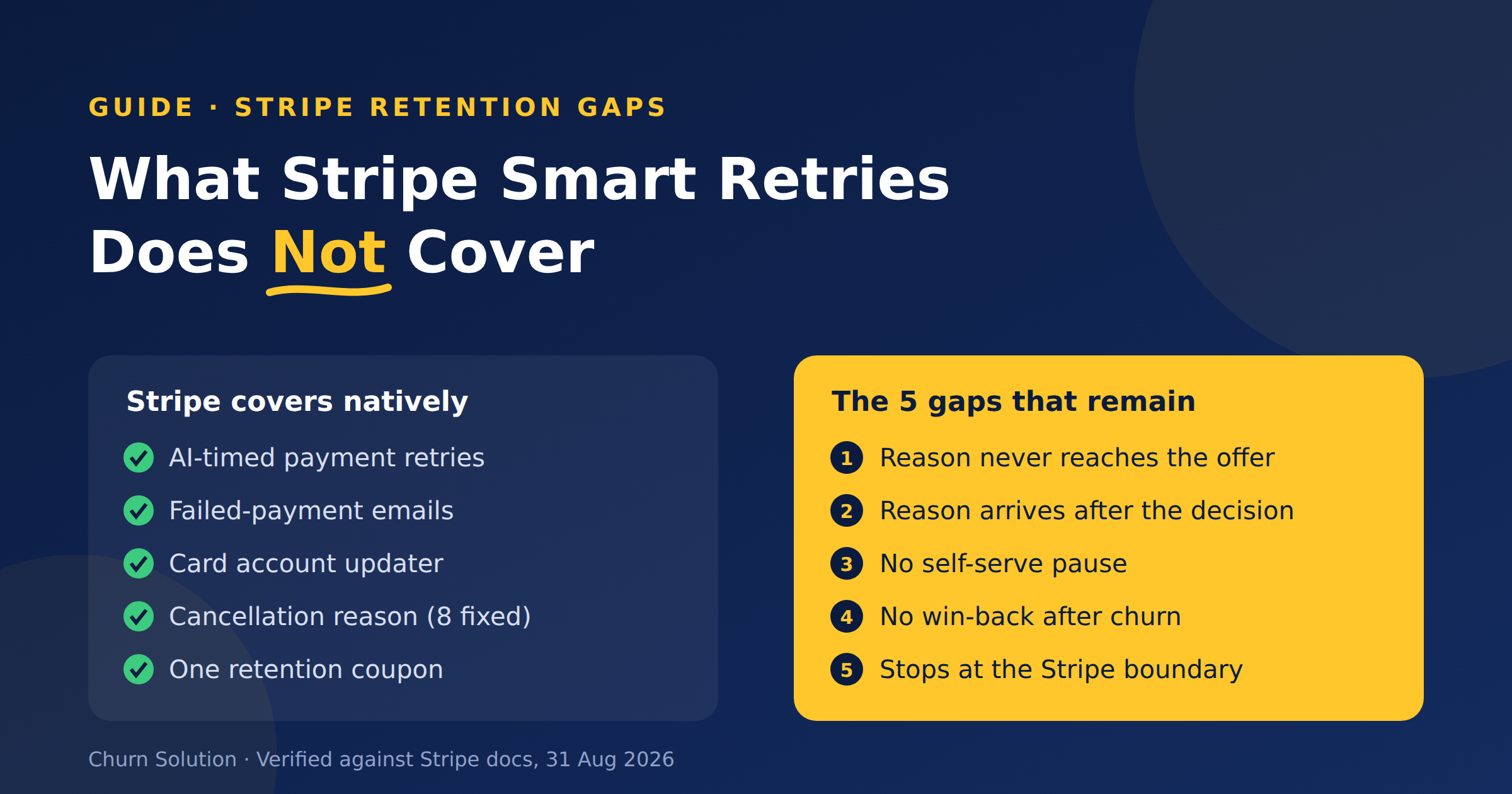
What Stripe Smart Retries Does Not Cover
Stripe Smart Retries recovers failed payments but doesn't run retention. Here are the five gaps that remain, sourced from Stripe's...

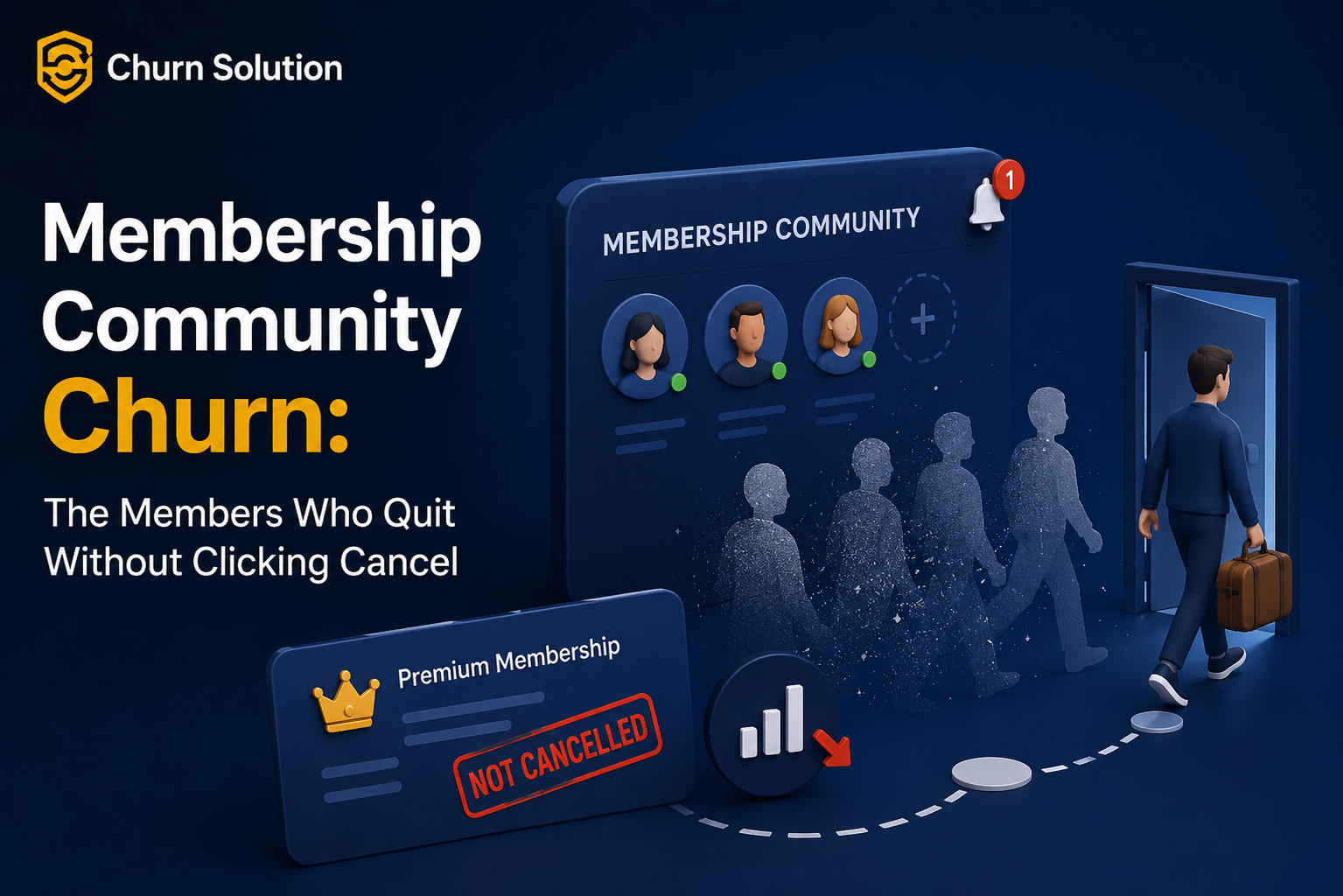
Membership Community Churn: The Members Who Quit Without Clicking Cancel
Quiet churn is the real leak: members who never clicked “cancel” at all. A card expires. A bank declines a...

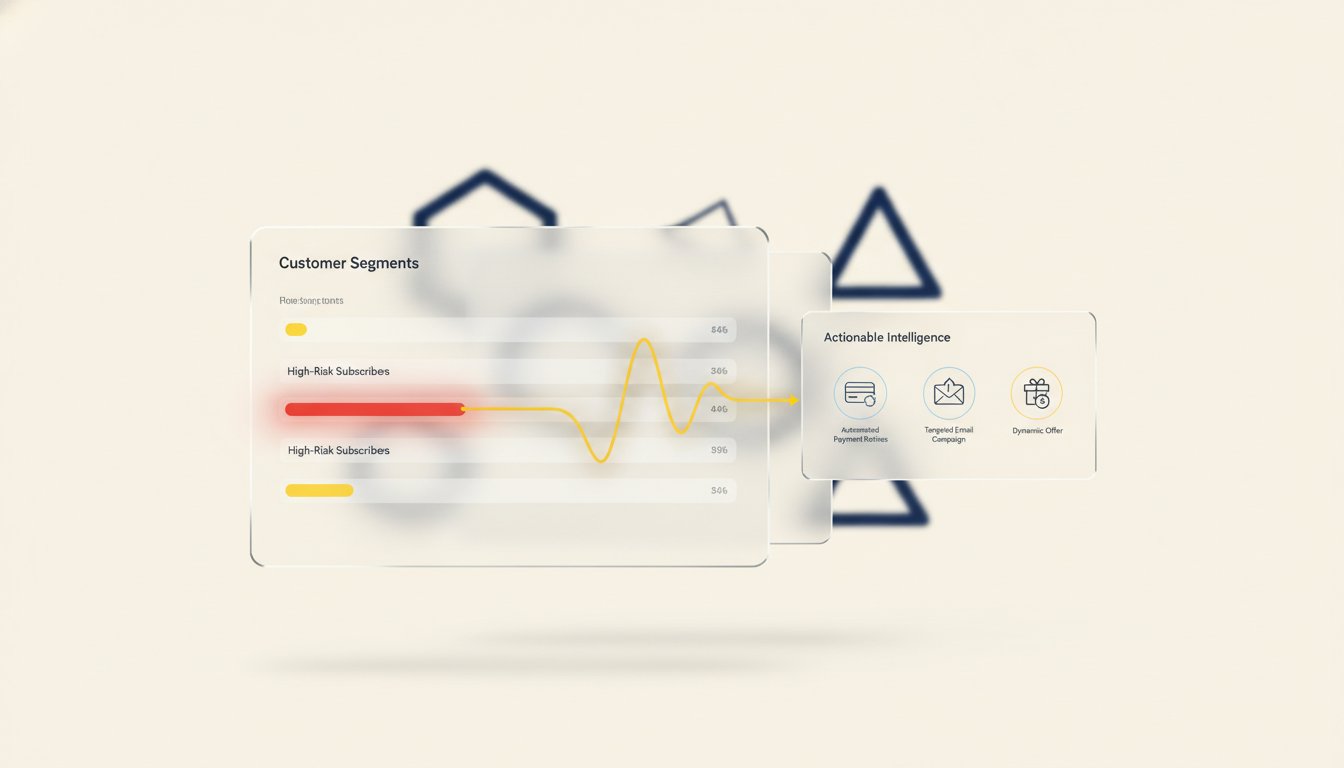
Subscription Churn Dashboard: The 2026 Guide to Actionable Revenue Intelligence
Up to 40% of subscription churn is involuntary, meaning your customers aren't choosing to leave; they're being forced out by...