ARTICLE
SaaS Retention Strategies: The 2026 Resource Guide for Revenue Growth

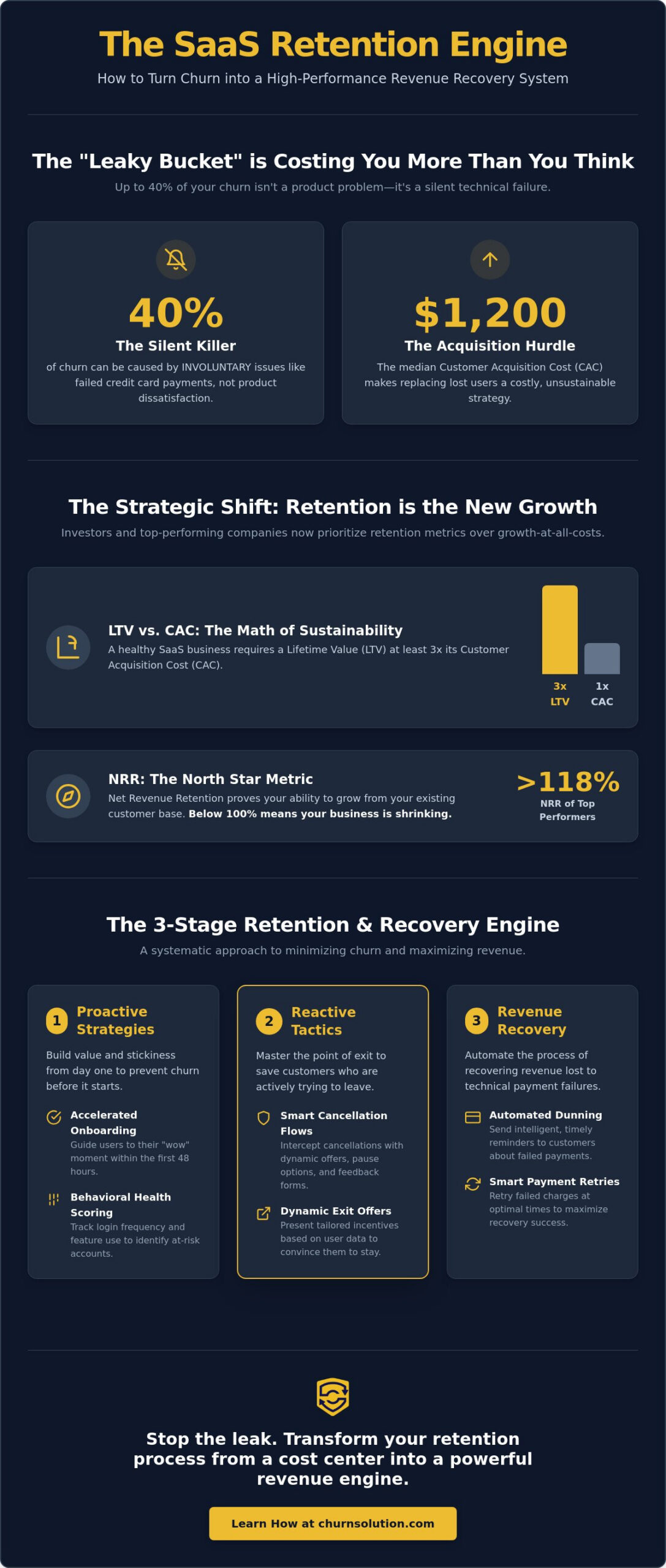
Up to 40% of your churn isn’t a product problem; it’s a silent technical failure that’s eroding your valuation. When failed credit card payments and unoptimized cancellation flows go unchecked, your hard-earned MRR vanishes before it even hits your bank account. Implementing sophisticated saas retention strategies is no longer optional when Customer Acquisition Costs (CAC) have climbed to a median of $1,200. You know that every lost user is a direct hit to your bottom line, yet manual outreach and generic emails simply won’t stop the bleed.
This resource guide empowers you to master the tactical frameworks and automated systems required to slash churn and maximize your Net Revenue Retention (NRR). We’ll show you how to move beyond guesswork and gain total control over your business outcomes through technical precision. We explore how to deploy smart retries, AI feedback analysis, and dynamic offers to turn at-risk accounts into long-term expansion opportunities. You’re about to learn how to transform your retention process from a passive goal into a high-performance revenue recovery engine that drives sustainable growth in 2026.
Key Takeaways
- Quantify the “leaky bucket” effect to understand why retention is the most critical driver of valuation and long-term MRR growth in 2026.
- Accelerate Time-to-Value (TTV) by integrating behavioral triggers and high-touch onboarding sequences that preemptively address user friction.
- Implement sophisticated saas retention strategies such as automated cancellation flows and dynamic offers to intercept churn at the point of exit.
- Recover up to 40% of lost revenue by deploying smart retries and automated dunning systems designed to solve involuntary payment failures.
- Establish a continuous optimization loop using granular churn metrics to benchmark performance and ensure your retention systems evolve with market demands.
The Strategic Shift: Why SaaS Retention is the Primary Growth Lever in 2026
Growth at all costs has reached its expiration date. In a saturated market where median Customer Acquisition Cost (CAC) has hit $1,200, pouring more capital into the top of your funnel while ignoring a “leaky bucket” is a mathematical suicide mission. Consider the physics of a 5% monthly churn rate. To achieve a 50% annual growth rate, your sales team must actually generate over 110% in new revenue just to offset the loss. This reality forces a fundamental shift in how we view saas retention strategies.
Retention isn’t a “customer happiness” initiative; it’s a technical revenue recovery system. Leading organizations are reclassifying customer success from a support function into a core revenue protection unit. This isn’t about being friendly. It’s about securing the bottom line. Customer retention is now the primary driver of enterprise valuation, as investors prioritize efficient, predictable growth over high-burn acquisition. If you aren’t protecting the revenue you’ve already won, you’re effectively subsidizing your competitors.
LTV vs. CAC: The Math of Sustainability
The math of SaaS health remains rooted in the LTV/CAC ratio. A 3:1 ratio is the absolute floor for sustainability. When retention improves, the Lifetime Value (LTV) increases without any corresponding increase in acquisition spend. This creates a compounding effect where every dollar saved generates exponential returns over the customer lifecycle. The Retention Compound Effect is the mathematical phenomenon where marginal gains in customer longevity produce geometric growth in cumulative revenue. By optimizing for stay-time, you turn a linear sales process into a self-sustaining growth engine.
NRR as the North Star Metric
Net Revenue Retention (NRR) has surpassed MRR as the most critical metric for securing venture capital. While Gross Churn tells you how many people left, Net Revenue Retention proves whether your product-market fit is deep enough to drive expansion. You must differentiate between Gross vs. Net Churn to identify exactly where your revenue is leaking. In 2026, top-performing enterprise SaaS companies maintain an NRR above 118%, primarily by using expansion revenue to neutralize unavoidable churn. If your NRR is below 100%, your business is shrinking from the inside out. Stop the leak before you try to fill the bucket.
Proactive SaaS Retention Strategies: Building Value Before the Churn Signal
Waiting for a cancellation request before taking action is a tactical failure. Professional saas retention strategies begin the moment a user signs up. You must implement high-touch onboarding sequences designed to minimize Time-to-Value (TTV). If a user doesn’t achieve their first “wow” moment within the initial 48 hours, the statistical probability of churn increases. High-performing teams use this window to drive feature adoption and establish a consistent workflow rhythm.
Building stickiness requires more than just a stable product; it demands deep integration into the customer’s existing ecosystem. When your platform becomes the central repository for their data or the primary engine for their daily operations, the cost of switching becomes a significant barrier to exit. This is why driving users toward advanced features and API integrations is a fundamental retention tactic. These proactive saas retention strategies ensure your product remains indispensable long before the renewal date approaches.
Behavioral Triggers and Health Scoring
Data acts as your early warning system. You must track specific metrics like login frequency, feature depth, and seat utilization. A sudden drop in these indicators is a clear churn signal. Utilize customer segmentation to categorize accounts by health score. Seat utilization is a primary indicator of account health. If a company pays for 50 seats but only 10 users log in, they are a prime candidate for a downgrade or total cancellation. Automated alerts allow your success team to intervene before the customer even considers the cancel page.
Expansion and Value Realization
The “Value Gap” represents the distance between a customer’s current usage and the full potential of your platform. You bridge this gap with educational content that targets specific underutilized features. Education should be personalized. If a user hasn’t tried your latest automation tool, trigger a walkthrough that demonstrates how it saves them time. Strategic upselling should be a data-driven response to increased demand. When a user approaches their seat or data limits, offering a higher tier solves a bottleneck rather than just pushing a sale. Automated triggers prevent voluntary churn by re-engaging users with relevant content the moment their activity levels dip.
You can start mapping these triggers to protect your MRR today.
Reactive Save Tactics: Mastering the Cancellation Flow and Exit Intent
The moment a user clicks “Cancel Subscription” is not the end of the relationship; it is a critical pivot point for your saas retention strategies. Treating this action as a finality is a fundamental UI failure that ignores the psychology of the exit. Users often cancel due to temporary friction, budget shifts, or perceived lack of value. An immediate, one-click exit provides no data and offers no path to recovery. Effective saas retention strategies require a transition from passive acceptance to active intervention at the point of exit. Treat the exit as a negotiation. You must implement a structured, automated cancellation flow that intercepts the intent and negotiates a save.
High-performance flows personalize the experience based on user data and tenure. If a long-term customer attempts to leave, the system should acknowledge their history and offer a “Pause” option. Pausing a subscription maintains the customer relationship and data integrity while providing the user with a low-friction alternative to a hard churn. This keeps the door open for reactivation without the high cost of re-acquisition. It’s about maintaining the connection even when the billing stops. Deploying dedicated voluntary churn reduction software ensures these flows are automated, personalized, and continuously optimized to intercept departures before they become permanent losses.
Exit Surveys and AI Feedback Analysis
Actionable intelligence starts with capturing the “why” behind the departure. By deploying exit surveys at the point of cancellation, you transform anecdotal complaints into structured data. It isn’t enough to know they left; you need to know if it was due to price, missing features, or poor performance. Use feedback analysis to aggregate these responses into clear product roadmap priorities. This technical approach turns a lost customer into a diagnostic tool for systemic improvement.
Dynamic Save Offers
A generic discount often erodes margin without addressing the core issue. Instead, deploy dynamic offers tailored to the specific churn reason identified in the survey. If the issue is budget, a temporary discount or free credit might bridge the gap. If the issue is feature-related, a free trial of a higher tier might demonstrate the missing value. Calculating the ROI of a discount is essential; saving a customer at a reduced margin is nearly always more profitable than losing the account entirely. Utilize A/B experiments to test different offer structures and find the exact “sweet spot” that maximizes retention without sacrificing unnecessary revenue.
Recovering Leaked Revenue: Automated Dunning and Payment Success
Involuntary churn is the silent killer of MRR. While voluntary cancellations often receive the most attention, failed payments account for 20% to 40% of all SaaS churn according to Data-Mania research from June 2026. This isn’t a product-market fit problem; it’s a technical leak. Every time a credit card fails due to an expired date or a soft decline, you lose a customer who still intended to remain active. High-performance saas retention strategies must prioritize the recovery of this leaked revenue through technical automation rather than manual outreach.
The solution lies in the logic of smart retries. Instead of retrying a card at random intervals, you must time attempts to match banking cycles and historical success data. This technical precision ensures you hit the account when funds are most likely available. You also need to reduce friction in the update process. If a customer has to navigate a complex login sequence just to update their card, they might decide it’s easier to let the subscription lapse. A secure customer portal that allows for direct updates is essential for maintaining continuity.
The Mechanics of Payment Recovery
Effective payment recovery systems handle expired cards and soft declines behind the scenes. You should aim for “Invisible Recovery” or pre-dunning. This involves using card account updaters to refresh details before a transaction even fails. Smart Retries represent a data-driven approach to transaction success by optimizing the timing and frequency of billing attempts. This proactive layer prevents the user from ever seeing a “payment failed” notification, preserving the brand experience while securing your cash flow.
Dunning Email Best Practices
When invisible recovery fails, your dunning email sequence becomes the final line of defense. A standard 3-stage sequence is most effective:
- The Reminder: A low-pressure notification sent immediately after the first failure.
- The Urgency: A second notice sent 3 to 5 days later, highlighting the risk of service interruption.
- The Final Notice: A firm communication stating that access will be revoked within 24 hours.
Each email must include direct-to-update links. Eliminating login hurdles during the payment fix is the single most effective way to improve recovery rates. Maintain an “Expert Partner” persona; your tone should be helpful yet firm, emphasizing that you want to prevent a disruption in their business operations. You can automate your dunning recovery today to stop losing revenue to technical failures.
The Retention Optimization Loop: Testing and Iterating for Growth
Retention isn’t a “set and forget” project. It’s a continuous technical loop that requires constant refinement to stay ahead of market shifts. Sophisticated saas retention strategies rely on a feedback cycle where data from every exit informs the next proactive intervention. You must utilize granular churn metrics to benchmark your performance against the 2026 industry median of 3.5% annual churn. If your metrics lag, the problem likely exists in the gap between your product’s promise and its daily utility.
Building a “Retention Culture” is the final step in securing your revenue. This isn’t just a task for the Success team. Product teams must use feedback to close feature gaps; Sales teams should focus on acquiring high-fit customers who are less likely to churn. When every department takes ownership of Net Revenue Retention (NRR), the entire organization moves from reactive firefighting to proactive growth. This cross-functional alignment ensures that your retention engine is powered by every customer interaction.
Winning Back the Lost: Reactivation Strategy
A lapsed user is often your most cost-effective source of “new” revenue. You should deploy reactivation sequences at 30, 60, and 90-day intervals following a churn event. These subscription win-back campaigns should focus on what has changed since they left. If a user cited a missing feature in their exit survey, target them with an announcement when that feature goes live. This transforms a previous failure into a demonstration of product evolution. Treat these campaigns as a low-CAC acquisition channel that leverages existing brand awareness.
A/B Testing Your Save Logic
Your save offers shouldn’t be based on intuition. You must use A/B experiments to validate your logic. Test whether a 30-day pause duration performs better than a 20% discount for specific user segments. Evaluate the impact of survey length on completion rates; sometimes a single, well-placed question yields more actionable data than a long-form survey. Continuous testing allows you to find the exact configuration that maximizes saves while protecting your margins. Protect your revenue with Churn Solution’s automated retention suite and turn your churn data into a competitive advantage.
Secure Your Revenue Engine for 2026 and Beyond
Maximizing Net Revenue Retention requires a fundamental shift from passive observation to technical intervention. You’ve learned how integrating behavioral triggers and high-touch onboarding can preempt voluntary churn before it ever reaches the cancellation page. You also understand that a significant portion of revenue loss is actually a technical failure. This is solvable through precision dunning and smart retries. Implementing these sophisticated saas retention strategies isn’t just about keeping customers; it’s about protecting the valuation and long-term viability of your entire enterprise.
By deploying AI-driven feedback analysis and dynamic save offers that protect margins, you transform every exit attempt into a data-driven opportunity for recovery. The era of manual “save” attempts is over. It’s time to leverage automation to ensure your growth is both predictable and sustainable. You have the tools to turn your churn data into a competitive advantage and secure your cash flow against market volatility. Your path to superior performance starts with a single automated workflow.
Stop the leak and protect your MRR with Churn Solution. Start optimizing your retention systems today to ensure your business remains a leader in the subscription economy.
Frequently Asked Questions
What is the difference between voluntary and involuntary churn?
Voluntary churn occurs when a customer actively decides to terminate their subscription, often due to price sensitivity, missing features, or a perceived lack of value. Involuntary churn is a silent revenue killer caused by technical payment failures, such as expired credit cards or soft declines. While voluntary churn requires product and success interventions, involuntary churn is a technical leak that you must solve through automated recovery systems and smart retry logic.
How much can a cancellation flow realistically reduce churn?
A sophisticated, automated cancellation flow can realistically reduce your churn rate by 15% to 30% by intercepting users at the point of exit. Instead of allowing a one-click cancellation, these systems present dynamic offers or alternatives tailored to the user’s specific reason for leaving. This technical negotiation transforms a certain loss into a saved account, directly protecting your MRR and improving overall saas retention strategies.
Is it better to offer a discount or a “pause” option to a cancelling user?
Providing a “pause” option is generally superior to a discount because it preserves your profit margins and maintains the customer’s data integrity. Pausing allows users to suspend billing during temporary budget freezes or seasonal shifts without devaluing your service. While discounts can be effective for price-sensitive segments, they should be used strategically through A/B testing to ensure you aren’t sacrificing revenue unnecessarily.
What is a good Net Revenue Retention (NRR) rate for a B2B SaaS?
In the current market, a median Net Revenue Retention (NRR) of 106% is the standard benchmark for healthy B2B SaaS companies. Top-performing organizations, particularly those in the enterprise sector, often achieve NRR figures exceeding 130%. Maintaining a high NRR is critical because it proves your product’s ability to generate expansion revenue, which is a primary driver for securing venture capital and high valuations.
How many dunning emails should be sent before a subscription is cancelled?
The optimal dunning sequence typically consists of three to four emails sent over a 14 to 21-day grace period. Your first email should be a helpful reminder, followed by a message of increased urgency, and finally a notice of service suspension. This structured approach provides multiple opportunities for the customer to update their payment details while maintaining a professional and authoritative brand persona throughout the friction point.
Can I reduce churn without offering any discounts?
You can effectively reduce churn without lowering your prices by focusing on feature adoption and proactive value realization. By identifying “at-risk” accounts through behavioral triggers, your team can intervene with educational content that helps users bridge the “Value Gap.” Strengthening your onboarding process and ensuring users reach their “wow” moment quickly are essential saas retention strategies that drive loyalty through performance rather than price cuts.
What are smart retries and how do they work with Stripe?
Smart retries are automated attempts to process failed payments at times when they are statistically most likely to succeed based on banking cycles. While platforms like Stripe offer basic retry logic, advanced retention tools use machine learning to optimize these attempts for specific card types and regions. This technical precision significantly increases the recovery of involuntary churn by bypassing temporary soft declines without requiring user intervention.
How do I calculate the ROI of my customer retention software?
To calculate the ROI of your retention software, divide the total revenue recovered through automated dunning and saved cancellations by the total cost of the platform. You should also factor in the saved Customer Acquisition Cost (CAC) that would have been required to replace those lost users. A high-performance system typically pays for itself within the first few months by plugging revenue leaks that would otherwise go unaddressed.
- Key Takeaways
- Table of Contents
- The Strategic Shift: Why SaaS Retention is the Primary Growth Lever in 2026
- Proactive SaaS Retention Strategies: Building Value Before the Churn Signal
- Reactive Save Tactics: Mastering the Cancellation Flow and Exit Intent
- Recovering Leaked Revenue: Automated Dunning and Payment Success
- The Retention Optimization Loop: Testing and Iterating for Growth
- Secure Your Revenue Engine for 2026 and Beyond
- Frequently Asked Questions

Churn solution that turns your customers right around.
Related Articles
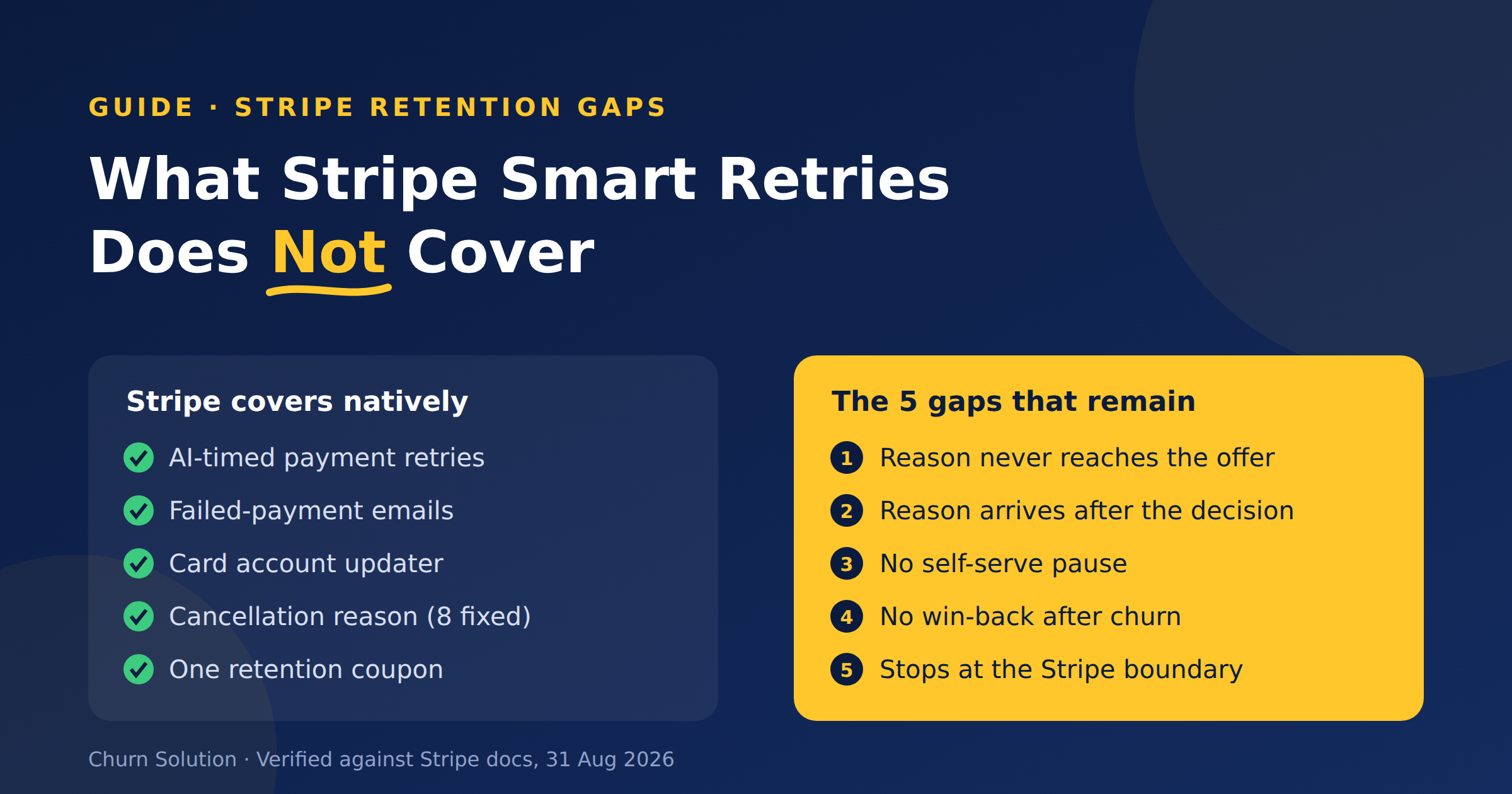
What Stripe Smart Retries Does Not Cover
Stripe Smart Retries recovers failed payments but doesn't run retention. Here are the five gaps that remain, sourced from Stripe's...

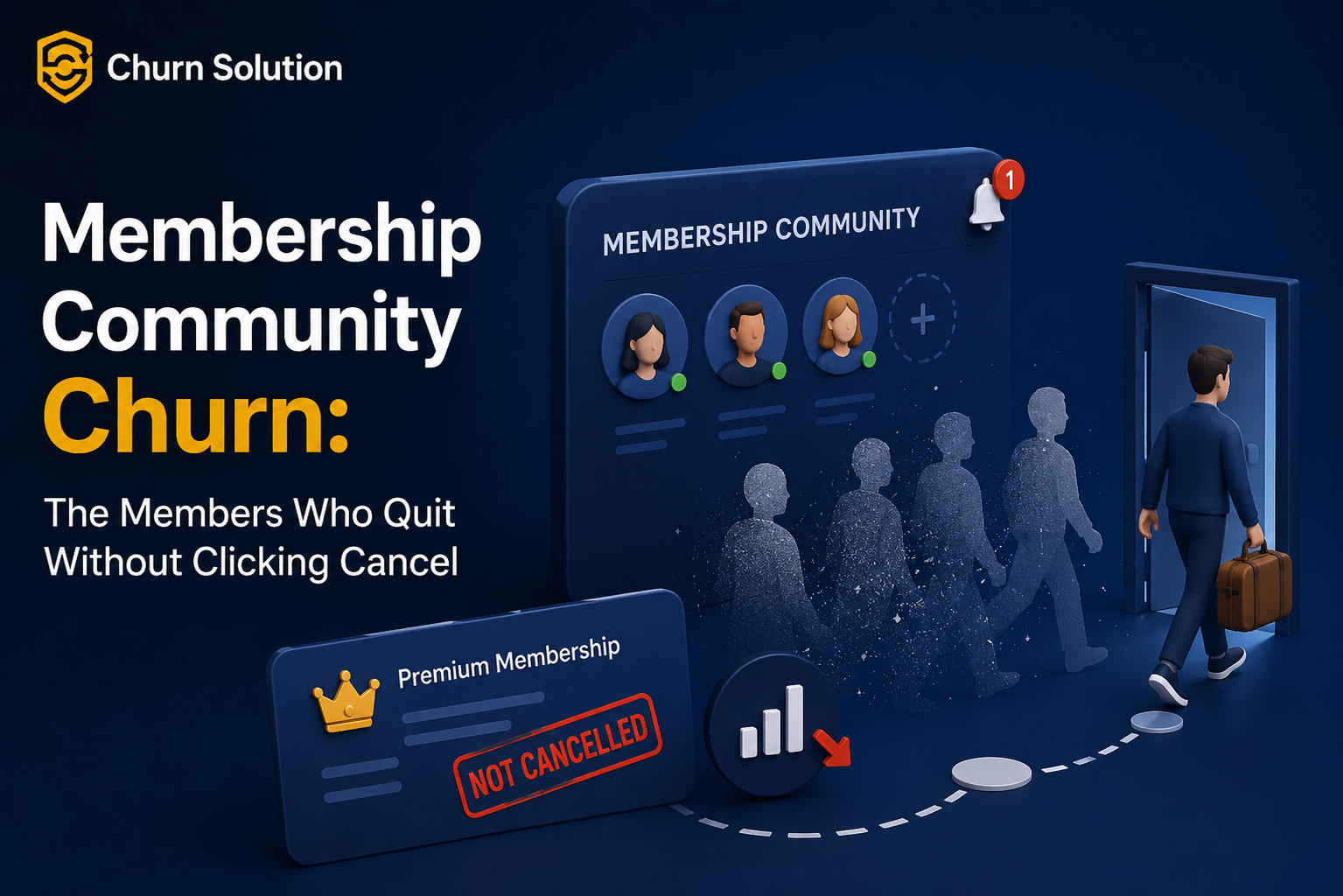
Membership Community Churn: The Members Who Quit Without Clicking Cancel
Quiet churn is the real leak: members who never clicked “cancel” at all. A card expires. A bank declines a...

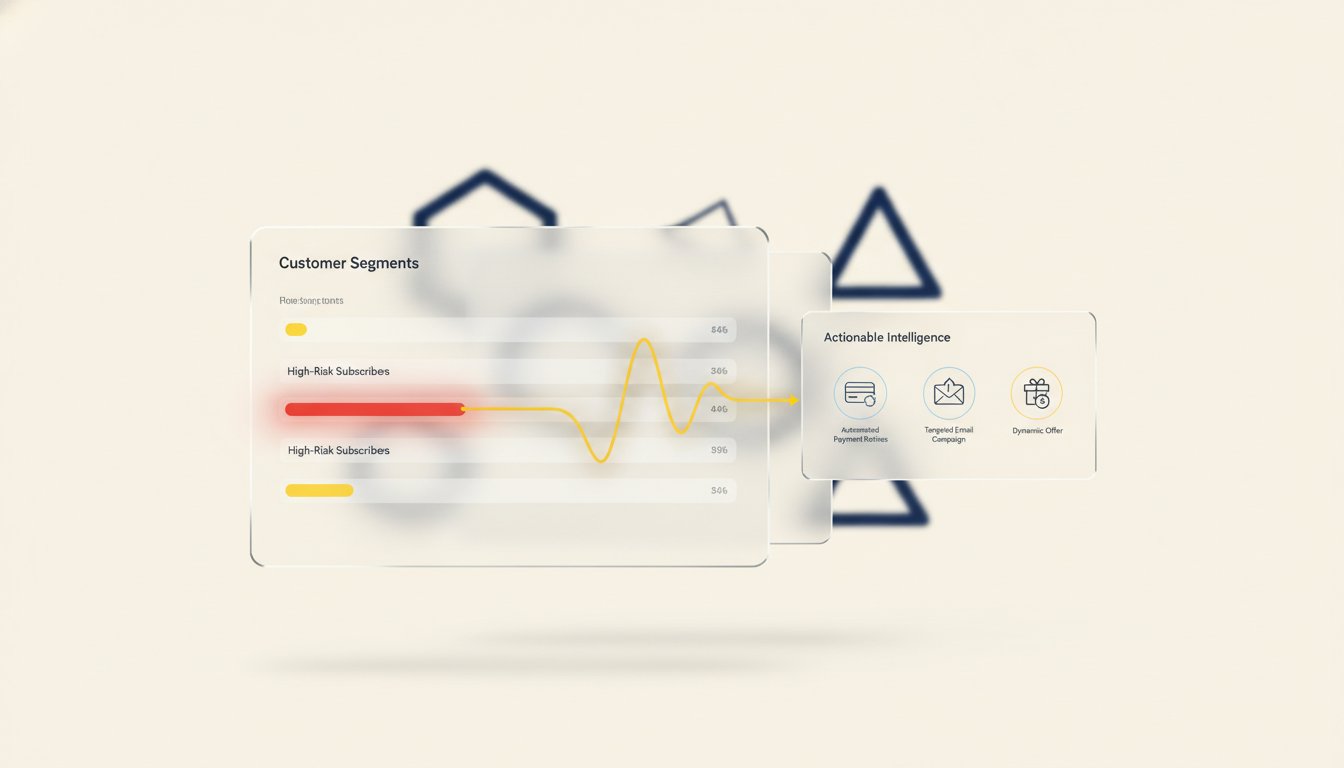
Subscription Churn Dashboard: The 2026 Guide to Actionable Revenue Intelligence
Up to 40% of subscription churn is involuntary, meaning your customers aren't choosing to leave; they're being forced out by...