ARTICLE
The Playbook for Subscription Win-Back Campaigns: 2026 Revenue Recovery Guide
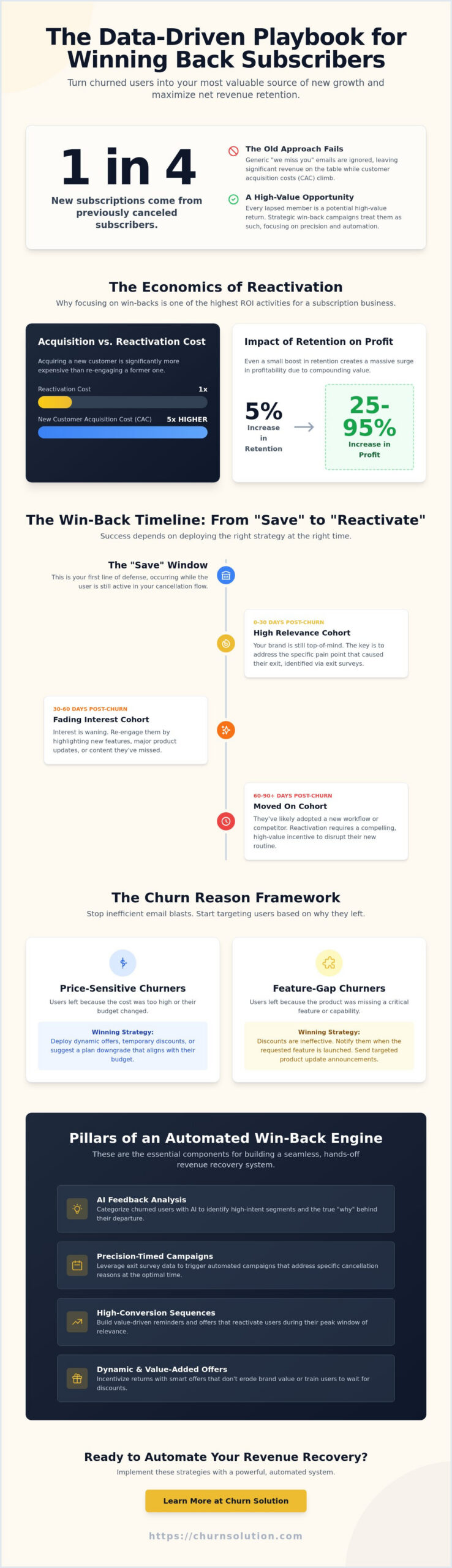
Nearly one in four new subscriptions come from previously canceled subscribers. If you’re still relying on generic “we miss you” emails that get ignored, you’re leaving significant revenue on the table while your customer acquisition costs continue to climb. You understand that churn is an inevitable part of the subscription lifecycle, but it doesn’t have to be a permanent loss. It’s time to stop guessing why users leave and start deploying sophisticated subscription win-back campaigns that treat every lapsed member as a high-value opportunity.
This playbook provides the data-driven strategies and automation tools required to reactivate your audience and maximize net revenue retention. You’ll learn how to implement intelligent cancellation flows and AI feedback analysis to identify the exact reasons for departure. We’ll examine how to use dynamic offers and smart retries to build an automated revenue recovery system that runs in the background. By the end of this guide, you’ll have a technical roadmap to lower your churn rates and scale your customer lifetime value with surgical precision.
Key Takeaways
- Categorize churned users with AI Feedback Analysis to identify high-intent segments rather than wasting resources on low-ROI “blast” campaigns.
- Deploy precision-timed subscription win-back campaigns that leverage exit survey data to address specific reasons for cancellation.
- Build a high-conversion sequence that leads with value-driven reminders to reactivate users during their peak window of relevance.
- Utilize Dynamic Offers to incentivize returns without eroding brand value or training your audience to wait for deep discounts.
- Integrate automated reactivation tools directly into your Cancellation Flows to create a seamless, hands-off revenue recovery engine.
What is a Subscription Win-Back Campaign and Why Does it Matter?
Subscription win-back campaigns are strategic interventions engineered to reactivate users who have already terminated their relationship with your service. These aren’t simple “we miss you” emails. They are data-driven workflows triggered by specific user behaviors and exit data. In the high-stakes subscription economy, your ability to recover revenue is just as critical as your ability to generate it. Every lapsed subscriber represents a sunk cost in acquisition spending that hasn’t reached its full potential. By focusing on reactivation, you address the leak in your funnel with surgical precision.
You must categorize your churn to apply the correct remedy. Involuntary churn occurs when technical failures, such as expired credit cards or bank declines, disrupt the billing cycle. Voluntary churn is a deliberate choice by the user to cancel their subscription. While both damage your Net Revenue Retention (NRR), subscription win-back campaigns primarily target the voluntary segment where the brand relationship still holds latent value. Recovering these users is significantly more cost-effective than starting from scratch, as customer acquisition costs are typically five times higher than the cost of reactivation. High NRR is the hallmark of a healthy SaaS business, and win-back efforts are the primary engine for maintaining it after a cancellation occurs.
The Economics of Reactivation
The financial impact of a successful win-back strategy is profound. Data indicates that increasing your retention rate by just 5% can result in a profit surge between 25% and 95%. This happens because reactivated customers often have a higher propensity to stay long-term, having already experienced your core value proposition. You should measure these efforts through “Recovered LTV,” which tracks the total revenue generated by a subscriber after they rejoin your platform. By leveraging Relationship marketing principles, you can transform a churn event into a re-engagement opportunity that strengthens the user’s connection to your brand. Win-back campaigns are the strategic bridge between customer departure and revenue restoration.
Winning Back vs. Saving: Understanding the Timeline
Success depends on understanding the critical distinction between a “Save” and a “Win-back.” The Save window exists while the user is still engaged with your interface, usually during the cancellation flow. This is your first line of defense. To master this early-stage intervention, read The Definitive Guide to Automated Cancellation Flows in 2026. Once the subscription period ends and access is revoked, you enter the Win-back window.
Your outreach must evolve as time passes. We recommend segmenting your lapsed users into three distinct cohorts:
- 30-Day Cohort: These users are recently churned and likely still have your brand top-of-mind. Focus on solving the specific pain point that led to their exit.
- 60-Day Cohort: Interest is fading. Use this period to highlight new features or major product updates they missed during their absence.
- 90-Day Cohort: These users have likely moved on to competitors or alternative workflows. Reactivation here requires a compelling, high-value incentive to disrupt their new routine.
Strategic Segmentation: Identifying Winnable Lapsed Subscribers
Broad-spectrum email blasts are a relic of inefficient marketing. They erode your sender reputation and yield diminishing returns. Effective subscription win-back campaigns rely on precise customer segmentation to ensure the right message reaches the right lapsed user. You shouldn’t treat a user who left due to a technical bug the same way you treat one who finished a one-time project. High-value recovery requires a surgical approach that prioritizes former subscribers with the highest historical engagement and Lifetime Value (LTV). These customer retention strategies emphasize that understanding the “why” behind churn is the first step toward reversal.
The Churn Reason Framework
Categorizing users by their exit reason allows you to deploy the correct incentive without sacrificing margin. Price-sensitive churners require a different lever; target them with dynamic offers or plan downgrades that align with their budget. Feature-gap churners, however, don’t need a discount. They need evidence of product evolution. Send them targeted update announcements and “new for you” content that highlights the exact tools they found missing. Project-based churners are unique. They didn’t leave because of dissatisfaction; they left because their task was complete. Target these users with seasonal or milestone-driven reactivation triggers that coincide with their next likely project cycle.
Using AI to Predict Reactivation Probability
Modern revenue recovery moves beyond basic filters. Sophisticated feedback analysis uses AI to interpret sentiment patterns in exit surveys, identifying who is actually winnable. AI doesn’t just read words; it interprets the intensity of dissatisfaction to separate “Never-Backs” from “Winnables.” This distinction is critical for optimizing your marketing spend. If a user expressed deep frustration with your core architecture, a 20% discount won’t bring them back. Focus your resources on the winnable segment. Incorporate granular churn metrics to track which segments respond best to specific hooks, then iterate rapidly. You can start building your recovery cohorts today by opening a recovery account to see which users are ready for reactivation.
Stop guessing which lapsed subscribers might return. Use the data you already have to build a predictive model that identifies high-probability targets. When you align your win-back hooks with the actual reasons for departure, you transform a generic outreach into a high-conversion event. This methodical approach ensures your subscription win-back campaigns deliver maximum ROI while protecting your brand’s integrity.
The Anatomy of a High-Conversion Win-Back Sequence
Constructing effective subscription win-back campaigns requires a methodical, multi-stage approach. You can’t rely on a single outreach to repair a broken customer relationship. Instead, you must orchestrate a sequence that builds momentum and addresses objections progressively. A high-performance cadence typically spans 60 days, transitioning from value-based reminders to urgent, time-sensitive incentives. This structured progression ensures you stay top-of-mind without causing brand fatigue or triggering spam filters.
- Email 1: The Soft Check-in (Day 1-3 post-access): Deploy this message immediately after the grace period ends. Don’t lead with a discount. Focus on the core utility the user lost. Remind them of the specific workflows or data insights they can no longer access.
- Email 2: The Incentive + Social Proof (Day 7-14): Introduce a concrete reason to return. Combine a targeted offer with a testimonial or case study from a similar user profile. To Optimize Your Customer Win-Back Strategy, you must prove that your platform is still the industry standard for their specific needs.
- Email 3: The Last Chance + Urgency (Day 30): Shift the tone to prioritize scarcity. Use a firm deadline for your reactivation offer. This creates a psychological “tipping point” for users who have been procrastinating their return.
- Email 4: The Feedback Loop (Day 60+): If the user remains lapsed, pivot your objective. Stop selling and start listening. Ask a single, pointed question about what prevented their return to refine your future segmentation.
Crafting the Subject Line for Maximum Open Rates
Your subject line is the single point of failure for your entire sequence. Avoid “We Miss You” clichés. These are passive and carry no professional weight. Use results-oriented hooks that promise immediate utility. For instance, “Your new dashboard is ready” or “We fixed the [Feature] you wanted” directly addresses previous friction. Your subject line must bridge the gap between the user’s past pain point and a new, optimized solution. It’s a challenge to their current, less efficient status quo.
Multi-Channel Orchestration: Moving Beyond Email
Email is your foundation, but it shouldn’t be your only channel. High-value lapsed users require a multi-touch approach. Use retargeting ads on professional networks to stay visible where your audience works. If the user still logs into a free tier or a limited customer portal, deploy in-app notifications that highlight recent product improvements. You can find specific sequence templates in How to Reactivate Lapsed Subscribers: The 2026 Data-Driven Playbook. By surrounding the user with consistent, value-driven touchpoints, you increase the probability of a successful reactivation.
Discounting vs. Value-Added Incentives: A Selection Framework
Leading with a discount is a strategic gamble. While it can drive immediate reactivations, it frequently fosters “discount addiction.” This occurs when users are conditioned to only engage with your brand during a price drop, which systematically erodes your margins. To mitigate this, your subscription win-back campaigns must employ a selection framework that balances temporary incentives with long-term revenue health. By deploying dynamic offers, you provide a surgical response to churn without training your audience to wait for the next sale. If you want to protect your MRR over the long term, understanding how to reduce churn without discounts using value-based retention strategies is essential for any subscription business in 2026.
Consider the “Subscription Pause” as your most effective pre-emptive win-back tool. Research shows that 75% of subscribers who pause their service eventually return. It’s a low-friction alternative to total cancellation that preserves the user’s data and settings, making the path back to a paid state seamless. When a pause isn’t enough, you must choose between temporary discounts, permanent plan grandfathering, or feature un-gating. Each lever serves a different segment of your lapsed audience, and the choice should be dictated by the specific exit reason identified in your feedback analysis. Teams that lack dedicated voluntary churn reduction software to intercept these departures at the moment of intent often find that even well-designed incentive frameworks fail to fire at the right time for the right user.
When to Use Discount-Based Incentives
Discounts are most effective for price-sensitive segments or in highly commoditized markets where switching costs are low. However, these shouldn’t be open-ended. Use “limited-time” offers to inject immediate urgency into the decision-making process. For instance, a 30% discount for three months creates a compelling reason to return now without permanently lowering your Average Revenue Per User (ARPU). You can find more targeted examples in our analysis of Dynamic Cancellation Offers.
Leveraging Value-Added Saves to Protect MRR
To protect your Monthly Recurring Revenue (MRR), you must often shift the conversation from price to utility. Value-added saves, such as free account credits, temporary premium support, or exclusive training modules, re-establish the product’s worth. Highlighting “What You Missed” is particularly effective for feature-gap churners; show them the tools you’ve launched since their departure. Improving subscriber lifetime value requires this focus on utility over cost. If you’re ready to deploy these precision incentives, start building your dynamic offers now.
Success in revenue recovery isn’t about the deepest discount; it’s about the highest relevance. By aligning your incentive with the user’s past behavior and stated reasons for leaving, you maximize your chances of a successful return while maintaining the integrity of your pricing model. This methodical approach ensures that every reactivated subscriber is a high-value asset, not just a temporary boost to your metrics.
Automating the Win-Back Lifecycle with Churn Solution
Manual intervention is the enemy of scale. While the strategies outlined in previous sections provide the framework for recovery, your growth team needs a technical engine to execute these processes at volume. Churn Solution serves as that infrastructure. It transforms raw data into actionable recovery workflows, ensuring your subscription win-back campaigns trigger with surgical precision. By automating the lifecycle, you move from reactive damage control to a proactive, high-performance revenue protection system.
You cannot optimize what you do not measure. Sophisticated teams utilize A/B experiments to rigorously test incentives and subject lines. This data-driven approach removes the guesswork from your reactivation strategy. Whether you’re testing a 30-day free credit versus a permanent plan grandfathering offer, the platform identifies the highest-converting variables in real-time. This iterative loop ensures your margins remain protected while your recovery rates climb.
While much of this playbook focuses on voluntary cancellations, you must also address the technical side of the equation. Involuntary churn, often caused by failed payments, accounts for 25% to 40% of total churn in e-commerce subscription models. Our payment recovery system handles these failures automatically. It bridges the gap between a technical decline and a lost customer, often recovering revenue before the user even realizes there was a billing issue.
Integrating Exit Surveys with Win-Back Triggers
The technical flow of a modern win-back sequence starts the moment a user initiates a cancellation. Data from exit surveys provides the essential context needed for personalization. Once a user submits their reason for leaving, our AI Analysis categorizes the sentiment and intent. This immediately triggers a targeted reactivation sequence tailored to that specific user’s pain point. Automation removes the manual burden from your team, allowing your recovery engine to run 24/7 in the background.
The Future of Revenue Protection: AI and Smart Retries
The most efficient win-back campaign is the one you never have to send. Using smart retries, the platform employs machine learning to time payment attempts when they are most likely to succeed based on historical bank behavior. This pre-emptive strike reduces involuntary churn at the source. The ultimate goal is a seamless, automated loop of retention, save, and win-back actions that secures your bottom line. It’s time to take control of your NRR. Start recovering your subscription revenue today with Churn Solution.
Secure Your Revenue Infrastructure for 2026
Effective revenue protection requires more than just reactive saving; it demands a sophisticated, automated approach to customer reactivation. You’ve seen that successful subscription win-back campaigns are built on surgical segmentation and the strategic application of value-added incentives rather than margin-eroding discounts. By integrating AI-powered feedback analysis into your cancellation flows, you transform every exit into a high-probability recovery opportunity. This systematic approach ensures your growth isn’t undermined by avoidable churn.
It’s time to stop leaving your net revenue retention to chance. Our platform allows you to recover up to 30% of cancelled subscribers automatically through seamless integration with Stripe and other major billing engines. You can deploy intelligent, targeted sequences that address the root cause of every departure without manual intervention. Engineer a more resilient business model and reclaim your lost revenue today. Automate Your Win-Back Strategy with Churn Solution
Frequently Asked Questions
What is a typical conversion rate for a subscription win-back campaign?
The probability of winning back a previous customer is estimated to be 20-40%, which is significantly higher than the 5-20% probability of converting a new prospect. These metrics vary by industry, but the baseline efficiency of targeting lapsed users remains consistent. Your success depends on the precision of your segmentation and the relevance of your reactivation offer. High-performance subscription win-back campaigns focus on winnable cohorts to maximize this probability without wasting outreach on low-intent segments.
How long should I wait after a customer cancels to send a win-back email?
Deploy your first outreach within 1-3 days after the subscriber’s access is officially revoked. Data shows that 45% of returning subscribers come back within the first 30 days of churning. Waiting too long allows the user to integrate a competitor’s solution into their daily workflow. Start with a soft value reminder while your platform’s utility is still fresh in their mind to capture this early-stage momentum before they move on permanently.
Should I offer a discount in my first win-back email?
You shouldn’t lead with a discount in the initial outreach. Lead with a value-driven reminder or a highlight of new features the user missed during their absence. Offering a price drop too early trains your audience to expect lower rates and erodes your brand’s perceived worth. Reserve financial incentives for later in the sequence to target users who haven’t responded to utility-based prompts, protecting your margins during the initial reactivation phase.
How do I handle subscribers who cancelled because of a bad experience?
Address negative experiences by using AI Feedback Analysis to identify the specific friction point that caused the departure. Once you’ve categorized the complaint, send a personalized message acknowledging the failure and explaining the technical or operational fix you’ve implemented. This transparent approach rebuilds trust more effectively than a generic discount. If the issue remains unresolved, it’s often better to exclude these users from automated subscription win-back campaigns to protect your sender reputation.
Can I automate win-back campaigns for Stripe or Braintree?
You can fully automate your recovery lifecycle through direct integration with major billing engines like Stripe or Braintree. These platforms provide the webhooks necessary to trigger automated sequences the moment a subscription status changes to “cancelled” or “unpaid.” By connecting your billing data to a recovery engine, you ensure that every churn event immediately initiates a targeted intervention without requiring manual oversight from your engineering or marketing teams. This creates a hands-off revenue recovery system.
What is the difference between a win-back campaign and a dunning sequence?
A dunning sequence focuses on involuntary churn by automating retries and notifications for failed credit cards. In contrast, win-back campaigns target voluntary churners who have actively terminated their relationship. While dunning is a technical recovery process for payment failures, a win-back campaign is a strategic marketing intervention for active cancellations. Both are essential pillars of a comprehensive revenue protection strategy, but they require different messaging and trigger logic to be effective.
How many emails should be in a reactivation series?
A high-conversion reactivation series typically consists of 3-4 emails spread across a 60-day window. This cadence allows you to transition from a soft value reminder to a high-urgency incentive without overwhelming the recipient or triggering spam filters. Spacing these touchpoints ensures you remain top-of-mind as the user’s needs evolve. If the user hasn’t reactivated by the final email, pivot to a feedback-only request to gather data for future product improvements and long-term strategy.
Is it better to offer a free month or a percentage discount?
Offering a free month is generally superior to a percentage discount because it protects your long-term Average Revenue Per User (ARPU). Percentage discounts can create a permanent expectation of lower pricing, whereas a free month is a discrete, one-time value add. This approach allows the user to re-experience your product’s utility without devaluing the core subscription. Use A/B testing to confirm which incentive resonates most with your specific audience segments and protects your bottom line.
- Key Takeaways
- Table of Contents
- What is a Subscription Win-Back Campaign and Why Does it Matter?
- Strategic Segmentation: Identifying Winnable Lapsed Subscribers
- The Anatomy of a High-Conversion Win-Back Sequence
- Discounting vs. Value-Added Incentives: A Selection Framework
- Automating the Win-Back Lifecycle with Churn Solution
- Secure Your Revenue Infrastructure for 2026
- Frequently Asked Questions

Churn solution that turns your customers right around.
Related Articles
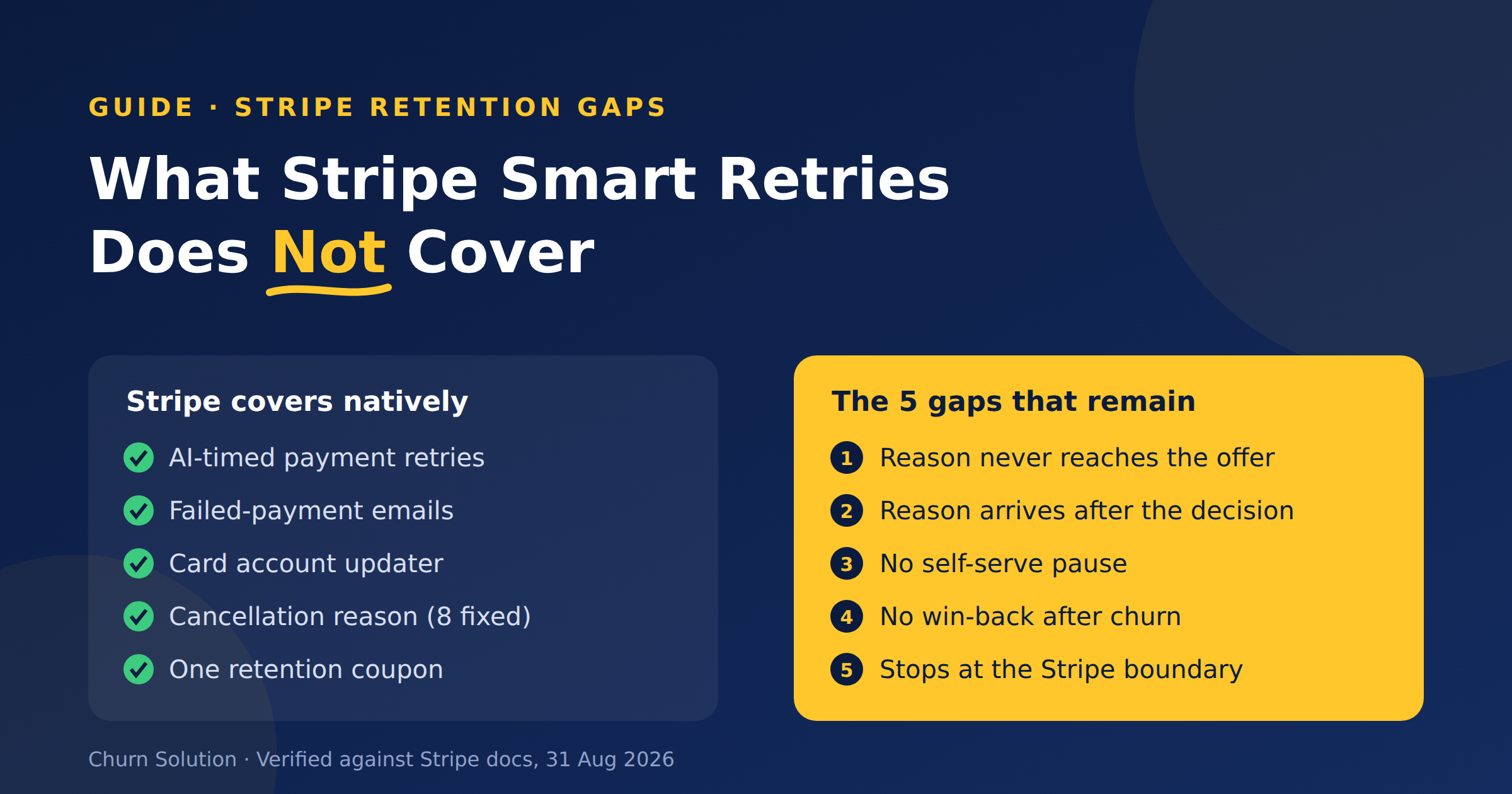
What Stripe Smart Retries Does Not Cover
Stripe Smart Retries recovers failed payments but doesn't run retention. Here are the five gaps that remain, sourced from Stripe's...

Membership Community Churn: The Members Who Quit Without Clicking Cancel
Quiet churn is the real leak: members who never clicked “cancel” at all. A card expires. A bank declines a...

Subscription Churn Dashboard: The 2026 Guide to Actionable Revenue Intelligence
Up to 40% of subscription churn is involuntary, meaning your customers aren't choosing to leave; they're being forced out by...