ARTICLE
How to Reactivate Lapsed Subscribers: The 2026 Data-Driven Playbook

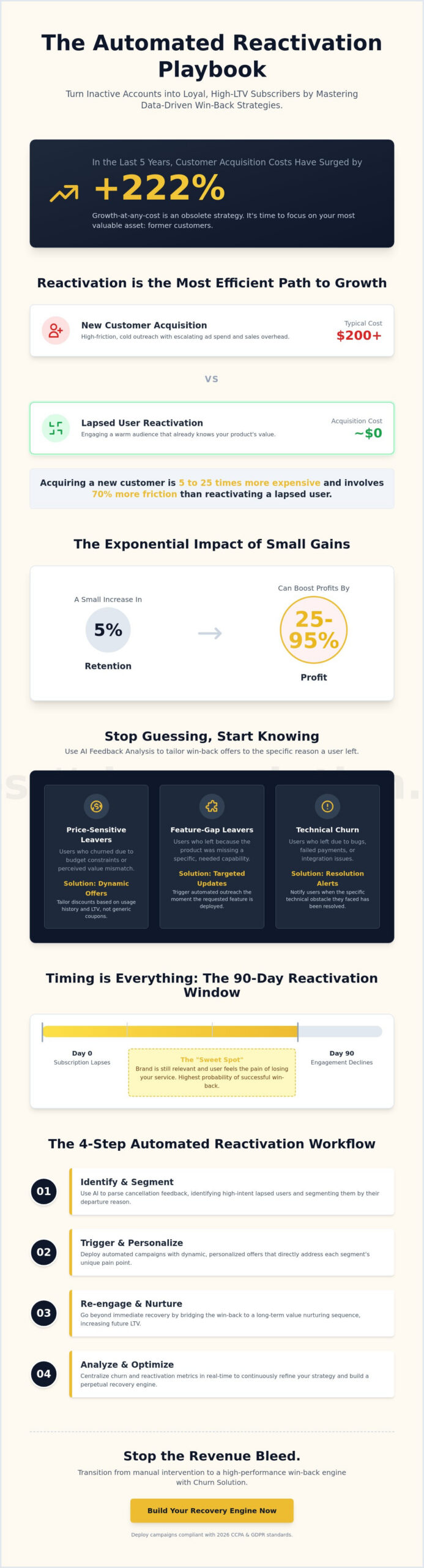
Your customer acquisition costs have surged by over 222% in the last five years, yet your most valuable revenue source is likely sitting idle in a dormant database. You already understand that acquiring a new user is significantly more expensive than retaining one. Despite this, many growth teams treat churn as a finality rather than a pivot point. It’s frustrating to watch a high-LTV segment drift into inactivity when you lack the technical insight to pull them back. Deploying sophisticated automated reactivation campaigns is no longer an optional marketing tactic; it’s a critical recovery mechanism for your bottom line.
This playbook provides the precise, data-driven strategies to recover lost revenue by turning inactive accounts back into loyal, high-LTV subscribers. You’ll learn how to leverage AI feedback analysis and dynamic offers to build a high-performance win-back engine. We’ll examine how to navigate 2026’s strict CCPA and GDPR compliance standards while deploying smart retries that capture failed payments. This is your technical blueprint to stop the revenue bleed and optimize the entire subscription lifecycle through methodical, automated intervention.
Key Takeaways
- Review the economic landscape of 2026 to understand why reactivation is the most cost-effective lever for sustainable subscription growth.
- Categorize cancellation data at scale using AI feedback analysis to ensure every win-back attempt addresses the specific reason a user left.
- Replace low-margin generic discounts with dynamic offers tailored to individual subscriber history and lifetime value.
- Deploy a systematic, four-step sequence for automated reactivation campaigns that bridges the gap between immediate account recovery and long-term value nurturing.
- Transition from manual intervention to a perpetual recovery engine by centralizing churn metrics and identifying win-back opportunities in real-time.
The Economic Case for Reactivating Lapsed Subscribers in 2026
Growth at any cost is an obsolete strategy. By 2026, customer acquisition costs (CAC) have escalated by over 222% in just five years, making the hunt for new leads an increasingly expensive gamble. Sustainable SaaS growth now depends on your ability to extract value from your existing ecosystem. Reactivation is the automated process of incentivizing former customers to resume their paid subscriptions. It’s a strategic intervention designed to plug the leaks in your revenue bucket.
Strategic automated reactivation campaigns offer a superior alternative to the high-friction world of cold outreach. Consider the math. A new acquisition might demand a $200 investment in ad spend and sales overhead. In contrast, reactivating a lapsed user often carries a near-zero acquisition cost. These users have already cleared the initial trust barrier. They’ve used your product. They’ve seen the value. Recovered users often exhibit a higher Lifetime Value (LTV) than new cohorts because they return with a clear understanding of your platform’s utility. A mere 5% increase in retention can boost profits by 25% to 95%. This isn’t just about saving a few accounts; it’s about exponential bottom-line impact.
This focus on retention and audience growth is equally critical for public sector and healthcare organisations; Throughmotion Ltd. specializes in helping these entities engage and nurture their communities for sustainable growth.
Defining the Lapsed Subscriber Segment
Data precision is the foundation of recovery. You must differentiate between “cancelled” users, who still have active access until their billing cycle ends, and “lapsed” users, whose access has been revoked. Leaving these “limbo” subscribers unmanaged is a liability. They clutter your database and degrade email deliverability. They also obscure your churn metrics, making it impossible to see the true health of your business. The 90-day window represents the critical “sweet spot” for re-engagement. Within this timeframe, your brand is still relevant, but the user has felt the pain of losing your service. Implementing automated reactivation campaigns allows you to scale this recovery without increasing headcount.
Reactivation vs. Acquisition: A Revenue Comparison
Marketing to lapsed users involves 70% less friction than targeting cold leads. You aren’t selling a concept; you’re offering a solution to a previously identified need. This efficiency directly impacts your Net Revenue Retention (NRR) and overall company valuation. High rates of customer attrition signal to investors that your product is a leaky bucket. By contrast, a robust reactivation strategy proves your product’s enduring market fit. Reactivation ROI is the ratio of recovered revenue to campaign spend. In a market where every dollar of CAC is scrutinized, recovering a lapsed subscriber is the most efficient way to expand your MRR.
Decoding the ‘Why’ with AI Feedback Analysis
Generic win-back emails fail because they treat every cancellation as a pricing problem. When you send a standard discount to a user who left because of a technical bug, you aren’t just wasting a margin; you’re proving that you don’t understand their needs. Since acquiring a new customer is five to 25 times more expensive than retaining one, your recovery attempts must be surgical. You can’t afford to guess what went wrong when the data is already in your system.
Advanced automated reactivation campaigns rely on AI feedback analysis to decode the specific “why” behind every departure. By categorizing cancellation data at scale, AI identifies high-intent users who left due to temporary friction versus low-intent users who were never a product-market fit. Sentiment analysis adds another layer of intelligence. It predicts which users are winnable by evaluating the tone of their final interactions. This allows you to prioritize high-yield recovery paths while ignoring segments that will only drive up your support costs without returning value.
Segmenting by Cancellation Reason
Price-sensitive leavers don’t just want a generic coupon; they want a value realignment. These users require dynamic offers that match their specific usage history and budget constraints. Feature-gap leavers should be tagged for reactivation only when the specific capability they lacked is actually deployed. Similarly, technical churn requires a specific trigger. Automating these win-backs ensures your message arrives exactly when the obstacle to subscription has been removed, whether that’s a bug fix or a total UI overhaul. Start analyzing your churn data today to identify these high-value segments.
The Power of Exit Surveys in Win-back Strategy
Your exit surveys are the primary fuel for your reactivation engine. Moving from static, multi-choice forms to conversational AI data collection captures richer qualitative insights that standard forms miss. This data allows you to turn negative feedback into a personalized “We Fixed It” outreach sequence. Instead of a generic “We miss you” email, you send a targeted update: “You mentioned our dashboard was slow; we’ve optimized our backend for 3x faster load times.” This level of personalization is only possible when your feedback loop is integrated directly into your automation stack, transforming raw complaints into actionable recovery triggers.
Designing High-Conversion Win-back Offers
A default “20% off” discount is often the weakest lever in your arsenal. While it provides a temporary spike in volume, it frequently devalues the product and attracts low-quality users who will churn as soon as the promotion expires. Effective automated reactivation campaigns require a more sophisticated psychological approach. You must align the incentive with the user’s previous behavior and the specific value they derived from the platform before they left. Stop treating your margins as a disposable commodity and start treating your offers as a strategic bridge back to utility. Before designing your incentive structure, it’s worth understanding how to reduce churn without discounts using value-based retention strategies, so your win-back offers reinforce product value rather than eroding it.
Implementing dynamic offers allows you to tailor incentives based on historical subscriber data. If a user was a high-frequency power user, a “feature credit” or a temporary upgrade to a higher tier may be more compelling than a cash discount. Conversely, for users who left due to budget constraints, offering a “Pause” alternative or a free month is often better for long-term LTV than a permanent price reduction. This preserves your pricing integrity while removing the immediate financial barrier to return. You’re not just buying a user back; you’re re-establishing the value proposition.
Types of Reactivation Incentives
Leverage the “Grandfathered Rate” appeal to trigger FOMO. Remind lapsed users that returning now secures their previous pricing before upcoming increases. Feature credits are often superior to cash discounts because they encourage product engagement without slashing your margins. For users who left several months ago, a “New Version” trial is a powerful reset. Invite them to test a major platform update for free. This treats the reactivation as a fresh onboarding experience rather than a desperate plea for revenue.
Testing and Optimization for Save Rates
Optimization is not a one-time event. You must run A/B experiments on win-back subject lines, CTA buttons, and offer structures to find the ceiling of your reactivation pricing. Focus on metrics that matter. A high “Save Rate” is meaningless if the “Reactivation Cost” per user exceeds the projected return. To improve subscriber lifetime value, you must filter out “discount-only” users and prioritize those who return for the product’s utility. Analyze the data, refine the triggers, and scale the offers that demonstrate the highest net retention over a six-month period.
The 4-Step Automated Reactivation Workflow
Manual email blasts are an inefficient relic of the past. To recover revenue at scale, you need a systematic, multi-stage architecture that triggers based on the time elapsed since a subscriber’s access was revoked. Precision is the antidote to churn. A high-performance workflow ensures your brand remains top-of-mind without becoming a source of inbox fatigue. These automated reactivation campaigns transform your lapsed database from a stagnant list into a perpetual recovery engine.
- Step 1: The Immediate Post-Access Sequence (Days 1-7): This phase begins the moment access ends. The goal is to bridge the gap between “cancelled” and “lapsed.” Send a soft reminder confirming their data is safe but highlighting the specific features they no longer have access to.
- Step 2: The Value-First Touchpoint (Day 30): Avoid the sales pitch here. Share a major product update, a new case study, or a high-value industry report. You’re proving that the platform has evolved since they left.
- Step 3: The Hail Mary Dynamic Offer (Day 60): Deploy a high-value incentive. Use dynamic offers to present a tailored deal that matches their previous usage patterns. This is the moment to remove all financial friction.
- Step 4: The Data Purge Warning (Day 90): Finality is a powerful motivator. In alignment with 2026 CCPA and GDPR data retention mandates, notify the user that their account data is scheduled for erasure. This creates a legitimate “last chance” FOMO trigger.
Timing and Frequency: The Retention Sweet Spot
Reactivation fatigue is real. If you message too frequently, you’ll see a spike in “mark as spam” reports, which destroys your sender reputation. The foundation of a successful win-back starts earlier in the lifecycle. You must use automated cancellation flows to capture the exit intent that will eventually dictate the timing of your reactivation sequence. If a user left due to a temporary budget freeze, your Day 60 offer will land with much higher impact than if they left due to a technical gap. Build your automated workflow now to capture every recovery opportunity.
Multi-Channel Outreach Strategies
In 2026, email alone is insufficient for high-value B2B SaaS recovery. Your automated reactivation campaigns should utilize a multi-channel approach to cut through the noise. Match your cancellation segments to retargeting ads on professional networks to stay visible during the user’s daily workflow. For high-ACV accounts, consider triggering an automated task for a CSM to send a personalized video message at the Day 30 mark. Combining SMS notifications for urgent offers with in-app “welcome back” modals ensures that wherever the former user goes, the path to re-subscription is clear and frictionless. For a deeper dive into structuring these efforts, the subscription win-back campaigns playbook provides additional data-driven frameworks for maximizing revenue recovery across every channel.
Scaling Reactivation with Churn Solution
Manual win-back blasts are a low-yield legacy tactic. They rely on intermittent effort and often arrive too late to be effective. To truly scale, you must transition to a perpetual reactivation engine that operates 24/7. This system identifies recovery opportunities at the exact moment of highest intent, ensuring your brand remains a constant solution rather than a forgotten service. Deploying automated reactivation campaigns removes the human bottleneck, allowing your growth team to focus on high-level strategy while the platform handles the execution.
Centralizing your churn metrics is the first step toward this technical mastery. When your recovery data is siloed, you miss the real-time signals that indicate a user is ready to return. Churn Solution integrates directly with Stripe and other major billing engines to automate the entire lifecycle, from the initial cancellation flow to the final win-back offer. This deep integration ensures that every action is backed by financial data, eliminating the risk of sending offers to users with unresolved billing issues or fraudulent histories.
The most effective reactivation strategy is one that needs to happen less frequently. Our internal data shows that implementing automated save flows can reduce the need for reactivation by 30%. By addressing concerns during the cancellation process, you retain users who would otherwise have entered the lapsed segment. For those who do leave, the system immediately pivots to a recovery stance, maintaining a seamless thread of communication that prioritizes long-term retention over short-term volume.
Integrating Reactivation into Your Product
Friction is the primary enemy of recovery. Churn Solution enables ‘One-Click’ Reactivation within your customer portal, allowing users to resume their subscriptions without re-entering payment details or navigating complex menus. We also ensure your win-back data syncs directly with your CRM, empowering sales teams to intervene on high-ACV accounts with full context. Automated triggers outperform manual campaigns by 4x. This efficiency is the result of perfect timing and data-driven personalization.
Future-Proofing Your Retention Strategy
The landscape of the subscription economy is shifting toward predictive reactivation. By 2027, the focus will move from reacting to churn to anticipating it before the user even reaches the cancellation page. Comprehensive subscription revenue protection requires this multi-layered approach, combining immediate save tactics with long-term win-back automation. Don’t wait for your churn rate to dictate your growth. Sign up for Churn Solution to start your automated win-back engine today and secure your revenue for the years ahead.
Secure Your Sustainable Growth Engine
Recovering lapsed users is no longer just a marketing goal; it’s a fundamental requirement for SaaS profitability in 2026. You’ve seen how skyrocketing acquisition costs make every dormant account a high-value asset. By leveraging automated reactivation campaigns, you move beyond guesswork and treat recovery as a scalable extension of your product lifecycle. Success depends on shifting from manual blasts to a data-driven, multi-channel architecture that triggers based on precise exit signals.
To lead in the subscription economy, you must replace fragmented effort with a perpetual recovery engine. Churn Solution provides the infrastructure to execute this strategy with technical mastery. Our platform features AI-powered feedback analysis to decode exit intent, one-click Stripe integration for zero-friction account resumption, and an automated dynamic offer engine that preserves your margins while maximizing save rates. You have the tools to plug the revenue leak and optimize your Net Revenue Retention (NRR) starting today.
Reactivate your lapsed subscribers automatically with Churn Solution. Take control of your revenue retention and turn your inactive list into a high-LTV growth channel.
Frequently Asked Questions
What is the best time to send a reactivation email?
The optimal window for a win-back outreach is between 30 and 90 days post-lapse. At the 30-day mark, the user has felt the absence of your service but still retains brand memory. Beyond 90 days, the success rate drops significantly as users transition to competitors. Use this period to trigger automated reactivation campaigns that highlight product evolution rather than just offering a price cut.
How much of a discount should I offer to lapsed subscribers?
There is no universal discount percentage that guarantees success. Instead of a flat discount, use dynamic offers that reflect the user’s historical spend and reason for leaving. High-LTV users may respond better to a grandfathered rate or a temporary tier upgrade. Low-margin accounts should receive smaller incentives to avoid attracting discount-only users who will churn again once the promotion ends.
Is it better to offer a discount or a free trial for win-back?
The choice between a discount and a free trial depends on the cancellation reason. For users who left due to a feature gap, a 14-day trial of your new version is superior. It allows them to re-experience the product’s utility without financial commitment. Use discounts specifically for price-sensitive segments identified through your exit surveys. This targeted approach preserves your brand value while optimizing recovery.
How do I avoid ending up in the spam folder during a win-back campaign?
Maintain high deliverability by segmenting your win-back list and using authenticated sending domains. Avoid sending massive blasts to inactive accounts simultaneously. Instead, stagger your outreach based on engagement triggers. Compliance with 2026 CCPA and GDPR mandates regarding consent is critical. Honor Global Privacy Control signals and provide clear opt-out links to prevent your emails from being flagged as unsolicited spam.
Should I reactivate users who were cancelled due to failed payments?
Prioritize these users, but distinguish between intentional cancellations and involuntary churn. For failed payments, your first line of defense should be dunning automation and smart retries. If the account remains lapsed after these attempts, it enters the reactivation cycle. These users often return quickly once the payment friction is removed, making them one of the most profitable segments to recover.
What is a good reactivation rate for SaaS companies in 2026?
An optimized SaaS company in 2026 typically sees a reactivation rate between 5% and 10% of their lapsed subscriber base. While these numbers vary by industry, your focus should be on the quality of the recovered revenue. High-performing automated reactivation campaigns prioritize Net Revenue Retention over raw volume. A 5% increase in retention can lead to profit gains of up to 95% depending on your cost structure.
How often should I clean my lapsed subscriber list?
Can I automate the reactivation process without a developer?
You can automate the entire win-back cycle without a developer by using platforms that offer native billing integrations. Tools that connect directly to Stripe or Paddle allow you to build sophisticated flows through a visual interface. These systems handle the complex logic of checking subscription status and applying coupons, enabling your marketing team to launch and optimize subscription win-back campaigns without technical overhead.
- Key Takeaways
- Table of Contents
- The Economic Case for Reactivating Lapsed Subscribers in 2026
- Decoding the 'Why' with AI Feedback Analysis
- Designing High-Conversion Win-back Offers
- The 4-Step Automated Reactivation Workflow
- Scaling Reactivation with Churn Solution
- Secure Your Sustainable Growth Engine
- Frequently Asked Questions

Churn solution that turns your customers right around.
Related Articles
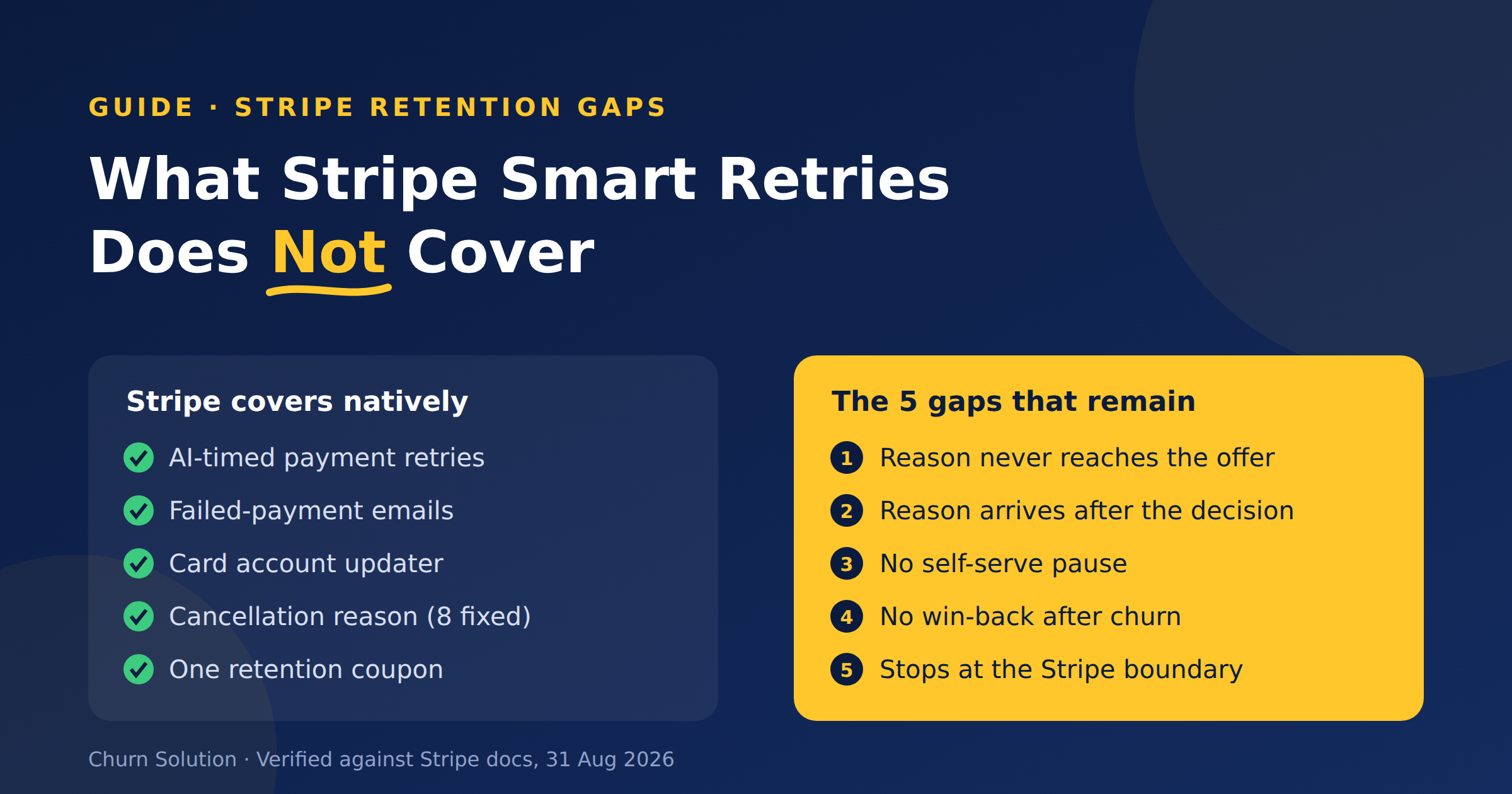
What Stripe Smart Retries Does Not Cover
Stripe Smart Retries recovers failed payments but doesn't run retention. Here are the five gaps that remain, sourced from Stripe's...

Membership Community Churn: The Members Who Quit Without Clicking Cancel
Quiet churn is the real leak: members who never clicked “cancel” at all. A card expires. A bank declines a...

Subscription Churn Dashboard: The 2026 Guide to Actionable Revenue Intelligence
Up to 40% of subscription churn is involuntary, meaning your customers aren't choosing to leave; they're being forced out by...