ARTICLE
How to Improve Subscriber Lifetime Value: A Strategic Guide to Revenue Retention

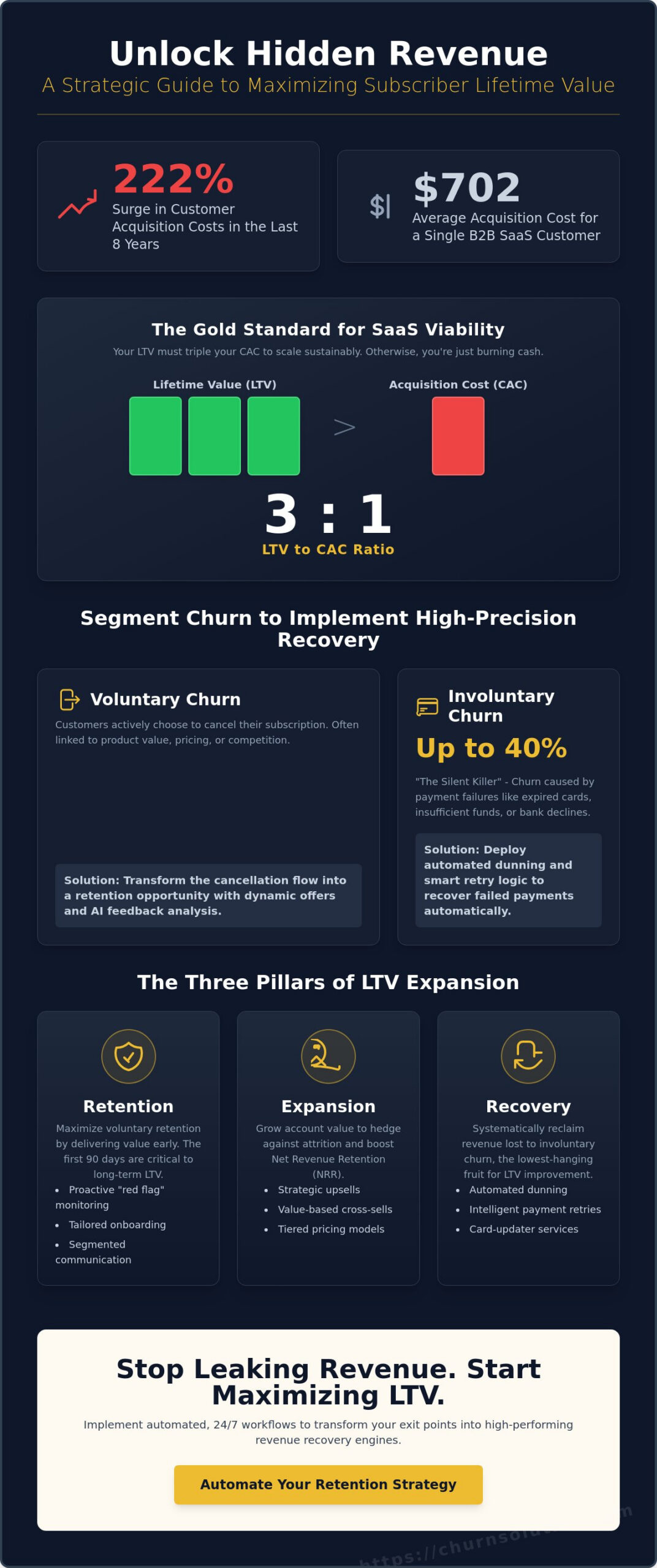
Customer acquisition costs have surged by 222% over the last eight years, making every lost subscriber a direct hit to your profit margins. When the average B2B SaaS acquisition cost sits at $702, you cannot afford to treat retention as a passive process. You likely recognize that high churn isn’t just a metric; it’s a leak in your business’s engine that stalls growth and wastes marketing spend. It is time to move beyond basic recovery and actively improve subscriber lifetime value through technical precision.
This guide provides the strategic framework to master the automated interventions and data-driven saves required to maximize revenue from every subscription. With recent regulatory shifts like the FTC’s Click to Cancel rule making exits easier for users, your defense must be smarter and more targeted. We will break down the mechanics of smart retries, AI feedback analysis, and dynamic cancellation flows to ensure your retention strategy is as sophisticated as your product. Prepare to transform your exit points into high-performing revenue recovery engines.
Key Takeaways
- Establish LTV as a core revenue engine by calculating the net present value of future profits against your customer acquisition costs.
- Segment churn into voluntary and involuntary categories to implement high-precision recovery mechanisms like smart retries and dunning automation.
- Capture and analyze exit-intent data to transform the cancellation flow into a strategic asset for revenue retention.
- Implement automated, 24/7 workflows to improve subscriber lifetime value through proactive interventions and dynamic offers.
- Use AI feedback analysis at the point of exit to identify systemic product issues and prevent future subscriber loss.
Decoding Subscriber Lifetime Value as a Revenue Growth Engine
The era of “growth at all costs” ended when capital became expensive and customer acquisition costs skyrocketed by 222% over the last eight years. Modern subscription businesses now prioritize unit economics over raw volume. At the heart of this shift is Customer Lifetime Value (CLV), defined as the net present value of all future profits generated by a single subscriber. To improve subscriber lifetime value, you must identify and plug the revenue leaks that silently drain your bottom line before they compound. These leaks often stem from unmanaged churn and failed payment sequences that go unaddressed by standard billing engines.
The LTV Formula for the Modern Subscription Economy
Calculating LTV requires more than a basic multiplication of Average Revenue Per Account (ARPA) and customer lifespan. While that formula provides a baseline, it fails to account for the complexities of expansion revenue and variable retention rates. High-performance teams now look toward Net Revenue Retention (NRR) as a more accurate predictor of LTV expansion because it captures the total value of your existing cohort, including upsells and cross-sells. You can track these shifts through advanced churn metrics to see where value is eroding. A high churn rate acts as a hard ceiling on your LTV, effectively capping the total revenue any single customer can ever contribute to your business regardless of your initial margins.
Why LTV/CAC Ratios Dictate Your Ability to Scale
The 3:1 LTV/CAC ratio remains the gold standard for B2B SaaS viability. When the average B2B SaaS customer acquisition cost is $702, your retention strategy must be flawless to ensure a healthy payback period. If your LTV doesn’t triple your CAC, you aren’t scaling; you’re burning cash to stay in place. Profitability doesn’t just grow linearly with subscriber lifespan. Extending a subscriber’s journey by just 10% can lead to an exponential increase in total profit as the initial acquisition cost is fully amortized.
Automated retention systems are the primary lever here. By deploying intelligent interventions at the exact moment of a failed payment or an intent to cancel, you shorten the time it takes to reach profitability for every new user. This systematic approach ensures that your marketing spend isn’t wasted on a “leaky bucket” model. Instead, every dollar spent on acquisition is protected by a robust infrastructure designed to improve subscriber lifetime value through every stage of the customer lifecycle.
The Three Pillars of LTV Expansion: Retention, Expansion, and Recovery
To effectively improve subscriber lifetime value, you must view LTV as a three-legged stool: retention, expansion, and recovery. Most growth teams obsess over voluntary retention while ignoring the silent revenue killer of involuntary churn. Expansion revenue, or growing the account value through strategic upsells, provides the necessary hedge against inevitable attrition. This ensures your Net Revenue Retention stays healthy. This framework serves as a strategic guide to revenue retention by addressing every point where capital leaks from your ecosystem. You can’t scale a business on a foundation of unmanaged churn.
Maximizing Voluntary Retention Through Value Realization
The first 90 days are the critical window for establishing long-term LTV. If a user doesn’t realize the core value of your product within this timeframe, they’ll churn. You must use customer segmentation to deliver tailored value propositions to specific cohorts based on their usage patterns. High-performance teams identify “red flag” behaviors early. A sudden drop in login frequency or a lack of engagement with new features are leading indicators of an impending cancellation. Addressing these signals with proactive outreach is far more efficient than trying to win back a user who has already mentally checked out.
Recovering Involuntary Churn via Automated Dunning
Up to 40% of subscriber churn is involuntary. This happens when credit cards expire, get lost, or trigger temporary bank declines. It’s the lowest-hanging fruit in the subscription economy. Implementing payment recovery systems allows you to extend LTV automatically without any manual intervention from your support team. These systems don’t just send emails; they use technical logic to solve payment friction.
By utilizing smart retries, you can navigate specific bank decline codes to process payments when they’re most likely to succeed. This recovery layer acts as a hidden lever for growth. It captures revenue that would otherwise be lost to technical errors, directly boosting your LTV/CAC ratio. If you’re ready to stop leaking revenue to failed payments, you can analyze your recovery potential today and start protecting your margins. Every recovered payment is a direct win for your bottom line. It’s the most straightforward way to improve subscriber lifetime value without increasing your marketing spend.
Proactive vs. Reactive Interventions: Optimizing the Save Strategy
Broad loyalty programs often reward customers who were never planning to leave, creating unnecessary margin compression. To improve subscriber lifetime value, your focus must shift toward high-precision Save Flows. These interventions trigger only when a user exhibits exit intent, which is the most critical behavioral data point you can capture. Exit intent represents the final friction point between retention and churn. It’s a binary moment that demands an immediate, automated response rather than a passive request to view a product roadmap. By intervening at this exact junction, you turn a potential loss into a data-collection event.
Introducing a “pause” option is a strategic alternative to a hard cancellation. When users face temporary budget constraints or seasonal shifts, offering a 30, 60, or 90-day pause preserves the customer relationship and keeps the account active in your database. This tactical maneuver prevents the total loss of the user and significantly lowers the cost of reactivation later. You must use A/B experiments to determine which pause durations and save incentives resonate most with specific user segments. Continuous testing ensures your save strategy evolves alongside changing market conditions.
The Role of Exit Surveys in Value Recovery
You cannot fix what you don’t understand. High-performance exit surveys transform the act of leaving into actionable product intelligence. Instead of a generic text box, use structured reason codes that trigger specific recovery workflows. If a user selects “price,” the system should instantly offer a lower-tier plan or a temporary discount. If they select “missing features,” the flow can highlight existing functionality they may have overlooked. This “Reason-Based Save” approach ensures the intervention matches the user’s specific pain point. For a deeper dive into these mechanics, consult The Definitive Guide to Automated Cancellation Flows.
Dynamic Offers vs. Flat Discounts
Blanket discounts are a blunt instrument that can erode your brand value and long-term LTV. When you give everyone a significant discount just for clicking “cancel,” you train your best customers to devalue your service. Use dynamic offers to preserve your margins. These offers are context-aware and tailored to the subscriber’s history and stated reason for leaving. A user on a legacy plan might receive a free month extension, while a high-volume user might be offered a plan downgrade to keep them in the ecosystem. You can find implementation ideas in our report on Dynamic Cancellation Offers: 5 High-Impact Strategies. This level of technical mastery is essential to improve subscriber lifetime value without sacrificing the integrity of your pricing model.
Implementing Automated Workflows to Extend Customer Lifespans
Manual retention efforts don’t scale in a high-growth environment. You need “set-and-forget” systems that operate 24/7 to protect revenue while your internal teams focus on product development. A robust customer portal is a prerequisite for this automation. It empowers your users to update payment methods, adjust billing cycles, or pause subscriptions without ever contacting support. By removing these operational hurdles, you proactively improve subscriber lifetime value by making it easier for customers to stay than to leave. Frictionless account management is the first line of defense against churn.
Setting Up a Multi-Stage Dunning Sequence
Payment failures shouldn’t result in immediate account termination. Instead, you must deploy a multi-stage dunning sequence that balances persistence with professionalism. The timing of these notifications is critical for recovery success. We recommend a structured cadence:
- Day 1: A helpful, soft reminder that a payment attempt failed, suggesting a quick check of card details.
- Day 3: A firmer nudge that emphasizes the risk of service interruption.
- Day 7: A high-urgency alert requiring immediate action to maintain account access.
- Day 14: Final notice before account suspension or cancellation.
The tone of these communications must evolve from a helpful reminder to an urgent demand for action. Pair this sequence with smart retries to optimize for bank processing windows. These retries use data-driven logic to attempt payments when they’re most likely to be approved. If you’re ready to automate your recovery engine and stop losing revenue to technical errors, you can start your free trial now.
Automating Win-Back Campaigns for Lapsed Users
LTV isn’t just about the initial customer lifecycle. It includes the “reactivated” value of former subscribers, a concept we define as the “LTV Second Life.” When a user churns, they shouldn’t be purged from your growth strategy. Automated reactivation triggers can be set based on the specific time since they left your ecosystem.
For example, a 90-day win-back campaign can offer a “Welcome Back” incentive to users who previously had high engagement scores but churned due to budget. Since the acquisition cost was already paid during their first lifecycle, these reactivated users represent high-margin growth with nearly zero additional CAC. To build a comprehensive strategy for recovering these dormant accounts, explore our data-driven framework for automated reactivation campaigns that turns inactive subscribers back into loyal, high-LTV customers. For a complete playbook on converting lapsed members into active revenue, see our guide on subscription win-back campaigns that treats every canceled subscriber as a high-value recovery opportunity. This systematic approach to recovery is a critical component of any strategy to improve subscriber lifetime value in a crowded market. Every reactivated user is a testament to the strength of your automated retention ecosystem.
Turning the Exit Point into a Retention Opportunity
Stop viewing the “cancel” button as a failure. It is a strategic asset. If you allow a subscriber to leave without capturing the “why” behind their decision, you lose twice: once in immediate revenue and once in critical business intelligence. To improve subscriber lifetime value, you must treat the exit point as a high-fidelity feedback loop. This final interaction is your last chance to save the account and your best chance to prevent future churn across your entire user base. High-performance teams don’t fear the exit; they optimize it.
Data-driven feedback loops turn subjective complaints into objective product requirements. When you systematically capture the reasons for cancellation, you move from guessing why users leave to knowing exactly how to keep them. This shift requires moving beyond generic text boxes and adopting structured, automated flows that respond to user input in real-time. Revenue protection is not a passive activity; it is an active, technical intervention that safeguards your margins.
Leveraging AI for Large-Scale Feedback Analysis
Manual review of cancellation comments is impossible for any scaling SaaS business. You need a way to synthesize thousands of disparate data points into actionable strategic themes. Deploying AI feedback analysis allows you to categorize churn reasons automatically, identifying whether the primary friction is pricing, feature gaps, or technical performance. This intelligence directly informs your product roadmap, ensuring you build what your users actually need to stay.
Quantifying the success of these interventions is essential for growth. Use advanced churn metrics to track the recovery rate of different save offers and survey responses. This data proves the ROI of your retention software by showing exactly how much revenue was “saved” at the point of exit. When you can link a specific product update to a 5% drop in churn for a certain cohort, you have successfully closed the loop between feedback and LTV expansion.
Building a High-Performance Retention Stack
Native billing engines like Stripe provide excellent infrastructure but lack the specialized logic required for high-performance retention. They are accounting tools, not recovery engines. Relying on them alone leaves significant capital on the table because they cannot handle complex, reason-based save logic or dynamic offer delivery. You need a dedicated layer for subscription revenue protection to manage these interventions at scale.
A dedicated retention stack empowers you to run A/B tests on your cancellation flows, optimize your dunning timing, and deploy win-back campaigns without draining your engineering resources. This specialized approach is the only way to improve subscriber lifetime value in an increasingly competitive market where acquisition costs continue to climb. Your exit flow should be as polished and optimized as your signup flow. Protect your revenue and improve subscriber LTV with Churn Solution.
Secure Your Revenue Engine and Scale Retention
Maximizing revenue requires moving beyond passive monitoring. You’ve seen how involuntary churn and unmanaged exit points act as silent killers of your profit margins. By integrating technical precision into your retention lifecycle, you can improve subscriber lifetime value and ensure every acquisition dollar works harder. It’s time to treat your cancellation flow as a strategic asset rather than a liability. Passive strategies won’t protect your bottom line in a competitive market.
You can now recover up to 40% of failed payments automatically through intelligent dunning and smart retries. Deploy high-performance, Red Dot-level cancellation flows in minutes to capture AI-driven feedback that informs your core product strategy. This systematic approach transforms exit intent into a powerful growth lever. Don’t leave your long-term viability to chance. Automate your retention and protect your LTV with Churn Solution. Take control of your revenue retention today and build a sustainable, high-performance subscription business. Success is a choice you make through technical mastery.
Frequently Asked Questions
What is a good Subscriber Lifetime Value (LTV) for SaaS?
A high-performance LTV is typically defined by its relationship to acquisition costs, targeting a 3:1 LTV/CAC ratio. In the B2B SaaS sector, where average acquisition costs sit at $702, your LTV must exceed $2,100 to ensure long-term viability and healthy profit margins. If your ratio is lower, it indicates a need for more aggressive retention interventions. Tracking this metric allows you to determine exactly how much you can spend to acquire new users without eroding your bottom line.
How does involuntary churn affect my overall LTV?
Involuntary churn artificially depresses your LTV by terminating customer relationships for technical reasons like expired cards or bank declines. Since these users didn’t intend to cancel, you’re losing revenue that has already been won. Recovering this lost capital through smart retries and dunning automation is the fastest way to expand your revenue ceiling. It captures high-margin dollars that would otherwise leak from your system, directly impacting your total profitability.
Can I improve LTV without offering discounts?
You can improve subscriber lifetime value by utilizing non-monetary incentives such as plan pauses, feature extensions, or account downgrades. These dynamic offers address the specific reason for an exit intent without devaluing your brand. Expansion revenue through strategic upsells also drives LTV growth without requiring price concessions. This approach maintains your price integrity while ensuring the user remains within your ecosystem for a longer duration.
What is the difference between LTV and ARPU?
ARPU measures the average revenue generated per account over a specific timeframe, while LTV predicts the total revenue a customer will generate throughout their entire relationship with your business. ARPU is a snapshot of current performance. LTV is a forward-looking metric that accounts for churn and lifespan. You need both to understand your business health, but LTV is the definitive metric for assessing the long-term ROI of your customer acquisition efforts.
How often should I retry failed subscription payments?
Retries should follow a data-driven cadence rather than a random schedule, typically spaced over a 14 to 21-day window. We recommend retrying on Day 1, 3, 7, and 14 to align with various bank processing cycles and cardholder paydays. Using smart retries allows you to automate this logic based on specific decline codes. This precision increases the success rate of recovery attempts while minimizing the risk of cardholder friction or bank flagging.
Does a “Pause Subscription” option actually improve LTV?
A “Pause Subscription” option is a high-leverage tool that prevents hard cancellations during seasonal usage dips or temporary budget constraints. It keeps the subscriber in your database and avoids the high cost of a full win-back campaign later. By offering a 30 or 60-day pause, you preserve the customer relationship and the future revenue potential of that account. It is a tactical maneuver that effectively extends the customer lifespan and total value.
How do I calculate LTV for a tiered subscription model?
Calculate LTV for tiered models by taking the weighted average revenue across all tiers and dividing it by your aggregate churn rate. For maximum precision, you should calculate LTV for each specific tier to identify which cohorts are most profitable. This segmentation helps you understand where to focus your retention efforts. Ensure you include expansion revenue from users moving to higher tiers, as this significantly impacts the total revenue generated from each subscriber.
What role does customer onboarding play in LTV expansion?
Onboarding is the foundation of value realization, which is the strongest predictor of long-term retention. If a user doesn’t find success with your product within the first 90 days, their LTV potential drops significantly. Effective onboarding reduces early-stage churn and primes the customer for future expansion revenue opportunities. It is the first and most critical step to improve subscriber lifetime value by ensuring users integrate your solution into their daily workflows.
- Key Takeaways
- Table of Contents
- Decoding Subscriber Lifetime Value as a Revenue Growth Engine
- The Three Pillars of LTV Expansion: Retention, Expansion, and Recovery
- Proactive vs. Reactive Interventions: Optimizing the Save Strategy
- Implementing Automated Workflows to Extend Customer Lifespans
- Turning the Exit Point into a Retention Opportunity
- Secure Your Revenue Engine and Scale Retention
- Frequently Asked Questions

Churn solution that turns your customers right around.
Related Articles
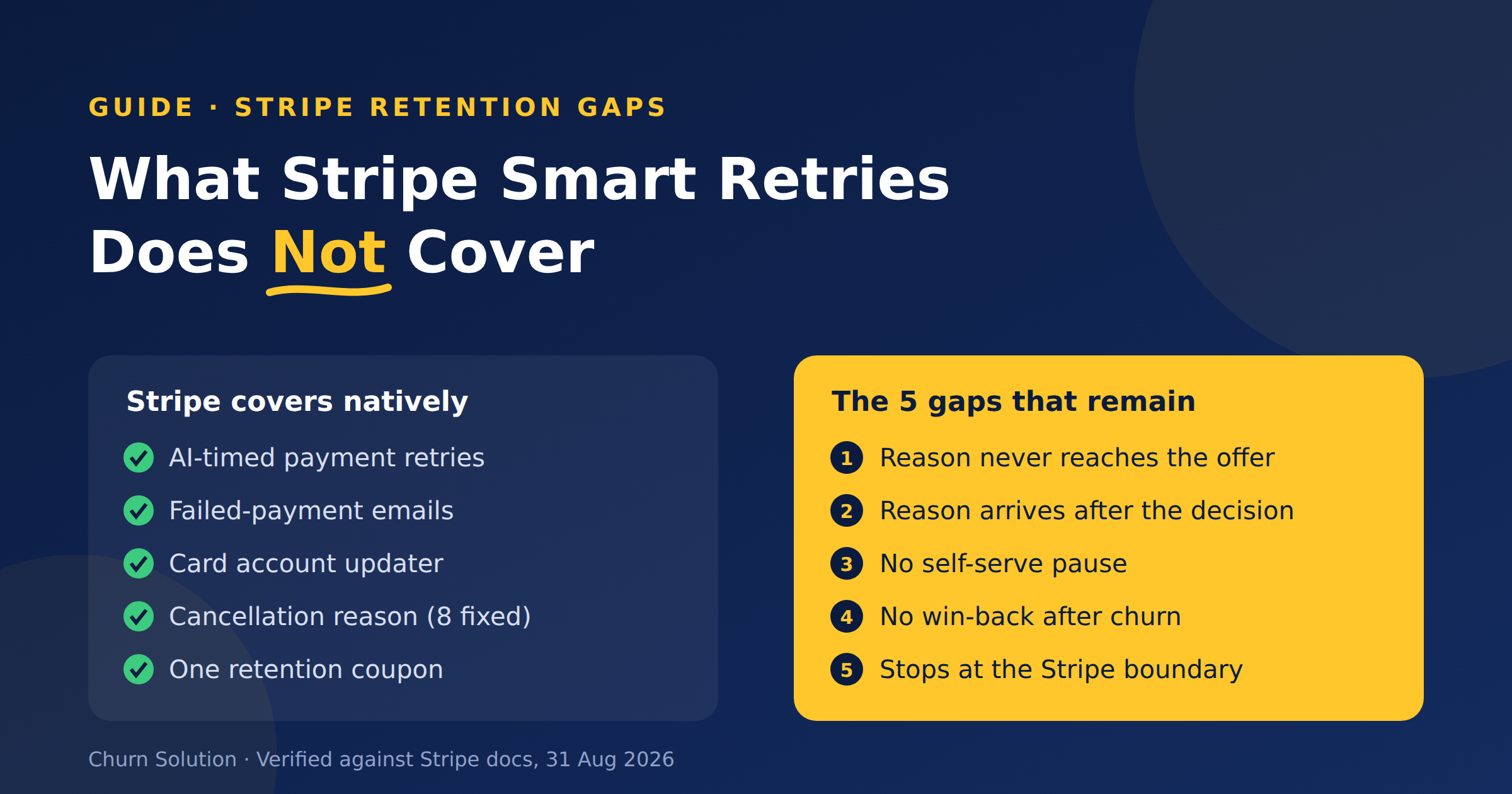
What Stripe Smart Retries Does Not Cover
Stripe Smart Retries recovers failed payments but doesn't run retention. Here are the five gaps that remain, sourced from Stripe's...

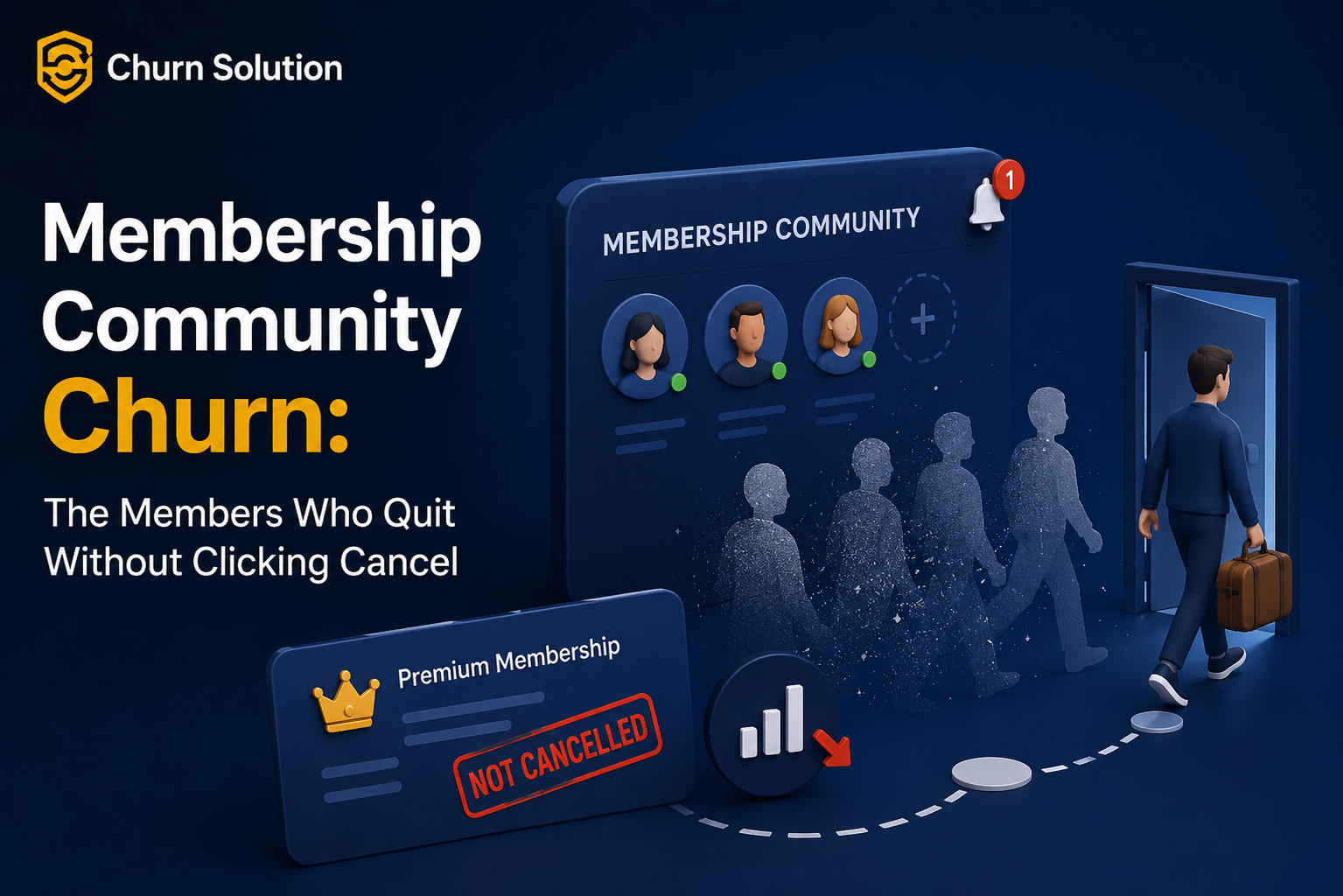
Membership Community Churn: The Members Who Quit Without Clicking Cancel
Quiet churn is the real leak: members who never clicked “cancel” at all. A card expires. A bank declines a...


Subscription Churn Dashboard: The 2026 Guide to Actionable Revenue Intelligence
Up to 40% of subscription churn is involuntary, meaning your customers aren't choosing to leave; they're being forced out by...