ARTICLE
Customer Churn Analysis: The 2026 Guide to Data-Driven Revenue Retention

Customer acquisition costs have surged by over 222 percent in the last five years, making the “growth at all costs” model obsolete. You recognize that every lost subscriber is a direct hit to your Net Revenue Retention and a failure of your current data architecture. With the median churn rate for computer software now sitting at 14 percent, most teams still perform customer churn analysis as a historical post-mortem instead of a proactive revenue diagnostic. Data silos and an inability to distinguish between voluntary and involuntary churn continue to mask the true causes of revenue leakage.
This guide delivers the frameworks and automated interventions you need to diagnose these leaks and reclaim your growth trajectory. You’ll learn to deploy AI-powered feedback analysis and smart retry logic to intercept cancellations before they occur. We’ll break down the systems required to transform raw behavior data into high-performance retention strategies that scale. From dunning automation to dynamic win-back campaigns, it’s time to stop guessing why users leave and start controlling your revenue outcomes with technical precision.
Key Takeaways
- Shift your perspective from reactive reporting to a real-time revenue diagnostic that uncovers exactly why subscribers stop paying.
- Distinguish between the deliberate decision to cancel and the “silent killer” of involuntary churn caused by failed transactions and expired cards.
- Master behavioral segmentation and customer churn analysis to pinpoint at-risk user cohorts based on declining engagement metrics.
- Deploy automated save flow architectures and dynamic offers that intervene with the right solution at the exact moment of friction.
- Optimize your revenue recovery by integrating smart retries and dunning automation directly into your existing billing ecosystem.
What is Customer Churn Analysis? Defining the Revenue Diagnostic
Customer churn analysis is the systematic process of identifying why and how subscribers stop paying for your service. It isn’t a passive report. It’s a high-stakes revenue diagnostic designed to find the exact point where value perception fails. Historically referred to as Customer attrition, modern analysis has moved beyond simple headcounts. In 2026, the industry standard has shifted from manual spreadsheets to automated, real-time data streams that trigger immediate action.
You must distinguish between descriptive and prescriptive analysis. Descriptive analysis merely catalogs what happened in the past. It’s a rearview mirror approach that provides little utility for growth. Prescriptive analysis uses that data to determine exactly how to fix the problem. If you don’t know if a user left because of a technical bug or a pricing mismatch, you can’t deploy a targeted recovery. This lack of clarity destroys your LTV:CAC ratio. Since acquiring a new customer is 5 to 25 times more expensive than retaining one, every unanalyzed exit represents a significant waste of marketing capital.
The Core Objectives of Modern Churn Diagnostics
The primary goal is to identify high-risk customer segments before they reach the exit point. You’re looking for behavioral red flags, such as declining login frequency or reduced feature adoption. Once you identify these segments, you can quantify the financial impact of specific churn reasons. You’ll know if a price hike caused more revenue loss than a missing product integration. Finally, this diagnostic validates the effectiveness of your current retention offers. It tells you if your save-flows are actually working or if they’re just delaying the inevitable.
Key Metrics: Beyond the Basic Churn Rate
To truly understand your business health, you must look at churn metrics that reflect revenue, not just user counts. Net Revenue Retention (NRR) is the percentage of recurring revenue retained from existing customers over a set period. It’s the ultimate SaaS health metric because it accounts for both losses and expansion revenue. While Gross Churn shows you the total revenue lost, Net Churn factors in upsells and cross-sells. High-performance companies aim for over 100 percent NRR, meaning their existing customer base grows even without new acquisitions. Mastering these nuances allows you to transform customer churn analysis from a cost-center into a growth engine.
Deconstructing Churn Types: Voluntary vs. Involuntary Revenue Loss
Effective customer churn analysis requires more than just counting cancellations. You must categorize every lost dollar by its root cause. Churn isn’t a monolith. It’s split into voluntary and involuntary loss. While one is a failure of value, the other is a failure of infrastructure. Treating them the same is a strategic error that leads to wasted resources and continued revenue leakage. You need to know if the customer chose to leave or if your payment processor chose for them.
Voluntary Churn: The Psychology of the Exit
Voluntary churn is the deliberate act of a user ending their relationship with your product. It signals a disconnect between your price and the perceived utility. To fix this, you need exit surveys to capture qualitative data at the moment of friction. By applying customer churn insights for business growth, you can identify if users are leaving because of specific feature gaps or changing market needs. Segment this data by plan tier. High-value users leaving for competitors requires a different intervention than low-tier users who find the tool too complex. You can’t solve a value perception problem with a technical fix; you need to understand the human reason behind the “goodbye.”
Involuntary Churn: The Technical Failure Points
Involuntary churn is the silent killer of MRR. It accounts for 20 to 40 percent of total SaaS churn, yet many teams ignore it. This occurs when a subscription fails due to expired cards, bank declines, or administrative errors. It’s revenue loss without a customer’s intent to leave. You can stop this leak by implementing payment recovery systems that handle the heavy lifting. Use smart retries to time transaction attempts based on machine learning, which bypasses temporary bank declines. If you haven’t optimized your recovery cadence, read our guide on Mastering Dunning Email Automation to see how to recover at-risk accounts.
Diagnosing these types requires specific data points. For voluntary churn, track NPS scores, feature usage trends, and exit survey responses. For involuntary churn, monitor decline codes, card expiration dates, and dunning success rates. If your current stack doesn’t provide this level of granularity, you’re flying blind. You can start building your recovery engine today to gain full visibility into these revenue leaks and stop the bleed immediately.

Advanced Frameworks for Churn Segmentation and Predictive Modeling
Advanced customer churn analysis demands a transition from historical reporting to predictive modeling. You can’t rely on aggregate numbers to save a failing subscription base. Instead, you must deploy granular frameworks that segment users by behavior and acquisition timing. This precision allows you to identify the specific cohorts that are bleeding revenue and the behavioral triggers that precede a cancellation. Moving beyond the “what” to the “who” and “when” is the only way to build a resilient growth strategy.
Cohort Analysis for Long-Term Retention Trends
Building a cohort table is the only way to visualize the “cliff” where most users drop off. By grouping subscribers by their signup month, you can track their survival rate over time. If your Month 3 retention consistently dips below 60 percent, you’ve identified a critical value gap in your user journey. This framework also allows you to compare retention across different marketing channels. You might find that organic search leads have a 20 percent higher lifetime value than paid social leads, which directly informs your acquisition strategy. To scale this process, our churn metrics product page provides the automated reporting required to track these trends in real-time without manual data entry.
Leveraging AI for Feedback Analysis
Manual survey review is obsolete for any company scaling past 1,000 users. You can’t expect a human team to extract actionable themes from thousands of open-ended exit survey responses every month. This is where AI feedback analysis becomes an essential revenue diagnostic. AI sentiment analysis converts qualitative complaints into quantitative data. It detects subtle sentiment shifts across your entire customer base, identifying emerging issues before they spark a mass exodus. By turning raw text into structured categories like “Pricing Dissatisfaction” or “UI Complexity,” you can prioritize product updates based on their actual impact on your bottom line. To understand how this process works end-to-end, see our deep dive on AI churn feedback analysis and turning qualitative exit data into revenue recovery.
Behavioral Segmentation and Predictive Scoring
Waiting for a user to hit the cancel button is a losing strategy. Predictive churn scoring assigns a risk value to every account in your CRM based on real-time behavioral data. You’re looking for patterns like declining login frequency, reduced feature adoption, or a sudden spike in support tickets. When an account’s risk score crosses a specific threshold, it should trigger an automated intervention. This proactive approach ensures your team focuses their energy on the accounts most likely to churn, rather than treating every subscriber with a generic, ineffective retention plan. By the time a user reaches your cancellation page, your predictive models should have already flagged them as a high-risk asset. For a comprehensive breakdown of how to decode the signals subscribers send before they leave, our guide on customer departure insights and reducing subscription churn walks through the full framework for transforming exit data into a strategic retention engine.
Operationalizing Insights: From Analysis to Automated Intervention
A static report is a liability if it doesn’t trigger a real-time response. You’ve diagnosed the revenue leaks; now you must plug them with automated systems. Moving from customer churn analysis to active intervention requires a shift in mindset. You’re no longer just observing loss. You’re engineering saves. According to McKinsey (2024), improving customer experience through data-driven strategies can reduce churn by up to 15 percent. This isn’t achieved through manual outreach, but through a structured architecture that responds to user behavior at the exact moment of friction.
The “Save Flow” architecture transforms the cancellation process into a dynamic negotiation. When a user initiates a cancellation, the system shouldn’t just process the request. It must deploy dynamic offers tailored to the specific churn reason identified in your diagnostic phase. If the user cites pricing, offer a temporary discount or a plan downgrade. If they mention project completion, suggest a “pause” state to preserve their data. This level of personalization is only possible when your analysis is integrated directly into your checkout and billing stack.
Building the Automated Save Flow
Effective retention begins with a sophisticated customer portal. This interface serves as the primary touchpoint for account management, providing alternatives to the exit button. Within this portal, you must treat retention like a conversion funnel. Trigger AB experiments to determine which save-offer resonates best with specific user groups. For a deeper dive into technical setup, consult The Definitive Guide to Automated Cancellation Flows in 2026.
Win-Back and Reactivation Strategies
Retention doesn’t end when a user leaves. High-performance teams use customer segmentation to fuel targeted win-back campaigns. These are not generic blasts. They are surgical strikes. Use reactivation workflows that time emails based on the original churn reason. For instance, a user who left due to a missing feature should be contacted the moment that feature is shipped. Acquiring a new customer is 5 to 25 times more expensive than retaining an existing one, so the ROI on these reactivation efforts is inherently higher than standard marketing spend.
Success in 2026 relies on your ability to automate these interventions. If you’re still relying on manual spreadsheets to track your saves, you’re losing revenue every hour. You can deploy your automated save flow today and start recovering lost MRR with precision.
Building a High-Performance Retention Engine with Churn Solution
You’ve identified the leaks. Now you need the infrastructure to plug them. Churn Solution integrates directly with your billing stack, whether you use Stripe or Paddle, to turn raw data into a real-time revenue diagnostic. This isn’t just about customer churn analysis as a reporting function. It’s about building an automated engine that protects your MRR without increasing your team’s workload. By syncing your billing data with our recovery tools, you gain a unified view of your revenue health that manual spreadsheets can’t replicate.
The true power lies in the synchronization of recovery tools. By combining payment recovery and dunning automation with intelligent cancellation flows, you address both sides of the churn equation simultaneously. While smart retries handle technical failures, your save-flow manages the psychological exit. This unified approach ensures no customer slips through the cracks due to fragmented tooling or delayed data processing. It’s a comprehensive system designed for high-performance subscription businesses.
The results are measurable and rapid. Typical SaaS platforms using this integrated approach reduce churn by 20 percent within the first 90 days of implementation. This shift transforms your retention efforts from a defensive customer churn analysis posture into a proactive revenue protection function. You’re no longer just observing loss; you’re actively reclaiming capital that has already been won. Since a 5 percent increase in customer retention can lead to a 25 to 95 percent increase in profits, the financial impact of this engine is undeniable.
Why Churn Solution is the Expert in the Room
Our platform operates with the precision of a dedicated data science team but without the overhead. We provide a seamless integration that identifies high-risk segments and deploys dynamic offers automatically. Churn Solution acts as the innovator expert that understands the technical nuances of the subscription economy. We offer a high-performance environment where every data point is leveraged for recovery, ensuring your growth remains sustainable and predictable.
Next Steps for Your Retention Strategy
Stop letting revenue leak through unoptimized workflows. Your first move is to audit your current exit intent and payment failure processes. Identify where you’re losing users to administrative errors versus value perception. Once you’ve mapped these friction points, you can set up your first automated save-flow to intervene before the cancel button is hit. Protect your subscription revenue with Churn Solution and turn your retention data into a high-performance growth strategy today.
Secure Your Revenue Future with Data-Driven Precision
The transition from a reactive business model to a proactive revenue engine requires more than just observation. It demands the integration of sophisticated diagnostic tools that distinguish between a user’s choice to leave and a technical failure in your billing stack. By mastering customer churn analysis, you move beyond mere reporting and begin to command your growth trajectory. You’ve seen how predictive scoring and automated save flows salvage high-risk accounts, transforming potential losses into expansion opportunities.
It’s time to operationalize these insights. Leverage AI-driven feedback insights to understand the “why” behind every exit and deploy automated revenue recovery systems that work around the clock. With seamless Stripe and billing integration, Churn Solution provides the technical mastery required to optimize your Net Revenue Retention with zero friction. Don’t let your growth be undermined by preventable leaks. Take control of your subscriber base with a system built for the high-performance subscription economy.
Stop the bleed and start recovering revenue today with Churn Solution. Your path to sustainable, data-driven growth starts here.
Frequently Asked Questions
What is the most important metric in customer churn analysis?
Net Revenue Retention (NRR) is the definitive metric because it measures the long-term viability of your revenue base. While simple churn rates track lost accounts, NRR accounts for expansion revenue and upsells. High-performance companies target an NRR above 100 percent to ensure growth from existing users, even without new acquisitions.
How often should a SaaS company perform a churn analysis?
You should monitor your churn diagnostics in real-time through automated dashboards. While a deep-dive customer churn analysis into cohort performance is typically conducted monthly, your intervention systems must respond to behavioral triggers instantly. Waiting for a quarterly report allows revenue leaks to become permanent losses that are impossible to recover.
Can AI actually predict which customers are about to cancel?
Yes, AI uses predictive scoring to identify accounts showing at-risk behavioral patterns. By analyzing declining login frequency or reduced feature adoption, these models assign a risk value to every account in your CRM. This allows your team to intervene with personalized offers or automated save flows before the user ever reaches the cancellation page.
What is the difference between customer churn and revenue churn?
Customer churn measures the percentage of subscribers who leave, while revenue churn measures the actual dollar amount lost. In a tiered pricing model, losing one enterprise account can be more damaging than losing fifty entry-level users. Revenue churn is the superior indicator of business health and valuation because it reflects the actual impact on the bottom line.
How do I reduce involuntary churn caused by failed payments?
Deploying smart retries and dunning email automation is the most effective way to recover administrative losses. These systems use machine learning to time transaction attempts when they’re most likely to succeed. Involuntary churn accounts for 20 to 40 percent of total SaaS churn, making automated recovery a high-ROI priority for any subscription business.
What are the most common reasons for voluntary customer churn in SaaS?
Users typically leave due to pricing dissatisfaction, missing features, or a lack of perceived value. Research indicates that 68 percent of churn occurs because customers feel unappreciated by the provider. Capturing these reasons through exit surveys allows you to address the root causes of dissatisfaction systematically and refine your product roadmap based on real user feedback.
How do automated cancellation flows help with churn analysis?
Automated cancellation flows serve as a qualitative data collection point that identifies the “why” behind every exit. They transform a binary “cancel” action into a diagnostic event. This data allows you to segment customer churn analysis by reason, enabling you to build more effective save-offers and interventions based on actual user sentiment.
Is it better to offer a discount or a pause option to a cancelling customer?
The choice depends entirely on the churn reason identified during the cancellation process. If a user cites budget constraints, a dynamic discount offer is the appropriate intervention to preserve the revenue. If the user reports a temporary project completion or seasonal downtime, a pause option preserves the account data and maintains the long-term relationship without a permanent cancellation.
- Key Takeaways
- Table of Contents
- What is Customer Churn Analysis? Defining the Revenue Diagnostic
- Deconstructing Churn Types: Voluntary vs. Involuntary Revenue Loss
- Advanced Frameworks for Churn Segmentation and Predictive Modeling
- Operationalizing Insights: From Analysis to Automated Intervention
- Building a High-Performance Retention Engine with Churn Solution
- Secure Your Revenue Future with Data-Driven Precision
- Frequently Asked Questions

Churn solution that turns your customers right around.
Related Articles
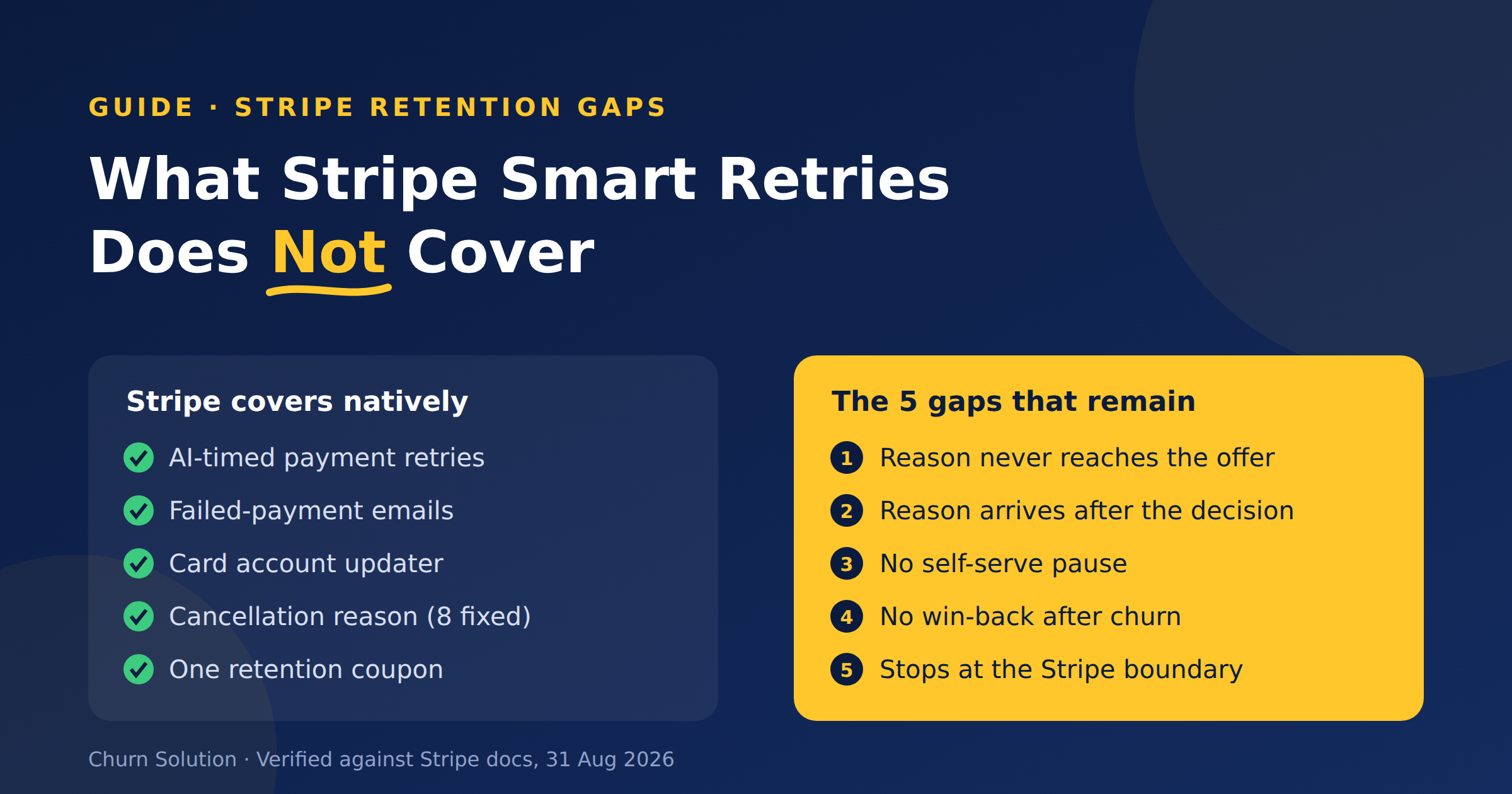
What Stripe Smart Retries Does Not Cover
Stripe Smart Retries recovers failed payments but doesn't run retention. Here are the five gaps that remain, sourced from Stripe's...

Membership Community Churn: The Members Who Quit Without Clicking Cancel
Quiet churn is the real leak: members who never clicked “cancel” at all. A card expires. A bank declines a...

Subscription Churn Dashboard: The 2026 Guide to Actionable Revenue Intelligence
Up to 40% of subscription churn is involuntary, meaning your customers aren't choosing to leave; they're being forced out by...