ARTICLE
Membership Community Churn: The Members Who Quit Without Clicking Cancel
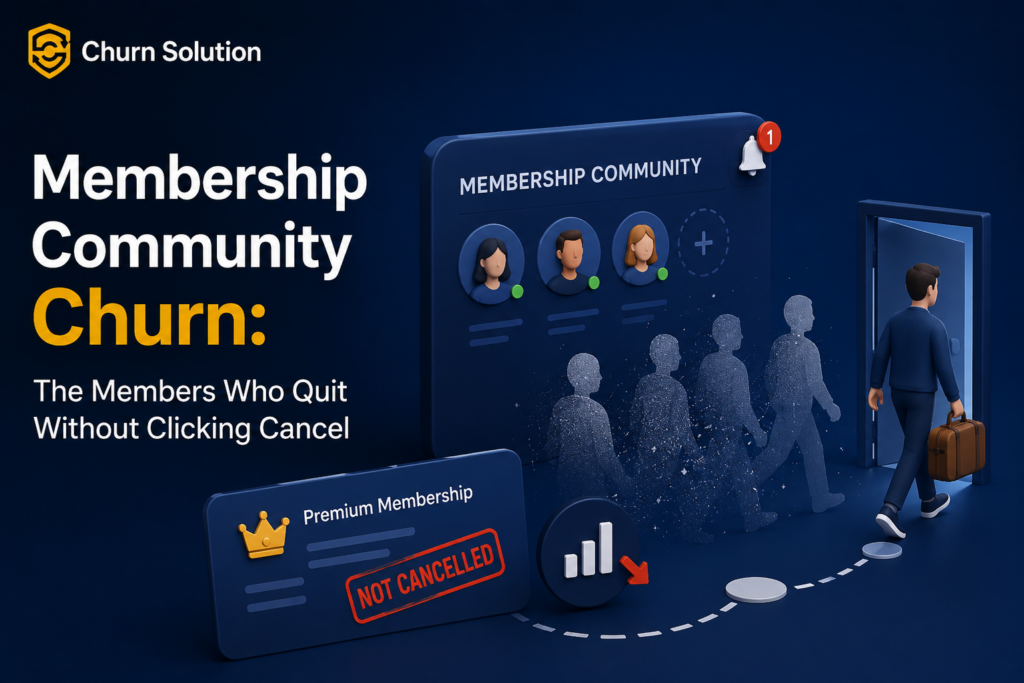
Most membership operators track one number: cancellations. That’s the wrong number to watch first.
Quiet churn is the real leak: members who never clicked “cancel” at all. A card expires. A bank declines a renewal. A subscription just stops — no click, no exit survey, no signal. You find out weeks later, when MRR is already down.
This post breaks down the two types of membership churn, why paid communities are especially exposed to the quiet kind, and a practical framework for catching both before they compound.
Key takeaways
- Quiet churn (involuntary) happens when a payment fails — expired card, insufficient funds, bank decline — not when a member decides to leave.
- Loud churn (voluntary) happens when a member actively cancels. It’s visible, but it’s only half the picture.
- Annual renewal cycles make membership communities more exposed to quiet churn than monthly SaaS tools, because cards go stale over 12 months.
- Community access often continues after a failed payment (nobody manually removes the member), which hides the revenue loss even longer.
- Fixing quiet churn starts with retry logic, not win-back emails — recover the payment before you try to recover the relationship.
- A structured win-back sequence for lapsed members can recover revenue you’ve already written off. See our win-back campaigns guide for the full sequence.
What “quiet churn” means for membership communities
Churn is usually modeled as one event: a subscriber decides to leave. For membership communities, that’s incomplete.
There are two distinct paths out the door:
Voluntary cancellation
The member actively cancels. They click “cancel,” fill out an exit survey, or message support. You know exactly when it happened and, often, why. This is loud churn — visible, trackable, and the type most cancellation-flow tools are built around.
Involuntary churn (the quiet kind)
The member never decides to leave. Their card expires. Their bank flags the renewal charge as suspicious. Their account has insufficient funds on the exact day billing runs. The subscription simply fails to renew. Depending on your platform’s default behavior, access may keep running for days or weeks after the member has effectively stopped paying.
Quiet churn is the harder problem for three reasons:
- No exit intent to capture. There’s no cancel button click to trigger a save offer. The member isn’t signaling anything — the payment rail is just failing silently.
- No obvious trigger for outreach. Support doesn’t get a ticket. Nobody flags it. It shows up as a dip in MRR, not a support conversation.
- It compounds monthly. Every renewal cycle has a fresh batch of expiring cards and failed charges. Left unaddressed, quiet churn becomes a permanent tax on revenue.
Why membership communities are especially exposed to quiet churn
Every subscription business deals with failed payments. Membership communities carry more exposure than typical monthly SaaS for a few structural reasons.
Annual billing is common. Course-and-community hybrids and creator memberships frequently price annually to reduce commitment friction and improve cash flow. A card that’s valid in January is a coin flip 12 months later. Annual renewals concentrate a large batch of stale-card failures into a single billing run.
Access doesn’t always cut off immediately. In a typical SaaS product, a failed payment can lock the account fast. In a Circle, Mighty Networks, or Discord/Slack-based community, access is often manual or loosely enforced — the member keeps posting, keeps showing up to calls, keeps reading content, while the payment sits unresolved in the background. That’s good for member experience in the short term. It’s bad for catching revenue leakage, because nothing forces the issue.
Community engagement masks payment status. An engaged member who’s still active in Slack or showing up to live calls looks retained. Operators watching engagement metrics instead of billing status can miss that the member hasn’t paid in two months.
Card-on-file volume is high relative to team size. Many membership businesses run lean — a solo creator or small team managing hundreds or thousands of recurring cards with no dedicated billing ops person watching decline rates.
The real cost of quiet churn
Quiet churn is commonly cited in subscription analytics as accounting for a meaningful share of total churn — often referenced in the 20-40% range across payment-based subscription businesses, depending on card mix and geography. Treat that range as a directional estimate, not a benchmark for your business — payment failure rates vary by processor, card type, and audience. (See Sources below.)
What’s not an estimate: every failed payment your platform doesn’t retry, or retries badly, is revenue you’ve already earned and are about to lose. The member wanted to keep paying. The charge just didn’t go through.
This is why quiet churn is often the highest-leverage fix in a membership business. You’re not trying to convince someone to stay. They already decided to stay — you just need the payment to clear.
How to catch quiet churn before it drains revenue
Fix the retry logic first
Most platforms retry failed charges on a fixed schedule regardless of why the charge failed. That’s a weak default. A card declined for “insufficient funds” behaves differently than one declined for “expired card” or “do not honor.” Retrying at the wrong time, or retrying a decline that will never succeed, wastes attempts and annoys members with repeated charge notifications.
Smart retries match the retry timing and messaging to the decline reason. For a full breakdown of what each Stripe decline code means and whether it’s worth retrying, see our guide on decline-code-aware retries.
Pair retries with dunning communication
A retry alone recovers some payments. Retry plus a clear, well-timed email or SMS (“your card was declined, here’s a one-click update link”) recovers more. Members in a paid community generally want to stay — most failed renewals are a logistics problem, not a loyalty problem. For the mechanics of building this system on Stripe, see our guide to failed payment recovery.
Watch decline rate as a leading indicator
Don’t wait for MRR to dip. Track failed-payment rate weekly, segmented by billing cycle (monthly vs. annual). A spike after an annual renewal batch is your earliest signal that card staleness is catching up with you.
Decide your access policy deliberately
Choose, on purpose, how long a member keeps access after a failed payment — not by default. A short grace period paired with proactive card-update messaging usually recovers more revenue than an indefinite grace period that removes any urgency to fix the payment.
Win-back campaigns for lapsed members
Some members will still churn — payment never recovers, or they actively decide to leave. That doesn’t mean the revenue is gone for good.
A structured win-back sequence targets members who’ve lapsed, whether from a failed payment that was never resolved or a voluntary cancellation. The mechanics differ from acquisition marketing. You’re not introducing the community — you’re reminding a former member what they’re missing, and removing the friction that’s keeping them from coming back (updating a card, seeing what’s new, a limited-time re-entry offer).
For the full sequence structure — timing, messaging, and offer design — see our win-back campaigns guide.
Don’t ignore intentional cancellations either
Quiet churn deserves more attention than it usually gets, but voluntary cancellations still matter. A well-built cancellation flow — one that asks why before confirming the cancellation and offers a relevant save (a pause option, a discount, a downgrade) — reduces loud churn the same way retries reduce quiet churn. Treat the two as complementary systems, not competing priorities.
A simple framework: Catch, Recover, Win Back
- Catch — Instrument failed-payment and decline-rate tracking so quiet churn is visible, not hidden inside engagement metrics.
- Recover — Use decline-code-aware retries and dunning messaging to fix the payment before the member ever needs to be “won back.”
- Win back — For members who do lapse, run a dedicated win-back sequence instead of letting them sit on a static “former member” list.
Proof: Revenue Recovered From Quiet Churn
Across customers, Churnsolution has helped recover $3M+ in revenue through automated payment recovery and retention flows. In one case study, a customer reported a 52% reduction in churn. In another, a win-back sequence achieved a 67% reactivation rate among lapsed subscribers. Across customer accounts, Churnsolution flows have saved 11,000 subscriber sessions from cancellation. These are case-study results, not guaranteed averages — but they show the scale of revenue that’s typically sitting in “quiet” churn, unaddressed.
How Much Is Quiet Churn Costing Your Community?
If you run a paid community, course-and-community hybrid, or creator membership, quiet churn is probably a bigger line item than your cancellation rate suggests. We’ll audit your Stripe account, show you exactly how much revenue is recoverable, and tell you where to fix it first — before you spend another dollar on new member acquisition.
- Key takeaways
- What “quiet churn” means for membership communities
- Why membership communities are especially exposed to quiet churn
- The real cost of quiet churn
- How to catch quiet churn before it drains revenue
- Win-back campaigns for lapsed members
- Don’t ignore intentional cancellations either
- A simple framework: Catch, Recover, Win Back
- Proof: Revenue Recovered From Quiet Churn
- How Much Is Quiet Churn Costing Your Community?

Churn solution that turns your customers right around.
Related Articles
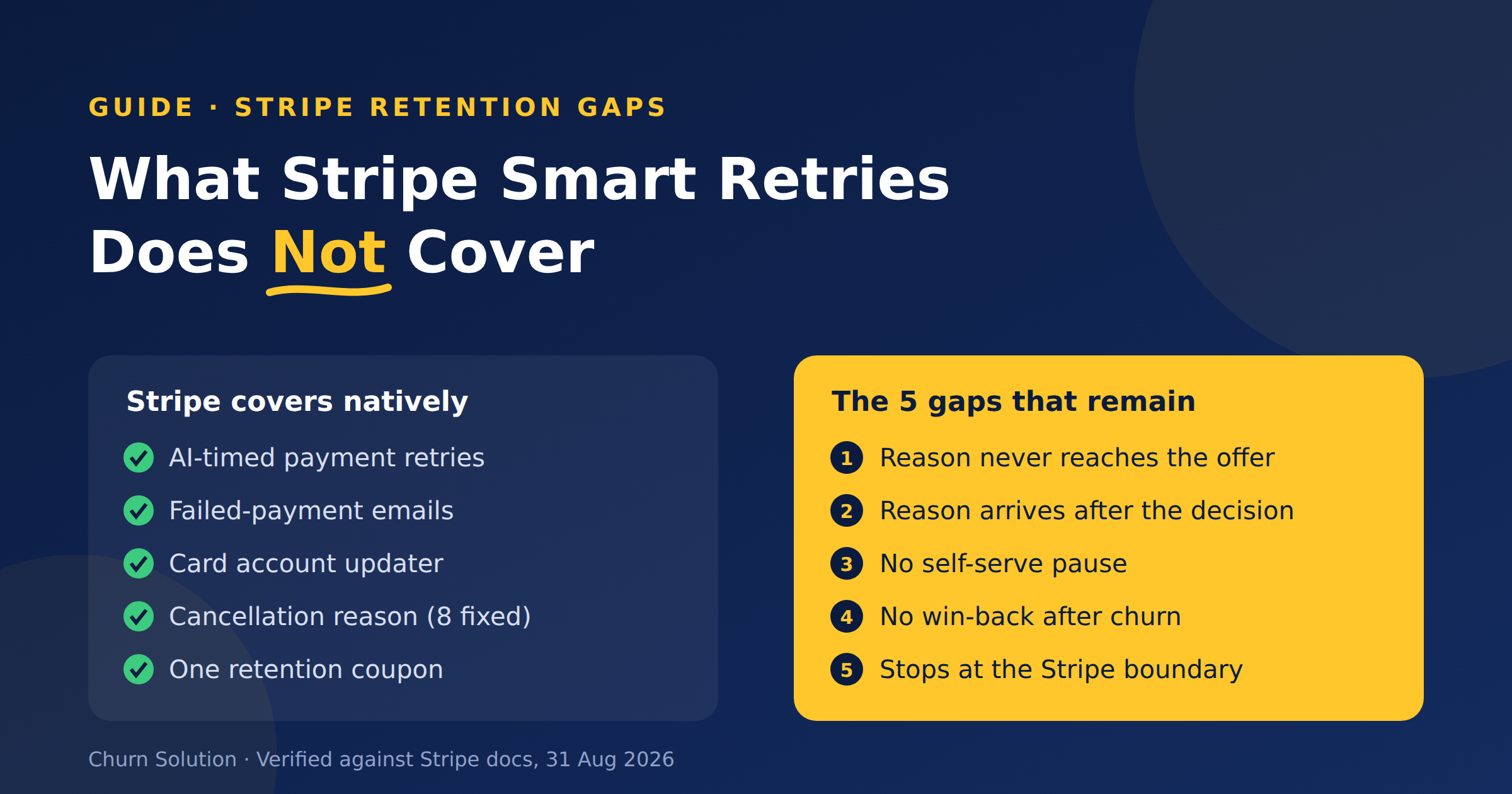
What Stripe Smart Retries Does Not Cover
Stripe Smart Retries recovers failed payments but doesn’t run retention. Here are the five gaps that remain, sourced from Stripe’s…

Subscription Churn Dashboard: The 2026 Guide to Actionable Revenue Intelligence
Up to 40% of subscription churn is involuntary, meaning your customers aren’t choosing to leave; they’re being forced out by…

Dynamic Retention Offers: The 2026 Guide to Automated Revenue Recovery
Did you know that acquiring a new customer in 2026 costs up to 25 times more than retaining an existing…