ARTICLE
Dynamic Retention Offers: The 2026 Guide to Automated Revenue Recovery
Did you know that acquiring a new customer in 2026 costs up to 25 times more than retaining an existing one? Most subscription leaders understand this reality, yet they still watch helplessly as high churn rates eat into their monthly recurring revenue. You’ve likely tried blanket discounts to stop the bleed, only to find they erode your profit margins without addressing the root cause of the exit. It’s a reactive cycle that lacks visibility and fails to scale as your business grows.
This guide will show you how to break that cycle by implementing dynamic retention offers that transform cancellation intent into long-term loyalty. You’ll learn to deploy an automated system that saves customers without human intervention, protecting your margins through surgical, data-driven incentives. We’ll examine the specific mechanics of revenue recovery, from optimizing Subscriber Lifetime Value (LTV) to extracting actionable intelligence from AI-powered exit surveys. It’s time to stop guessing why customers leave and start using automated flows to keep them. By the end of this article, you’ll have a blueprint for a high-performance retention engine that operates with technical mastery and strategic precision.
Key Takeaways
- Shift from generic discounting to strategic, value-based retention to protect your SaaS margins and stop revenue leaks.
- Deploy dynamic retention offers that utilize behavioral triggers and exit survey data to deliver the right incentive at the exact moment of cancellation.
- Utilize subscription pauses and plan downgrades to recover at-risk users without losing the customer relationship entirely.
- Connect specific exit reasons, such as price sensitivity or low usage, to automated offer categories for maximum relevance and impact.
- Automate your save flows through integrated engines to scale your retention efforts without taxing your engineering or support teams.
Beyond Blanket Discounts: The Evolution of Dynamic Retention Offers
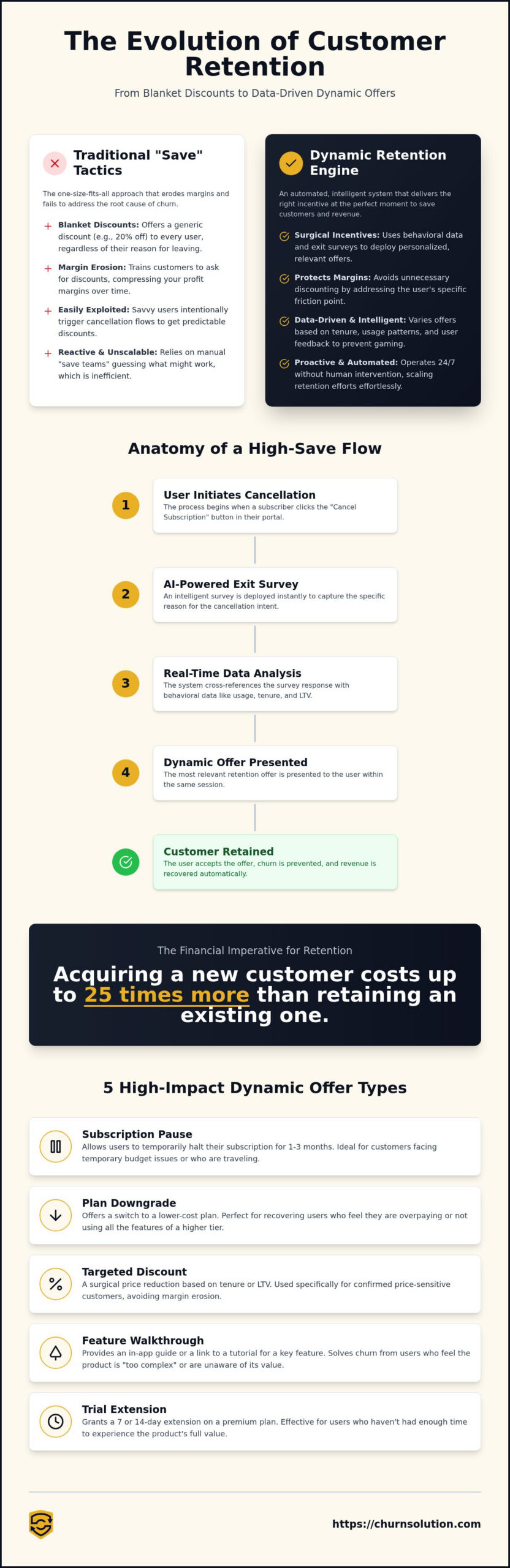
The subscription economy has reached a tipping point where traditional “save” tactics no longer suffice. For years, SaaS companies relied on transactional discounting as a primary defense against churn. If a user attempted to leave, the system would trigger a generic 20% discount code. This approach is fundamentally flawed. It treats every cancellation as a price objection, ignoring the nuanced psychological reasons behind a user’s decision to exit. Modern customer retention requires a shift from these desperate, one-size-fits-all bribes to sophisticated, value-based interventions. By deploying dynamic retention offers, you move beyond temporary compliance and start building long-term loyalty through relevance.
Static offers are the primary driver of margin erosion in mature subscription businesses. When you present the same incentive to every departing user, you fail to address the specific friction points that led to their exit intent. A customer leaving because of a lack of technical support doesn’t need a discount; they need an onboarding session or a feature walkthrough. Offering a price cut to a satisfied but over-budget user might save the account, but doing the same for a user who simply isn’t using the product is a wasted gesture. Dynamic offers use real-time intelligence to ensure the intervention matches the intent, protecting your bottom line while recovering revenue that would otherwise be lost to the void.
The Problem with Predictability in Retention
Predictable cancellation flows are easily exploited. Savvy subscribers have learned to game standard systems, intentionally triggering the “cancel” button just to harvest a discount they know is coming. This behavior creates a cycle of “discount fatigue” where your brand perception shifts from a premium solution to a commodity. Predictability in retention pricing leads to involuntary margin compression because your lowest price point becomes your default price point for anyone willing to click a button. You aren’t saving customers; you’re simply training them to pay you less for the same value. To combat this, you must implement dynamic offers that vary based on tenure, usage patterns, and specific feedback.
Defining the Dynamic Intervention Model
The dynamic model replaces manual, unscalable “save teams” with automated, data-driven flows. Instead of a support agent guessing what might keep a customer, the system processes exit surveys and behavioral data in milliseconds to present the most logical solution. This transition from reactive saves to proactive revenue protection is essential for growth. It allows your engineering and support teams to focus on core product value while an automated engine handles the surgical recovery of at-risk MRR. It’s a high-performance framework that treats retention as a technical optimization problem rather than a negotiation, ensuring every save is both profitable and sustainable.
What is a Dynamic Retention Offer? Anatomy of a High-Save Flow
A dynamic retention offer is a surgical, automated intervention triggered the moment a subscriber initiates the cancellation process. Unlike the static, manual “save” attempts common in legacy credit card industries, these offers rely on a real-time logic engine to match a specific incentive to a user’s unique behavior. It’s an intelligent response to exit intent. By integrating these technical triggers with broader customer retention strategies, you ensure your automated flows align with long-term growth rather than just providing a temporary patch. The goal is to resolve the friction point immediately within the customer portal, preventing the need for human support intervention.
The efficacy of dynamic retention offers rests on three foundational pillars: behavioral triggers, exit survey data, and customer segmentation. When a user clicks “cancel,” the system doesn’t just ask why; it cross-references their survey response with their historical usage and account value. If a user cites “missing features” but has never accessed your core tools, the engine presents a walkthrough or a trial extension instead of a discount. This data-driven approach ensures that every “save” is margin-positive. Predictive models can now identify at-risk customers with 80% to 90% accuracy, allowing these engines to act with incredible precision. You aren’t just guessing; you’re executing a calculated revenue recovery plan.
Behavioral Triggers: Timing is Everything
Timing is the difference between a saved account and a lost subscriber. High-save flows identify “at-risk” signals long before the final cancellation click. A sharp decline in login frequency or a plateau in feature adoption serves as a leading indicator of churn. By linking these churn metrics to automated interventions, you can present a dynamic retention offer at the peak moment of dissatisfaction. This proactive stance transforms a potential exit into an opportunity for re-engagement. It’s about catching the leak before the bucket is empty.
Customer Segmentation: Not All Churn is Equal
Treating a high-LTV enterprise account the same as a low-tier individual user is a strategic error. Effective customer segmentation allows you to protect your most valuable MRR with higher-tier incentives while maintaining strict margin control on smaller accounts. Tenure also dictates the offer type. A loyal advocate of three years who suddenly cancels due to budget cuts deserves a more aggressive “pause” or “discount” option than a new user who hasn’t reached the “Aha!” moment. Segment. Target. Recover. This methodical breakdown ensures that your retention efforts scale without eroding your brand’s perceived value. Start optimizing your save flows today to see these mechanics in action.
The 5 Most Effective Types of Dynamic Retention Offers
To recover revenue effectively, you must match the incentive to the specific friction point identified during the exit process. Dynamic retention offers aren’t a single tool; they are a toolkit. Deploying the wrong offer at the wrong time doesn’t just lose the customer; it erodes your brand’s perceived value. By mapping specific exit reasons to these targeted incentives, you ensure that your margins remain protected while your retention rates climb. There are five primary offer types that every sophisticated SaaS leader should have in their automated arsenal.
- Subscription Pause: This allows users to halt billing for 1 to 3 months. It’s the most effective way to save customers who are “too busy” or facing temporary project lulls.
- Plan Downgrades: When price is the primary friction, moving a user to a lower tier captures remaining value. It prevents a total loss of MRR.
- Temporary Discounts: Time-bound price drops (e.g., 50% off for 3 months) bridge usage gaps. They provide immediate relief without permanently lowering your price floor.
- Feature Credits/Add-ons: You can increase value perception without decreasing price. Offering a premium add-on for free for a limited time can re-engage a user who feels they’ve outgrown the base product.
- Win-back Credits: These apply a balance to the user’s account if they choose to stay. It creates a psychological “sunk cost” that incentivizes them to continue using the platform.
Pause vs. Cancel: The Power of the “Snooze” Button
The data is clear: 40% of users would rather pause their subscription than cancel it entirely if the option is visible. Pausing is a low-friction alternative that keeps the customer relationship active. It prevents the data loss and configuration headaches associated with full offboarding, making reactivation much simpler. When you implement this within your automated cancellation flows, you provide a graceful exit that isn’t really an exit at all. It’s a strategic delay that preserves the long-term lifetime value of the account.
Value-Based Saves: Retaining Without Discounting
You don’t always need to cut your price to save a customer. Value-based saves solve the underlying problem that led to the cancellation intent. If a user hasn’t reached their “Aha!” moment, an “Extended Trial” or a free 1-on-1 training session is far more effective than a 20% discount. These interventions address the lack of perceived utility directly. Value-based saves ensure your product isn’t perceived as a discount brand; they reinforce the premium nature of your solution by solving problems rather than just lowering costs. By focusing on utility, you build a foundation for genuine loyalty rather than temporary, price-driven compliance.
Implementation: Turning Exit Surveys into Dynamic Saves
Implementation starts with high-fidelity intelligence. You can’t recover revenue if you’re operating in a data vacuum. The exit surveys you deploy at the point of cancellation are the primary diagnostic tools for your retention engine. They identify the “Why” behind the exit intent, allowing you to move beyond guesswork. By mapping specific survey responses to automated save categories, you ensure that every intervention is surgically targeted toward the user’s friction point.
The logic is straightforward but powerful. A user selecting “Too expensive” receives a plan downgrade or a temporary discount. A user claiming “Missing features” is presented with an onboarding credit or a feature walkthrough. This mapping transforms a passive survey into an active revenue recovery mechanism. You aren’t just collecting data; you’re using feedback analysis to refine your offer logic in real time. This ensures your dynamic retention offers remain relevant as market conditions and customer expectations evolve.
AI-Driven Feedback Mapping
Modern retention systems use AI to bridge the gap between qualitative feedback and quantitative action. AI-powered models categorize open-ended survey responses into actionable retention buckets with high precision. If a customer writes a sentence about budget cuts, the system identifies the price sensitivity and triggers the dynamic offers engine immediately. Speed is a critical factor here. Presenting the offer the millisecond the survey is completed reduces friction and captures the user while they’re still engaged in the portal.
Continuous Optimization and Testing
A high-performance retention strategy is never static. You must utilize A/B experiments to find the winning combination of incentives. Test different discount depths against non-monetary offers like extended trials or premium support access. Establishing control groups is essential to measure true “save” incrementality; you need to know which customers would’ve stayed anyway versus those saved by the intervention.
Iterating on your voluntary churn reduction software settings allows you to optimize for both save rate and margin protection. It’s a technical balancing act. Too aggressive with discounts, and you erode LTV. Too conservative, and you lose the customer. Data-driven testing provides the evidence needed to strike the perfect balance.
Custom-building a retention engine is a strategic error that creates a persistent revenue leak within your engineering department. Instead of iterating on your core product, your developers end up maintaining complex logic for cancellation flows and billing state management. Churn Solution eliminates this technical debt. Our platform provides a sophisticated, “set it and forget it” infrastructure that handles the heavy lifting of automated revenue recovery. It integrates seamlessly with Stripe and other major billing platforms through robust APIs and webhooks. This ensures that your dynamic retention offers are executed with perfect technical accuracy and immediate billing state synchronization.
Real-time reporting provides immediate visibility into saved revenue and recovered Lifetime Value (LTV). You don’t have to wait for end-of-month audits to see the impact of your save flows. The dashboard tracks every interaction, from the initial exit survey to the final offer acceptance, providing a transparent view of your retention health across different customer segments. This level of granular data allows you to justify your retention spend with concrete performance metrics. You can see exactly which incentives are driving the highest ROI and which segments require more aggressive intervention.
Automating the Reactivation Cycle
Revenue recovery doesn’t end if a user declines the initial offer. Churn Solution manages the full reactivation cycle of lapsed users through automated win-back campaigns. By analyzing the data captured during the exit process, the system triggers targeted outreach weeks or months later with incentives specifically designed to bring them back. There’s a powerful synergy between your active cancellation flows and these automated win-back sequences. If the initial save flow fails to convert, the system transitions the user into a long-term recovery track. This ensures no lead is permanently abandoned and every exit reason is eventually met with a compelling reason to return.
Getting Started: The Path to Zero Manual Retention
Deploying a high-performance retention engine shouldn’t take months of development. Our 3-step setup process allows you to go live in hours. First, connect your billing provider to sync customer data and subscription states. Second, use our logic builder to map exit survey responses to specific offer categories based on the friction points you’ve identified. Third, embed the flow into your application via our low-code customer portal. As your subscriber base grows, the system scales with you, handling thousands of concurrent cancellation events without human intervention. This is the transition from manual, unscalable save teams to a fully automated layer powered by dynamic retention offers. It’s time to secure your MRR with a solution designed for the speed of the modern subscription economy.
Stop the revenue leak with Churn Solution’s dynamic offers.
Secure Your Growth with Automated Revenue Recovery
Retaining subscribers in a competitive SaaS market requires more than just high-quality features; it demands a technical intervention at the exact moment of friction. You’ve seen how manual retention efforts fail to scale and how predictable, blanket discounts destroy your profit margins. By deploying dynamic retention offers, you transform the point of cancellation into a surgical revenue recovery event. You now have the strategic blueprint to map AI-driven feedback to high-impact incentives like subscription pauses, plan downgrades, and value-based credits.
The transition from a reactive save team to an automated save flow is the only way to protect your MRR at scale. With the ability to recover up to 30% of canceling subscribers through no-code integration and AI-powered feedback analysis, the path to improved LTV is clear. Stop letting your engineering resources drain into custom-built retention logic. Instead, leverage a specialized engine that identifies the why and delivers the how of customer loyalty automatically.
Take control of your revenue lifecycle today. Turn every exit intent into a measurable opportunity for long-term growth and technical mastery.
Frequently Asked Questions
What is a dynamic retention offer?
A dynamic retention offer is a targeted incentive triggered by specific customer feedback and behavioral data during the cancellation process. Unlike static bribes, these offers adapt in real time to the user’s reason for leaving. If a user cites price sensitivity, the system presents a discount or downgrade. This surgical approach ensures you address the actual friction point rather than applying a blanket solution that erodes your profit margins.
How do dynamic offers differ from standard discounts?
Dynamic offers prioritize relevance and margin protection over volume. Standard discounts are one-size-fits-all bribes that give away value to users who might have stayed for less. Dynamic retention offers use logic engines to select the most profitable save tactic based on the user’s tenure and account value. This method protects your bottom line by reserving aggressive incentives for high-value accounts while offering non-monetary solutions to others.
Do retention offers train customers to cancel?
Only if they are predictable and easily harvestable. Static cancellation flows are often gamed by savvy users seeking a discount. Dynamic offers mitigate this risk by varying the incentive based on user behavior and history. If a user repeatedly attempts to trigger a deal through the cancel button, the system can identify the pattern and withhold the offer. This technical safeguard prevents involuntary margin compression and protects your brand’s value.
Can dynamic offers be automated with Stripe?
You can automate these flows through seamless API integrations with Stripe and other major billing platforms. Churn Solution connects directly to your billing engine to sync subscription states and apply incentives instantly. When a user accepts an offer, the system updates the Stripe metadata and billing cycle without manual intervention. This automation ensures a frictionless experience for the customer while eliminating administrative overhead for your support and engineering teams.
What is the best type of offer for a SaaS business?
The optimal offer depends entirely on the specific exit reason identified in the survey. For users facing temporary project lulls, a subscription pause is often the most effective save tactic. For price-sensitive users, a plan downgrade or a time-bound discount works best. Data suggests that non-monetary offers like feature credits or extended trials are increasingly effective for re-engaging users who haven’t yet reached their “Aha!” moment with your product.
How do I measure the success of a retention offer?
Success is measured through the save rate and the subsequent recovered LTV of the saved accounts. You must track how many users who accepted an offer remained active after three to six months. Compare this against a control group of users who received no offer to determine the true incrementality of your save flow. High-performance reporting dashboards provide these metrics in real time to ensure your retention strategy remains profitable.
What is an exit survey and why is it part of a dynamic offer?
An exit survey is a diagnostic tool used to capture the qualitative reason a user is leaving. it’s the critical first step in a dynamic flow because it provides the data needed to select the correct incentive. Without this intelligence, your retention engine is just guessing. By mapping survey responses to specific offer categories, you ensure that your intervention is relevant to the user’s actual problem, significantly increasing the probability of a save.
Is it better to offer a discount or a subscription pause?
A subscription pause is often superior for margin protection because it keeps the relationship active without devaluing your product. Research indicates that 40% of users prefer pausing over canceling when they are temporarily too busy to use the service. Discounts should be reserved for users who explicitly cite price as their primary friction point. Balancing these options ensures you recover revenue while maintaining the long-term integrity of your pricing model.
- Key Takeaways
- Table of Contents
- Beyond Blanket Discounts: The Evolution of Dynamic Retention Offers
- What is a Dynamic Retention Offer? Anatomy of a High-Save Flow
- The 5 Most Effective Types of Dynamic Retention Offers
- Implementation: Turning Exit Surveys into Dynamic Saves
- Secure Your Growth with Automated Revenue Recovery
- Frequently Asked Questions

Churn solution that turns your customers right around.
Related Articles
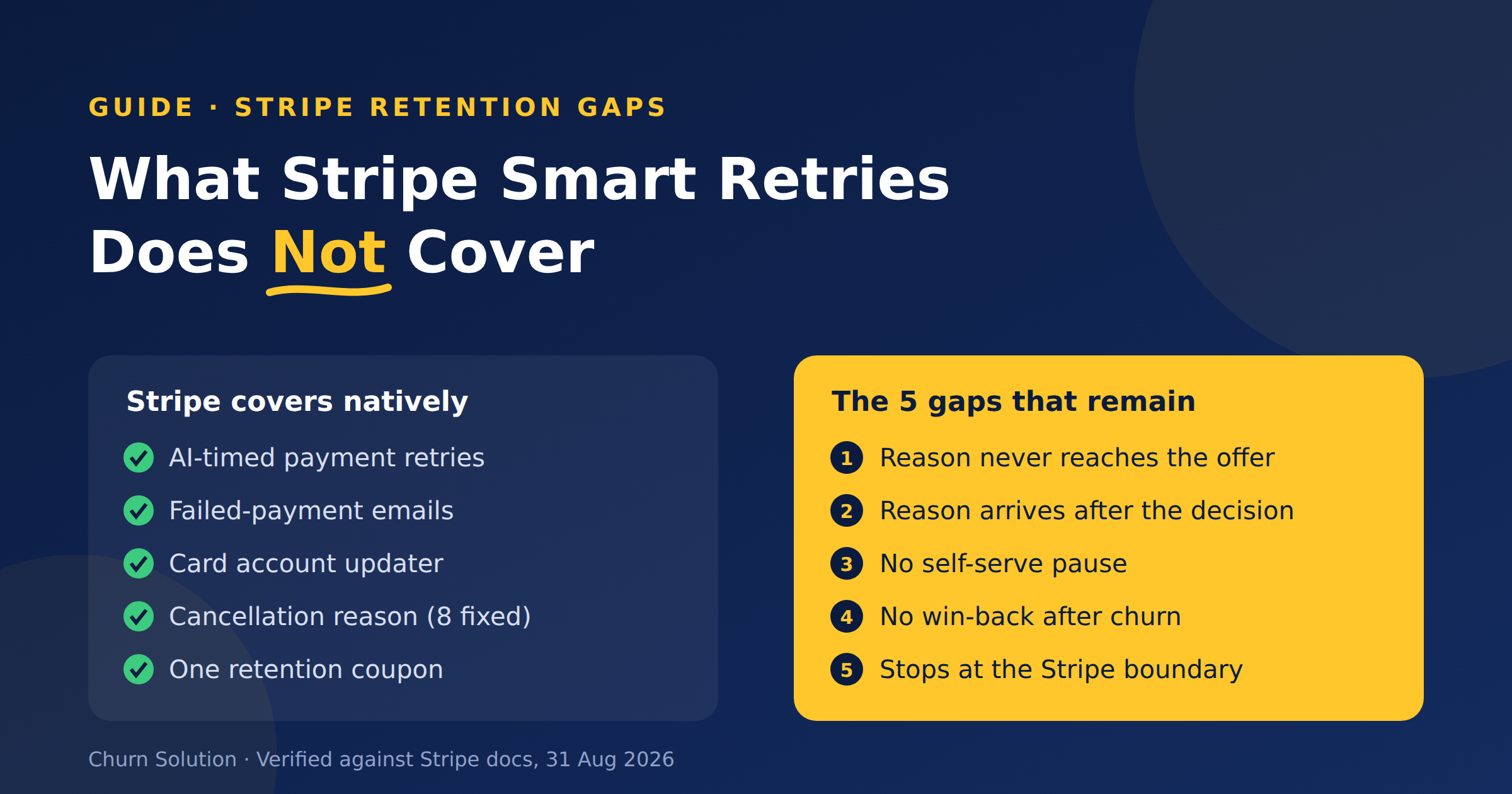
What Stripe Smart Retries Does Not Cover
Stripe Smart Retries recovers failed payments but doesn't run retention. Here are the five gaps that remain, sourced from Stripe's...

Membership Community Churn: The Members Who Quit Without Clicking Cancel
Quiet churn is the real leak: members who never clicked “cancel” at all. A card expires. A bank declines a...

Subscription Churn Dashboard: The 2026 Guide to Actionable Revenue Intelligence
Up to 40% of subscription churn is involuntary, meaning your customers aren't choosing to leave; they're being forced out by...