ARTICLE
Voluntary Churn Reduction Software: The 2026 Guide to Protecting Subscription Revenue

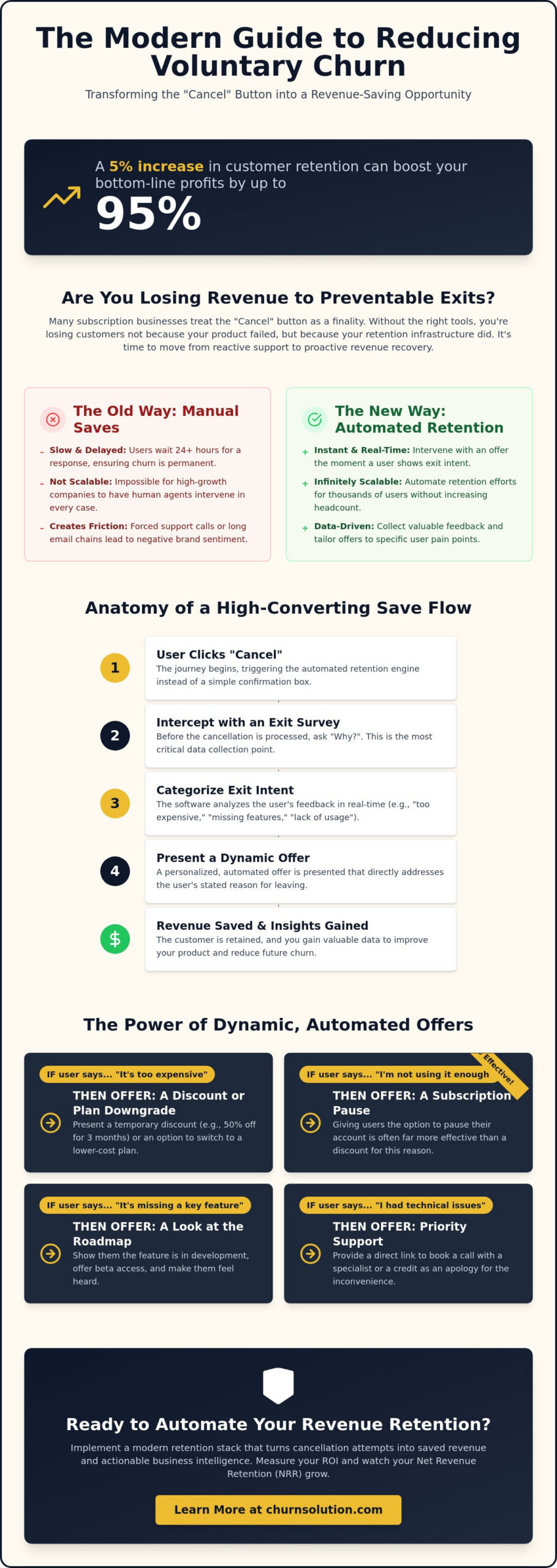
A 5% increase in customer retention can boost your bottom-line profits by up to 95% according to verified industry research. Despite this massive leverage, many subscription leaders still view the “Cancel” button as a finality rather than a critical conversion opportunity. If your growth stack lacks dedicated voluntary churn reduction software to intercept these departures, you’re likely losing a significant percentage of your MRR to preventable exits that could be salvaged with automated intervention.
It’s a frustrating reality for many SaaS executives. Your product satisfaction is high, yet your churn rate remains stubbornly stagnant because you lack the granular data to understand why users are clicking away. You’re losing revenue not because your product failed, but because your retention infrastructure did. You need a way to move beyond reactive support and toward proactive revenue recovery.
This guide provides a comprehensive framework for deploying automated systems that identify exit intent and convert potential losses into saved revenue. You’ll learn how to build sophisticated cancellation flows, utilize AI feedback analysis to uncover the truth behind every departure, and implement dynamic offers that protect your Net Revenue Retention (NRR). We’ll break down the essential components of a modern retention stack that turns every cancellation attempt into actionable business intelligence.
Key Takeaways
- Distinguish between customer-initiated and payment-related churn to ensure your recovery efforts are targeted and effective.
- Build a high-converting cancellation flow that intercepts users with automated surveys to capture the specific reasons behind every departure.
- Utilize specialized voluntary churn reduction software to automate dynamic offer logic, matching incentives directly to the customer’s stated exit intent.
- Integrate your retention engine with core billing platforms like Stripe or Chargebee to enable seamless, data-driven revenue recovery.
- Measure the direct impact of your “Save Rate” on Net Revenue Retention (NRR) to quantify the long-term ROI of your automated retention infrastructure.
What is Voluntary Churn Reduction Software?
Voluntary churn occurs when a customer actively decides to terminate their subscription. This is distinct from involuntary churn, which stems from passive payment failures like expired credit cards. While involuntary churn is a technical hurdle, Customer attrition driven by user choice is a strategic one. Voluntary churn reduction software serves as the automated defense layer designed to intercept these users at the exact moment of exit. It transforms the “Cancel” button from a revenue leak into a data collection point and a recovery opportunity.
In the 2026 subscription economy, relying on your billing engine’s default cancellation logic is insufficient. Billing engines are built to process transactions, not to retain relationships. A dedicated “save” layer sits between the user interface and the billing platform, providing the intelligence needed to understand exit intent before the subscription is deactivated. This automation allows companies to scale their retention efforts infinitely without adding a single member to their customer support headcount. It ensures that every departing user is met with a personalized alternative rather than a cold confirmation page.
The evolution of the “Cancel” button
The standard “Cancel” button has evolved from a simple confirmation dialog into a sophisticated, logic-based intervention flow. Modern voluntary churn reduction software is defined as the automated infrastructure that manages the customer departure experience to maximize revenue retention. Regulatory shifts, such as the February 2026 update to Colorado’s auto-renewal law requiring “one-step online cancellation,” make these automated flows a legal and strategic necessity. You must provide an easy exit, but you aren’t prohibited from offering a compelling reason to stay. By using exit surveys within these flows, businesses capture the “why” behind the departure, allowing for dynamic offers that address specific pain points in real time.
Why manual save attempts fail in 2026
Manual intervention is a relic of low-volume, high-touch enterprise models. For high-growth PLG companies, it’s physically impossible to have a human agent intervene in every cancellation attempt. If a user has to wait 24 hours for a “retention specialist” to email them back, they’ve already moved on to a competitor. This delay creates negative brand sentiment and ensures the churn is permanent. Real-time, event-triggered offers provide an immediate alternative. Whether it’s a temporary discount, a plan downgrade, or a “pause” option, the intervention happens while the user is still engaged with the platform. This speed is the difference between a lost customer and a saved account.
The Anatomy of a High-Converting Save Flow
A high-performing save flow is not a digital barrier designed to trap users. It is a strategic diagnostic tool that identifies why a customer is leaving and presents a logical reason for them to stay. By deploying voluntary churn reduction software, you replace the generic “Are you sure?” confirmation with a multi-step intervention that prioritizes revenue recovery. This process relies on sophisticated Customer Churn Prediction models that analyze user behavior to determine the most effective save tactic in real time.
The first stage of any effective flow is the exit survey. You cannot fix what you don’t understand. By using exit surveys, you categorize departing users into distinct segments based on their specific pain points. Whether a user cites “too expensive,” “missing features,” or “technical issues,” this data serves as the trigger for the next phase: the dynamic offer.
The power of dynamic cancellation offers
Generic discounts are a blunt instrument that can erode your brand value. Effective flows utilize dynamic offers to match the incentive to the exit reason. If a user selects price sensitivity, a temporary discount or a plan downgrade is appropriate. However, if the issue is a lack of usage, offering a discount won’t solve the core problem. In these cases, industry data suggests that providing an option to pause a subscription is often 40% more effective than a one-time discount. Pausing preserves the customer relationship without forcing a total termination, allowing them to return when their needs change.
Psychological triggers in retention
Retention logic often hinges on the principle of loss aversion. Before a user confirms their departure, your flow should remind them of the specific data, progress, or premium benefits they will lose. This isn’t about guilt; it’s about highlighting the value they’ve already built within your platform. For budget-conscious users, presenting a “Plan Downgrade” serves as a middle ground that maintains the account while reducing the immediate financial friction.
Success requires constant optimization. You should implement A/B experiments to test different incentive timings and offer types. One segment might respond better to a free month, while another prefers a permanent move to a lower tier. Refine these flows until you find the “sweet spot” that maximizes your save rate without sacrificing long-term LTV. If you’re ready to stop the leak in your subscription revenue, you can start building your first save flow today.
Core Features of Professional Retention Software
High-performance retention infrastructure requires more than a simple exit survey. To protect your subscription revenue effectively, voluntary churn reduction software must bridge the gap between user behavior and your financial ledger. This necessitates deep, bidirectional integration with billing platforms like Stripe, Chargebee, and Recurly. Without this technical link, your retention system cannot verify subscription status, apply dynamic discounts, or execute account pauses in real time. It ensures that every “save” is immediately reflected in your MRR data, providing a single source of truth for your growth team.
Beyond billing, professional tools offer real-time revenue dashboards. These interfaces do not just track the number of cancellations; they quantify the exact dollar value of “saved” versus “lost” revenue. This visibility allows executives to move beyond vanity metrics and focus on Net Revenue Retention (NRR). When a save attempt fails, the software should facilitate a seamless handoff to automated win-back campaigns, ensuring that the relationship remains active even if the subscription does not.
AI and the future of churn analysis
Modern retention engines utilize AI feedback analysis to transform qualitative survey noise into quantitative product roadmaps. Instead of manually tagging thousands of responses, the system automatically categorizes churn reasons and surfaces hidden product friction points at scale. Advanced predictive scoring models further enhance this by identifying “at-risk” behavior patterns before a user ever reaches the cancellation page. This proactive intelligence allows you to intervene earlier in the customer lifecycle, often preventing the exit intent from forming in the first place.
Segment-based retention strategies
Generic incentives often fail because they ignore the unique profile of the departing user. By implementing sophisticated customer segmentation, you can deploy tailored save paths that reflect a user’s lifetime value (LTV) and account tier. An Enterprise client with a high-contract value requires a different intervention logic than a self-serve Pro user. You might offer a dedicated success call to the former while presenting an automated plan downgrade to the latter. The most effective software treats every customer departure as a unique data point rather than a generic event, allowing for hyper-personalized recovery tactics that maximize LTV. This strategic granularity ensures that your most valuable accounts receive the highest level of automated protection.
Measuring ROI: Software Impact on NRR and LTV
Net Revenue Retention (NRR) has surpassed simple growth as the primary indicator of SaaS health in 2026. While acquisition remains necessary, valuation multiples are now ruthlessly tied to your ability to maintain and expand your existing revenue base. Implementing voluntary churn reduction software provides the direct attribution required to prove that retention is a profit center, not a cost center. Every saved customer represents a recovery of the initial Customer Acquisition Cost (CAC) and an extension of that user’s Lifetime Value (LTV).
Calculating the “Save Rate” is the first step in quantifying your ROI. This metric tracks the percentage of users who initiated the cancellation process but were successfully retained through automated intervention. The financial impact is compounding. A saved account continues to generate monthly revenue, contributes to expansion opportunities, and eliminates the need for a replacement acquisition. By preserving these accounts, you lower your blended CAC and ensure that your marketing spend is used for true growth rather than just filling a leaky bucket.
The relationship between NRR and valuation
Investors prioritize NRR because it demonstrates product-market fit and operational efficiency. You can use this guide on Mastering Net Revenue Retention to audit your current calculation methods. It’s also vital to understand the distinction between GRR vs. NRR to identify exactly where voluntary churn is eroding your margins. Industry data indicates that a mere 1% reduction in monthly churn can lead to a 20% or higher increase in total company valuation over time. This happens because the retained revenue scales exponentially, creating a more predictable and stable financial forecast.
Reactivating lost revenue
Retention doesn’t end when a user completes the cancellation flow. Strategic use of reactivation tools allows you to target former users with high-intent offers based on their historical data. By referencing the Subscription Win-Back Campaigns playbook, you can implement a post-cancellation strategy that treats churn as a temporary state. Measuring the long-term LTV of these “saved” or “reactivated” customers often reveals they are more loyal than new acquisitions, as their return is based on a deliberate choice to re-engage with your value proposition. If you want to quantify the impact on your own bottom line, you should start tracking your save rate today.
Implementation Strategy: Building Your Retention Stack
Executing a high-performance retention strategy requires a methodical transition from reactive support to automated recovery. Begin by auditing your existing cancellation interface to identify friction points that frustrate users or obscure your value proposition. Once you’ve identified these leaks, integrate your billing provider with your chosen voluntary churn reduction software. This technical connection allows the system to pull historical data and push real-time subscription changes without manual oversight, ensuring your revenue data remains accurate and actionable.
Don’t over-engineer your initial deployment. Launch a Minimum Viable Save Flow consisting of a single, concise exit survey. This phase focuses on gathering the raw intelligence needed to build your first three dynamic offers. Analyze the responses to identify the most common churn drivers. Typically, these fall into price sensitivity, low usage, or technical barriers. Match these drivers to specific incentives: a temporary discount for budget concerns, a subscription pause for low usage, and a plan downgrade for users who find the current tier excessive.
Optimization is a continuous cycle. Utilize A/B testing to refine the language, timing, and value of each offer. Measure which incentives yield the highest save rates and the most significant impact on your NRR. This data-driven approach ensures your retention stack evolves alongside your customer base, turning every cancellation attempt into a laboratory for growth.
Choosing the right software partner
Selecting a partner requires prioritizing deep subscription intelligence. Standalone voluntary churn reduction software outperforms generic CRMs because it is purpose-built for the complexities of recurring billing and exit intent. Look for no-code builders that empower your growth team to experiment and iterate without waiting for engineering resources. A critical component is providing a customer portal. This enables self-service management, which reduces support tickets while maintaining a professional, high-performance user experience.
Final steps to revenue protection
For high-value Enterprise accounts, set up automated triggers that alert your Customer Success team the moment a cancellation is initiated. This allows for high-touch intervention when the financial stakes are highest. Real estate investors, for example, can utilize REI Reply to streamline these high-stakes support interactions and maximize their save rate. By combining automated flows with targeted human intervention, you create a comprehensive defense against revenue loss. In 2026, revenue protection is an automated, always-on business function. Start your automated retention journey today.
Secure Your Revenue Future with Automated Retention
Protecting your subscription revenue in 2026 requires more than reactive support. It demands a sophisticated, automated defense layer that intercepts exit intent in real time. We’ve established that voluntary churn is a failure of infrastructure. By deploying specialized voluntary churn reduction software, you transform the “Cancel” button into a high-converting revenue recovery point.
Success hinges on moving from generic discounts to dynamic, data-driven offers that address the specific “why” behind every departure. Integrating these flows directly with your billing engine ensures that every saved account contributes immediately to your Net Revenue Retention (NRR) and long-term valuation. Stop allowing preventable exits to erode your margins and start treating every cancellation attempt as a critical conversion opportunity.
Automate your retention and stop the revenue leak with Churn Solution. Our platform provides the AI-driven exit insights, dynamic offer engine, and seamless billing integrations you need to protect your bottom line. With advanced A/B testing, you can optimize your save flows until every departure becomes a data point for growth. Your revenue is too valuable to leave to chance; start building your defense today.
Frequently Asked Questions
What is voluntary churn reduction software?
Voluntary churn reduction software is a specialized technology layer that intercepts customers who initiate a cancellation. It replaces the standard confirmation button with a diagnostic flow that identifies the user’s reason for leaving and presents automated incentives to retain them. This infrastructure ensures that revenue recovery is a systematic, data-driven process rather than a manual task for support teams.
How does an automated cancellation flow actually save customers?
Automated cancellation flows save customers by matching specific incentives to the user’s stated exit intent in real time. When a user selects “price sensitivity” in an exit survey, the system triggers a discount or a plan downgrade. If the user indicates a “temporary lack of usage,” it offers a subscription pause. This logic-based intervention provides a personalized alternative to churning while the customer is still engaged.
Will adding a save flow frustrate my users?
A well-designed save flow enhances the user experience by providing flexible alternatives to a total exit. Instead of a rigid “all or nothing” model, you offer valuable options like account pausing or downgrading that users may prefer over complete termination. This approach respects the user’s decision while ensuring they’re aware of all available solutions to their current friction points.
Can I use this software with Stripe or Chargebee?
Professional retention tools feature native, bidirectional integrations with major billing platforms like Stripe and Chargebee. This connectivity allows the software to pull historical subscription data and execute immediate account changes. Whether it’s applying a credit, updating a plan tier, or pausing a billing cycle, the integration ensures your financial ledger remains accurate without any manual data entry.
Is it better to offer a discount or a pause option?
The optimal choice depends entirely on the customer’s exit reason. Industry data suggests that a pause option is often 40% more effective than a discount for users citing temporary lack of usage. Discounts are best reserved for price-sensitive segments. Utilizing voluntary churn reduction software allows you to test both options through A/B experiments to determine what maximizes LTV for your specific audience.
How do I measure the ROI of churn reduction software?
ROI is measured through the “Save Rate,” which is the percentage of users who initiated cancellation but were successfully retained. You then calculate the recovered MRR and the resulting increase in Net Revenue Retention (NRR). By preserving these accounts, you also lower your blended Customer Acquisition Cost (CAC) by extending the lifetime value of users you’ve already paid to acquire.
How long does it take to implement a voluntary churn solution?
Implementation typically occurs in phases, starting with a “Minimum Viable Save Flow” that can be launched quickly once the billing integration is active. This initial setup focuses on gathering raw feedback through an exit survey. More complex, dynamic logic and segment-based offers are usually developed and refined over the first 30 days of deployment as data begins to accumulate.
Does voluntary churn software help with product development?
Yes, it serves as a critical feedback loop for product teams. By using AI feedback analysis on thousands of exit survey responses, you surface hidden product friction points and missing features at scale. This qualitative data is transformed into quantitative insights, allowing you to prioritize your product roadmap based on the actual reasons customers are leaving your platform.
- Key Takeaways
- Table of Contents
- What is Voluntary Churn Reduction Software?
- The Anatomy of a High-Converting Save Flow
- Core Features of Professional Retention Software
- Measuring ROI: Software Impact on NRR and LTV
- Implementation Strategy: Building Your Retention Stack
- Secure Your Revenue Future with Automated Retention
- Frequently Asked Questions

Churn solution that turns your customers right around.
Related Articles
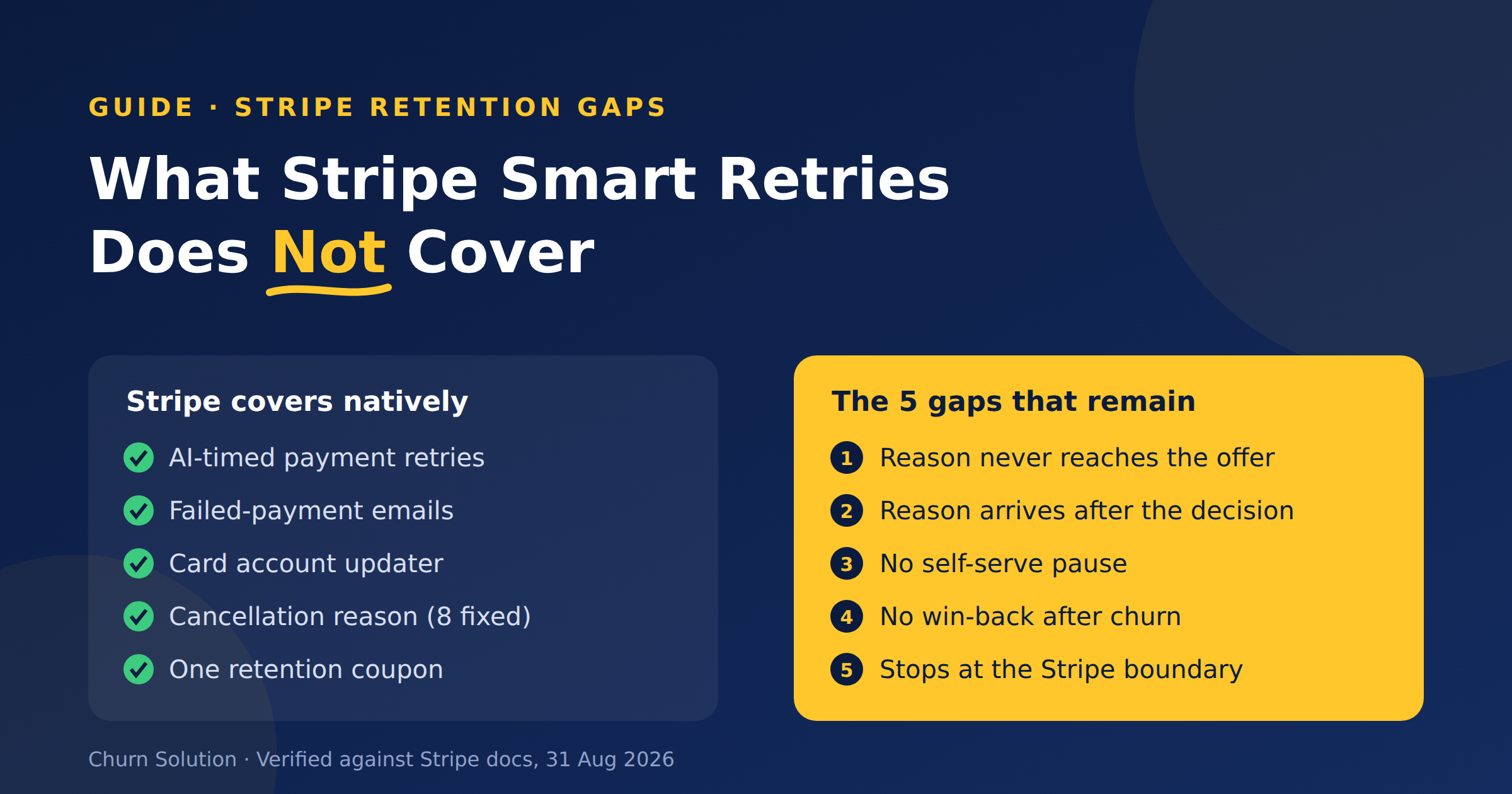
What Stripe Smart Retries Does Not Cover
Stripe Smart Retries recovers failed payments but doesn't run retention. Here are the five gaps that remain, sourced from Stripe's...

Membership Community Churn: The Members Who Quit Without Clicking Cancel
Quiet churn is the real leak: members who never clicked “cancel” at all. A card expires. A bank declines a...

Subscription Churn Dashboard: The 2026 Guide to Actionable Revenue Intelligence
Up to 40% of subscription churn is involuntary, meaning your customers aren't choosing to leave; they're being forced out by...