ARTICLE
The 2026 Failed Payment Recovery Checklist: Stop Involuntary Churn
Up to 40% of your subscription churn isn’t a conscious customer choice; it’s a silent technical failure. When a transaction fails, your revenue doesn’t just stall. It triggers a cascade of high customer support volume and friction that degrades your brand equity. Relying on default dunning emails that get flagged as spam is no longer a viable strategy in 2026. You need a sophisticated failed payment recovery system that acts as an invisible revenue guardrail.
We understand the frustration of watching hard-earned MRR vanish due to simple card expirations or outdated ACH protocols. This article delivers a high-performance framework designed to identify, recover, and prevent these leaks before they hit your bottom line. You’ll gain a methodical checklist covering the 2026 Nacha fraud monitoring requirements, smart retry logic, and automated workflows that turn involuntary churn into a solved problem. We’ll show you how to build a system that works in the background, allowing you to reclaim total control over your business outcomes.
- Treat failed payment recovery as a proactive revenue layer to recapture the 20-40% of churn caused by technical failures.
- Execute a 7-point audit to identify specific bottlenecks in your billing cycle and prioritize high-impact recovery actions.
- Implement smart retry logic to distinguish between soft and hard declines, ensuring you don’t waste attempts on unrecoverable cards.
- Eliminate friction in dunning email automation by utilizing direct-access portals that don’t require customer logins.
- Transition from manual processes to an automated recovery system to achieve recovery rates significantly higher than the 15% baseline.
Beyond the Decline: The 2026 Framework for Failed Payment Recovery
A declined transaction in the modern subscription business model isn’t just a billing error. It is a critical threat to your growth trajectory. We define failed payment recovery as a proactive revenue protection layer that sits between your billing engine and your bank. It transforms a passive administrative task into a high-performance strategy for capital preservation. If you aren’t treating recovery as a core product function, you’re effectively leaving your net revenue to chance.
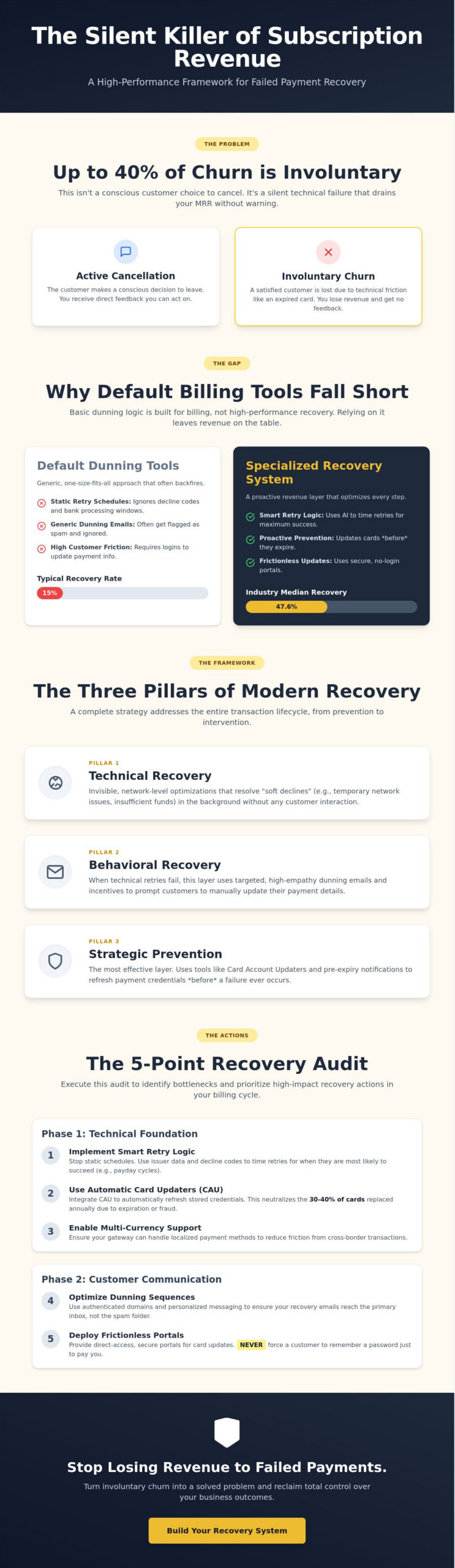
Involuntary churn is often deadlier than active cancellations. When a customer cancels, they’re giving you feedback. When a payment fails, you’re losing a satisfied customer to technical friction. Industry data suggests that businesses without a dedicated system lose between 10% and 15% of their MRR to this “Invisible Leak.” These losses compound over time, silently eroding your customer lifetime value while your acquisition costs continue to rise. Distinguishing between a customer who wants to leave and one who simply has an expired card is the first step toward total revenue control.
The Three Pillars of Modern Recovery
To stop involuntary churn, your framework must address three distinct layers of the transaction lifecycle:
- Technical Recovery: This involves network-level optimization and invisible retries. These actions happen in the background, resolving “soft declines” without ever bothering the user.
- Behavioral Recovery: This utilizes targeted dunning email automation and customer incentives. It focuses on high-empathy communication to prompt manual updates when technical retries fail.
- Strategic Prevention: This layer uses card account updaters and pre-expiry interventions to refresh credentials before a failure occurs.
Why Default Billing Tools Fall Short
Most subscription engines provide basic dunning logic, but they’re built for billing, not recovery. Their “one-size-fits-all” retry schedules often ignore the specific context of decline codes, which can lead to higher permanent decline rates and even card network penalties. These tools lack the sophisticated AI-driven logic required to navigate 2026’s complex regulatory landscape. Relying on generic logic means you’re missing the granular timing and channel optimization that specialized payment recovery software provides. To achieve industry-leading recovery rates, you must move beyond the limitations of your primary billing provider.
The Ultimate Failed Payment Recovery Checklist: 7 Essential Components
Success in failed payment recovery requires more than a single automated email. It demands a multi-layered ecosystem that addresses technical failures and human behavior simultaneously. Before deploying new tools, execute a comprehensive audit of your current recovery performance. Analyze your recovery rate against the industry median of 47.6% to identify exactly where revenue is slipping through the cracks. Establishing this baseline allows you to measure the efficacy of each intervention you implement.
Phase 1: Technical Foundation
Your technical layer must resolve failures without customer intervention. Item 1: Smart Retry Logic. Stop using static schedules. Instead, utilize issuer data and decline codes to time retries when they’re most likely to succeed, such as payday cycles or specific bank processing windows. Item 2: Automatic Card Account Updaters (CAU). Integrate CAU to refresh stored credentials before a charge fails, neutralizing the 30-40% of cards replaced annually due to expiration or fraud. Item 3: Multi-currency support. Ensure your gateway handles localized payment methods to reduce cross-border friction. Adhering to Billing Error Resolution rules ensures your technical retries remain compliant while protecting your merchant reputation and standing.
Phase 2: Customer Communication
When technical retries fail, your communication strategy must take over. Item 4: High-deliverability dunning sequences. Avoid generic templates that trigger spam filters. Use authenticated domains and personalized messaging to ensure your message reaches the inbox. Item 5: Frictionless portals. Deploy customer portals that require no login. Forcing a user to remember a password just to pay you is the primary cause of recovery abandonment. Item 6: Omni-channel fallbacks. If emails go unanswered, trigger SMS or in-app notifications. This creates a persistent but professional presence that demands immediate attention without being intrusive.
Phase 3: Optimization
Item 7: Continuous A/B testing. Recovery is not a set-it-and-forget-it process. Test your dunning copy, the placement of your call-to-action, and the specific timing of your interventions. Small adjustments in your sequence can lead to compounding improvements in your net revenue retention. You should also integrate AI-driven feedback analysis to understand why payments are failing at specific stages of the customer journey. This data allows you to refine your strategy and prevent future churn. If you’re ready to stop the leak in your subscription business, you can start building your recovery workflow today.
Optimizing Technical Recovery: Smart Retries and AI-Driven Logic
Technical recovery is your first line of defense against involuntary churn. It operates in the background, resolving issues before the customer even realizes a transaction has stalled. A high-performance failed payment recovery strategy relies on precision engineering rather than brute force. By leveraging machine learning to analyze transaction metadata, you can neutralize failures at the network level and preserve your merchant reputation.
Blindly retrying every declined transaction is a tactical error that degrades your MerchantID (MID) health. Issuers track retry patterns; excessive attempts on terminal declines signal high risk and can lead to your account being flagged or blacklisted. Implementing smart payment retries ensures that you only attempt recovery when the probability of success is high. This approach protects your standing with card networks while maximizing the amount of capital you successfully recapture.
Decoding Decline Codes
You must distinguish between recoverable and terminal errors to optimize your workflow. Soft declines are temporary issues like network timeouts or temporary funding gaps. For example, a code 051 (Insufficient Funds) suggests the account exists but lacks immediate liquidity, making it a prime candidate for a strategic retry. Conversely, a code 054 (Expired Card) or a “Stolen Card” response represents a hard decline. Retrying these terminal codes is a waste of resources and a direct threat to your processing reputation. Your system must be intelligent enough to route hard declines immediately to your dunning sequence or card account updater rather than hitting the gateway again.
The Logic of Timing
The “when” of a retry is just as critical as the “why.” Standard billing engines often use a basic “retry every 3 days” logic, which ignores the nuances of banking cycles. AI-driven systems analyze variables such as card type, geographical location, and historical issuer behavior to determine the optimal window for success. In the US, aligning your attempts with payday cycles significantly boosts recovery rates. Retrying a transaction at 3 AM on a Tuesday often yields better results than a Friday morning, as you’re bypassing the peak processing congestion that leads to false declines. Leveraging smart retries allows you to navigate these issuer-level blocks with surgical precision. This data-driven timing ensures your recovery efforts hit the bank when the path to approval is clearest, turning potential losses into confirmed revenue.
Reducing Friction in Customer Interventions: Portals and Dunning
When automated technical retries reach their limit, the recovery process moves from the background to the customer’s inbox. This transition is a high-stakes moment where friction becomes your greatest adversary. Every additional step you demand from a customer increases the probability of permanent churn. To master failed payment recovery, you must treat your dunning sequence as a customer experience touchpoint rather than a cold collections effort. High-performance teams utilize dunning email automation to scale personal outreach without losing the precision of a professional brand voice.
Psychology of the Recovery Email
Stop using aggressive, debt-focused language that triggers defensive behavior. Subject lines like “Payment Failed” or “Action Required” often get ignored as administrative noise or flagged as spam. Shift your tone toward value preservation and empowerment. Use messaging like “Help Us Keep You Going” to remind the user of the benefits they’re about to lose. You can reduce involuntary churn by emphasizing continued access to your service rather than the missing payment. Keep your call-to-action singular and prominent. If a user is hesitant, consider offering a temporary discount or a “pause” option. This keeps the account active and preserves the relationship while the billing issue is resolved.
Frictionless Self-Service Portals
Forced logins are the primary killer of payment recovery. If a customer has to remember a password just to update a card, they’ll likely abandon the process entirely. Implement secure “magic links” that provide direct access to a payment update screen. Your portal should support modern wallets like Apple Pay and Google Pay to enable instant, one-touch updates. This is also a strategic moment to integrate feedback analysis. By asking a single question during the update process, you gather critical data on why payments are failing for specific segments. This insight allows you to refine your technical retry logic and prevent future failures. Eliminate the barriers between your customer and their payment method. Deploy a frictionless recovery workflow today to capture revenue that would otherwise be lost to simple friction.
Securing Your Revenue: Implementing an Automated Recovery System
Manual intervention is a high-cost, low-yield approach to a technical problem. Relying on finance teams to track down declined transactions is a reactive strategy that fails as your subscriber base grows. When you scale, the volume of involuntary churn becomes too high for human oversight. You need a system that operates with algorithmic precision 24 hours a day. Implementing a specialized failed payment recovery platform transforms these losses into a predictable revenue stream. By automating these workflows, you ensure that every transaction is processed through a high-performance framework that prioritizes the most likely path to success.
Evaluating the ROI of a dedicated system requires looking beyond simple recovery totals. You must analyze the impact on your Net Revenue Retention (NRR) and long-term Customer Lifetime Value (LTV). Recovering a single payment doesn’t just save one month of revenue; it preserves the entire future value of that customer relationship. To monitor this effectively, you should track your churn metrics on a weekly basis. This visibility allows you to see exactly how technical retries and dunning sequences are moving the needle on your bottom line.
Execution follows a structured 30-day roadmap. Your first week must focus on a comprehensive audit to identify where revenue is leaking. From there, you transition into deploying tiered retry logic and frictionless dunning portals. By the end of the month, your focus shifts to continuous optimization based on real-world performance data. This methodical progression ensures that your recovery infrastructure is robust, compliant, and highly efficient.
The Churn Solution Advantage
Our AI-driven flows are engineered to outperform the static defaults found in standard billing engines. We don’t rely on generic schedules. Instead, our logic adapts to issuer behavior and transaction metadata in real time. We provide a seamless integration with your existing Stripe or B2B billing stack, allowing you to upgrade your recovery capabilities without replacing your core financial infrastructure. This sophisticated approach has a direct, measurable impact on your NRR, ensuring that technical friction never stands in the way of your growth.
Next Steps for Your Finance Team
Finance leaders must take control of revenue protection today. Start by conducting a “Revenue Leakage” audit to quantify exactly how much MRR is disappearing into the invisible leak of involuntary churn. Once you have identified the scale of the problem, execute your first smart retry sequence to begin recapturing that capital. Don’t leave your net revenue to the limitations of basic billing tools. Book a demo to see Churn Solution in action and discover how our specialist technology can secure your revenue at scale.
Mastering Revenue Protection for 2026 and Beyond
Involuntary churn is a technical leak that requires a technological solution. We’ve established that failed payment recovery is no longer just about sending emails; it’s about a multi-layered framework of smart retries, frictionless portals, and AI-driven logic. By implementing a high-performance system, you move from reactive collections to proactive capital preservation. High-growth SaaS companies already utilize these standards to protect their MRR and maximize customer lifetime value. You’ve seen the roadmap; now it’s time to execute.
Don’t let technical friction erode your hard-earned growth. By following the 30-day recovery roadmap and conducting a revenue leakage audit, you can identify exactly where your billing engine is falling short. You can recover up to 25% of failed payments automatically using AI-driven retry logic optimized for 2026 standards. It’s time to plug the leak and secure your business outcomes with a specialist partner that understands the high stakes of revenue loss. Your revenue is too valuable to leave to default billing logic. Take the first step toward a more resilient subscription model today.
Stop the leak and recover your revenue with Churn Solution
Frequently Asked Questions
What is the difference between active and involuntary churn?
Active churn is a conscious decision to cancel a subscription through your platform’s interface. Involuntary churn is a passive event where a customer is lost because their payment method failed at the time of renewal. While active churn requires product improvements or win-back campaigns, involuntary churn is a technical failure that you can solve with a robust failed payment recovery framework. Addressing this “invisible leak” is the fastest way to stabilize your net revenue.
How often should I retry a failed payment before giving up?
Optimal retry frequency depends on the specific decline codes you receive. Most high-performance systems attempt between 4 and 8 retries over a 14 to 21-day window. You should never use a static daily schedule, as this can trigger fraud alerts or card network penalties. Instead, utilize smart timing logic that aligns with banking cycles and payday schedules. Stop all attempts immediately for hard declines like stolen or fraudulent cards to protect your processing reputation.
Will sending multiple dunning emails increase my spam rate?
Sending multiple dunning emails won’t damage your spam rate if you prioritize deliverability and value-led copy. The key is using authenticated domains and shifting the tone from “collections” to “service preservation.” When customers perceive the email as a helpful reminder to keep their access active, they’re less likely to flag it as junk. By providing a direct, no-login link for updates, you ensure the user journey is as efficient and professional as possible.
What are the most common reasons for credit card declines in SaaS?
Insufficient funds and expired cards are the two most common reasons for credit card declines in SaaS. These “soft declines” are often temporary and highly recoverable with the right timing logic. Other common issues include bank-level fraud blocks for international transactions or outdated billing addresses. Since approximately 30-40% of cardholders replace their cards annually, a proactive credential refresh strategy is non-negotiable for any subscription business looking to protect its long-term growth.
Can I recover payments without asking the customer to log in?
You can absolutely recover payments without forced logins by utilizing secure magic links. These links provide a temporary, tokenized path directly to a payment update screen. Eliminating the password barrier removes the #1 cause of abandonment in the dunning process. This frictionless experience allows your customers to update their billing information in seconds, whether they’re on a mobile device or a desktop, significantly improving your overall recovery conversion rates.
How does smart retry logic differ from standard dunning?
Smart retry logic is a technical, background process that resolves transaction failures at the network level without bothering the customer. It uses machine learning to identify the best time to re-attempt a charge. Standard dunning is a communication-based strategy that triggers only after those background retries have failed. A complete failed payment recovery system integrates both, using smart retries for technical issues and dunning emails for behavioral interventions that require customer action.
What is a card account updater and do I need one?
A card account updater is a network-level service that automatically refreshes stored credit card data when a card is re-issued or updated. It ensures your billing engine always has the most current credentials, neutralizing the churn caused by lost or expired cards. You definitely need one because it stops failures before they even happen. By integrating this into your stack, you can significantly reduce the volume of dunning emails you need to send to your users.
How much revenue can I realistically expect to recover with automation?
Subscription businesses can expect to recover 60-80% of their involuntary churn by implementing a specialized automation system. Without these tools, the natural recovery rate is often as low as 15%, which leads to massive annual revenue loss. By combining smart technical retries with high-converting dunning sequences, you can consistently outperform the industry median recovery rate of 47.6%. This transition turns a major source of revenue leakage into a predictable and automated profit center.
- Table of Contents
- Beyond the Decline: The 2026 Framework for Failed Payment Recovery
- The Ultimate Failed Payment Recovery Checklist: 7 Essential Components
- Optimizing Technical Recovery: Smart Retries and AI-Driven Logic
- Reducing Friction in Customer Interventions: Portals and Dunning
- Securing Your Revenue: Implementing an Automated Recovery System
- Mastering Revenue Protection for 2026 and Beyond
- Frequently Asked Questions

Churn solution that turns your customers right around.
Related Articles
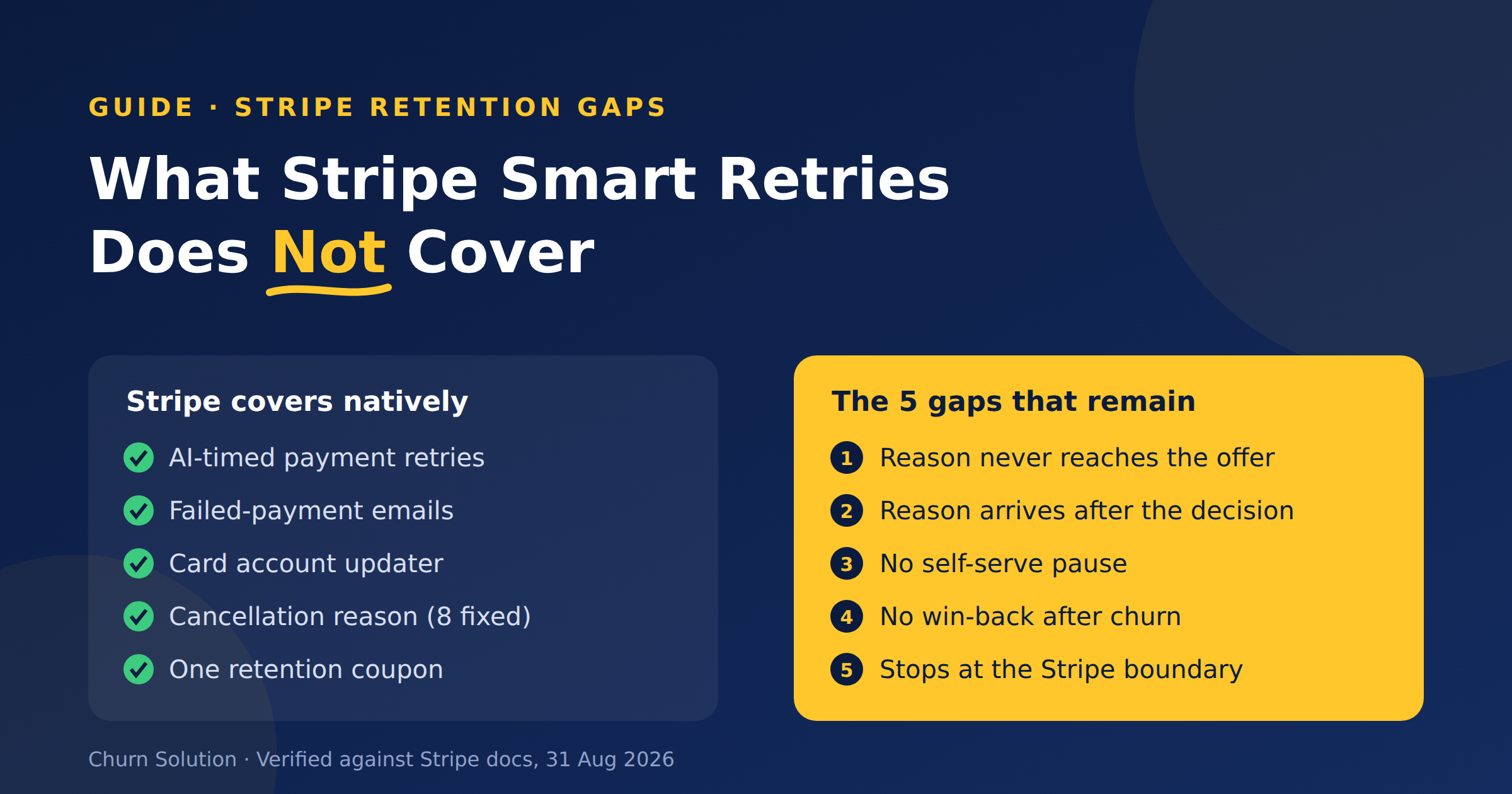
What Stripe Smart Retries Does Not Cover
Stripe Smart Retries recovers failed payments but doesn't run retention. Here are the five gaps that remain, sourced from Stripe's...


Membership Community Churn: The Members Who Quit Without Clicking Cancel
Quiet churn is the real leak: members who never clicked “cancel” at all. A card expires. A bank declines a...

Subscription Churn Dashboard: The 2026 Guide to Actionable Revenue Intelligence
Up to 40% of subscription churn is involuntary, meaning your customers aren't choosing to leave; they're being forced out by...