ARTICLE
Smart Payment Retries: The 2026 Guide to AI-Driven Revenue Recovery

Subscription businesses lose approximately 9% of their total revenue to failed payments, often before a customer even realizes there is an issue. It’s a silent leak that compromises your Net Revenue Retention (NRR) and forces your team into unscalable, manual intervention. You likely already know that standard dunning emails feel pushy and frequently fail to address the technical root of the problem. This guide shows you how to eliminate that friction and recover up to 20% more failed transactions using smart payment retries.
By implementing AI-driven logic, you can transform your recovery efforts into a high-performance, “set and forget” machine. We’ll explore how to leverage decline-reason-specific timing and navigate the 2026 Visa and Mastercard retry limits to ensure maximum success rates. This article provides a comprehensive roadmap for deploying intelligent automation that recovers revenue silently while providing the granular data you need to understand exactly why payments fail. Stop guessing at your recovery strategy and start using a data-driven system built for the modern subscription economy.
Key Takeaways
- Identify why static retry schedules trigger bank friction and how AI-orchestrated logic bypasses common failure points.
- Leverage specific data signals like issuer location and card type to deploy smart payment retries that maximize transaction success.
- Evaluate the performance gap between basic gateway retries and precision recovery platforms to capture more lost revenue.
- Integrate automated retry logic with dunning flows to enable “silent recovery” and preserve customer sentiment.
- Transform fragmented billing processes into a centralized revenue recovery machine for complete visibility into Net Revenue Retention.
What are Smart Payment Retries and Why Do Static Schedules Fail?
Smart payment retries represent a paradigm shift from rigid, calendar-based billing to AI-orchestrated revenue recovery. In a standard setup, your billing engine likely follows a linear path, retrying a failed card every three days at a fixed time until the subscription is canceled. This is the “Static Trap.” It ignores the underlying technical reason for the decline and fails to account for the specific behavior of issuing banks. By contrast, intelligent retry logic analyzes hundreds of data signals to determine the exact millisecond a transaction is most likely to clear. The 2026 benchmark is clear: businesses leveraging AI-driven smart payment retries achieve a 15-25% higher recovery rate than those relying on fixed schedules.
Understanding the distinction between churn types is critical for revenue protection. Voluntary churn occurs when a customer actively decides to leave your platform. Involuntary churn happens when a legitimate, paying customer is forced out because of a technical payment failure. We define this as preventable revenue leakage. While you can’t always stop a user from clicking “cancel,” you can absolutely stop a technical error from destroying your Net Revenue Retention (NRR). A comprehensive strategy to reduce involuntary churn requires moving beyond passive retries and into intelligent, data-driven recovery automation.
The Anatomy of a Failed Transaction
Every transaction triggers a complex communication chain. The merchant sends a request to the payment gateway, which passes it to the acquiring bank, eventually reaching the customer’s issuing bank. When the chain breaks, the issuing bank returns a decline code. Unfortunately, codes like “05: Do Not Honor” or “51: Insufficient Funds” are notoriously vague and offer little guidance for recovery. Involuntary churn is the silent killer of SaaS growth. Without a system that can interpret these signals and adjust the retry strategy in real-time, you are essentially gambling with your most valuable assets: your existing customers.
The High Cost of Recovery Failure
The impact of a failed recovery extends far beyond a single missed invoice. When a loyal user is accidentally locked out of your platform, their Customer Lifetime Value (LTV) drops to zero instantly. This creates a massive “Re-acquisition Penalty.” Industry data confirms it costs 5x more to win back a churned user through marketing than it does to recover their payment through automation. You aren’t just losing today’s revenue; you’re losing the future expansion and renewal potential of that account. Churn Solution automates this entire intervention, replacing manual guesswork with a high-performance recovery engine that protects your bottom line without human oversight.
The AI Mechanism: How Smart Logic Predicts Success
Predictive recovery isn’t a guessing game. It’s a calculated orchestration of hundreds of unique data signals. While basic billing systems might only look at the time of day, smart payment retries utilize a multidimensional matrix to find the path of least resistance. This includes analyzing the issuer country, specific card types, and historical success rates for similar transaction profiles. By identifying the intersection where bank liquidity is high and fraud filters are low, the system optimizes every attempt for success.
Dynamic Signal Processing takes this a step further by adjusting to real-time variables. Banks have maintenance windows. Countries have regional holidays. These events cause temporary spikes in decline rates that static systems ignore. Smart logic detects these anomalies as they happen and shifts retry attempts to a more viable window. This real-time adaptability ensures that you don’t waste your limited retry attempts during a period of known bank downtime.
Cross-merchant data provides a significant advantage in the recovery process. When a payment method successfully clears on one platform within a network, that signal informs the retry timing for other merchants. This collective intelligence allows the system to recognize when a previously “insufficient funds” card has been topped up. Precision is vital here. With 2026 Visa and Mastercard regulations capping retries at 15 attempts per 30 days, managing your “Transaction Velocity” is no longer optional. Exceeding these limits triggers heavy penalties and damages your merchant reputation. You can set up a high-performance recovery engine to navigate these constraints automatically.
Soft vs. Hard Declines: The Decision Engine
The core of the recovery engine is its ability to distinguish between decline types. Soft declines, such as temporary insufficient funds or network timeouts, are the primary targets for recovery. These are solvable problems. Hard declines, including stolen cards or closed accounts, represent a dead end. Retrying a hard decline is a waste of resources and can lead to increased processing fees. The AI decision engine categorizes ambiguous response codes to determine if a second attempt is viable or if the account requires immediate dunning intervention.
Machine Learning and Issuer-Specific Patterns
Different banks operate on unique internal cycles. Many debit card issuers process payroll deposits in specific “refresh” windows, which varies by region and institution. Smart logic identifies these patterns to time retries exactly when funds are most likely to be available. Tracking these recovery patterns over time requires robust Churn Metrics to validate the effectiveness of your strategy. This data-driven approach ensures that every retry is backed by a logical probability of success rather than a random schedule.

Static vs. Smart vs. Precision Retries: A Performance Comparison
Revenue recovery performance exists on a spectrum of technical sophistication. Most businesses begin with static retries, which are rigid and ignore the reason for failure. While better than doing nothing, they offer the lowest recovery rates and the highest risk of bank penalties. As you scale, smart payment retries provide a necessary layer of intelligence by analyzing basic signals like time of day and card type. However, for high-growth SaaS companies, the ultimate goal is Precision Retries. This tier utilizes extended recovery windows of up to 30 days and custom logic to capture revenue that simpler systems leave behind.
Choosing the right level of sophistication depends on your recovery goals and the complexity of your subscriber base. Static systems are obsolete. Smart systems are the current standard. Precision systems are the future of Net Revenue Retention (NRR). To truly master this ecosystem, you must also align these technical attempts with your communication strategy, as detailed in our guide on Mastering Dunning Email Automation.
Why Gateway-Level Retries Are Not Enough
Standard gateway tools offer a “one-size-fits-all” approach that prioritizes broad compatibility over specific recovery optimization. These tools are often a “black box.” You don’t know why a retry worked, and more importantly, you don’t know why it failed. This lack of transparency prevents you from refining your strategy. Specialized Smart Retries provide the granular visibility required to understand issuer-specific behavior. Without this data, you’re essentially flying blind, relying on a third-party processor whose primary incentive is transaction volume, not your specific retention metrics.
The Layering Strategy: Maximizing NRR
The most effective recovery models use a layering strategy often called the “8-Retry Playbook.” In this scenario, your primary processor handles the first four attempts within a short window. If those fail, a precision engine takes over for the remaining four attempts over an extended 30-day period. This approach is highly effective at capturing users who update their card information mid-month or whose accounts refresh on a different billing cycle. It respects the 15-attempt limit enforced by Visa and Mastercard while maximizing every opportunity for success. You can use A/B Experiments to test different cadences and find the exact sequence that resonates with your audience. This data-driven layering ensures that no preventable failure results in a lost customer.
Effective revenue protection requires a unified strategy. You cannot treat technical recovery and customer communication as separate silos. When smart payment retries operate in a vacuum, you risk sending redundant dunning emails for payments that have already cleared. This creates unnecessary friction and signals instability to your subscribers. The primary objective is “Silent Recovery.” You want to resolve the technical failure behind the scenes before the user even realizes there was a hurdle. This preserves the customer experience and prevents the psychological trigger of a “failed payment” notification from turning into a cancellation decision.
If silent recovery fails after the initial AI-timed attempts, your communication must be perfectly synchronized with your billing logic. This is where you need advanced Dunning Management for Stripe to bridge the gap. A failed card is often a moment of reflection for the user. If they’re already on the fence about your service, a technical lockout provides the perfect excuse to walk away. You must manage this intersection with precision to ensure that a temporary billing error doesn’t escalate into permanent churn.
The Dunning-Retry Feedback Loop
A high-performance recovery engine follows a strict, logical progression. We recommend a three-stage workflow: Retry 1 (Silent), Retry 2 (Soft Dunning), and Retry 3 (Urgent Dunning). During the silent phase, smart payment retries attempt to clear the balance without bothering the user. If the AI determines the failure requires customer action, the system triggers a soft dunning notification. You should use Customer Segmentation to tailor these messages. High-value enterprise accounts deserve “white-glove” recovery tactics, perhaps involving a personal reach-out from an account manager, while self-serve users receive automated prompts. The best dunning email is the one that never has to be sent because the smart retry succeeded.
Preventing Voluntary Churn During Recovery
There is a significant danger in forcing a user against a “Pay Now” wall. When a subscriber is greeted with a hard lockout, they may decide it’s easier to cancel than to find their wallet. If a user chooses to terminate their account during a payment failure window, you must capture the “why” using Exit Surveys. This data reveals if the churn was truly voluntary or simply a reaction to billing friction. To combat this, deploy Dynamic Offers within your card update portal. Incentivizing a card update with a small discount, such as “Update your card now and get 10% off this month,” can flip a potential cancellation into a successful recovery. You can automate your entire recovery workflow today to stop losing subscribers to preventable billing friction.
Building a Revenue Recovery Machine with Churn Solution
Blind retries are a liability in a high-growth environment. Transitioning from a reactive, “hit-or-miss” approach to a structured recovery machine requires a shift toward total visibility. You must be able to track every attempt, every dunning touchpoint, and every cancellation reason within a single, centralized ecosystem. This level of orchestration ensures that smart payment retries never conflict with your customer communications. When your technical and psychological recovery efforts work in tandem, you eliminate the friction that leads to permanent revenue loss.
The ROI of retention is undeniable. Recovering an additional 10% of failed payments doesn’t just provide a one-time boost to your cash flow. It creates a compounding asset that strengthens your Net Revenue Retention (NRR) over the entire fiscal year. Every recovered subscriber represents preserved Lifetime Value (LTV) and future expansion potential. Stop leaving your revenue to chance. Protect your subscription revenue with Churn Solution’s automated recovery suite and turn your billing failures into a predictable growth lever.
Implementation Roadmap for 2026
Deploying a sophisticated recovery engine involves three critical stages. First, you must audit your current involuntary churn rates using Churn Metrics to identify where your current system is failing. Next, configure your retry windows to align with specific bank payday cycles and regional liquidity patterns. Finally, integrate Feedback Analysis to understand the qualitative reasons behind payment failures for specific customer segments. This methodical approach ensures your logic is grounded in data rather than assumptions. For a step-by-step framework covering the 2026 Nacha requirements and automated workflows, review the complete failed payment recovery checklist to ensure no gap in your strategy goes unaddressed.
The Future of Revenue Protection
The industry is moving toward proactive retention. We’re entering an era where systems predict failures before they happen by monitoring card expiration dates and network-token status. Churn Solution stays ahead of evolving card-network rules and complex SCA (Strong Customer Authentication) requirements, ensuring your business remains compliant while maximizing success. For those rare instances where smart payment retries cannot resolve the issue, you must have aggressive Reactivation strategies in place. Total revenue protection means having a tool for every stage of the customer lifecycle, from the first decline to the final win-back attempt.
Optimize Your Revenue Recovery Infrastructure
The window for using static billing schedules has closed. To maintain a competitive edge in 2026, you must replace rigid systems with smart payment retries that adapt to real-time bank behaviors and regulatory caps. Moving beyond the “black box” of basic gateway tools allows you to implement a precision recovery machine that scales with your business. This strategy doesn’t just clear invoices. It protects your customer relationships by enabling silent recovery before friction occurs, ensuring your Net Revenue Retention remains high.
Our platform provides AI-driven logic trained on billions of data points, offering a sophisticated layer of intelligence that standard processors lack. With seamless integration for Stripe and other major gateways, you can recover up to 20% more failed transactions while staying fully compliant with the latest issuer rules. It’s time to stop treating payment failures as inevitable losses and start treating them as optimized recovery opportunities. Stop losing revenue to failed payments; start your Churn Solution trial today. You now have the blueprint to plug the leaks in your subscription model and build a more resilient, data-driven business.
Frequently Asked Questions
What is the difference between a smart retry and a dunning email?
Smart retries are technical attempts to process a transaction behind the scenes, whereas dunning emails are external communications sent to notify customers of a failure. The primary goal of a smart retry engine is “silent recovery.” By resolving the issue without user intervention, you preserve the customer experience and prevent the psychological trigger of a billing notification. Ideally, the customer never realizes there was a problem because the retry cleared before a dunning email was necessary.
How many times should I retry a failed payment?
Most industry benchmarks suggest between four and eight attempts over a 21 to 30-day window. While standard gateway-level tools often stop after four attempts, this approach misses the “long tail” of recovery. High-growth businesses use a layering strategy to capture revenue from users who refresh their accounts on the 1st or 15th of the month. This extended window ensures you maximize every opportunity to clear the balance without exceeding regulatory limits.
Can smart retries hurt my credit card processing reputation?
Excessive retries on hard declines can damage your processing reputation and lead to higher transaction fees. However, smart payment retries are specifically engineered to mitigate this risk. The AI identifies hard declines immediately and halts attempts, focusing only on soft declines during high-probability windows. This precision improves your standing with issuing banks by reducing wasted API calls and maintaining a healthy success-to-failure ratio across your merchant account.
Does Stripe already have smart retries built-in?
Stripe Billing does include a version of smart retries, but generic models often lack the granularity required for maximum recovery. High-growth SaaS companies frequently find that these built-in tools don’t offer the extended windows or custom logic needed to capture complex failures. Layering a dedicated retention platform typically yields an additional 15-20% in recovered revenue beyond what a standard gateway captures alone. This added layer is essential for optimizing Net Revenue Retention.
What are the most common reasons for failed subscription payments?
Approximately 70-90% of failed subscription payments are “soft declines” like insufficient funds, temporary bank holds, or expired card dates. These are technical hurdles that are often recoverable with the right timing. Other common issues include ambiguous “Do Not Honor” codes, which require sophisticated logic to interpret. Hard declines, such as stolen cards or closed accounts, represent a small fraction of failures and must be excluded from your retry attempts to protect your reputation.
How much revenue can I expect to recover with smart retries?
Most subscription businesses experience a recovery lift of 10% to 30% when migrating from static schedules to smart payment retries. The exact impact depends on your industry and current churn rates. When you combine these technical attempts with optimized dunning and cancellation flows, the total effect on your bottom line is substantial. This integrated approach can be the primary driver for achieving record-breaking growth and stabilizing your long-term revenue streams. For a deeper framework on systematically eliminating these failures, explore our complete guide on how to reduce involuntary churn through automated revenue recovery.
- Key Takeaways
- Table of Contents
- What are Smart Payment Retries and Why Do Static Schedules Fail?
- The AI Mechanism: How Smart Logic Predicts Success
- Static vs. Smart vs. Precision Retries: A Performance Comparison
- Building a Revenue Recovery Machine with Churn Solution
- Optimize Your Revenue Recovery Infrastructure
- Frequently Asked Questions

Churn solution that turns your customers right around.
Related Articles
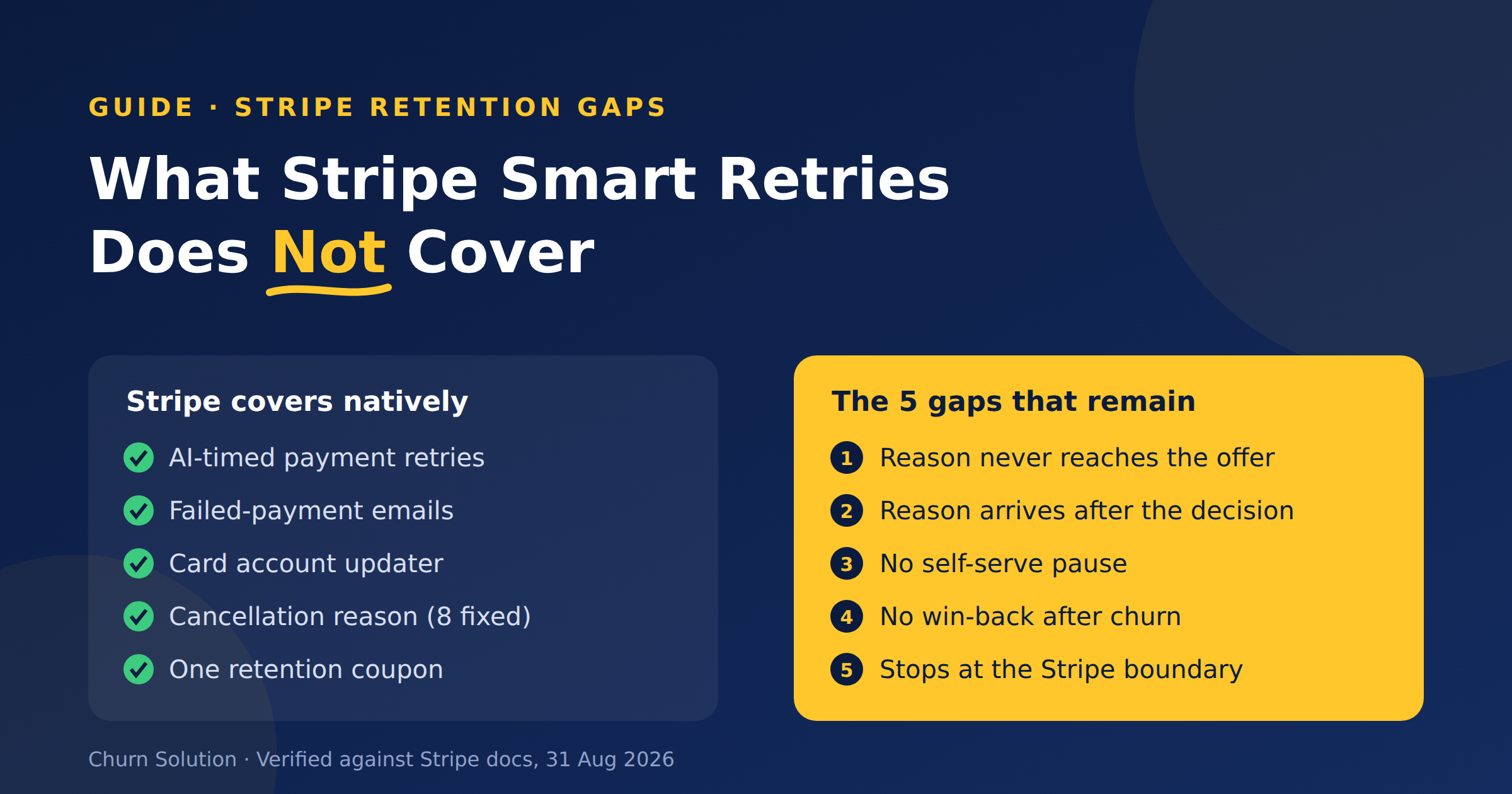
What Stripe Smart Retries Does Not Cover
Stripe Smart Retries recovers failed payments but doesn't run retention. Here are the five gaps that remain, sourced from Stripe's...


Membership Community Churn: The Members Who Quit Without Clicking Cancel
Quiet churn is the real leak: members who never clicked “cancel” at all. A card expires. A bank declines a...


Subscription Churn Dashboard: The 2026 Guide to Actionable Revenue Intelligence
Up to 40% of subscription churn is involuntary, meaning your customers aren't choosing to leave; they're being forced out by...