ARTICLE
How to Reduce Involuntary Churn: The 2026 Guide to Automated Revenue Recovery

Involuntary churn accounts for as much as 40% of total subscriber loss for the average SaaS business. This isn’t a sign of customer dissatisfaction; it’s a technical leak that drains your MRR while your team remains blind to the cause. If you’re currently relying on underperforming dunning sequences or high-touch manual outreach, you’re leaving significant revenue on the table. You need a strategy to reduce involuntary churn that moves beyond passive retries and into the realm of intelligent, data-driven recovery.
You already know that every failed payment represents a broken link in your growth engine. It’s frustrating to lose loyal customers to expired cards or rigid network rules. This guide provides the exact framework you need to identify and systematically eliminate these failures using advanced automation. We’ll show you how to recover 20-40% of lost revenue by leveraging smart retries and AI-enhanced dunning flows. We’ll explore the technical pillars of automated revenue recovery and provide a roadmap to gain total visibility into your churn metrics.
Key Takeaways
- Analyze the technical anatomy of payment failures to identify why processors and issuing banks are declining legitimate transactions.
- Deploy AI-driven smart retries that navigate the complex ecosystem of issuing banks and payment gateways without manual intervention.
- Re-engineer your dunning cycle using service continuity language to maintain positive customer relationships while securing payment.
- Systematically reduce involuntary churn by implementing a multi-layered framework focused on real-time transaction monitoring and automated recovery.
- Transition from reactive recovery to proactive prevention by leveraging predictive AI within your revenue protection strategy.
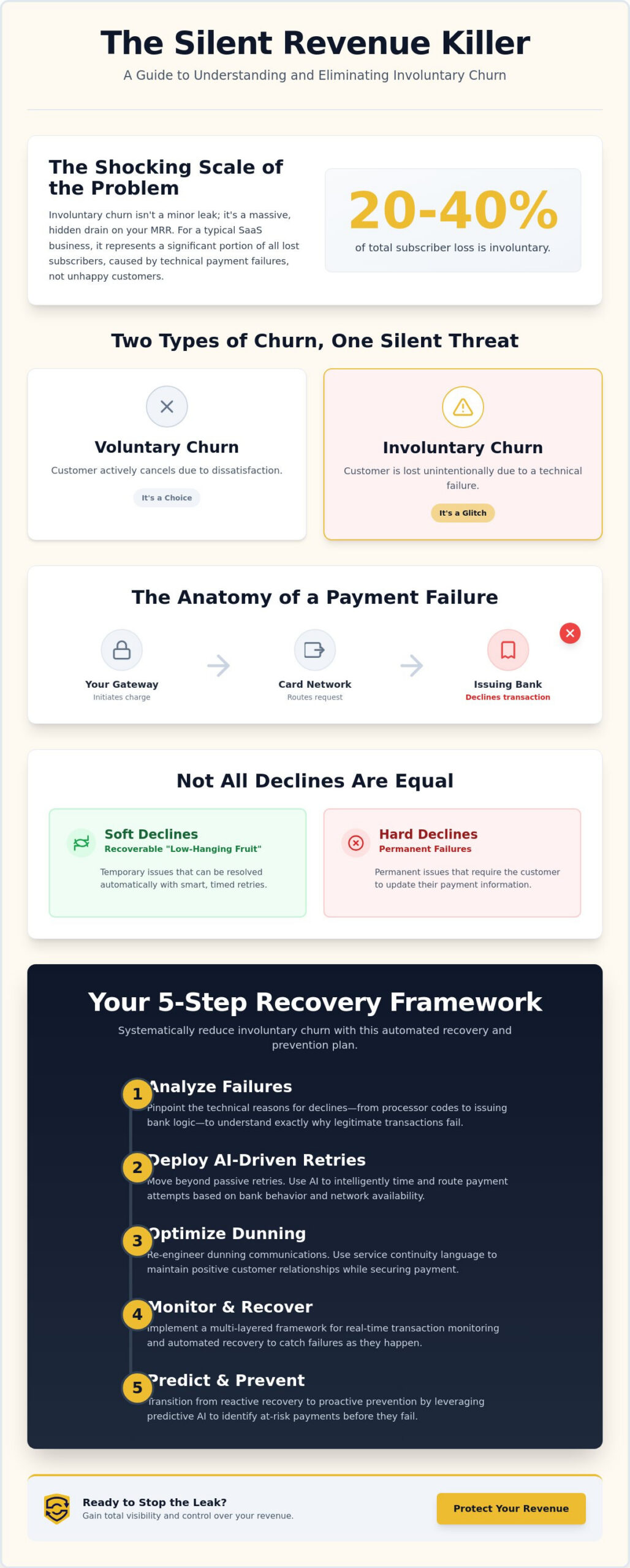
Understanding Involuntary Churn in 2026: The Silent Revenue Killer
Involuntary churn is the mechanical loss of subscribers due to payment failures rather than active cancellations. While voluntary churn reflects a failure in product-market fit or customer satisfaction, involuntary churn reveals a failure in your billing infrastructure. It’s the byproduct of expired cards, insufficient funds, or overly aggressive bank fraud filters. By June 2026, industry data confirms that involuntary churn accounts for 20% to 40% of total subscriber loss in typical SaaS models. This is a massive revenue leak that operates entirely in the background.
To effectively reduce involuntary churn and combat The Silent Revenue Killer, you must first distinguish it from active attrition. When a user cancels, they provide feedback. When a payment fails, they simply disappear. This distinction is critical for your Net Revenue Retention (NRR). High involuntary churn rates signal to investors that your revenue is fragile and your technical stack is inefficient; it directly suppresses your long-term business valuation by creating an artificial ceiling on growth.
The Hidden Costs of Passive Subscriber Loss
Failed payments do more than just stop a single transaction. They destroy Customer Lifetime Value (LTV) by terminating relationships that were otherwise healthy. By 2026, failed payments remain the #1 cause of preventable revenue leakage. Every decline creates a ripple effect across your profitability; it forces your team into high-touch manual recovery or leads to permanent customer loss. If your authorization rates are low, your entire customer acquisition cost (CAC) efficiency suffers. You’re paying to acquire users only to lose them to a technical glitch.
Why Involuntary Churn is More Dangerous Than Active Cancellations
The silent nature of passive churn is its most lethal trait. Customers often don’t realize their subscription has lapsed until they lose access to your service. This creates immediate friction. Re-acquiring a customer who left involuntarily is significantly more expensive than implementing automated recovery. You’re forced to restart the marketing cycle for someone who was already a fan. Identifying these leaks requires a granular look at your churn metrics. This data is the first step in diagnosing where your billing logic is failing. You can’t fix what you don’t measure. Establishing clear visibility into why transactions fail allows you to reduce involuntary churn systematically and protect your MRR from invisible erosion.
The Technical Anatomy of Payment Failures: Why Transactions Decline
To reduce involuntary churn, you must first understand that a payment failure isn’t a single event. It’s the result of a complex, multi-layered communication breakdown between your gateway, the card networks, and the issuing bank. Most standard billing engines treat a decline as a finality. They lack the technical sophistication to interpret raw response codes, often defaulting to a “failed” status when a strategic retry could have secured the funds. In 2026, the rise of opaque “fraud flagging” in recurring B2B transactions has exacerbated this issue. Issuing banks have tightened their security parameters, frequently blocking legitimate subscription renewals because the transaction pattern triggers a false positive in their risk models.
Your billing infrastructure’s inability to speak the language of the issuing bank creates a massive revenue bottleneck. Generic gateways often strip away critical metadata during the authorization process. This data loss makes your transactions look higher-risk to bank algorithms. When you fail to provide the right data points, you’re not just losing a payment; you’re signaling to the banking ecosystem that your business is a liability. Sophisticated recovery requires a deep dive into these technical triggers to ensure your legitimate revenue isn’t caught in a legacy net.
Soft Declines vs. Hard Declines
Understanding the distinction between decline types is fundamental to recovery. Soft declines occur due to temporary issues like insufficient funds, network timeouts, or temporary bank blocks. These are transient. Hard declines, however, result from permanent issues such as stolen cards or closed accounts. Soft declines represent the “low-hanging fruit” of revenue recovery, often recoverable through smart payment retries. Treating these two categories with the same logic is a tactical error that leads to unnecessary churn.
The Role of Outdated Billing Information
Card lifecycle management is a constant battle. Cards expire, are lost, or are replaced with new numbers, often without the customer notifying you. While basic card updaters catch some changes, they don’t solve the friction caused by Strong Customer Authentication (SCA) requirements. In 2026, SCA mandates mean that even a valid card might fail if the bank requires a new layer of verification for a recurring charge. You need proactive payment recovery systems that can handle these technical hurdles automatically. Analyze your transaction health and start optimizing your recovery rates today by exploring our automated billing workflows. This proactive approach is the only way to reduce involuntary churn at scale. For a comprehensive methodology covering 2026 Nacha requirements and automated workflows, review our failed payment recovery checklist to ensure your billing infrastructure meets every critical standard.
A 5-Step Framework to Reduce Involuntary Churn Automatically
Stopping revenue leaks requires more than just a basic billing engine; it demands a systematic, automated response to every failed transaction. To reduce involuntary churn effectively, you must move away from manual intervention and toward a self-healing billing ecosystem. This framework prioritizes technical precision and customer experience to ensure that payment friction doesn’t end a valuable relationship.
- Step 1: Implement Real-Time Monitoring. You can’t fix what you can’t see. Your system must capture and categorize ISO 8583 response codes in real time. This visibility allows you to distinguish between a temporary network glitch and a permanent card block.
- Step 2: Deploy AI-Driven Retry Logic. Stop using static retry schedules. Use historical data to determine the specific moment a transaction is most likely to succeed based on the bank’s behavior and the user’s past payment patterns.
- Step 3: Orchestrate Multi-Channel Dunning. Don’t rely solely on email. Use a coordinated sequence of in-app notifications and SMS to reach customers where they’re most active, ensuring the message isn’t buried in a crowded inbox.
- Step 4: Provide a Frictionless customer portal. When a customer needs to update their details, the process must be instantaneous. A secure, mobile-responsive portal allows users to resolve payment issues without technical hurdles.
- Step 5: Leverage AI feedback analysis. Use machine learning to analyze the outcomes of your recovery attempts. This identifies systemic issues in your payment flow, such as specific regional gateways that consistently underperform.
Implementing Smart Retry Logic
Static retry schedules are a legacy approach that often triggers bank fraud alerts. Instead, smart retries analyze millions of data points to find the “prime time” for a re-attempt. For example, retrying a charge on a common payday or during specific morning hours can significantly increase authorization rates. This dynamic approach bypasses temporary bank blocks by mimicking natural transaction patterns rather than robotic, repetitive hammering. It’s a technical shift from guessing to knowing exactly when the funds are available.
Bridging the Gap with Customer Portals
If a retry fails, the burden of resolution shifts to the customer. You must make this “work” as light as possible. Self-service portals eliminate the friction of logging into complex account settings; instead, they provide direct, secure links where users can swap a card in seconds. These portals must be mobile-responsive, as most dunning notifications are opened on smartphones. By providing a secure environment for updates, you maintain PCI compliance while ensuring the user feels in control. This accessibility is a core pillar for any business serious about its efforts to reduce involuntary churn.
Optimizing the Dunning Cycle: Advanced Communication Strategies
Most companies treat dunning as a debt collection exercise. This is a tactical error that alienates your users and increases the likelihood of a permanent exit. In 2026, effective communication must focus on service continuity rather than past-due balances. When you position a payment failure as a threat to the customer’s workflow, you transform a negative billing event into a proactive service notification. This psychological shift is essential to reduce involuntary churn without damaging the underlying customer relationship.
Timing and frequency are the technical pillars of a successful dunning cycle. If you send too many emails too quickly, you trigger ISP spam filters and ensure your recovery messages never reach the inbox. A sophisticated sequence balances urgency with deliverability, using staggered intervals that align with your retry logic. For a deep dive into high-performance messaging, consult our guide on Mastering Dunning Email Automation. Every message must remain brand-aligned and personalized, reinforcing the value of the subscription while providing a clear, frictionless path to resolution.
The Psychology of the Dunning Notice
Aggressive subject lines like “Payment Failed: Immediate Action Required” often backfire. They create unnecessary anxiety and can provoke a user to evaluate whether they actually need the service, leading to voluntary cancellation. Instead, adopt a value-first approach. Remind the user of the specific features or data they will lose access to if their service pauses. You should utilize customer segmentation to tailor these messages. A high-value enterprise account requires a different tone and escalation path than a self-service Pro plan user. By matching the message to the segment, you maintain trust while securing the payment.
Multi-Channel Recovery: Beyond the Inbox
Email is no longer the only channel for recovery. For active users, in-app notifications are significantly more effective because they reach the customer while they are deriving value from your product. If email and in-app alerts fail, escalate to SMS or push notifications for high-priority accounts. This multi-channel orchestration ensures that technical friction doesn’t result in a lost customer. You must also run constant AB experiments to determine which sequence of channels and messages yields the highest conversion for your specific audience. To start building a high-conversion recovery ecosystem, configure your automated dunning workflows here. This data-driven approach is the only way to reduce involuntary churn while scaling your operations.
Future-Proofing Retention: Leveraging AI and Data-Driven Protection
Effective revenue recovery is only the first step. To achieve sustainable growth, you must transition from reactive dunning to a comprehensive subscription revenue protection strategy. This involves using every failed transaction as a data point to train your billing ecosystem. By analyzing these patterns, you can identify technical vulnerabilities before they impact your MRR. You don’t just want to fix a leak; you want to eliminate the pressure points that cause it. This data-driven approach allows you to reduce involuntary churn by anticipating failures rather than just responding to them.
Churn Solution positions itself as the specialized partner for high-growth SaaS companies that can’t afford revenue leakage. We provide the technical mastery and automated infrastructure required to safeguard your bottom line. Our system operates as a “silent auditor,” constantly optimizing your billing flows and ensuring that your technical stack never becomes a bottleneck for your success. It’s time to implement a system that works while you sleep, protecting your hard-earned revenue with precision and speed.
Predictive Payment Recovery
AI is changing the nature of billing from a static process to a predictive one. Advanced algorithms now flag cards that are likely to fail before the next billing cycle even begins. By analyzing BIN data, historical authorization rates, and card lifecycle patterns, the system can trigger proactive updates or adjust retry logic in advance. Predictive modeling can reduce involuntary churn by up to 15% before a decline even occurs. To maintain this edge, continuous A/B testing is essential. You must constantly refine your recovery flows to adapt to changing bank behaviors and network regulations, ensuring your authorization rates stay at peak performance.
Turning Failed Payments into Win-Back Opportunities
A failed payment doesn’t have to be the end of the customer journey. If a recovery attempt fails, that user becomes a prime candidate for targeted reactivation campaigns. Since their departure was technical rather than voluntary, they often respond well to simple re-engagement prompts. Once a customer returns to update their billing details, use dynamic offers to solidify the relationship. Providing a small incentive or an extended trial of a new feature during the payment update process can turn a negative experience into a loyalty-building moment. Stop letting technical friction dictate your growth. Protect your MRR with Churn Solution’s automated recovery tools and take full control of your retention metrics today.
Secure Your Revenue Engine with Automated Recovery
Stop treating payment failures as inevitable losses. By shifting from legacy billing logic to an automated recovery ecosystem, you transform technical friction into a predictable growth lever. You’ve learned that identifying the technical anatomy of declines and deploying a multi-channel dunning strategy are the primary ways to protect your customer lifetime value. By implementing these advanced tactics, you can systematically reduce involuntary churn and stabilize your MRR while your team focuses on product innovation.
It’s time to stop the silent revenue leak. Churn Solution offers seamless integration with Stripe and all major billing engines, providing you with AI-driven smart retries optimized for the complex 2026 banking landscape. Our platform allows you to recover up to 40% of failed payments automatically, ensuring your revenue engine remains resilient without manual overhead.
Start Recovering Your Lost MRR with Churn Solution. You have the tools to plug the leak; now it’s time to execute. Your growth is too valuable to leave to chance.
Frequently Asked Questions
What is the difference between voluntary and involuntary churn?
Voluntary churn occurs when a customer explicitly chooses to end their subscription through a cancellation flow. Involuntary churn is a passive event triggered by mechanical payment failures, such as expired cards or bank declines. While voluntary churn suggests a dissatisfaction with the product, involuntary churn represents a technical breakdown in your billing infrastructure that requires automated intervention to resolve.
How much revenue is typically lost to involuntary churn in SaaS?
Subscription businesses typically lose between 20% and 40% of their total churn to payment failures. This revenue leakage often goes unnoticed because it doesn’t involve an active cancellation request from the user. Implementing a dedicated system to reduce involuntary churn is one of the fastest ways to recover lost MRR without increasing your customer acquisition costs.
Can I reduce involuntary churn using only Stripe or Braintree?
Standard billing engines provide basic dunning tools, but they often lack the technical depth to handle complex banking logic. Basic retries use static schedules that can trigger fraud alerts or reach bank limits. To maximize recovery, you need a specialized layer that interprets raw response codes and orchestrates multi-channel communication beyond simple automated emails.
What are smart retries and how do they work?
Smart retries use machine learning to determine the optimal moment to re-attempt a failed charge. Instead of retrying on a generic 24-hour cycle, the system analyzes data points like issuing bank behavior and historical success rates. This precision increases authorization chances by avoiding periods of high network congestion or specific bank maintenance windows.
How many dunning emails should I send before canceling a subscription?
A high-performance sequence typically consists of four to five messages sent over a 14 to 21 day period. The frequency should be front-loaded to capture easy recoveries within the first 72 hours. Each message must provide a direct link to a secure portal, ensuring the customer can resolve the issue with minimal friction before service termination.
Is it better to pause or cancel a subscription after a payment failure?
Pausing a subscription or implementing a grace period is generally superior to immediate cancellation. Cancellation is a permanent action that requires a full re-acquisition cycle. A pause keeps the customer’s account data intact and maintains a psychological connection to the service, making it significantly easier to reactivate them once they update their payment method.
What is a soft decline in credit card processing?
A soft decline is a temporary transaction failure that has the potential for future success. Common causes include insufficient funds, temporary network errors, or bank-imposed daily limits. Unlike hard declines, which involve stolen cards or closed accounts, soft declines are the primary targets for automated retry logic and smart recovery cycles.
How does AI help in reducing involuntary churn?
AI helps reduce involuntary churn by moving from reactive recovery to predictive prevention. Machine learning models analyze transaction history to flag cards likely to fail before the next billing date. This allows you to trigger proactive update prompts or adjust retry timing based on real-time banking data, effectively stopping the churn event before it happens.
- Key Takeaways
- Table of Contents
- Understanding Involuntary Churn in 2026: The Silent Revenue Killer
- The Technical Anatomy of Payment Failures: Why Transactions Decline
- A 5-Step Framework to Reduce Involuntary Churn Automatically
- Optimizing the Dunning Cycle: Advanced Communication Strategies
- Future-Proofing Retention: Leveraging AI and Data-Driven Protection
- Secure Your Revenue Engine with Automated Recovery
- Frequently Asked Questions

Churn solution that turns your customers right around.
Related Articles
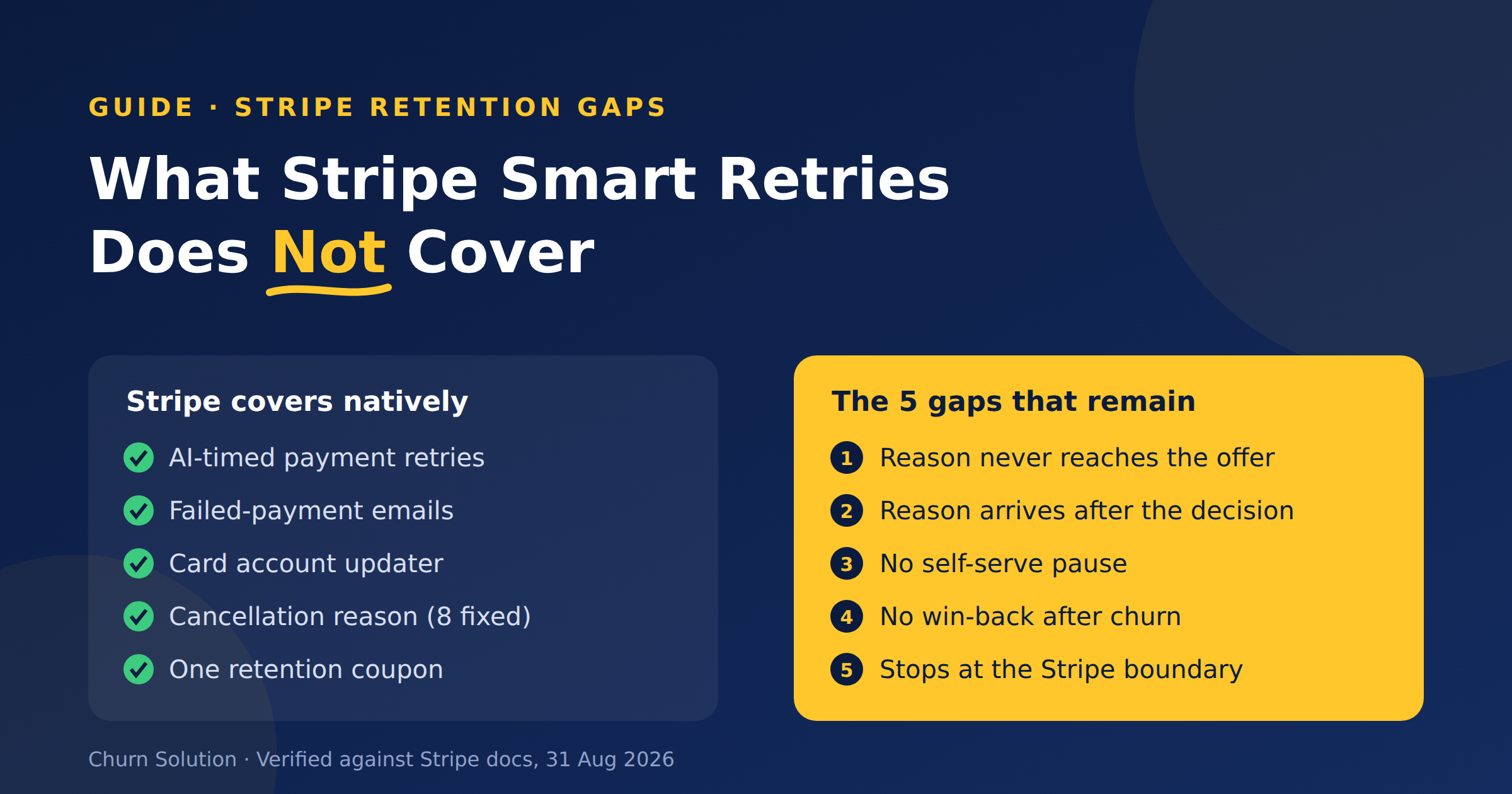
What Stripe Smart Retries Does Not Cover
Stripe Smart Retries recovers failed payments but doesn't run retention. Here are the five gaps that remain, sourced from Stripe's...


Membership Community Churn: The Members Who Quit Without Clicking Cancel
Quiet churn is the real leak: members who never clicked “cancel” at all. A card expires. A bank declines a...

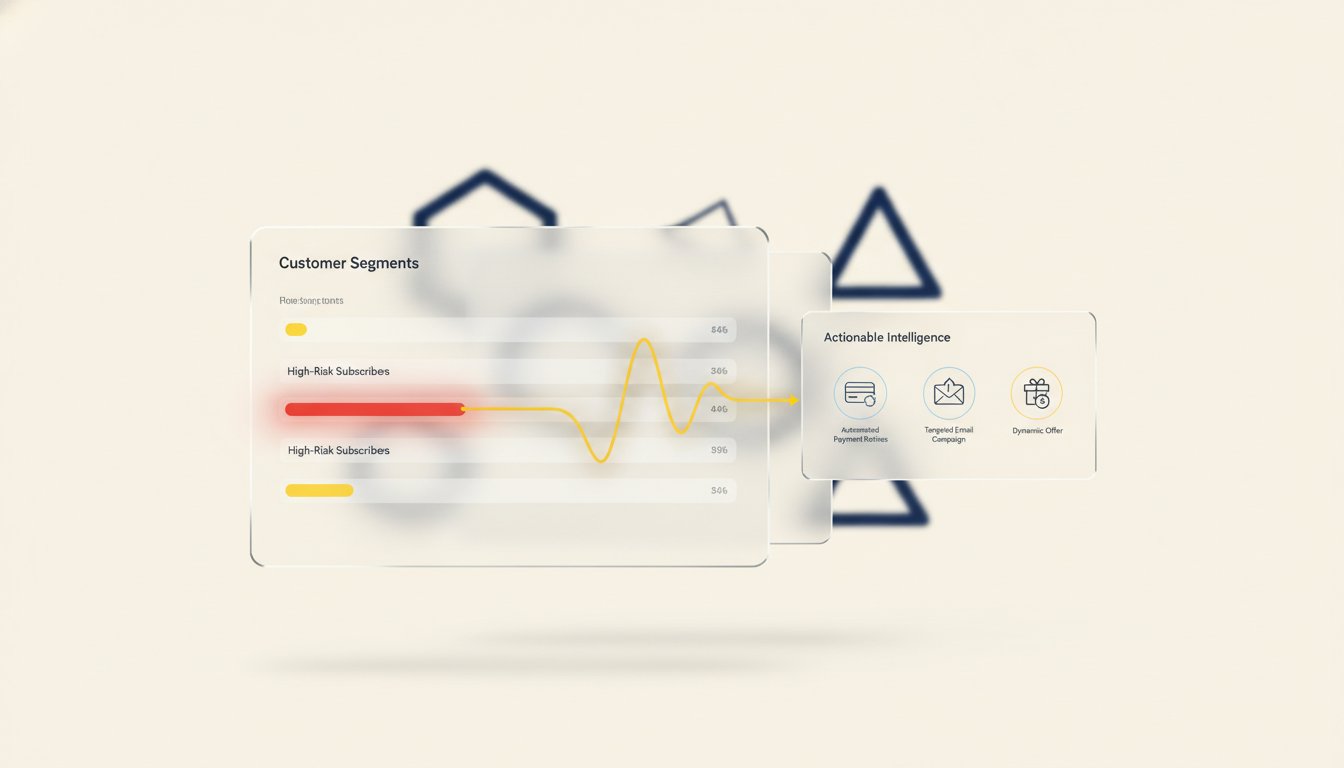
Subscription Churn Dashboard: The 2026 Guide to Actionable Revenue Intelligence
Up to 40% of subscription churn is involuntary, meaning your customers aren't choosing to leave; they're being forced out by...