ARTICLE
How to Reduce Churn with a Pause Subscription Option: The 2026 Strategy Guide
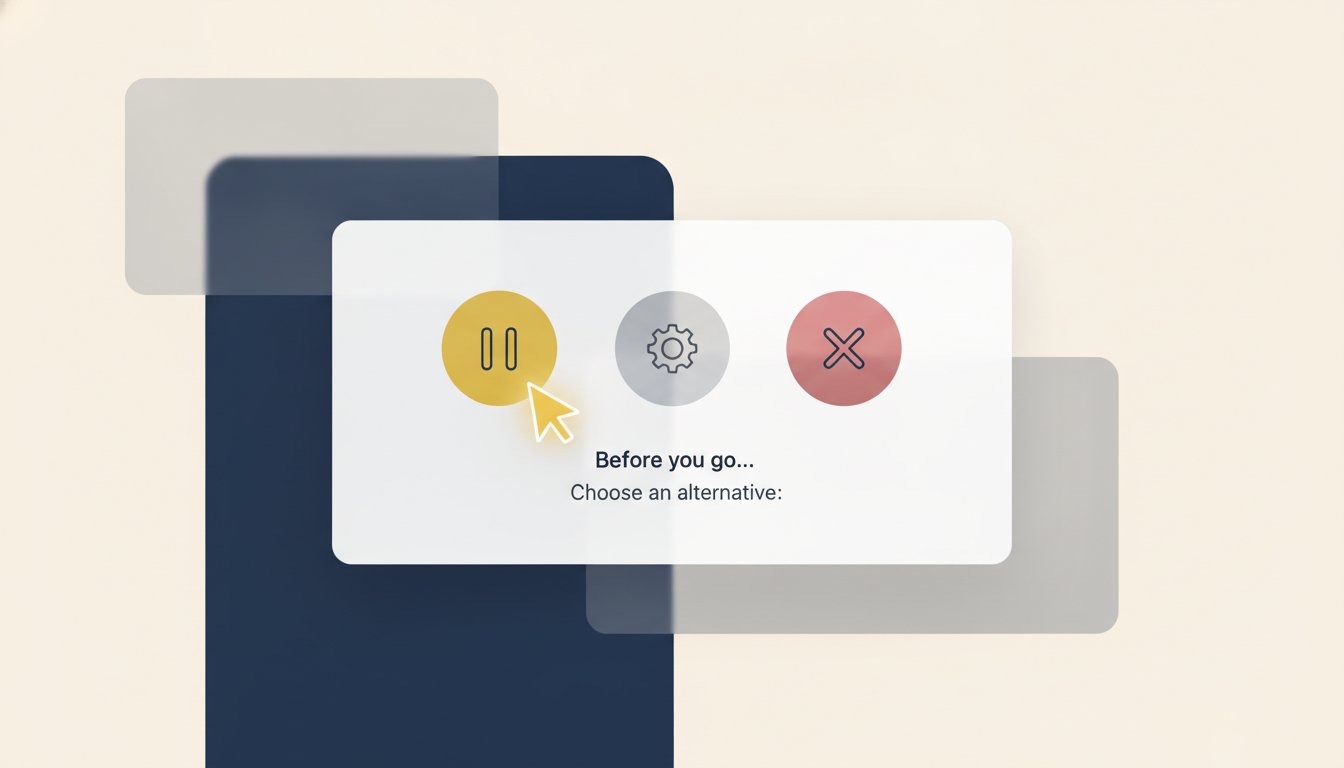
75% of subscribers who choose to pause their service eventually return to full-paying status. Most subscription leaders treat cancellation as a finality. They present a binary choice that forces users to leave when they only needed a temporary reprieve. This rigid approach drives unnecessary revenue leakage. It wastes sunk acquisition costs. Master how to reduce churn with a pause subscription option to stop losing high-LTV customers to temporary budget constraints or shifting priorities.
You recognize that a “cancel or stay” ultimatum is a relic of legacy billing models. This guide provides a strategic framework to implement a sophisticated pause mechanism. It transforms exit intent into long-term retention while protecting your monthly recurring revenue. We will analyze the data-driven benefits of flexible flows. We will also examine the exact automated triggers required to optimize your Net Revenue Retention within the 2026 regulatory landscape.
Key Takeaways
- Eliminate the binary “cancel or stay” trap by using a strategic suspension that protects user data and historical settings.
- Discover how to reduce churn with a pause subscription option by integrating it into a sophisticated, survey-driven cancellation flow.
- Establish clear eligibility rules based on customer tenure and lifetime value to ensure the pause feature targets your most valuable segments.
- Use automated reactivation sequences and “What you missed” reports to transition paused users back into active, paying customers.
- Deploy dynamic offer engines that utilize AI feedback analysis to predict and capture the highest-probability save opportunities.
Beyond the Binary: Why the “Cancel” Button is a Revenue Trap
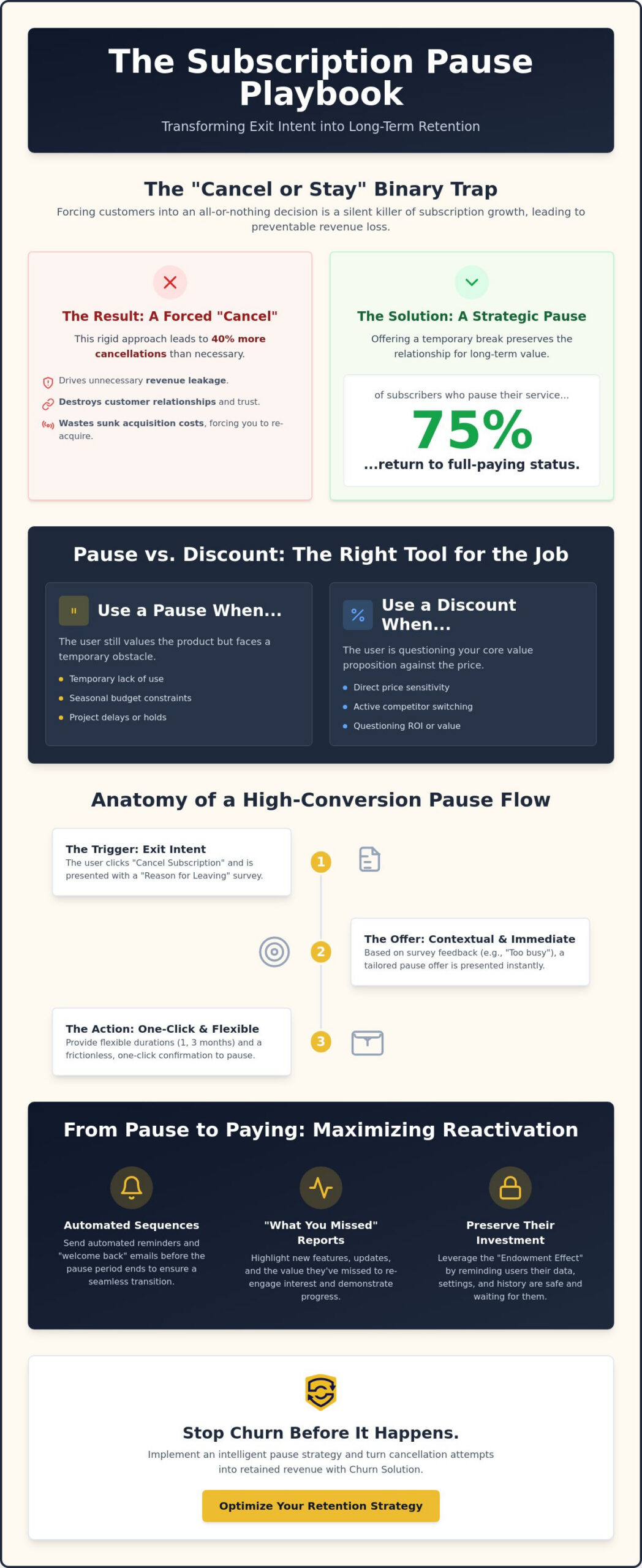
The “Binary Trap” is a silent killer of subscription growth. Most businesses present users with a stark, destructive choice: continue paying or sever the relationship entirely. This lack of flexibility leads to 40% more cancellations than necessary. When a user encounters a temporary hurdle, such as a project delay or a seasonal budget freeze, they don’t necessarily want to leave your ecosystem. They simply need to stop the clock. Forcing a total exit destroys the customer relationship and forces you to pay the high cost of acquisition all over again if they decide to return. Learning how to reduce churn with a pause subscription option is no longer a luxury; it is a baseline requirement for high-performance revenue teams.
A strategic pause option is a sophisticated suspension of service that preserves user data, custom configurations, and historical settings without active billing. It is a critical tool for managing customer churn. By 2026, leading B2B SaaS platforms are seeing a 10-15% save rate specifically from pause offers. Research shows that companies offering this flexibility can reduce total cancellations by up to 18%. This mechanism protects your Net Revenue Retention (NRR) by keeping the door open for seamless reactivation rather than forcing a cold win-back campaign later.
The Psychology of the Pause
Subscription fatigue is a primary driver of modern churn. Users often feel overwhelmed by recurring obligations and respond by purging their active stacks. Offering a low-friction alternative to total departure empowers the user and provides a sense of control. This strategy leverages the “Endowment Effect.” Users are statistically more likely to reactivate when their account configuration is “waiting” for them with all their data intact. The Pause Rate is the percentage of cancellation attempts converted into temporary suspensions.
Pause vs. Discount: When to Use Which?
Not every exit intent requires the same intervention. You must deploy the right tool for the specific friction point. Use a pause for users experiencing a temporary lack of use or seasonal budget cuts. These users still value the product but cannot justify the cost right now. Conversely, use discounts for price sensitivity or competitor switching intents where the user is questioning your core value proposition. Effective customer segmentation dictates the optimal offer, ensuring you don’t cannibalize full-price revenue when a simple pause would suffice. Identifying how to reduce churn with a pause subscription option allows you to segment your “at-risk” pool into recoverable cohorts rather than lost causes.
The Anatomy of a High-Conversion Pause Subscription Flow
Placement is the decisive factor in conversion. A static pause button buried in a settings menu is ineffective. To truly master how to reduce churn with a pause subscription option, the offer must manifest at the precise moment of exit intent. This means inserting the pause option immediately after the user completes your “Reason for Leaving” survey. By presenting the pause as a tailored solution to their specific friction point, you shift the narrative from a final goodbye to a strategic break. This timing captures the user while they are still engaged in the cancellation workflow but before they have finalized the decision.
High-performance flows rely on the “Active Preservation” message. You aren’t merely stopping a bill; you are safeguarding an investment. Explicitly remind users that they retain their data, custom configurations, and historical reports during the suspension. This strategy focuses on profitable customer retention by highlighting the inherent value of their account history. When users see exactly what they stand to lose by clicking “cancel,” the pause becomes the logical, risk-free alternative.
Flexibility drives adoption. Offer duration settings that mirror real-world business cycles, such as 1-month or 3-month intervals. Some users require a custom date to align with project restarts or fiscal quarters. Once the duration is selected, the commitment must be a “One-Click” action. Any additional friction, like secondary confirmation modals or login prompts, will cause the save rate to plummet. If you want to see these flows in action, you can deploy a high-conversion flow today.
Integrating Exit Surveys with Pause Logic
Context is king. You must map specific churn reasons, such as “Too busy right now” or “Temporary project pause,” directly to the pause offer. Sophisticated feedback analysis identifies which segments are most likely to accept a temporary suspension rather than a full cancellation. Your system should learn from these interactions. Automating offer triggers ensures that the highest-probability save is always prioritized based on real-time data, preventing you from offering a pause to someone who actually needs a discount to stay.
Data Preservation as a Retention Hook
Loss aversion is a powerful psychological lever. Visualizing the potential loss of account history creates a significant barrier to exit. Communicate clearly that “Your data is safe with us” to reassure the user that their work won’t vanish. Use the customer portal to maintain visibility of the paused status. This ensures the user feels their account is dormant, not dead. Knowing how to reduce churn with a pause subscription option depends on making the return path significantly easier than the departure.
Step-by-Step: Implementing a Strategic Pause Feature
Moving from the theory of retention to technical execution requires a precise logic flow. You aren’t just adding a button; you’re re-engineering the exit experience to prioritize reducing customer effort. When a user decides to leave, the path to staying must be frictionless and immediately rewarding. This transition requires a methodical approach to ensure your billing logic, customer data, and communication triggers remain synchronized. Executing these steps correctly is the most effective way to master how to reduce churn with a pause subscription option without creating operational chaos.
- Step 1: Deploy sophisticated exit surveys to categorize the churn intent. You must distinguish between users who are leaving due to temporary hurdles and those with fundamental product dissatisfaction.
- Step 2: Set “Pause Eligibility” rules based on customer tenure and lifetime value. Not every user earns the right to a pause; prioritize those who have demonstrated long-term value.
- Step 3: Configure your billing engine to “skip” invoices rather than terminating the subscription. This maintains the active status of the record while halting the financial transaction.
- Step 4: Design a “Pause Confirmation” email that clearly outlines the reactivation date. Transparency prevents “billing shock” when the service resumes.
- Step 5: Monitor your churn metrics to track the pause-to-active conversion rate. This data allows you to refine your offer durations and timing for maximum impact.
Eligibility and Guardrails
Unrestricted access to a pause feature can lead to “Pause Abuse,” where users perpetually cycle through suspensions to avoid payment. You should limit pauses to once per 12-month period to protect your bottom line. Establish a minimum tenure requirement, such as 3 months of paid service, before a pause is even presented as an option. Additionally, you must exclude high-risk segments who cite “Missing Features” as their reason for leaving. A pause won’t solve a product-market fit issue; it only delays the inevitable for those specific users.
Automating the Billing Transition
Technical precision in your billing engine is non-negotiable. When a user requests a mid-cycle pause, your system should calculate pro-rata credits and apply them to the future reactivation date. This ensures the user isn’t double-billed or short-changed. The “Resume” date must be hard-coded into the billing logic to prevent indefinite free access to your platform. A pause must be a temporary state with a defined end-point to protect MRR. By automating these transitions, you ensure that how to reduce churn with a pause subscription option becomes a scalable, hands-off revenue recovery engine.
Maximizing Reactivation: Turning Paused Users into Paying Customers
A pause is a strategic bridge, not a dead end. If you fail to manage the return path, the pause simply becomes a delayed cancellation. High-performance retention teams understand that the suspension period is an active “warming” phase. You must maintain brand presence without being intrusive. This is the final stage in mastering how to reduce churn with a pause subscription option. It requires a transition from passive waiting to proactive engagement. You are not just restarting a bill; you are re-onboarding a customer who has already expressed a commitment to your ecosystem.
The “T-Minus 7” sequence is your primary tool for transparency. Send automated reminders exactly seven days before the pause expires. This eliminates billing shock. It provides users with the necessary notice to adjust their settings or prepare for the upcoming invoice. Alongside these reminders, deploy a value-first content strategy. Send “What you missed” reports or summaries of new feature releases. This reminds the user of the utility they are about to regain. By the time the reactivation date arrives, the user should feel that returning is the natural next step.
Technical default settings are critical for MRR stability. The system must be configured for automated reactivation. Unless the user takes further action to extend the pause or cancel, the billing engine should resume on the scheduled date. If a user attempts to cancel immediately after the pause ends, trigger specific win-back sequences. These should be high-urgency offers designed to capture the “at-risk” intent before the account is closed. You can automate your reactivation sequences today to ensure no revenue falls through the cracks.
The “Welcome Back” Campaign
Personalization is the catalyst for successful returns. You must tailor the reactivation message to the original reason the user paused. If they cited a project delay, ask how that project concluded. Offer a “Reactivation Bonus” to ease the transition back to full-price billing. A 10% discount on the first month back can significantly reduce the friction of the returning invoice. Use sophisticated reactivation workflows to catch users who might otherwise lapse during the first week of their return.
Testing and Optimization with A/B Experiments
Data-driven refinement is the only way to maximize your save rate. You must use A/B experiments to test every variable of your pause flow. Does a 30-day default pause period result in higher long-term LTV than a 60-day default? Test your copy and your offer placement. Compare the retention rates of users saved by a pause versus those saved by a discount. This analysis allows you to optimize your 2026 strategy based on actual performance metrics rather than industry assumptions.
Automating the Save: How Churn Solution Optimizes Your Pause Strategy
Manual intervention is the enemy of scale. While the strategic benefits of a suspension period are clear, executing this at the individual account level is operationally impossible for growing SaaS enterprises. You need a system that identifies the exact moment of friction and applies the correct remedy without human oversight. Churn Solution provides the technological infrastructure to master how to reduce churn with a pause subscription option by transforming your cancellation flow into a dynamic revenue recovery engine. We replace guesswork with algorithmic precision; this ensures that your retention efforts are both consistent and profitable.
Our Dynamic Offer Engine serves the pause option only when data indicates it is the highest-probability save. By utilizing sophisticated feedback analysis, the platform analyzes exit intent in real-time to predict which users are likely to reactivate and which require a different intervention. This intelligence prevents you from offering a pause to a user who would have stayed with a simple discount. Our system achieves revenue recovery synergy by combining voluntary save tactics with smart retries. This dual-layered approach addresses both the users who choose to leave and those whose payments fail due to technical friction.
Integration is seamless and non-disruptive. Churn Solution plugs directly into your existing billing stack and industry-standard payment processors. It executes pauses and resumes without requiring manual updates to your billing logic or database. This ensures your financial records remain accurate while your customers enjoy a frictionless experience. You can manage thousands of concurrent pauses with the same level of precision as a single account.
Why Automation is Non-Negotiable
Manual pause management is a significant revenue leak for scaling businesses. It leads to inconsistent application of rules and missed reactivation dates. If a user isn’t charged the moment their pause ends, you lose MRR that you’ve already saved. Automation ensures 100% consistency in your cancellation flow. It protects your revenue by enforcing hard-coded resume dates and eligibility guardrails. Churn Solution provides this revenue protection as a hands-off service. This allows your team to focus on core product growth rather than manual retention tasks.
Next Steps for Your Retention Strategy
The first step toward optimization is identifying the gaps in your current system. Audit your exit flow today to find “Binary Traps” that force users into unnecessary cancellations. You don’t need a months-long development cycle to fix this. You can set up your first pause experiment in under 30 minutes using our intuitive dashboard. Stop letting high-LTV customers walk away due to temporary hurdles. Protect your subscription revenue with Churn Solution’s automated flows.
Secure Your Recurring Revenue with Strategic Flexibility
The binary trap of “cancel or stay” is a primary driver of revenue leakage in the modern subscription economy. You must shift from reactive damage control to proactive retention management. By preserving account data and automating reactivation sequences, you transform exit intent into a temporary suspension rather than a permanent loss. Mastering how to reduce churn with a pause subscription option ensures your most valuable customers remain within your ecosystem instead of contributing to your competitor’s growth metrics.
Automation is the only way to execute this strategy at scale. You can recover up to 40% of cancelling users by deploying AI-driven feedback loops that serve the right offer at the right time. With seamless integration into Stripe and major billing engines, you eliminate manual billing updates and technical overhead. Continuous optimization through data-driven insights allows you to refine your save triggers and protect your Net Revenue Retention without constant oversight.
Stop letting preventable churn erode your bottom line. Deploy an automated pause option today with Churn Solution to optimize your growth trajectory and secure your recurring revenue. Your business deserves a retention strategy as sophisticated as your product.
Frequently Asked Questions
Does offering a pause option increase overall churn?
No, offering a pause option reduces voluntary churn by providing a flexible alternative to total cancellation. It captures users who aren’t dissatisfied with the product but face temporary external constraints. Without this middle ground, these users are forced to sever the relationship entirely. Presenting a pause at the moment of exit intent preserves the customer relationship and prevents the high cost of re-acquisition later.
How long should a subscription pause last for maximum retention?
Optimal pause durations typically range from 30 to 90 days. This window is sufficient for users to resolve seasonal budget issues or project delays without losing brand salience. You should offer preset intervals like one, two, or three months to simplify the decision process. If you want to know how to reduce churn with a pause subscription option effectively, you must ensure the duration aligns with your specific industry’s usage cycles.
What is the difference between a subscription pause and a “maintenance mode” plan?
A subscription pause is a total suspension of both billing and service access for a set period. In contrast, a “maintenance mode” or “parked” plan often involves a nominal fee to keep data accessible or certain background processes running. Pausing is ideal for total breaks. Maintenance plans work best for high-data products where the user needs to access historical records without using the core software’s active features.
Should I charge a small fee for users to pause their accounts?
You should generally avoid charging a fee for pausing unless your infrastructure costs for dormant accounts are exceptionally high. The goal of a pause is to remove financial friction during a period of low utility. Adding a “pause fee” creates a new barrier to retention and may push the user toward a total cancellation instead. Focus on the long-term lifetime value recovered rather than short-term fee extraction during a sensitive exit moment.
How do I handle users who want to extend their pause period?
Limit extensions to a single occurrence within a 12-month cycle to protect your recurring revenue. When a user requests an extension, it often signals a deeper issue with product-market fit or a permanent shift in their needs. Use this request as a trigger for a personalized outreach or a high-value discount offer. This proactive approach helps you determine if the user is truly “paused” or simply delaying an inevitable departure.
What metrics should I track to see if my pause option is working?
Track the Pause-to-Active conversion rate as your primary success indicator. This metric reveals the percentage of users who successfully resume their subscriptions after the suspension. Monitor the Churn Save Rate and the 6-month retention of reactivated users. Comparing the LTV of paused users against those saved by discounts will reveal the true economic impact of your how to reduce churn with a pause subscription option strategy.
Can a pause option help reduce involuntary churn from failed payments?
A pause option is designed for voluntary churn where the user initiates a cancellation. It doesn’t solve involuntary churn caused by expired cards or bank declines. To address failed payments, you must deploy dunning automation and smart retries. While pausing keeps the account record active, involuntary churn requires a technical recovery of the payment method rather than a strategic suspension of the service itself.
- Key Takeaways
- Table of Contents
- Beyond the Binary: Why the "Cancel" Button is a Revenue Trap
- The Anatomy of a High-Conversion Pause Subscription Flow
- Step-by-Step: Implementing a Strategic Pause Feature
- Maximizing Reactivation: Turning Paused Users into Paying Customers
- Automating the Save: How Churn Solution Optimizes Your Pause Strategy
- Secure Your Recurring Revenue with Strategic Flexibility
- Frequently Asked Questions

Churn solution that turns your customers right around.
Related Articles
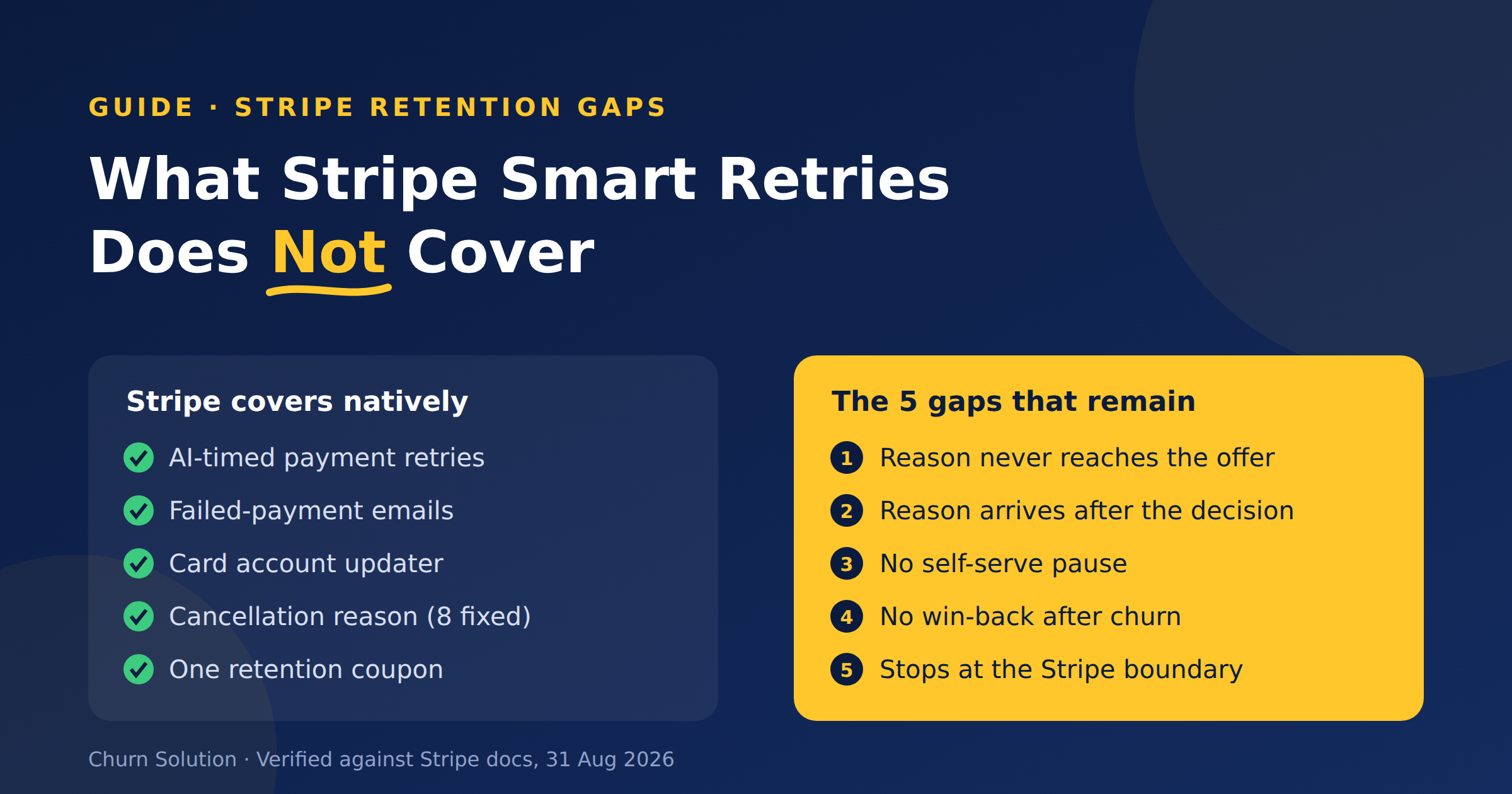
What Stripe Smart Retries Does Not Cover
Stripe Smart Retries recovers failed payments but doesn't run retention. Here are the five gaps that remain, sourced from Stripe's...

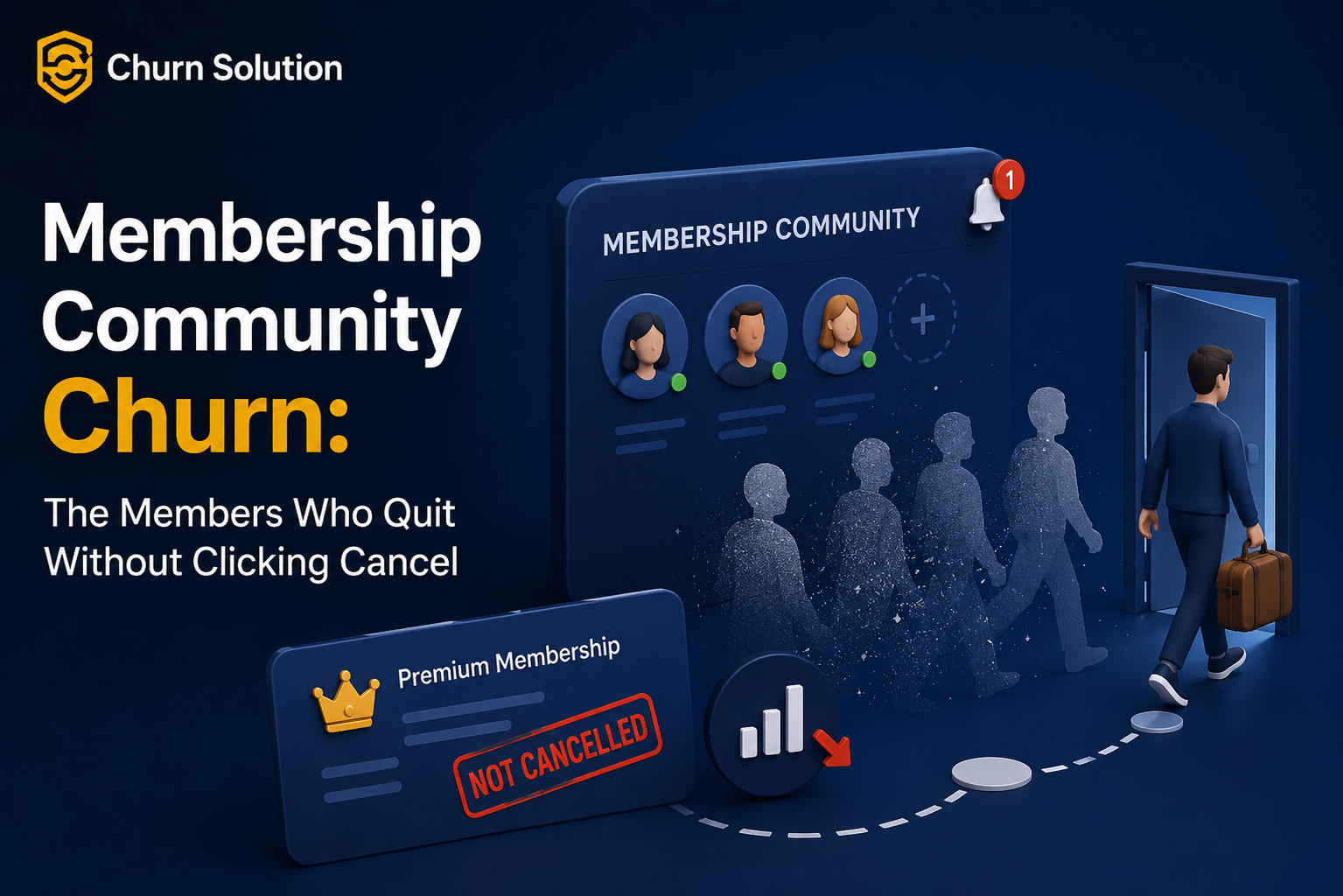
Membership Community Churn: The Members Who Quit Without Clicking Cancel
Quiet churn is the real leak: members who never clicked “cancel” at all. A card expires. A bank declines a...

Subscription Churn Dashboard: The 2026 Guide to Actionable Revenue Intelligence
Up to 40% of subscription churn is involuntary, meaning your customers aren't choosing to leave; they're being forced out by...