ARTICLE
Dynamic Cancellation Offers: 5 High-Impact Strategies to Save Subscriptions in 2026

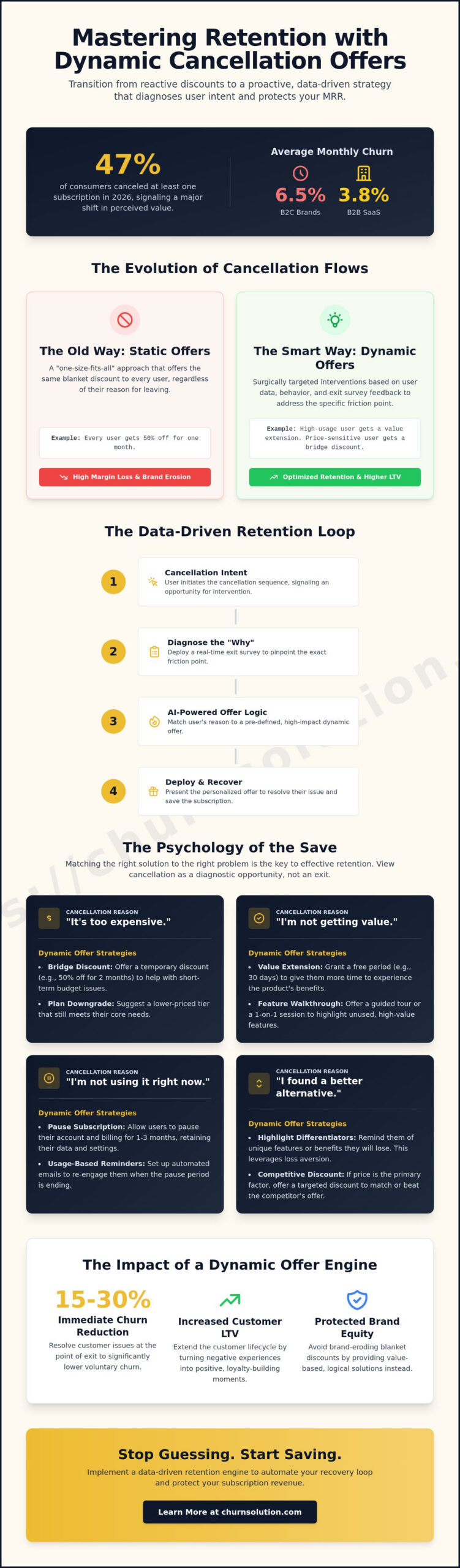
In 2026, 47% of consumers canceled at least one subscription, signaling a massive shift in how users perceive digital value. For B2C brands facing 6.5% monthly churn and B2B SaaS teams fighting a 3.8% leak, the standard response is often a desperate, brand-eroding discount. This reactive approach fails because it ignores the specific friction point driving the exit. To protect your MRR, you must deploy dynamic cancellation offers that leverage real-time data to intervene exactly when it matters most.
You likely recognize that blanket discounts do more harm than good; they train your best customers to wait for a price drop. It’s frustrating to watch revenue leak away because you lack visibility into why users are actually leaving. This guide provides the strategic blueprint to change that. We will explore five high-impact strategies to automate your retention process with smart logic and AI feedback analysis. You’ll learn how to reduce churn by 15-30% immediately while improving Customer Lifetime Value through surgically targeted interventions that protect your brand equity.
Key Takeaways
- Transition from static retention pages to intent-based engines that respond to specific user behaviors and exit signals in real time.
- Utilize exit surveys to diagnose the exact friction point, treating a cancellation request as a strategic diagnostic tool rather than a final goodbye.
- Deploy dynamic cancellation offers such as bridge discounts or value extensions to resolve unique customer pain points without eroding brand equity.
- Automate the recovery loop by integrating retention platforms with billing systems to track precise ROI and long-term retention metrics.
- Leverage AI feedback analysis to refine your offer logic, ensuring every intervention is data-driven and focused on protecting your monthly recurring revenue.
What are Dynamic Cancellation Offers and Why Do They Matter in 2026?
Subscription businesses in 2026 face a sophisticated consumer base that treats recurring payments with extreme fluidity. The traditional “Please don’t go” splash page has become a relic of a less competitive era. Today, dynamic cancellation offers represent automated, logic-based incentives triggered the moment a user initiates a cancellation sequence. These are not generic discounts; they are surgically targeted interventions designed to address the specific friction point causing a user to leave. By transitioning from static pages to intent-based retention engines, companies can stabilize their Net Revenue Retention (NRR) and protect profit margins from unnecessary erosion.
High churn rate metrics often stem from a lack of engagement at the point of exit. In an environment where 47% of consumers canceled at least one subscription this year, a simple “Cancel” button is a missed opportunity for recovery. Modern subscription models require sophisticated logic to identify if a user is leaving due to price sensitivity, technical hurdles, or temporary budget constraints. Implementing dynamic cancellation offers allows you to deploy the exact remedy needed to extend Customer Lifetime Value (LTV) without sacrificing brand integrity.
The Evolution of the Cancellation Flow
The industry has moved through three distinct phases of cancellation management. Early models relied on manual friction, forcing users to email support or call a representative. While this deterred some, it ultimately destroyed brand trust. The second phase introduced automated, yet static, flows that offered the same 20% discount to every departing user. This led to massive revenue leakage as users learned to game the system for lower prices. The current phase utilizes sophisticated automated cancellation flows that prioritize user experience while maximizing recovery. Modern users demand self-service options, yet they remain highly responsive to personalized interventions that feel like a proactive solution rather than a desperate plea.
Static vs. Dynamic: The Revenue Difference
Static offers are a one-size-fits-all trap. When you offer a blanket discount, you give away margin to users who might’ve stayed for a feature walkthrough or a temporary account pause. Dynamic offers utilize customer data such as tenure, plan level, and product usage to tailor the save attempt. Consider the difference in impact:
- Static: Every user gets 50% off for one month. Result: High margin loss.
- Dynamic: A high-usage user receives a “Value Extension” of 30 days; a low-usage user receives a “Bridge Discount” to help with budget concerns. Result: Optimized retention.
Dynamic cancellation offers are the intersection of customer intent and revenue protection.
The Psychology of the Save: Matching Offers to Cancellation Reasons
Cancellation is rarely a binary decision. It’s a signal that the perceived value of your service has dipped below its cost. When a user clicks “cancel,” they aren’t necessarily gone; they’re often expressing a specific frustration that hasn’t been addressed. To recover this revenue, you must view exit intent as a diagnostic opportunity. By leveraging an exit survey, you can identify the exact friction point and deploy dynamic cancellation offers that resonate with the user’s current psychological state.
Effective retention strategies rely on two core psychological pillars: loss aversion and reciprocity. Loss aversion reminds users of the data, history, or status they’ll forfeit upon account closure. Reciprocity involves providing immediate value, such as a free month of service, to trigger a sense of obligation and continued commitment. Mastering customer retention requires moving beyond guesswork and using these principles to drive measurable business outcomes.
Mapping Intent to Incentives
Generic offers ignore the nuance of why people leave. Your recovery logic should follow a strict “Problem-Mechanism-Outcome” structure to ensure high-impact results. Consider these strategic pairings:
- Reason: “Too expensive” — Strategy: Deploy a temporary “Bridge Discount” or offer a plan downgrade to keep them in the ecosystem at a lower price point.
- Reason: “Missing features” — Strategy: Grant an extended trial of a higher-tier plan or trigger a specialized onboarding sequence to highlight existing functionality they may have overlooked.
- Reason: “No time to use” — Strategy: Implement the pause functionality to preserve their data while removing the immediate financial burden.
The “Pause” Phenomenon: Why Users Choose a Break Over a Breakup
Psychological safety is a powerful retention tool. Pausing feels temporary and reversible, whereas cancelling feels final and destructive. Industry professionals report that offering a pause option can capture up to 40% of users who otherwise would have fully churned. This mechanism protects your MRR by keeping the customer relationship alive. It also ensures that when the user’s schedule or budget clears, their settings and data remain intact, making reactivation seamless. A paused user remains within your marketing loop, and internal data suggests they are significantly more likely to reactivate than a user who has fully terminated their subscription. You can start building your custom pause logic today to see these results in your own dashboard.
5 High-Impact Dynamic Offer Examples to Implement Today
Retention is a game of precision. Deploying dynamic cancellation offers requires more than a single discount toggle; it demands a suite of incentives tailored to specific user friction points. When you move beyond the “one-size-fits-all” discount, you safeguard your margins while simultaneously improving the user’s perception of your brand. These five strategies represent the current gold standard for high-performance subscription recovery in 2026.
- The Bridge Discount: Offer 50% off for the next two months. This mechanism specifically targets users experiencing temporary budget constraints, allowing them to remain in your ecosystem while they stabilize their finances.
- The Value Extension: Grant 30 days of free service in exchange for completing a detailed feedback loop. This trades a small amount of time for high-value qualitative data you can use to improve your product.
- The Plan Pivot: Suggest a lower-tier “Lite” plan automatically when usage data indicates the user is underutilizing their current tier. This preserves the relationship and prevents a total exit.
- The Expert Intervention: Trigger a 1-on-1 strategy call for high-LTV users who indicate they feel “stuck” or haven’t reached their desired outcomes. High-touch intervention often solves the complexity issues that automated flows cannot.
- The Account Credit: Apply a one-time $20 credit to the next invoice. This acts as “found money” in the user’s mind, creating an immediate psychological incentive to stay for at least one more billing cycle.
Segment-Specific Offer Strategies
Effective recovery logic depends on where the user sits in their lifecycle. New users who have been active for less than three months often haven’t reached their “Aha!” moment. For this group, focus on education and extended trials of premium features. Power users with over 12 months of tenure respond better to “Loyalty Credits” or protection of their legacy pricing. High-volume enterprise accounts require service extensions rather than price cuts. Focus on maintaining high Average Contract Value (ACV) by offering additional seats or premium support modules instead of eroding your core pricing structure.
Winning Back the “Price Sensitive” Segment
Not every user who claims your product is “too expensive” actually needs a discount. You must use customer segmentation to distinguish between true budget-constrained users and “discount hunters” who habituate to lower prices. If you offer a high-value discount to a power user with high willingness to pay, you’re simply leaving money on the table. Industry data shows that a well-executed “Save-with-Downgrade” offer can preserve up to 80% of the original seat value. This strategy keeps the user active on a more sustainable plan, ensuring they don’t migrate to a competitor. By implementing dynamic cancellation offers based on actual usage and tenure, you ensure that every incentive served is a calculated investment in long-term revenue growth. To build on this foundation, it’s equally critical to improve subscriber lifetime value through a broader strategic framework that extends well beyond the cancellation moment.
How to Implement a Data-Driven Offer Engine
Establishing a high-performance retention engine requires a shift from manual oversight to methodical, automated execution. You can’t optimize what you don’t measure. Implementing dynamic cancellation offers starts with a seamless technical foundation that links user behavior directly to your revenue management system. This technical alignment ensures every saved account is a measurable win for your Net Revenue Retention rather than a statistical anomaly. Follow this four-step methodology to deploy a sophisticated recovery system.
- Step 1: Billing Integration. Connect your retention layer to your source of truth, such as Stripe. This allows the system to apply coupons, credits, or plan changes instantly without manual support intervention.
- Step 2: Define Success Metrics. Move beyond the initial save as your primary KPI. Measure success based on 30-day and 90-day retention persistence to ensure your offers drive long-term value.
- Step 3: Construct the Intent Tree. Use qualitative data from your exit surveys to map specific cancellation reasons to logical remedies. If the reason is technical, the logic should trigger a support intervention; if it’s financial, it should trigger a value-based incentive.
- Step 4: Launch Controlled Testing. Deploy your offers against a control group. This is the only way to verify that your interventions actually change user behavior rather than just subsidizing users who would’ve stayed anyway.
A/B Testing Your Way to Zero Churn
Execution without experimentation is just guesswork. You must use A/B experiments to validate the efficacy of every new offer rollout. For instance, test a “1 Month Free” incentive against a “20% Off for 3 Months” structure to see which drives better 90-day retention for your specific audience. Adhere to the control group rule: never offer a save to 100% of your users. By withholding offers from a small, randomized segment, you gain the clean data necessary to calculate the true ROI of your retention efforts. This scientific approach prevents you from eroding your margins with unnecessary discounts.
Segmenting by Health Score
Aggressive discounting is a tool, not a strategy. You must use product usage data to dictate which offers are served to which users. A “Ghost User” who hasn’t logged in for 30 days requires a fundamentally different intervention than an “Overwhelmed User” who is active but struggling with complexity. Your customer health score serves as the primary dial for offer aggressiveness; a loyal user in a temporary slump receives a softer touch than a ghost user on the verge of permanent churn. By segmenting your audience this way, you ensure that dynamic cancellation offers are only deployed when they’re most likely to succeed. Build your first data-driven experiment today to stop revenue leakage at the source.
Protecting Subscription Revenue with Churn Solution’s Dynamic Offers
Retention excellence requires more than just a list of tactics; it demands a unified system that operates at the speed of your users. Churn Solution provides the infrastructure to automate the entire “Capture-Analyze-Offer” loop, turning potential revenue loss into a predictable recovery engine. By deploying dynamic cancellation offers through our platform, you eliminate the gap between identifying churn intent and taking corrective action. Our system captures the user’s reason for leaving, analyzes the data through our proprietary logic, and serves the optimal incentive instantly. This process ensures that no user leaves without a surgically targeted attempt to preserve the relationship.
Visibility is the foundation of control. Our real-time ROI tracking allows you to see exactly how much MRR is saved by each specific offer type. You don’t have to guess if a bridge discount or a value extension is performing better; the data is displayed in a centralized dashboard. This transparency enables you to refine your strategy based on hard numbers rather than intuition. Deploying these dynamic cancellation offers is a seamless process that requires no engineering resources. You can launch, test, and iterate on your flows without writing a single line of code, allowing your product team to stay focused on core development while you protect the bottom line.
The 2026 Revenue Protection Stack
A holistic approach to retention must address both voluntary and involuntary churn. Churn Solution allows you to combine sophisticated cancellation flows with advanced payment recovery tools to create a comprehensive revenue shield. The secret weapon in this stack is our AI-driven feedback analysis, which processes qualitative exit survey data to uncover hidden trends in user sentiment. This intelligence informs your offer optimization, ensuring your incentives remain relevant as market conditions shift. For global enterprises, our platform supports multi-currency and multi-language configurations, allowing you to scale your retention strategy across every territory you serve.
Getting Started: Your 30-Day Retention Roadmap
Transforming your retention metrics doesn’t happen overnight, but it does happen quickly with a structured plan. Follow this roadmap to stabilize your MRR within a single billing cycle:
- Day 1-7: Audit your current “Cancel” button and install our smart exit surveys to begin gathering intent data.
- Day 8-14: Identify your top three churn reasons and build matching dynamic offers using our no-code builder.
- Day 15-30: Launch your first A/B test against a control group and monitor your save rates in real time.
Even when a user chooses to leave, the relationship isn’t over. Our automated reactivation campaigns stay in contact with former subscribers, using their previous exit data to time win-back offers perfectly. Ready to stop the leak? Start your free Churn Solution trial now and take command of your subscription growth.
Take Command of Your Retention Strategy
Mastering retention is no longer optional for high-growth subscription brands. You’ve seen how intent-based logic and segment-specific incentives outperform static “please stay” pages. By implementing dynamic cancellation offers, you move beyond generic discounts and address the specific friction points that drive users away. This strategic shift ensures your brand value remains intact while your MRR continues to scale. Every save represents a compound win for your long-term LTV.
The transition to a data-driven retention engine doesn’t require months of development. You can save up to 30% of cancelling subscribers with a system that offers no-code integration with Stripe and provides AI-powered churn insights. It’s time to stop the revenue leak and take control of your business outcomes. Your path to sustainable growth begins with a single, data-driven intervention. Automate your retention and launch dynamic offers today with Churn Solution. Start building your recovery engine now.
Frequently Asked Questions
What is a dynamic cancellation offer?
A dynamic cancellation offer is a logic-based incentive triggered by specific user intent during a cancellation sequence. Unlike static discounts, these offers adapt in real time based on customer data such as tenure, plan level, or product usage. This ensures that the intervention directly addresses the user’s unique friction point while protecting your overall profit margins from unnecessary erosion.
Do cancellation discounts actually work long-term?
Cancellation discounts are highly effective when structured as temporary bridge incentives rather than permanent price drops. They provide the necessary breathing room for users to re-engage with your product’s core value. To ensure long-term success, you must monitor Customer Lifetime Value (LTV) to verify that saved users remain profitable and engaged over the subsequent 90 to 180 days.
How do I prevent users from abusing cancellation offers?
Prevent abuse by implementing frequency capping and eligibility rules within your offer engine. You can restrict high-value incentives to users who haven’t received a discount in the last 12 months or those with a specific health score. This strategic barrier prevents “discount hunting” behavior and protects your brand equity from being undermined by opportunistic subscribers who game the system.
Can I offer a “Pause” instead of a “Cancel” option?
Offering a pause is a sophisticated alternative that maintains the customer relationship without the finality of a termination. It preserves user data and account settings, which significantly lowers the friction for future reactivation. This mechanism is particularly effective for users citing temporary budget constraints or a lack of time to utilize the service effectively during a specific period.
How do I know which offer is performing the best?
Identify top-performing incentives by running controlled A/B tests that compare save rates and post-save retention across different cohorts. Your analytics dashboard should track MRR recovery and long-term persistence metrics for each offer type. Clean data requires a randomized control group that receives no offer, establishing a baseline to measure the true uplift of your interventions.
Do I need developer help to set up dynamic offers?
Modern retention platforms allow you to deploy dynamic cancellation offers without writing a single line of code. These systems integrate directly with your billing stack to automate coupon application and account state changes. This no-code approach empowers marketing and growth teams to iterate on retention strategies rapidly without consuming valuable engineering resources or disrupting the product roadmap.
What is the average save rate for a good cancellation flow?
A high-performing cancellation flow typically recovers between 15% and 30% of users who initiate the exit process. These results vary based on industry benchmarks and the surgical precision of the incentives provided. Reaching the upper end of this performance bracket requires continuous optimization of your intent-mapping logic and a diverse library of segment-specific offers.
How does segmentation improve my retention offers?
Segmentation ensures that you only deploy aggressive incentives to users with high potential LTV or specific churn risk profiles. By categorizing users by tenure or product engagement scores, you avoid providing unnecessary discounts to loyal users who might have stayed with a simpler intervention. This precision maximizes your total revenue recovery while minimizing profit margin leakage across your entire subscriber base.
- Key Takeaways
- Table of Contents
- What are Dynamic Cancellation Offers and Why Do They Matter in 2026?
- The Psychology of the Save: Matching Offers to Cancellation Reasons
- 5 High-Impact Dynamic Offer Examples to Implement Today
- How to Implement a Data-Driven Offer Engine
- Protecting Subscription Revenue with Churn Solution's Dynamic Offers
- Take Command of Your Retention Strategy
- Frequently Asked Questions

Churn solution that turns your customers right around.
Related Articles
What Stripe Smart Retries Does Not Cover
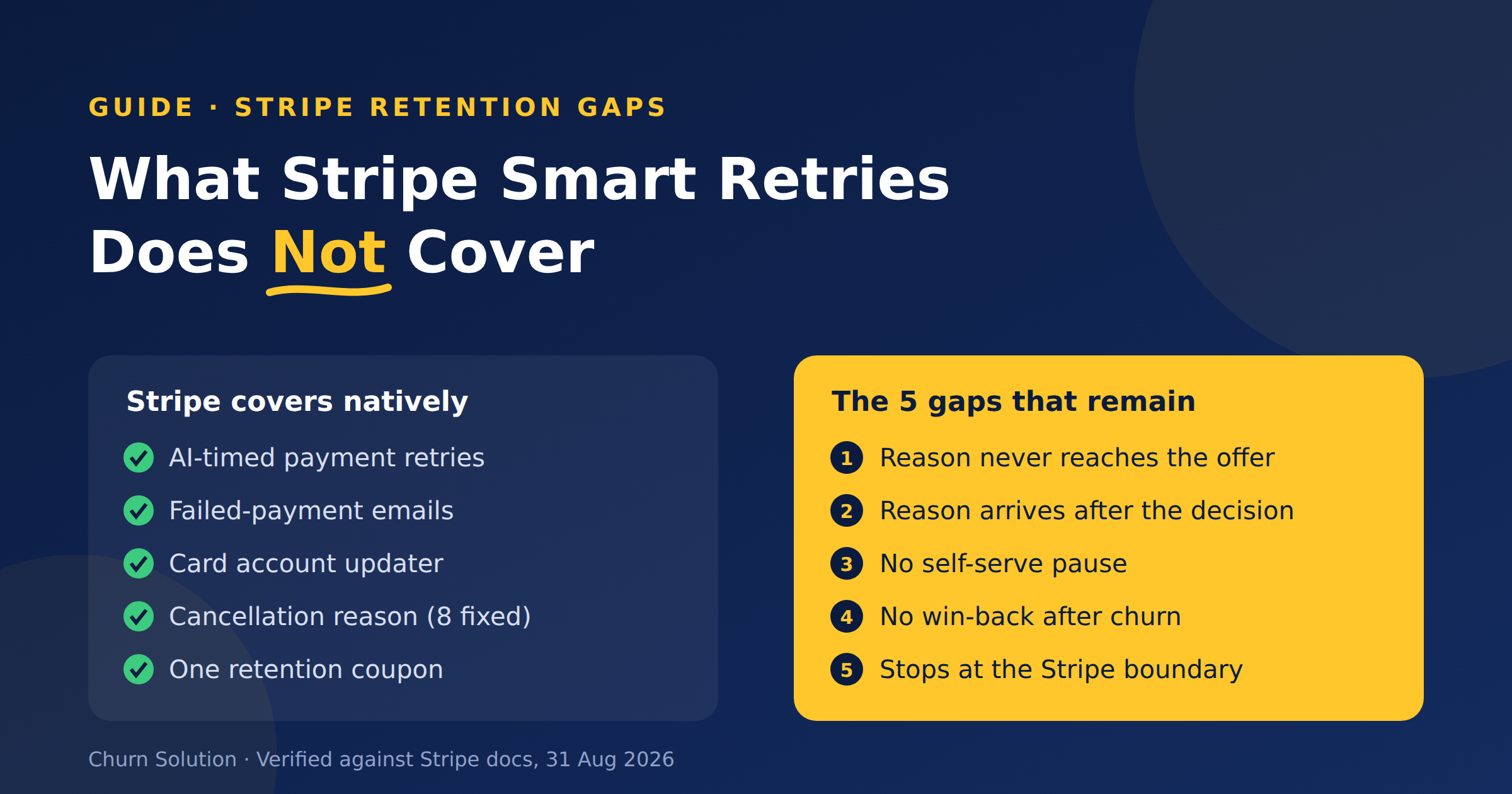
Stripe Smart Retries recovers failed payments but doesn't run retention. Here are the five gaps that remain, sourced from Stripe's...

Membership Community Churn: The Members Who Quit Without Clicking Cancel
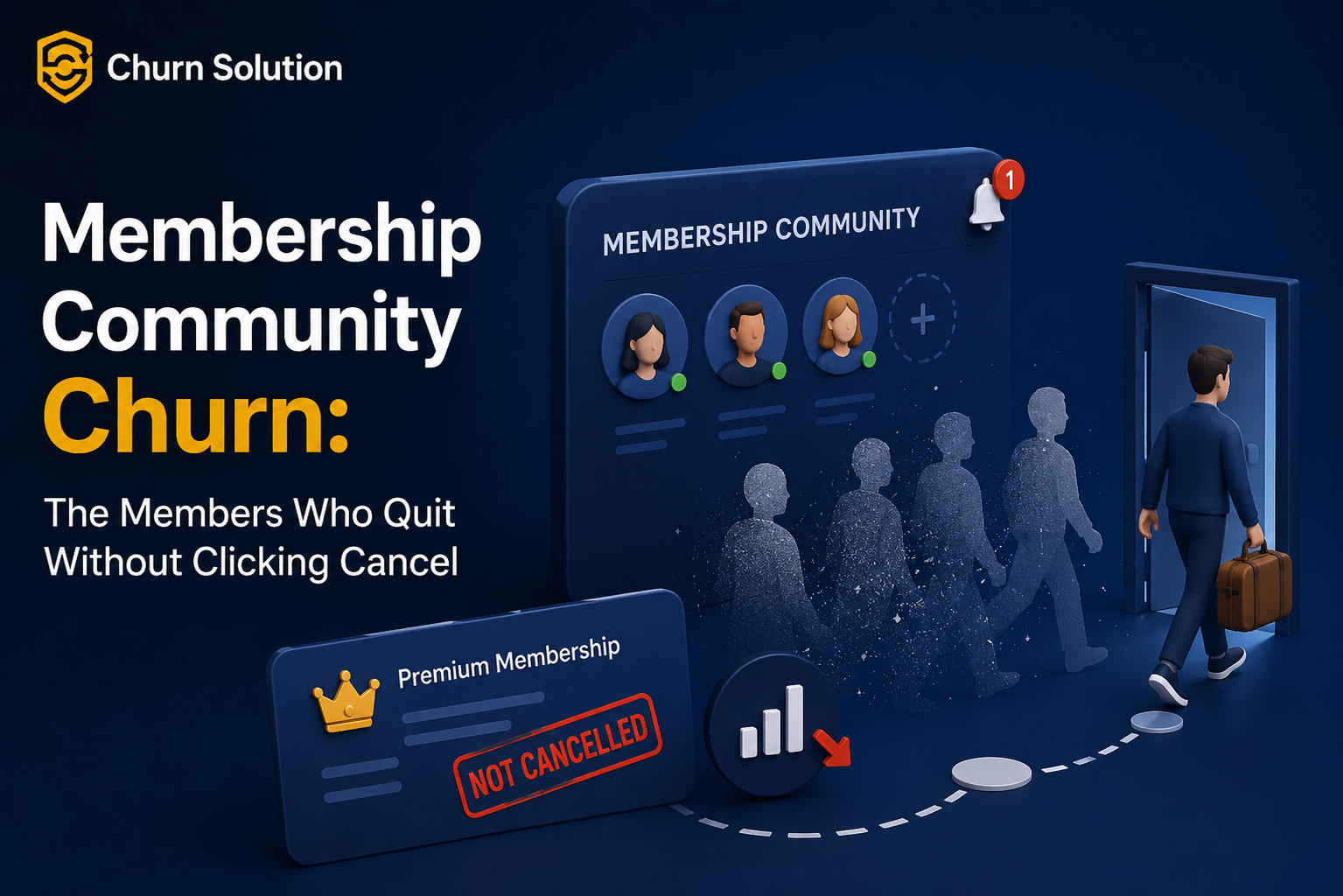
Quiet churn is the real leak: members who never clicked “cancel” at all. A card expires. A bank declines a...

Subscription Churn Dashboard: The 2026 Guide to Actionable Revenue Intelligence
Up to 40% of subscription churn is involuntary, meaning your customers aren't choosing to leave; they're being forced out by...