ARTICLE
Precision Retention: Customer Segmentation for Churn Reduction in 2026

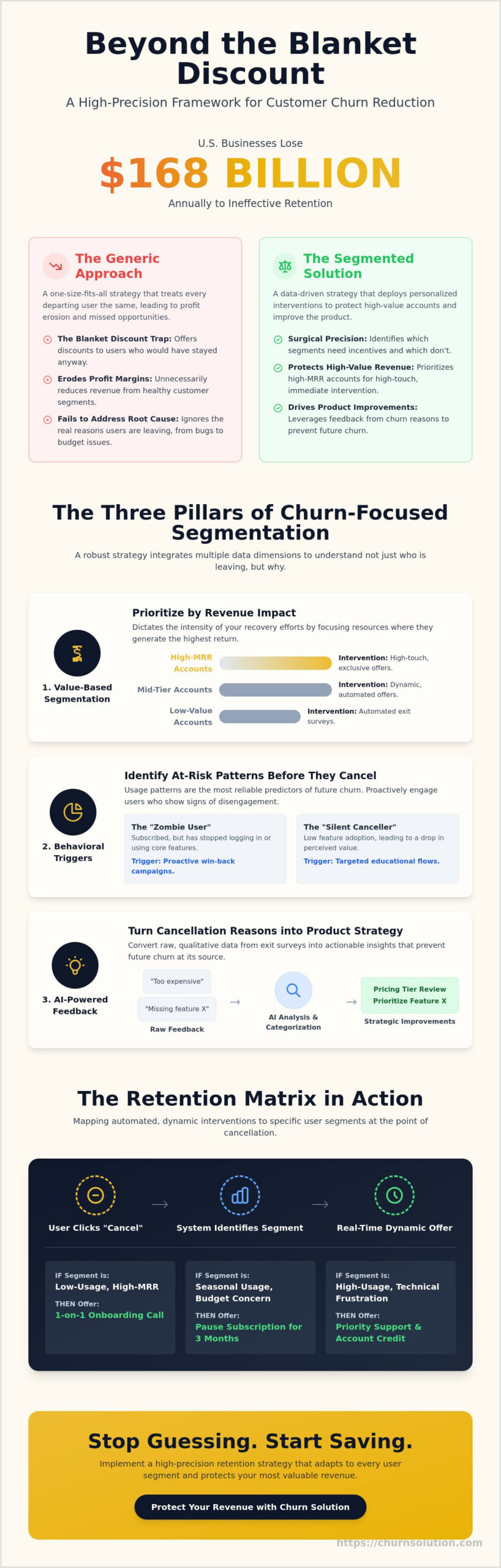
U.S. businesses lose $168 billion every year to customer churn, yet the majority of subscription companies still treat their departing users as a single, monolithic block. You likely recognize the pattern. When a high-value account hits the cancel button, they receive the same generic discount offer as a low-tier user who barely engaged with the product. This lack of precision doesn’t just fail to stop the bleed; it actively erodes your profit margins. Effective customer segmentation for churn reduction is no longer a diagnostic luxury. It’s an essential execution engine for revenue recovery in 2026.
We agree that your retention strategy should be as sophisticated as your acquisition funnel. You’ll learn how to transform fragmented data into high-conversion retention workflows by segmenting at-risk users and deploying automated interventions. This guide explores how to leverage cancellation flows and dynamic offers to personalize the offboarding experience for every segment. We’ll show you how to lower your net churn, protect your high-value accounts, and use automated feedback loops to drive your product strategy forward with precision.
Key Takeaways
- Abandon the blanket discount trap by identifying which at-risk segments require incentives and which are merely eroding your profit margins.
- Implement a high-precision framework for customer segmentation for churn reduction that prioritizes high-MRR accounts for immediate, high-touch intervention.
- Categorize users within a Retention Matrix to align behavioral triggers with automated responses like dynamic offers and targeted win-back campaigns.
- Synchronize billing data from providers like Stripe and other billing platforms to trigger real-time cancellation flows the moment a high-risk threshold is crossed.
- Leverage AI feedback analysis to convert raw cancellation data into strategic product improvements that prevent future churn at the source.
Why Generic Retention Strategies Fail: The Case for Segmentation
Generic retention programs often act as a silent tax on your margins. Many SaaS leaders fall into the “Blanket Discount” trap, automatically triggering a 20% discount for every user who enters a cancellation flow. This approach is fundamentally flawed. It rewards users who were already planning to stay while failing to address the root causes of those who are actually leaving. It doesn’t just lose revenue; it destroys the perceived value of your product. High-performance teams in 2026 have moved beyond these reactive tactics. They utilize customer segmentation for churn reduction to intercept at-risk accounts with surgical precision.
The core objective is a shift from reactive damage control to predictive revenue protection. Customer attrition isn’t a single event but a process that begins long before the final click. By the time a user reaches your exit survey, your data should already indicate why they’re there. AI-driven micro-segmentation has become the industry standard because it allows you to distinguish between “Good Churn” and “Catastrophic Churn.” Losing a low-value, high-support-cost user might actually improve your operational efficiency. Conversely, losing a high-value account with massive expansion potential is a failure of strategy that requires immediate, automated intervention.
The Psychology of Segmented Interventions
Precision matters because the reason for leaving dictates the solution. A user facing a temporary budget freeze or seasonal downtime needs a “Pause” offer, not a discount. Offering a price cut to a user frustrated by a technical bug feels dismissive and erodes trust. You must match the intervention to the specific user pain point. Using dynamic offers based on specific behavioral segments ensures your communication is relevant, authoritative, and effective. This data-backed approach builds confidence in your brand even during a potential exit.
The Impact on Net Revenue Retention (NRR)
Segmentation protects your most profitable cohorts by ensuring retention resources are allocated where they generate the highest return. It directly influences the relationship between segment-specific LTV and acquisition spend. When you stop over-discounting healthy segments and start saving high-value ones, your NRR stabilizes. High-precision retention strategies act as a valuation multiplier by proving your revenue is both predictable and resilient against market shifts.
The Three Pillars of Churn-Focused Segmentation
Effective customer segmentation for churn reduction requires more than basic demographic data. You must architect a multi-dimensional view of your customer base to understand not just who is leaving, but the specific economic and behavioral drivers behind their exit. Relying on a single data point creates blind spots. A robust strategy integrates behavioral activity, account value, and qualitative sentiment into a unified customer segmentation framework. This allows you to deploy interventions that are proportional to the risk and the revenue at stake.
Value-based segmentation serves as your primary filter. It dictates the intensity of your recovery efforts. High-MRR accounts with significant expansion potential represent “Catastrophic Churn” and demand high-touch, manual intervention or exclusive loyalty offers. Conversely, low-value accounts might be best served through automated exit surveys and standard retention flows. By prioritizing your segments based on their contribution to your Net Revenue Retention, you ensure that your team’s energy is focused on the accounts that define your company’s valuation. To begin optimizing these cohorts, you can start building your segmentation matrix today.
Behavioral Triggers and Usage Depth
Usage patterns are the most reliable predictors of future attrition. You must identify the “Zombie User,” the customer who remains subscribed but has stopped logging in or engaging with core features. Research indicates that a significant portion of churn occurs within the first 90 days of the relationship, often due to a failure to reach the “Aha! moment.” Tracking “Feature Blindness” is critical. When a user only utilizes a fraction of your platform’s capabilities, their perceived value drops, making them a “Silent Canceller.” You can proactively trigger targeted win-back campaigns or educational flows the moment usage depth falls below established thresholds.
AI-Powered Feedback Analysis
The most overlooked data source in traditional modeling is the qualitative feedback provided during the cancellation process. While many legacy systems rely on simple multiple-choice questions, sophisticated operators use AI feedback analysis to parse open-ended text. This technology transforms subjective complaints into structured data segments. It allows you to group users by specific themes such as “Technical Friction,” “Missing Features,” or “Price Sensitivity.” Automating this tagging process at scale enables you to identify systemic issues and refine your dynamic offers based on the actual intent of the user, rather than a guessed category.
The Retention Matrix: Mapping Segments to Interventions
Identifying your segments is only half the battle. To drive measurable results, you must map these groups to specific, automated actions. A Retention Matrix categorizes users by their economic value and their engagement depth, allowing you to visualize where your revenue is most vulnerable. For instance, a High Value/Low Engagement user represents a critical risk. They’re paying for a service they’ve stopped using. This “At-Risk VIP” segment requires manual intervention. An automated email won’t suffice here. A personal outreach from a Customer Success Manager is the only way to recover the account and justify the continued investment.
Conversely, the “Budget-Conscious” segment consists of users who find value in the product but struggle with the price point. Here, you deploy dynamic offers to protect the account without unnecessarily slashing your margins across the board. By using customer segmentation for churn reduction, you ensure that a 15% discount only goes to those who actually need it to stay. This prevents you from giving away revenue to users who were never actually at risk of leaving.
The “Technical Friction” segment requires a different approach entirely. These users want to succeed but are blocked by complexity or platform bugs. Offering them a discount is a mistake because it doesn’t solve their problem. Instead, use education and support resources as your primary retention tool. Redirecting these users to a dedicated support queue or a specific tutorial can solve the underlying issue. It secures the long-term relationship by proving you’re invested in their success.
Automating the Save Flow
Efficiency requires automation. You shouldn’t present the same exit surveys to a Pro user as you do to an Enterprise account. Tailor the questions to the plan level to extract the most relevant data. Once your flows are live, implement A/B experiments to refine your tactics. Test different save reasons and offer types to find the specific “Sweet Spot” that maximizes retention for each segment without over-incentivizing.
Value-Based Offer Logic
Protect your NRR by setting strict thresholds for discount eligibility based on customer LTV. If a user hasn’t reached their “Aha!” moment, a monetary discount rarely helps. Try “Extension” offers instead. Give them more time to realize the product’s value. In many cases, “Feature Unlocks” are more effective than discounts. Granting temporary access to a higher-tier feature can demonstrate additional value and lead to an eventual upgrade rather than a churn event. It turns a potential loss into an expansion opportunity.
Implementing Segmented Cancellation Flows
Executing customer segmentation for churn reduction requires a shift from passive observation to active intervention. You’ve mapped your segments; now you must build the infrastructure to intercept them. This process moves beyond simple analytics and into the territory of automated revenue recovery. By the time a user reaches your cancellation page, the system should already have a pre-determined path based on their historical data and current risk profile.
Follow this five-step implementation framework to operationalize your retention strategy:
- Step 1: Synchronize your billing data. Connect Stripe, Chargebee, or your specific billing engine directly to your retention platform. This ensures your segment data is backed by real-time financial truth.
- Step 2: Define high-risk behavioral thresholds. Establish the specific triggers, such as a 40% drop in login frequency or the abandonment of a core feature, that automatically flag an account for intervention.
- Step 3: Design segment-specific cancellation flows. Create unique offboarding experiences that present tailored save offers or educational content based on the user’s specific segment.
- Step 4: Deploy automated win-back campaigns. For lapsed segments that do churn, trigger automated reactivation sequences that address their specific exit reason with a relevant incentive.
- Step 5: Monitor performance via churn metrics dashboards. Continuously analyze save rates and NRR impact across every segment to refine your logic.
To start protecting your revenue with these automated workflows, you can deploy your retention engine in minutes.
The “Exit Intent” Trigger
Proactive retention begins before the user clicks “Cancel.” Your system must detect “Exit Intent” patterns, such as a user visiting the billing or plan management page multiple times within a 24-hour period. Personalize the cancellation header for these segments to acknowledge their specific usage history. Timing the intervention is just as important as the offer itself. Intercepting a user while they’re still in the decision-making phase increases your save rate significantly compared to waiting for the final confirmation.
Dynamic Feedback Loops
The data captured during segmented flows should inform your entire business strategy. Feed this qualitative data back into your product roadmap to address the technical friction points that drive high-value churn. This process also allows you to identify “un-saveable” segments. Some cohorts consistently churn regardless of the incentive provided. Identifying these low-fit users allows you to stop wasting resources on them and instead refine your Ideal Customer Profile (ICP) based on the segments that actually stay and grow.
Scaling Your Revenue Protection with Churn Solution
Scaling a subscription business requires shifting away from manual interventions. Spreadsheets and static reports don’t scale. They’re reactive. They’re error-prone. As your customer base grows, the complexity of managing individual account health becomes a bottleneck that leads to revenue leakage. Churn Solution eliminates this friction by automating the entire “Segment-Analyze-Save” lifecycle. It provides the infrastructure needed to execute customer segmentation for churn reduction at a pace that matches modern SaaS growth. By closing the gap between data and action, you ensure that no high-value account slips through the cracks due to operational lag.
True revenue protection requires a unified approach to both voluntary and involuntary attrition. You must integrate payment recovery workflows directly with your behavioral segmentation data. This allows you to prioritize recovery efforts based on account value. When a payment fails, Churn Solution utilizes smart retries to recover revenue without manual outreach. By applying these intelligent retry logic patterns to your high-value segments first, you protect your most critical revenue streams from technical failures while maintaining a seamless user experience.
Beyond the Cancel Button
Retention doesn’t start at the cancellation page. It lives within a customer portal that adapts to the specific user segment in real time. If a “Power User” visits the billing section, the portal should highlight expansion opportunities or loyalty rewards rather than just showing a “Cancel” link. This proactive approach uses segmentation to drive engagement before exit intent even occurs. The future of autonomous retention lies in AI agents that negotiate directly with specific segments, offering personalized resolutions based on years of historical save data and behavioral patterns.
Launch Your First Segmented Campaign
Speed to implementation is a competitive advantage. You can connect your billing provider, such as Stripe or Chargebee, and see actionable segmentation insights in minutes. Start by setting up a “High-Value Save” flow. This sequence should trigger specific, high-leverage offers or manual success alerts the moment a top-tier account shows signs of feature abandonment. Don’t let generic strategies dilute your margins or alienate your best customers. It’s time to take control of your NRR with a system built for precision. Start reducing churn with precision segmentation today.
Operationalize Your Revenue Recovery Strategy
Generic retention tactics are a relic of the past. High-growth SaaS companies in 2026 understand that every customer interaction, especially at the point of exit, must be data-driven. By moving from blanket discounts to a sophisticated model of customer segmentation for churn reduction, you protect your margins while securing your most valuable accounts. You’ve seen how to map segments to the Retention Matrix and deploy automated interventions that address the root causes of attrition. Now, you must execute.
It’s time to eliminate the guesswork. Churn Solution provides the specialized infrastructure to recover up to 40% of cancelling subscribers through automated cancellation flows and dynamic offers. Our platform includes AI-driven feedback analysis and offers seamless Stripe and Chargebee integration to ensure your data is always actionable and synchronized. Empowerment over your business outcomes starts with the right technical partner. Recovering lost revenue is no longer a manual burden; it’s a strategic advantage.
Stop the leak and start saving high-value customers now. Your revenue is too important to leave to chance. Take control of your NRR today.
Frequently Asked Questions
What is the most effective way to segment customers for churn reduction?
The most effective strategy integrates behavioral usage depth with account lifetime value. You must distinguish between power users facing technical friction and low-engagement accounts that have already checked out. This dual-axis approach ensures your retention efforts are proportional to both the risk and the revenue potential of the account. It allows you to prioritize high-value saves while automating the offboarding of low-fit cohorts.
Can customer segmentation help with involuntary churn?
Yes, customer segmentation for churn reduction is critical for managing involuntary attrition. By segmenting accounts by MRR, you can deploy more aggressive dunning email automation and smart retries for your top-tier customers. This ensures that high-value revenue is protected through persistent recovery attempts. Lower-value accounts follow standard retry logic to balance recovery rates with processing costs.
How does AI improve customer segmentation in 2026?
AI transforms qualitative data into quantitative segments through automated feedback analysis. Modern AI models identify subtle shifts in login frequency and feature adoption that human analysts often miss. These systems predict churn risk weeks before a user visits the billing page. This allows for proactive intervention via dynamic offers rather than reactive damage control after the intent to cancel is finalized.
Should I offer the same discount to all churning segments?
Blanket discounts destroy profit margins and should be avoided. You should deploy dynamic offers tailored to the specific reason for cancellation and the user’s value segment. A seasonal user might benefit from a pause option, while a price-sensitive user in a high-growth segment might require a strategic, time-bound discount. This precision ensures you only trade margin for retention when it is mathematically justified.
What metrics should I track to measure the success of segmented retention?
Success is measured through Net Revenue Retention (NRR) and segment-specific Save Rates. You must also track the Lifetime Value (LTV) of saved customers versus the cost of the incentives provided. High-performing teams monitor these metrics via specialized dashboards. This ensures that retention campaigns are contributing to long-term profitability rather than just delaying the inevitable exit of a low-value user.
Is it possible to automate segmentation without a data science team?
Specialized retention platforms eliminate the need for internal data science resources. These tools offer native integrations with billing engines like Stripe and Chargebee to automate the “Segment-Analyze-Save” lifecycle. You can deploy sophisticated cancellation flows and behavioral triggers without writing custom code. This empowers product and success teams to manage revenue protection independently of the engineering roadmap.
How often should I update my customer segments?
Customer segments must update in real-time to remain effective. Static monthly reports are insufficient for the fast-paced subscription economy. Your retention engine should continuously ingest usage data and billing signals to re-categorize users the moment their behavior shifts. This ensures that your interventions are always based on the most current risk profile, preventing missed opportunities for recovery.
What is the difference between behavioral and demographic segmentation for churn?
Behavioral segmentation focuses on product engagement and feature adoption, while demographic segmentation categorizes users by industry, size, or location. For churn reduction, behavioral data is far more predictive of future attrition. Knowing how a user interacts with your platform allows you to solve specific friction points. Demographic data provides context, but behavioral triggers provide the timing for the actual intervention.
- Key Takeaways
- Table of Contents
- Why Generic Retention Strategies Fail: The Case for Segmentation
- The Three Pillars of Churn-Focused Segmentation
- The Retention Matrix: Mapping Segments to Interventions
- Implementing Segmented Cancellation Flows
- Scaling Your Revenue Protection with Churn Solution
- Operationalize Your Revenue Recovery Strategy
- Frequently Asked Questions

Churn solution that turns your customers right around.
Related Articles
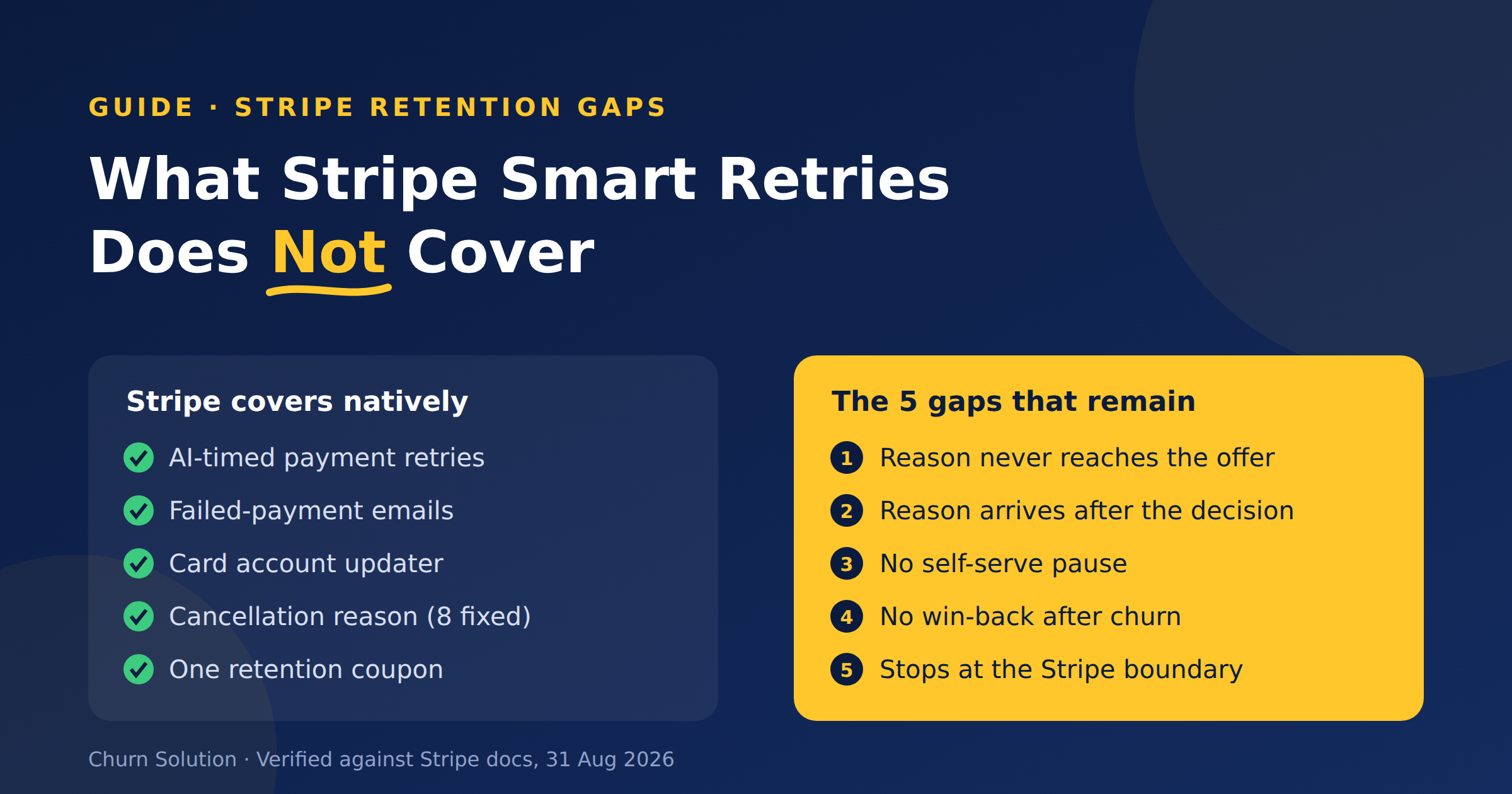
What Stripe Smart Retries Does Not Cover
Stripe Smart Retries recovers failed payments but doesn't run retention. Here are the five gaps that remain, sourced from Stripe's...

Membership Community Churn: The Members Who Quit Without Clicking Cancel
Quiet churn is the real leak: members who never clicked “cancel” at all. A card expires. A bank declines a...

Subscription Churn Dashboard: The 2026 Guide to Actionable Revenue Intelligence
Up to 40% of subscription churn is involuntary, meaning your customers aren't choosing to leave; they're being forced out by...