ARTICLE
15 High-Impact Customer Retention Offer Examples to Protect Your MRR in 2026
Your generic “10% off” discount isn’t a retention strategy; it’s a margin-killer that signals you don’t understand why your customers are leaving. With the cost of acquiring new customers now 5 to 25 times higher than keeping existing ones, every point of churn represents a massive drain on your bottom line. You likely feel the pressure of high churn rates eroding your MRR growth, yet a 5% increase in retention can boost profits by up to 95%. High-impact customer retention offer examples must go beyond simple price cuts to address specific friction points.
You don’t have to watch your subscribers walk away or manually intervene in every cancellation. This guide reveals the exact offers that stop churn in its tracks and explains how to deploy them through automated cancellation flows and dynamic offers. We’ll explore 15 surgical interventions designed to protect your revenue and maximize subscriber lifetime value. You’ll learn how to transform your exit process from a liability into a high-performance recovery mechanism that identifies why users leave and presents the precise incentive needed to make them stay.
Key Takeaways
- Stop revenue leaks by deploying surgical interventions instead of generic, margin-killing discounts.
- Master the psychology of loss aversion to implement “pause” offers that consistently outperform traditional price cuts.
- Explore 15 proven customer retention offer examples tailored to specific financial and functional exit triggers.
- Automate your defense by mapping AI-analyzed feedback directly to dynamic offer deployments.
- Scale your recovery efforts with intelligent cancellation flows that protect your MRR without manual intervention.
Beyond the Discount: The Strategic Role of Retention Offers in SaaS
Retention offers are not bribes. They are surgical, data-driven interventions deployed at the exact moment of exit intent. Think of them as your last line of defense for protecting Monthly Recurring Revenue (MRR). When a user initiates a cancellation, you have a high-stakes window to intercept that decision. Generic “one-size-fits-all” discounts often fail because they don’t address the underlying reason for leaving; they simply erode your profit margins for users who might have stayed for a more relevant reason. Effective customer retention offer examples focus on value restoration rather than just price reduction.
You must differentiate between voluntary churn, where a user actively chooses to leave, and involuntary churn, caused by technical payment failures. While payment recovery and smart retries handle the technical failures, strategic offers target the psychological and functional reasons for voluntary departure. Identify the leak. Deploy the fix. Protect the MRR.
The Economics of Retention vs. Acquisition
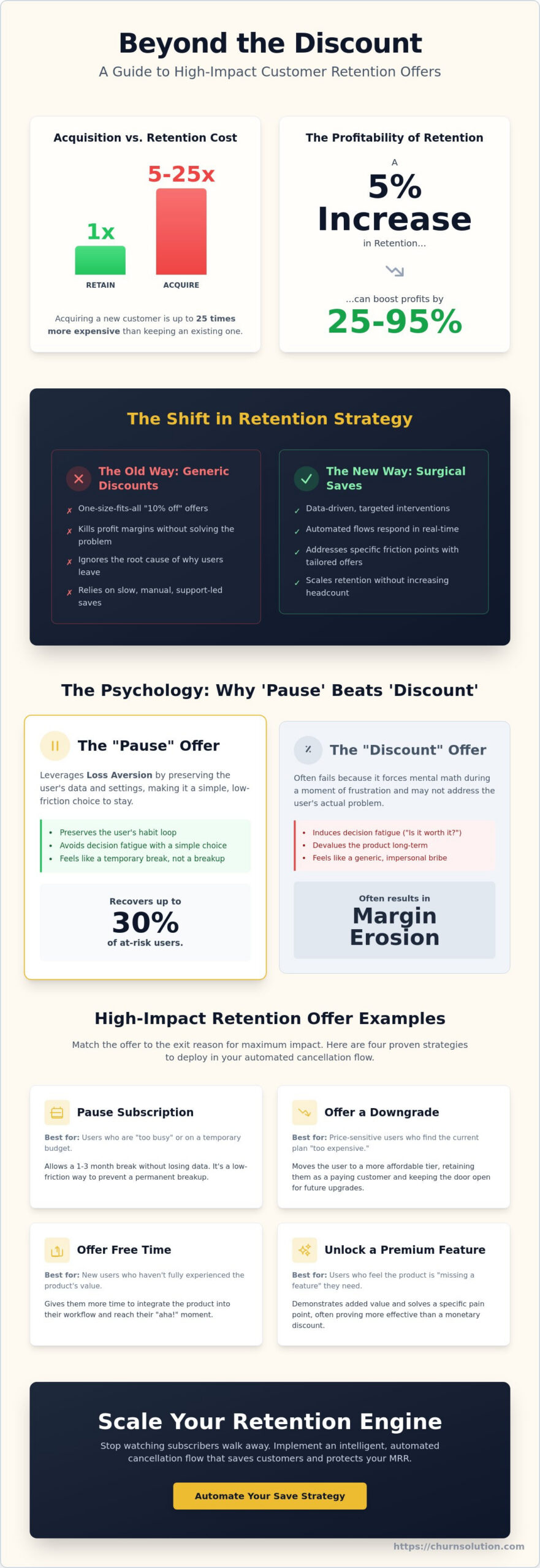
Acquiring a new customer is 5 to 25 times more expensive than retaining an existing one. This massive cost disparity makes Customer retention the most efficient lever for growth in your business. Data shows that a mere 5% increase in your retention rate can drive a profit surge of 25% to 95%. By deploying high-impact customer retention offer examples, you directly improve your Net Revenue Retention (NRR). High NRR signals a healthy, scalable SaaS engine where expansion revenue and saved accounts outweigh the natural attrition of the market.
Why 2026 Demands Dynamic Save Flows
The era of manual, support-led saves is over. Today’s subscription economy moves too fast for human intervention at every exit point. Modern businesses must transition to automated cancellation flows that operate in real-time. These systems use AI feedback analysis and customer usage data to dictate the perfect offer based on the specific reason for cancellation. Whether it’s a “pause” for a seasonal user or a “downgrade” for a price-sensitive one, automation ensures the response is instant and relevant. This data-driven approach removes the guesswork and scales your retention efforts without increasing your headcount.
The Psychology of the Save: Why ‘Pause’ Often Outperforms ‘Percentage Off’
Understanding why customers stay requires more than a spreadsheet. It requires a grasp of cognitive biases. Loss aversion dictates that users feel the pain of losing access to their data and custom configurations twice as strongly as the joy of a discount. When you present customer retention offer examples like a “pause” button, you leverage this bias. You aren’t asking them to walk away; you’re offering to hold their place. This preserves the habit loop. Canceling breaks the cycle entirely, making it significantly harder to win them back later.
Decision fatigue often kills the save. A percentage-based discount forces the user to perform mental math during a moment of frustration. “Is 15% off enough to justify the friction?” is a complex question. A “pause” or a “free month” is a binary choice. It’s simple. It’s empathetic. By addressing the “Why” through AI-driven feedback analysis, you can offer a solution that fits the specific exit trigger rather than a generic bribe. Incorporating 14 must-know customer retention strategies requires understanding that psychology often trumps simple price adjustments.
The Power of the Subscription Pause
For users who claim they are “too busy” or “not using the product enough,” a pause is the ultimate save. Internal data across various SaaS segments suggests a 1-3 month pause option can recover up to 30% of these specific churners. The technical implementation is critical. You must maintain all user data, settings, and history during the dormant period. This makes the “unpause” seamless. The psychological difference is profound; the user is simply taking a break, not ending a relationship. It keeps your product in their tech stack while removing the immediate financial pressure.
Value-Based Saves: Extending the Trial or Adding Features
“More Product” often beats “Less Price.” If a user is under-utilizing your platform, a discount won’t help them find value. Instead, try extending their trial or unlocking a premium feature for a limited time. This proves the product’s worth. Upgrading a churn-risk user to a higher tier for free can actually increase long-term LTV by exposing them to more “sticky” features. These customer retention offer examples transform a potential loss into an expansion opportunity. If you’re ready to stop the leaks, start building your automated save flow today.
15 Customer Retention Offer Examples Categorized by Intent
Deploying the right incentive requires matching the solution to the specific exit trigger. If you offer a discount to a user who doesn’t understand your product’s value, you’ve wasted margin without solving the underlying issue. These customer retention offer examples provide a framework for surgical revenue recovery. Categorizing your approach ensures that your intervention is relevant, timely, and effective. Effective customer retention strategies rely on this level of segmentation to maximize recovery rates.
Your offers should fall into four distinct pillars. Financial offers address budget constraints. Functional offers solve usage or technical hurdles. Educational offers bridge the knowledge gap for under-utilizers. Relational offers reward long-term commitment. By diversifying your save library, you move beyond generic bribes and toward strategic account management.
Relational engagement is just as vital in the physical world; for example, you can discover Tacoverse to see how modern hospitality brands use unique experiences and bold flavors to reward customer commitment and build a loyal community.
Top 5 Financial Save Offers
Financial incentives are your most direct tool for price-sensitive churn. The “Bridge Discount” offers 50% off for two months to help users through temporary budget constraints. This keeps the account active while providing immediate relief. The “Annual Pivot” suggests switching from monthly to yearly billing in exchange for two months free; this secures long-term commitment and improves cash flow. For a more immediate impact, a “Credit Back” applies a specific dollar amount, such as $20, to the next invoice. This creates an instant psychological win for the user without permanently lowering your price point.
Top 5 Functional & Support Saves
When users feel they aren’t getting enough value, functional saves preserve the relationship. The “Data Vault” is a low-cost tier, perhaps $5 per month, that preserves all data and settings while disabling active features. It’s a high-performance alternative to total cancellation. The “Extension” adds 14 days to the current billing cycle for free, giving users time to finish a specific project. For technical friction, the “Consultation” offers a free 1-on-1 session with a success manager to fix setup issues. These interventions prove your commitment to the user’s success rather than just their subscription fee.
Managing this variety of incentives requires a sophisticated infrastructure. You can automate the deployment of these incentives using Dynamic Offers. This system ensures the right offer reaches the right segment at the right time. Furthermore, variety is essential for A/B experiments. Testing different offer types allows you to identify which customer retention offer examples drive the highest recovery rates for your specific audience. Stop guessing and start optimizing your save strategy with data-backed decisions.
Implementing Dynamic Offers: How to Automate Your Save Strategy
Negotiating manual saves through support tickets or phone calls is a strategy that fails at scale. It leads to inconsistent margins, exhausted teams, and a sluggish response to churn. You need a systematic approach that triggers the right intervention without human delays. Automation allows you to deploy diverse customer retention offer examples based on real-time data. This ensures your recovery efforts are both surgical and profitable. By moving from reactive support to proactive automation, you maintain control over your revenue destiny.
The implementation of a high-performance save engine requires a structured five-step process. First, utilize customer segmentation to categorize users by LTV and usage frequency. Second, map specific exit reasons to your offer library. Third, establish “Save Thresholds” to ensure that discount depths don’t compromise your unit economics. Fourth, deploy Dynamic Offers through automated cancellation flows. Finally, use AI feedback analysis to iterate on your logic and refine your success rates over time.
Segment-Based Offer Logic
Categorize your users before they reach the exit. High-LTV users represent your most critical revenue; protect them with VIP concierge offers or significant multi-month discounts that reflect their value to your business. Conversely, low-usage users often suffer from a lack of product knowledge. Target them with educational saves or feature-discovery incentives that prove value. For budget-conscious segments, utilize pause options or “lite” plan downgrades to keep the account active without a total loss of MRR. This relevance is the difference between a successful save and a permanent departure.
Mapping Exit Surveys to Offers
Data from Exit Surveys acts as the primary trigger for your save engine. If a user selects “Too Expensive,” your system should automatically present a 3-month discount or a pause option to alleviate financial pressure. If the reason is “Missing Features,” the logic should pivot to a free upgrade or a concierge success call to demonstrate existing capabilities they may have overlooked. This automated mapping ensures the customer feels heard while you protect your bottom line. Stop letting revenue slip away through manual processes and automate your retention strategy today.
Scaling Your Retention Engine with Churn Solution
Scaling your retention engine requires moving beyond manual intervention. Churn Solution automates the entire Save Flow process. It eliminates the need for dedicated development resources or complex engineering sprints. You can deploy the customer retention offer examples discussed in this guide within a single afternoon. This agility allows you to respond to market shifts and competitor moves instantly. By removing technical bottlenecks, you empower your growth team to focus on high-level strategy rather than implementation details.
The platform offers a comprehensive revenue protection suite. It integrates Payment Recovery with proactive cancellation saves. This creates a dual-layered defense against churn. While your save flows target voluntary departures, Smart Retries resolve involuntary payment failures in the background. This happens before the user even realizes there’s a billing issue. The result is a seamless experience that preserves access and protects MRR. Detailed reporting provides transparency into this process. It tracks the specific ROI of every offer given, allowing you to see which incentives maximize long-term lifetime value.
Why Automation is Non-Negotiable in 2026
The pace of the digital economy has made manual saves obsolete. In 2026, waiting for a support representative to respond to a cancellation request is a death sentence for your retention metrics. Users demand immediate control over their subscriptions. Automation provides this autonomy while still giving you the chance to intervene strategically. It ensures total consistency across your entire user base. Every customer, regardless of their time zone, receives a relevant offer at the perfect moment. AI feedback loops further refine this process. The system analyzes user profiles to predict which customer retention offer examples will yield the highest save probability. This predictive power transforms your exit flow into a high-performance revenue engine.
Ready to stop the revenue leak?
You now have the framework to transform your business from a leaky bucket into a robust retention machine. The transition from reactive churn management to proactive revenue recovery is the most significant growth lever available to SaaS leaders. Stop guessing why users leave. Start presenting them with the exact reasons to stay. Protect your margins. Scale your MRR. Secure your future. Start your free trial of Churn Solution and build your first save flow today.
Transform Your Exit Flow into a High-Performance Revenue Engine
Stop treating cancellations as an inevitable loss. You now have the framework to deploy surgical interventions that address the root causes of churn. High-performance recovery relies on matching specific exit triggers with the right incentives. These customer retention offer examples prove that relevance always outperforms generic discounts. By preserving the habit loop through pauses or value-based upgrades, you maintain your relationship with the user while protecting your profit margins.
Scaling this strategy requires total automation. Leading subscription companies rely on Churn Solution to recover up to 40% of cancelling users. Our platform includes AI-driven feedback analysis to identify why users leave and deploys dynamic offers in real-time. Don’t let another point of MRR slip away through manual processes or ineffective bribes. It’s time to take control of your revenue destiny. Build your automated save flow and stop churn now. Your growth engine is ready for optimization.
Frequently Asked Questions
What is a customer retention offer example for SaaS?
A customer retention offer is a targeted incentive triggered by exit intent to prevent a subscription cancellation. Common customer retention offer examples include account credits, temporary discounts, or the option to pause a subscription for a set period. These interventions aim to address the specific friction point identified during the exit process, such as budget constraints or temporary under-utilization.
Should I always offer a discount to customers who try to cancel?
No. Constant discounting erodes your profit margins and can devalue your brand. If a user leaves because of technical friction or a lack of perceived value, a price cut won’t solve the underlying issue. Use educational saves or functional offers, like a free strategy call or a temporary feature unlock, to address non-financial churn triggers. Reserve financial incentives for segments that explicitly cite price as their primary reason for leaving.
How do I know which retention offer will work best for my users?
Deploy AI feedback analysis to categorize exit reasons and then use A/B testing to measure the recovery rate of different incentives. Your data-driven strategist should map specific offers to specific segments based on usage patterns and lifetime value. Analyzing the performance of customer retention offer examples in real-time allows you to refine your logic and prioritize the saves that yield the highest long-term revenue retention.
What is the difference between a save flow and a win-back campaign?
A save flow is a proactive intervention that occurs during the cancellation process to prevent the customer from leaving. A win-back campaign is a reactive strategy targeting users who have already terminated their subscription. Save flows are significantly more efficient because they maintain the existing habit loop and avoid the high cost of re-acquisition, which can be 5 to 25 times more expensive than retention.
Can I automate retention offers without a developer?
Yes. Modern retention platforms allow you to build sophisticated cancellation flows and dynamic offers using no-code interfaces. You can implement conditional logic that triggers specific incentives based on survey responses or customer data without touching your core codebase. This empowerment allows growth teams to iterate rapidly and scale their recovery efforts without waiting for engineering sprints.
Is it better to offer a pause or a discount for subscription retention?
A pause is often superior for users who report being “too busy” or having a seasonal need. It preserves the user’s data and settings, making the return process seamless and maintaining the relationship. Discounts are more effective for price-sensitive users but should be used sparingly. Data suggests that a well-timed pause can recover up to 30% of users who would otherwise cancel due to temporary inactivity.
How do I measure the success of my retention offers?
Track your Save Rate and the subsequent Net Revenue Retention of recovered accounts. You must measure the ROI of every offer to ensure the cost of the incentive is justified by the additional lifetime value generated. Use detailed reporting to monitor how saved users behave in the months following the intervention. This ensures your save strategy is actually protecting MRR rather than just delaying inevitable churn.
- Key Takeaways
- Table of Contents
- Beyond the Discount: The Strategic Role of Retention Offers in SaaS
- The Psychology of the Save: Why 'Pause' Often Outperforms 'Percentage Off'
- 15 Customer Retention Offer Examples Categorized by Intent
- Implementing Dynamic Offers: How to Automate Your Save Strategy
- Scaling Your Retention Engine with Churn Solution
- Transform Your Exit Flow into a High-Performance Revenue Engine
- Frequently Asked Questions

Churn solution that turns your customers right around.
Related Articles
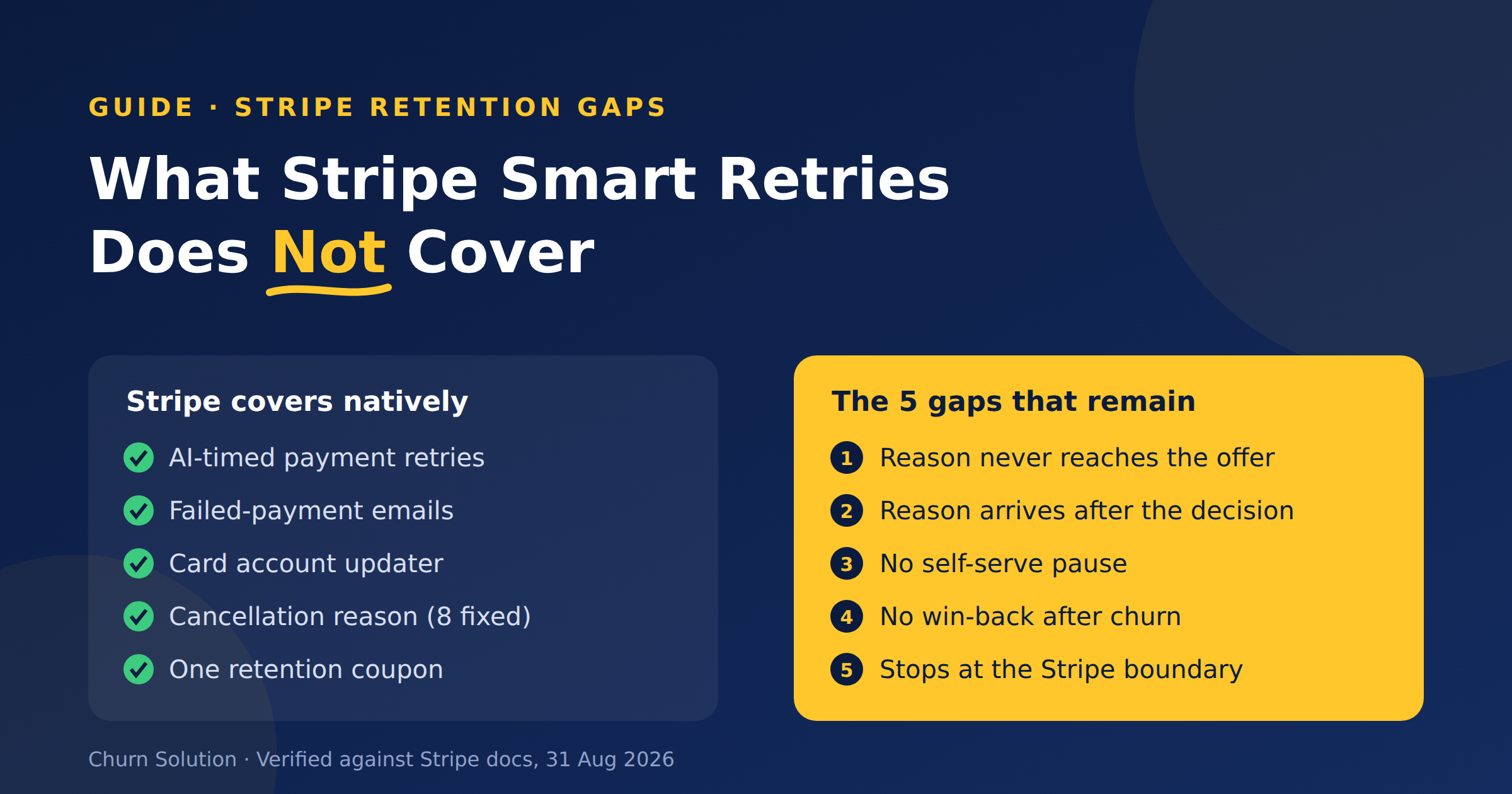
What Stripe Smart Retries Does Not Cover
Stripe Smart Retries recovers failed payments but doesn't run retention. Here are the five gaps that remain, sourced from Stripe's...

Membership Community Churn: The Members Who Quit Without Clicking Cancel
Quiet churn is the real leak: members who never clicked “cancel” at all. A card expires. A bank declines a...

Subscription Churn Dashboard: The 2026 Guide to Actionable Revenue Intelligence
Up to 40% of subscription churn is involuntary, meaning your customers aren't choosing to leave; they're being forced out by...