ARTICLE
How to Optimize Cancellation Flows: The 2026 SaaS Retention Playbook
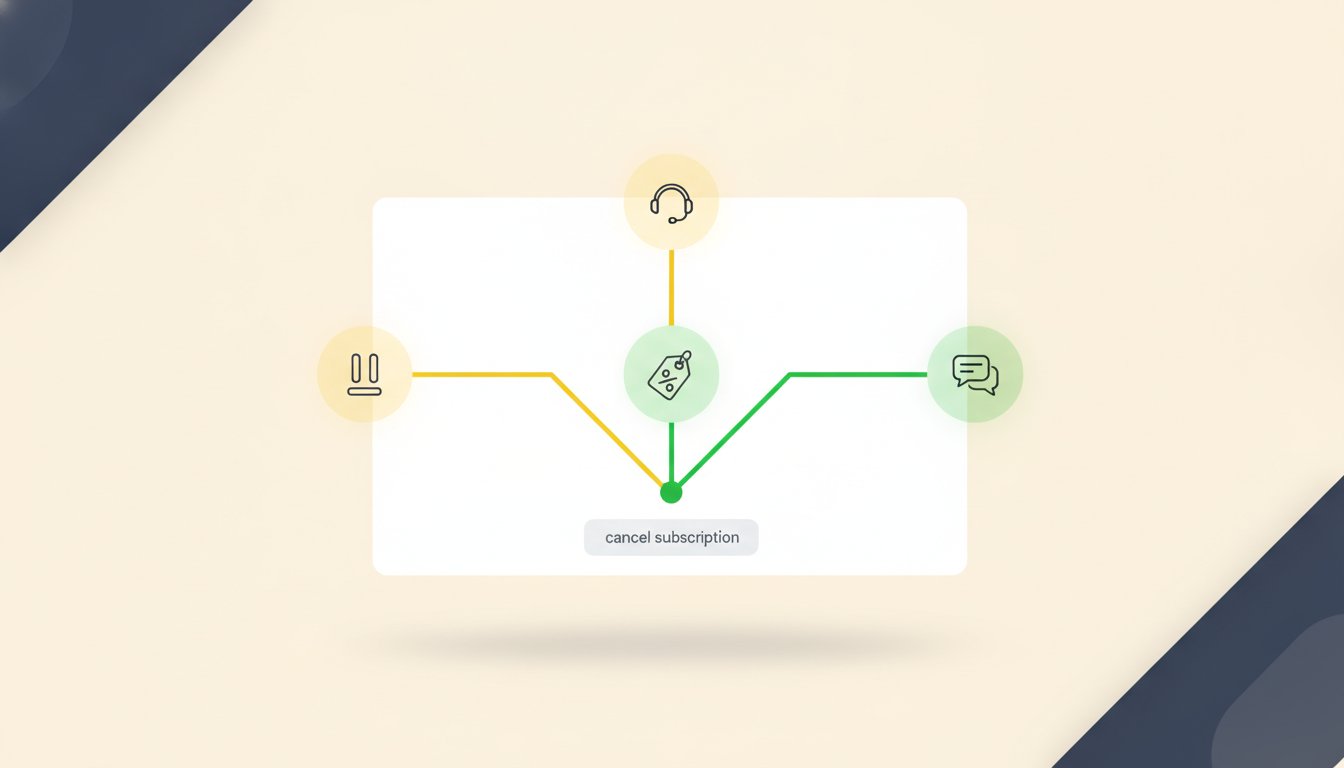
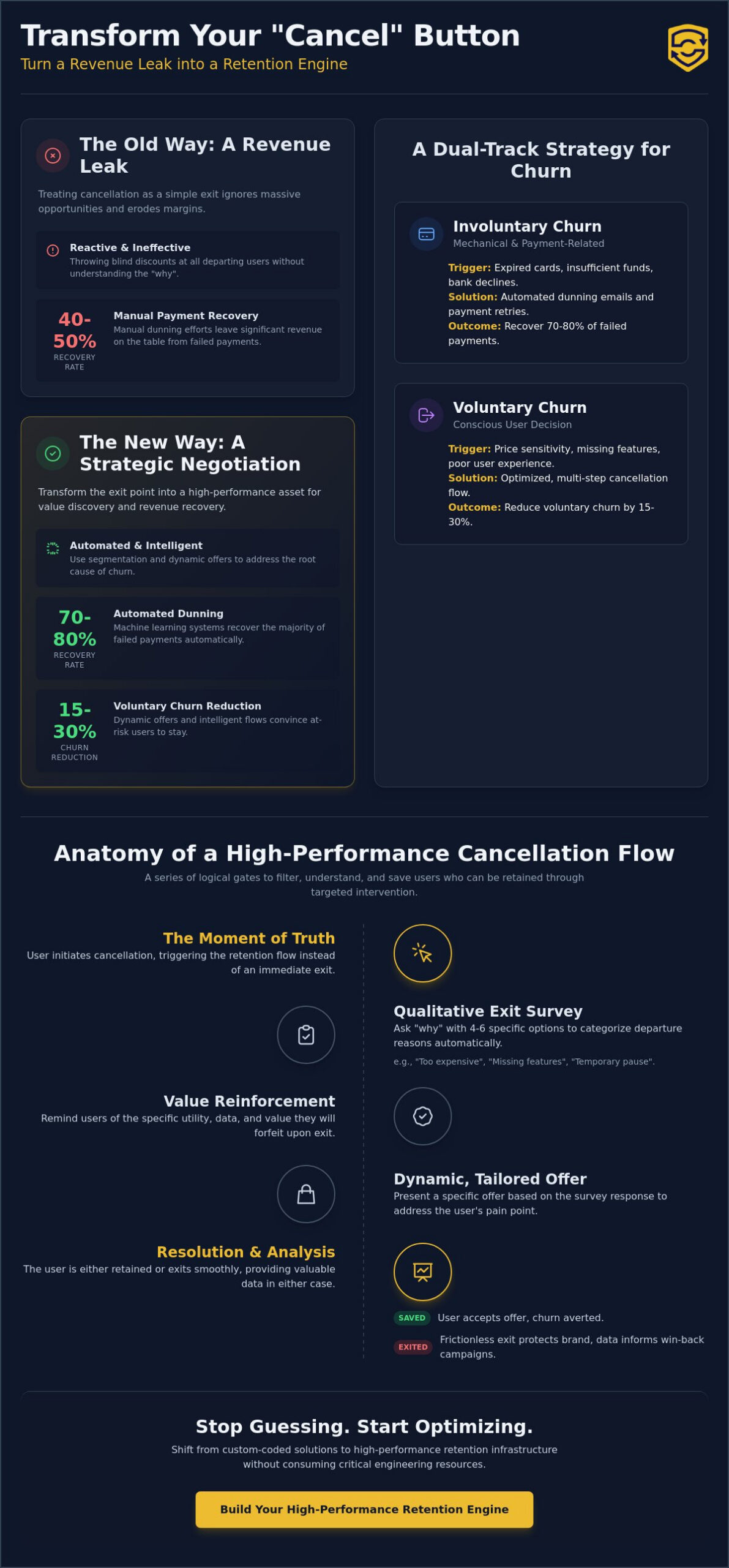
Your “Cancel” button is not an exit; it is a strategic negotiation point where friction serves as a tool for value discovery. Most SaaS leaders watch churn metrics climb while throwing blind discounts at departing users. This reactive approach erodes margins and ignores the root causes of customer departure. By implementing sophisticated dunning email best practices and automated recovery logic, you stop guessing and start optimizing. Automated systems using machine learning can recover 70-80% of failed payments, a significant jump from the 40-50% typical of manual efforts.
You’ll learn how to transform your cancellation flow from a revenue leak into a high-performance recovery asset. We’ll show you the exact mechanisms required to reduce voluntary churn by 15-30% using dynamic offers and intelligent segmentation. This playbook provides a categorical breakdown of how to gather actionable feedback, automate the save process, and leverage data to protect your bottom line in the 2026 subscription economy.
Key Takeaways
- Reframe the cancellation flow from a passive exit into a strategic negotiation point that protects recurring revenue through proactive intervention.
- Deploy qualitative exit surveys and value reinforcement mechanisms to identify specific departure triggers and remind users of the utility they are forfeiting.
- Integrate dunning email best practices with dynamic save offers, such as account pauses or plan downgrades, to maximize revenue recovery at the point of exit.
- Utilize AI feedback analysis to categorize thousands of open-ended exit comments, turning subjective complaints into actionable data for product development.
- Shift from custom-coded solutions to high-performance retention infrastructure to automate the save process without consuming critical engineering resources.
The Strategic Role of an Optimized Cancellation Flow
A cancellation flow is a proactive retention mechanism, not a courtesy exit. It serves as the final strategic barrier between a user and permanent churn. Treating this process as a simple administrative task is a categorical failure of revenue protection. In the subscription economy, there is a fundamental difference between “Exit Intent” and “Exit Finality.” One-click cancellations are massive leaks in your recurring revenue model because they ignore the opportunity to negotiate and discover underlying value gaps. High-performance flows directly optimize Net Revenue Retention (NRR) and Lifetime Value (LTV) by capturing the segment of users who are salvageable with the right intervention.
Voluntary vs. Involuntary Churn: Why Strategy Matters
Effective retention requires a dual-track strategy to address different churn triggers. Involuntary churn stems from mechanical failures like expired credit cards or insufficient funds. This is where Dunning processes are essential for recovery. Implementing dunning email best practices ensures that up to 80% of these failed payments are recovered through intelligent automation rather than manual outreach. However, voluntary churn is a conscious decision based on perceived value. While dunning handles the financial plumbing, a cancellation flow manages the customer relationship. You must identify the “danger zone” where a user stops engaging but hasn’t yet clicked away. Applying the same logic to both types of churn is a mistake; payment failures need retries, but voluntary exits need a conversation. By following dunning email best practices, companies move beyond simple payment collection to true revenue optimization.
The Psychology of the “Cancel” Button
Users don’t click the “Cancel” button in a vacuum. It is typically a reaction to price sensitivity, a perceived lack of utility, or temporary frustration with a specific feature gap. This interaction is your “Moment of Truth.” An optimized flow uses this friction to remind users of the specific milestones and value they’ve realized within your platform. It’s a pivot point where you transition from a passive service provider to a proactive retention specialist. Instead of accepting the exit, you present data-driven alternatives that address the user’s specific friction point. This shift transforms a potential loss into a strategic feedback loop that informs your product roadmap. By analyzing these moments, you gain a deeper understanding of churn metrics and the specific reasons why your users consider leaving.
Step-by-Step: Building a High-Conversion Cancellation Sequence
A high-conversion cancellation sequence operates as a series of logical gates designed to filter out users who can be saved through targeted intervention. It moves beyond the binary choice of “Stay” or “Go” by introducing a structured negotiation. This sequence begins with a qualitative exit survey to categorize departure reasons. Once the intent is identified, the system triggers value reinforcement, showing the user the specific utility they will forfeit upon exit. Following this, a dynamic offer is presented, tailored to the survey response. For those who stay, a confirmation phase reinforces the decision. For those who proceed, a frictionless exit protects your brand reputation while leaving the door open for future win-back campaigns.
While dunning email best practices focus on recovering revenue from passive payment failures, your cancellation sequence must actively negotiate with intentional churn. Effective retention is not about trapping users; it’s about resolving the friction that led them to the exit. You can begin exploring automated save flows to see how these steps integrate into a seamless retention engine.
Designing the Perfect Exit Survey
Precision in your survey design is critical for effective recovery. Provide 4-6 specific, mutually exclusive options rather than a generic text box. This structure allows your backend to map responses to specific save offers automatically. For example, selecting “Too expensive” should trigger a discount or a plan downgrade, while “Missing features” should trigger a consultation or a link to the product roadmap. This level of churn feedback analysis transforms subjective exits into actionable product intelligence. Avoid overwhelming the user; keep the interface clean and the language direct to ensure high completion rates.
Value Reinforcement: The “You are losing X” Screen
Before confirming the exit, use personalized usage data to create positive friction. Remind the user of the tangible results they’ve achieved. If a user has processed $10,000 through your platform this month, show them that number. Highlighting specific features they haven’t tried yet, but which are relevant to their segment, can also pivot the conversation from cost to utility. This screen serves as a psychological “Moment of Truth.” It forces the user to weigh the immediate relief of a cancelled subscription against the long-term loss of a functional tool. By emphasizing realized value, you move the user from an emotional decision to a logical assessment of their business needs.
Advanced Optimization: Dynamic Offers and Segmentation
The core of high-performance retention lies in the intelligence of the offer. Static, one-size-fits-all “please stay” messages are inefficient. They often result in giving away margin to users who would’ve stayed with a simpler solution, or losing high-value accounts that required a more personalized touch. Advanced optimization requires a hierarchy of save offers that prioritizes margin protection. This hierarchy typically moves from a subscription pause to a plan downgrade, followed by a time-based extension, and finally, a temporary discount. By structuring your flow this way, you ensure that price cuts are a last resort rather than a default response.
Segmentation is the mechanism that powers this logic. By using customer tenure and Lifetime Value (LTV) as primary variables, you can determine the aggressiveness of the recovery attempt. A user with three years of history and high MRR warrants a different approach than a trial user on day 29. While dunning email best practices secure the floor of your revenue by fixing payment failures, dynamic segmentation builds the ceiling by maximizing the value of every save. You must treat these two processes as complementary systems within your broader revenue recovery strategy.
Pause vs. Discount: Protecting Your Margins
Price cuts should be your last resort. Offering a 1-3 month subscription pause is often more effective for users facing temporary budget freezes or seasonal usage drops. It retains the customer’s data and configuration, making reactivation seamless. This strategy protects your long-term margins and avoids devaluing your product. In many cases, a “Free Month” credit outperforms a “50% Off for 3 Months” offer because it feels like a gift of value rather than a desperate price slash. You can implement these dynamic offers to see which resonates best with your specific audience segments.
Segmenting the Save: High-Value vs. Low-Value Users
Your retention engine must distinguish between segments to allocate resources effectively. Enterprise-level churners often signal deep-seated product gaps or organizational shifts that require white-glove support calls or manual intervention. Conversely, prosumer or lower-tier users are best served through automated, self-service offers that minimize operational overhead. Using customer segmentation tools allows you to trigger these distinct paths automatically. This ensures your team isn’t wasting time on low-margin saves while high-value accounts slip through the cracks. Continuous A/B experiments are necessary to refine these thresholds and find the exact “sweet spot” where retention rates and profit margins intersect.
Turning Departures into Data: AI Feedback and Analysis
Departure is a data point. While most SaaS teams accept a generic “Price is too high” response as the end of the conversation, sophisticated organizations use AI to uncover the structural product gaps driving churn. This feedback loop is essential for long-term growth. It transforms subjective complaints into categorical evidence for product and marketing teams. Just as dunning email best practices rely on clear communication and timing to recover failed payments, AI-driven analysis relies on pattern recognition to recover future revenue. You must stop viewing the exit as a dead end and start seeing it as a laboratory for optimization. Integrating these insights with dunning email best practices creates a comprehensive revenue recovery ecosystem that protects both your current and future cash flow.
Establishing a “Retention Feedback Loop” between Customer Success and Product teams is the final step in this data-driven approach. When Product teams see quantified churn reasons, they prioritize fixes that directly impact the bottom line. This alignment reduces voluntary churn over time. It shifts the organization from a reactive stance to a proactive, performance-focused culture. You aren’t just saving a single account; you’re hardening the entire platform against future loss. You can start analyzing your exit data today to build a more resilient product and stop the bleed.
Analyzing Exit Intent with AI
Manually reading thousands of cancellation notes is impossible at scale. Automated AI feedback analysis solves this by performing sentiment analysis on open-ended comments. It identifies whether a user is leaving because they outgrew the tool or because they’re frustrated with a specific bug. This distinction is vital. It allows you to identify trends by customer cohort or plan type, ensuring your roadmap addresses the highest-impact issues. While 70% of recoverable soft-decline payment failures are recovered within 72 hours using automated systems, voluntary feedback analysis provides the long-term insights needed to prevent the intent to leave in the first place. This proactive intelligence is what separates market leaders from those struggling with high churn.
Using Insights to Fuel Win-Back Campaigns
Data gathered during the exit flow shouldn’t sit idle. It must fuel your subscription win-back campaigns. By tagging users based on their specific departure reason, you can trigger highly relevant re-marketing. If a user left due to a missing feature, an automated alert when that feature launches becomes a powerful recovery tool. This strategy ensures your win-back efforts are surgical rather than generic. It’s about reaching out with the right solution at the exact moment the original friction is removed. Note that as of August 2026, the EU AI Act’s transparency requirements for AI-generated content will take effect. This means any AI-generated win-back outreach to EU recipients must be disclosed. Compliance is as critical as performance in maintaining a high-authority brand reputation.
Scaling Retention with Churn Solution’s Infrastructure
Custom-coding a cancellation flow is a strategic distraction that drains high-value engineering resources. Your development team should focus on core product innovation that drives market differentiation, rather than maintaining internal collections tools. Bespoke systems often fail to keep pace with evolving billing APIs and shifting consumer behaviors, leading to technical debt and missed recovery opportunities. Churn Solution provides a sophisticated, no-code retention engine that allows growth teams to take direct control of the save process. By integrating directly with billing platforms like Stripe, you ensure that every transaction is monitored for exit intent without exhausting your technical roadmap. This infrastructure transforms a complex technical bottleneck into a flexible, high-performance revenue safeguard.
While implementing dunning email best practices is a fundamental requirement for payment recovery, a complete infrastructure must address both the financial and psychological aspects of churn simultaneously. High-performance dunning configurations can recover 60-80% of failed payments, yet this only addresses involuntary loss. You need a unified system that manages voluntary exits with the same level of technical precision. Preventing churn from failed payments requires more than retry logic alone — it demands a holistic platform that merges automated payment recovery with intelligent cancellation logic, ensuring that no revenue leak goes unaddressed. This holistic approach creates a stable, predictable revenue stream that scales alongside your business growth.
Rapid Deployment and A/B Testing
Speed is a critical competitive advantage in the subscription economy. Deploying a flow in minutes rather than weeks of development allows for immediate revenue impact and faster learning cycles. You can use A/B experiments to optimize save rates in real-time, testing different offer sequences and survey logic. This is the hallmark of a “Data-Driven Strategist” approach. Don’t guess which discount or pause length will resonate; test it against hard data. Measure the impact on Net Revenue Retention and iterate based on performance metrics to find the exact configuration that keeps users in your ecosystem. This level of agility is impossible with hard-coded solutions that require a full sprint cycle for every minor adjustment.
Comprehensive Revenue Protection
Churn Solution doesn’t just manage exits; it provides an end-to-end shield for your MRR. It combines sophisticated cancellation flows with smart payment retries to automate the entire customer lifecycle. By adhering to dunning email best practices through this automated infrastructure, you secure the floor of your revenue while the cancellation flow protects the ceiling. This dual-track approach manages everything from the first failed payment notification to the final win-back campaign. The result is a hardened billing environment that maximizes Lifetime Value. Optimize your cancellation flow with Churn Solution today.
Future-Proof Your Retention Strategy
Revenue protection in 2026 requires more than a simple exit survey. It demands a sophisticated, automated ecosystem that treats every departure as a strategic negotiation. By implementing the multi-step flows and segmentation strategies discussed, you transform a passive exit into a high-performance recovery asset. While mastering dunning email best practices secures your financial floor, an optimized cancellation flow builds your retention ceiling. You must leverage data to understand the “why” behind the exit and act with precision to stop it.
Churn Solution provides the exact infrastructure needed to scale these efforts without consuming engineering resources. Our platform features AI-powered feedback analysis to decode user intent, a no-code dynamic offer engine to protect your margins, and seamless billing integration with your existing stack. Don’t let your growth be undermined by preventable churn. It’s time to take control of your subscription lifecycle and maximize Net Revenue Retention through technical mastery.
Stop the bleed; launch your optimized cancellation flow with Churn Solution. Secure your revenue and build a more resilient SaaS business today.
Frequently Asked Questions
What is a cancellation flow in SaaS?
A cancellation flow is a structured sequence of interactions triggered when a subscriber initiates the termination of their service. It serves as a strategic negotiation point designed to identify the reason for departure and present relevant alternatives to churn. Unlike a simple “cancel” button, these flows use logic to filter users through value reinforcement and dynamic offers, transforming a passive exit into a proactive retention opportunity.
Should I make it hard for customers to cancel?
You shouldn’t use “dark patterns” that hide the cancellation option or require manual phone calls, as this damages brand reputation and increases chargeback risks. Instead, implement “positive friction.” This involves using the exit process to remind users of the value they’ve realized and offering immediate solutions to their friction points. Transparency builds trust, while strategic negotiation protects revenue without alienating the customer.
How much can an optimized cancellation flow reduce churn?
An optimized cancellation flow can reduce voluntary churn by 15-30% by addressing the specific reasons users choose to leave. By deploying dynamic offers and value reinforcement, you capture salvageable accounts that would otherwise be lost to a one-click exit. This reduction in churn directly correlates to improved Net Revenue Retention (NRR) and higher customer lifetime value across your entire subscriber base.
What are the best offers to give a canceling customer?
The most effective offers are those that directly resolve the user’s stated reason for leaving. These include subscription pauses for seasonal users, temporary discounts for price-sensitive segments, or plan downgrades for those with lower utility requirements. Integrating these with dunning email best practices ensures that both voluntary and involuntary churn are handled with maximum efficiency, securing your revenue floor while protecting your long-term profit margins.
How do I use exit surveys without annoying my users?
Limit your exit survey to 4-6 specific, mutually exclusive options to avoid survey fatigue. Users appreciate being heard if they believe their feedback leads to a solution. By linking survey responses to immediate, relevant save offers, you demonstrate that the survey is a tool for problem-solving rather than a hurdle. This approach turns a potentially annoying step into a value-added interaction for the customer.
Can I A/B test my cancellation flow?
You can and must A/B test your cancellation flow to optimize save rates and margin protection. Testing different offer types, survey questions, and value reinforcement screens allows you to identify which combinations resonate best with specific customer segments. This data-driven iteration ensures your retention strategy evolves alongside changing market conditions and user behaviors, preventing your save logic from becoming stagnant or ineffective.
Is it better to offer a discount or a subscription pause?
A subscription pause is generally superior to a discount because it preserves your price integrity and protects long-term margins. Pauses are particularly effective for users experiencing temporary budget constraints or project gaps. While discounts are useful for price-sensitive accounts, they risk devaluing the product. Choosing the right mechanism depends on the user’s tenure and LTV, ensuring your dunning email best practices and save logic remain highly profitable.
How do I integrate a cancellation flow with Stripe?
Integrating a cancellation flow with Stripe requires connecting your retention engine to Stripe’s billing API to manage subscription states in real-time. This allows the flow to trigger account pauses, apply coupons, or process downgrades automatically upon user acceptance. Using a dedicated retention infrastructure simplifies this process, eliminating the need for custom-coded webhooks and ensuring your revenue protection measures are deployed across your entire billing ecosystem seamlessly. For a deeper dive into the technical and strategic side of preventing churn from failed payments, our 2026 guide covers the automated recovery frameworks that complement your cancellation flow.
- Key Takeaways
- Table of Contents
- The Strategic Role of an Optimized Cancellation Flow
- Step-by-Step: Building a High-Conversion Cancellation Sequence
- Advanced Optimization: Dynamic Offers and Segmentation
- Turning Departures into Data: AI Feedback and Analysis
- Scaling Retention with Churn Solution's Infrastructure
- Future-Proof Your Retention Strategy
- Frequently Asked Questions

Churn solution that turns your customers right around.
Related Articles
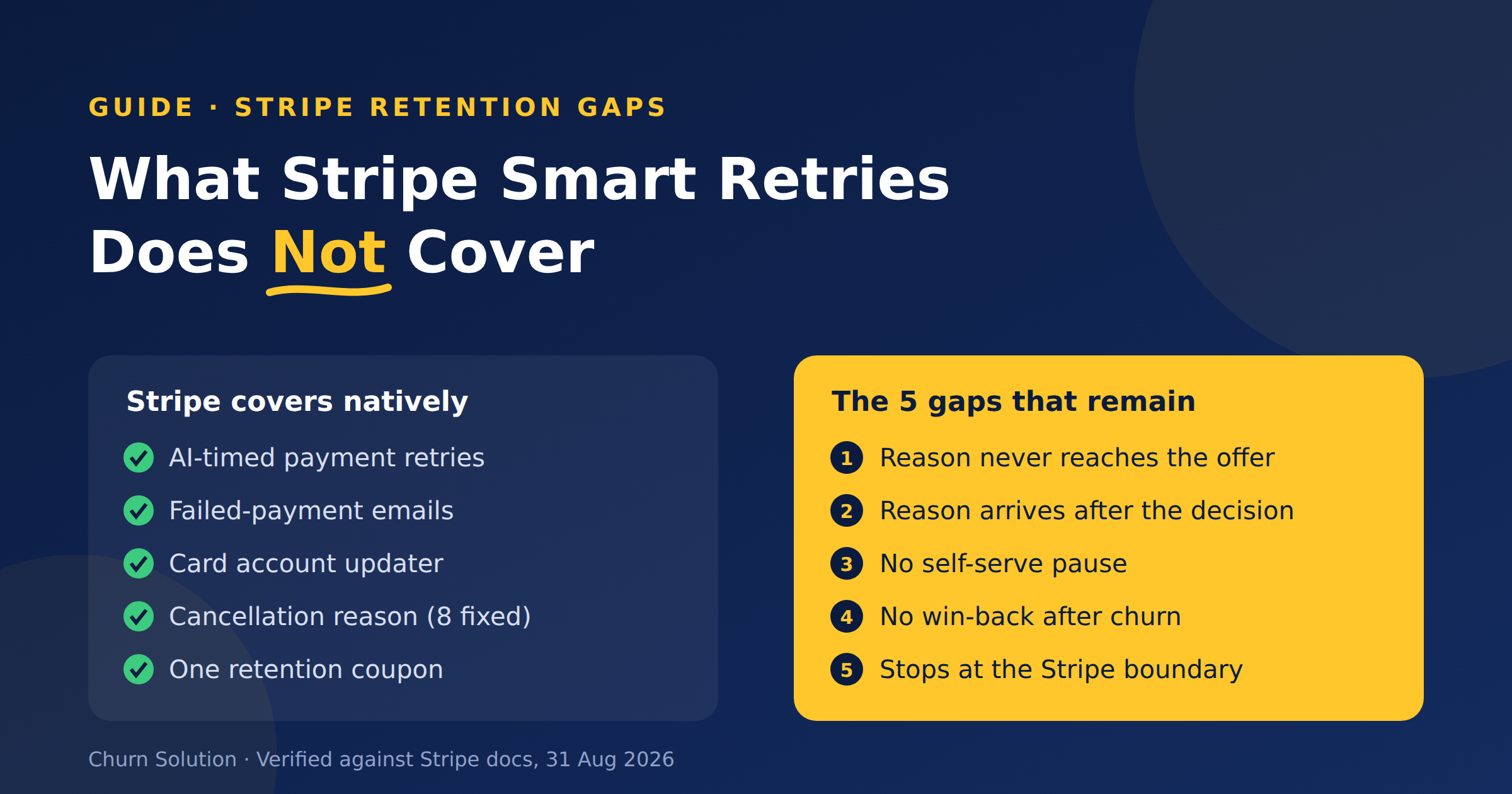
What Stripe Smart Retries Does Not Cover
Stripe Smart Retries recovers failed payments but doesn't run retention. Here are the five gaps that remain, sourced from Stripe's...

Membership Community Churn: The Members Who Quit Without Clicking Cancel
Quiet churn is the real leak: members who never clicked “cancel” at all. A card expires. A bank declines a...

Subscription Churn Dashboard: The 2026 Guide to Actionable Revenue Intelligence
Up to 40% of subscription churn is involuntary, meaning your customers aren't choosing to leave; they're being forced out by...