ARTICLE
Preventing Churn from Failed Payments: The 2026 Guide to Revenue Recovery

Up to 40% of your customer churn isn’t a choice; it’s a technical failure. In 2026, the median B2B SaaS churn rate has stabilized at 3.5%, but the underlying data reveals a harsh reality for growth. Your business is likely losing 10% to 20% of its monthly recurring revenue to payment friction and outdated recovery methods. Mastering the process of preventing churn from failed payments is no longer a back-office task. It’s a high-performance mandate for any serious subscription leader.
We understand the frustration of seeing manual dunning efforts fail while your team struggles to distinguish between a temporary bank outage and a permanent card expiration. It’s time to reclaim that lost revenue. This guide provides the strategic framework and automated technologies required to reduce involuntary churn by 30% or more. You’ll learn how to deploy smart retries, leverage AI feedback analysis, and automate your recovery process to protect your recurring revenue and improve Customer Lifetime Value through a truly seamless billing experience.
Key Takeaways
- Identify why technical friction now accounts for 40% of SaaS departures and how to audit your current revenue leaks.
- Decipher the complexity of 2,000+ bank decline codes and the impact of 2026 SCA requirements on your recurring billing success.
- Transition from manual dunning to Intelligent Recovery Flows and Smart Retries as the core mechanism for preventing churn from failed payments.
- Deploy proactive card update prompts and optimized checkout experiences to resolve payment friction before it disrupts the customer lifecycle.
- Leverage AI Feedback Analysis and Automated Customer Save Flows to distinguish between technical failure and intentional churn for higher recovery precision.
The Anatomy of Involuntary Churn: Why Satisfied Customers Drift Away
Involuntary churn is the unintentional loss of subscribers caused by payment friction. It’s the silent killer of recurring revenue. In 2026, data shows that involuntary churn now accounts for up to 40% of total SaaS departures. These aren’t customers who decided to leave. They’re customers who were forced out by a broken billing process. Effectively preventing churn from failed payments requires understanding that this isn’t just a ledger issue. It’s a customer experience crisis.
There’s a critical distinction between passive and active involuntary churn. Passive churn involves card expirations or address changes that the subscriber simply forgets to update. Active involuntary churn is more complex. It involves bank-side declines, fraud flags, or temporary network outages. When these failures occur, they damage the “Broken Relationship” cost. Trust is lost. The customer perceives your service as unreliable. This form of Customer attrition is entirely preventable with the right technological intervention.
The Hidden Cost of Payment Friction
Payment friction destroys your Customer Acquisition Cost (CAC) efficiency. You’ve already paid to win these users. Losing them to a technicality means your ROI vanishes instantly. Service interruptions are also psychological triggers. When a user is locked out because of a failed payment, they’re forced to re-evaluate their need for your product. This often initiates the “Churn Cascade.” A single failed transaction doesn’t just stop one payment; it often leads to a permanent account cancellation as the user seeks out a more stable alternative.
Voluntary vs. Involuntary: The Blurring Lines
The distinction between these two categories is narrowing. We see an increase in “Silent Cancellers.” These are users who don’t click the cancel button but intentionally allow their credit card to expire as a low-confrontation way to opt-out. Involuntary churn is a technical failure that creates an emotional exit. If you treat every failure as a simple technical error, you miss the opportunity to re-engage. High-performance recovery requires distinguishing between a legitimate bank error and a user looking for a way out.
Decoding the Failure: Why Transactions Decline at Checkout in 2026
The payment ecosystem in 2026 is a complex maze of security protocols and legacy friction. Banks now utilize over 2,000 unique decline codes to communicate why a transaction failed. Most standard billing engines ignore this rich metadata, treating every failure as a generic error. This lack of visibility is the primary obstacle to effectively preventing churn from failed payments. To recover revenue, you must first understand the specific technical reason for the rejection.
Modern security standards like Strong Customer Authentication (SCA) and 3D Secure 2.0 have introduced new hurdles for recurring billing. While these protocols reduce fraud, they often trigger false declines for legitimate “Card-Not-Present” transactions. Network Tokenization has emerged as a critical solution to this problem. By replacing sensitive card data with merchant-specific tokens, you can maintain a 1:1 relationship with the issuing bank. This ensures that even when a physical card is replaced, the underlying payment token remains valid, significantly reducing technical friction.
Distinguishing between “Soft Declines” and “Hard Declines” is the foundation of a sophisticated recovery strategy. A soft decline, such as insufficient funds or a temporary network timeout, suggests the payment method is still valid but requires a tactical retry. A hard decline, involving a stolen card or a closed account, indicates a permanent failure. Treating these two scenarios identically leads to wasted processing fees and frustrated customers. If you want to see how your current recovery stack compares to modern standards, you can audit your failure rates here.
The Evolution of Bank Decline Logic
Banks are becoming more aggressive with fraud filters in 2026. This shift is driven by the mandatory enforcement of PCI DSS v4.0, which became standard on March 31, 2025. Stricter validation requirements mean that international subscription growth is often stunted by regional banking regulations that vary wildly. An outdated billing engine that fails to interpret modern decline metadata will inevitably see higher failure rates as these security measures tighten globally.
The Technical Debt of Legacy Billing
Static, “one-size-fits-all” retry attempts are a relic of the past. A billing engine that retries a card every 24 hours regardless of the decline code is the leading cause of preventable revenue loss. High-performance teams now utilize Smart Retries to time attempts based on historical success data and specific bank behavior. This intelligence ensures that you aren’t just retrying payments; you’re optimizing for the exact moment a transaction is most likely to be approved.

Beyond Basic Dunning: The Shift Toward Intelligent Payment Recovery
Static dunning calendars are a relic of the past. In 2026, relying on a fixed schedule of “Day 1, Day 3, Day 5” emails is a recipe for revenue leakage. Modern leaders have shifted toward Intelligent Recovery Flows. These systems don’t just send alerts; they orchestrate a multi-layered response based on real-time data. Effectively preventing churn from failed payments requires moving beyond these binary “pass/fail” sequences. You need a system that understands the context of every failure.
Smart Retries represent the core of this shift. Instead of brute-forcing a payment attempt, Machine Learning models analyze billions of historical transactions to determine the exact millisecond a charge is most likely to clear. This isn’t about guesswork. It’s about data. For instance, charging a card during a specific payday cycle in a user’s local timezone can increase recovery rates by over 15%. Automated Payment Recovery systems are now mandatory for maintaining high-growth Customer Lifetime Value.
The Logic of Smart Retries
ML models process vast datasets to identify patterns in issuer behavior. They recognize that retrying a card at 3 AM is no longer a viable strategy for global SaaS companies serving multiple time zones. Sophisticated systems adjust retry schedules to align with bank processing windows and individual user liquidity patterns. This precision reduces “Bank Fatigue.” When you stop spamming banks with failed attempts, you lower the risk of your merchant ID being flagged as high-risk. You optimize for success rather than persistence.
Automated Dunning Personalization
Communication must evolve. Generic “Update Your Card” messages are often ignored or caught in spam filters. High-performance recovery uses value-based communication. Remind the user of the specific features or data they’ll lose access to if the payment fails. Use dynamic sender profiles to ensure the message feels human rather than automated. Multi-channel notifications are essential. Email alone is insufficient. Integrating SMS and in-app alerts ensures the message reaches the user where they’re most active. To dive deeper into the specifics of messaging, read our guide on Mastering Dunning Email Automation. This layered approach ensures that technical recovery is supported by effective human engagement.
Strategic Framework: How to Reduce Churn at Checkout and Renewal
High-performance recovery requires a front-end strategy that mirrors your back-end automation. While smart retries handle the technical heavy lifting, your user-facing framework determines whether a customer stays or searches for a competitor. Effectively preventing churn from failed payments means removing every possible barrier at the exact moment of friction. You must transform a payment failure from a service roadblock into a guided resolution path.
Service continuity is your primary retention tool. Implement “Grace Periods” that allow users to maintain full access to your product while recovery is in progress. Cutting off access immediately destroys trust and signals a lack of confidence in your own billing system. Instead, direct users to centralized Customer Portals where they can update billing details in seconds. A frictionless update experience is the difference between a recovered account and a permanent departure.
Optimizing the In-App Recovery Experience
Don’t let a payment failure go unaddressed until the next login. Deploy a “Checkout Save” strategy. If a transaction fails during a renewal or upgrade, present the user with an immediate, in-app resolution. You can use Dynamic Offers to incentivize a card update, such as a temporary discount or a one-month plan downgrade. The psychology of this notification is critical. Avoid alarmist language that creates panic. Instead, use supportive, urgent messaging that positions the update as a way to “Unlock Continued Success” rather than “Fixing a Problem.”
Proactive Retention Triggers
The most efficient way to handle a failed payment is to ensure it never happens. Identify “At-Risk” accounts by monitoring card expiration metadata well before the billing cycle ends. For high-value annual contracts, trigger pre-dunning sequences 30 days in advance to verify payment details. You can significantly reduce churn at checkout by providing alternative payment methods like Apple Pay or PayPal instantly when a primary card is flagged. This immediate pivot preserves the transaction and the relationship without requiring the user to find a physical wallet. To see how these triggers can be automated for your specific tech stack, start your revenue recovery audit here.
Automating the Save: Integrating Recovery into Your Retention Strategy
Recovery efforts shouldn’t exist in a silo. In 2026, the most successful subscription businesses treat failed payment resolution as a core component of their broader retention ecosystem. You’ve already invested heavily in acquiring these customers; letting them drift away due to a technicality is a failure of strategy. Integrating your recovery logic with Automated Customer Save Flows ensures that every billing friction point is met with a proactive retention attempt. This holistic approach is the only way to scale while effectively preventing churn from failed payments.
Data is your most powerful asset in this process. By deploying AI Feedback Analysis, you can determine if a payment failure was a genuine technical error or an intentional “silent cancellation.” If the AI detects a pattern of disengagement, the system can pivot the recovery message from a standard billing alert to a value-driven save attempt. You don’t just want the payment; you want the long-term relationship. When a recovery attempt ultimately fails, don’t delete the record. Establish a “Win-Back” bridge that turns the closed account into a Reactivation opportunity through targeted, time-sensitive offers.
Optimization requires constant testing. What worked in 2025 may not resonate with the stricter banking filters of 2026. Use A/B Experiments to find the most effective dunning copy and notification timing for different segments. Small adjustments in your subject lines or the sequence of your SMS alerts can lead to a 5% to 10% increase in successful recoveries. Stop guessing and start measuring the impact of every communication touchpoint.
Segmenting Recovery Efforts
A one-size-fits-all recovery schedule is inefficient. High-LTV enterprise accounts require a different touch than prosumer tiers. Use Customer Segmentation to prioritize high-value recovery, perhaps triggering personalized outreach for your top decile of users while automating the rest. Track the efficacy of these efforts by monitoring your Churn Metrics in real-time. You’ll see a direct correlation between automated recovery precision and your bottom-line growth.
The Logical Conclusion: Revenue Protection as a Service
Scaling a subscription business in 2026 requires a specialized “Revenue Protection” layer. You can’t rely on basic billing engines to navigate the complexities of global decline codes and evolving security standards. Churn Solution provides the authoritative partner you need for both voluntary and involuntary retention. We identify the leaks in your billing process and provide the exact automated tools to plug them. Don’t leave your growth to chance. Protect your bottom line with Churn Solution’s automated recovery tools.
Protect Your Revenue with Intelligent Recovery
Technical friction is no longer an acceptable cost of doing business. In 2026, high-growth leaders distinguish themselves by mastering the strategic mandate of preventing churn from failed payments. You’ve transitioned from understanding the complex anatomy of bank declines to deploying sophisticated, automated save flows that protect every dollar. By replacing static dunning with intelligent, data-driven interventions, you secure your recurring revenue against the volatility of the modern payment ecosystem.
Our platform empowers you to recover up to 30% of failed transactions automatically using AI-powered logic optimized for 2026 security standards. With seamless integration for Stripe and Braintree, your recovery engine starts protecting your bottom line immediately without heavy engineering overhead. Stop letting technical errors dictate your growth trajectory and start leveraging a high-performance solution built for the specialized needs of the subscription economy.
Start Recovering Your Failed Payments Today and experience the impact of professional revenue protection. Your business deserves a billing experience as reliable as the product you’ve built.
Frequently Asked Questions
How much revenue is typically lost to involuntary churn in SaaS?
Subscription businesses typically lose about 9% of their monthly recurring revenue to failed payments. In the B2B SaaS sector, involuntary churn accounts for 20% to 40% of all customer departures. These technical failures represent a massive leak in your growth engine that often goes unnoticed because it occurs behind the scenes. Plugging this gap is the most efficient way to increase your bottom line without increasing your marketing spend.
Can I reduce churn at checkout without bothering my customers?
Yes, you can significantly lower friction by implementing invisible recovery layers like network tokenization and smart retries. These technologies resolve failures at the bank level without requiring user intervention. By maintaining a 1:1 relationship with the issuing bank, you ensure that even when a physical card is replaced, the digital token remains valid. This strategy is essential for preventing churn from failed payments while preserving a seamless user experience.
What is the difference between a soft decline and a hard decline?
A soft decline occurs when a transaction fails due to a temporary issue, such as insufficient funds or a network timeout. These are recoverable through strategic retry attempts. A hard decline indicates a permanent failure, such as a stolen card or a closed account. You shouldn’t retry hard declines; instead, trigger an immediate dunning flow to request a new payment method. Distinguishing between these two is vital for optimizing recovery efficiency.
How many times should I retry a failed subscription payment?
There is no universal number; success depends on timing and decline metadata. Standard billing engines often retry blindly every 24 hours, which increases bank fatigue and fraud flags. High-performance systems use machine learning to schedule 4 to 8 attempts over a 21 day period. These retries are timed to coincide with payday cycles and bank processing windows to maximize the probability of approval for soft declines.
Does Stripe billing provide enough dunning automation on its own?
Stripe provides foundational dunning tools, but it often lacks the granular intelligence required for high-scale revenue protection. Standard platforms typically use basic retry logic that doesn’t account for complex bank behaviors or regional regulations. For businesses losing 10% or more of their MRR to technical failures, a specialized recovery layer is necessary. You need advanced features like AI feedback analysis and dynamic save flows to maximize your retention ROI.
What are the most common reasons for credit card failures in 2026?
In 2026, the primary drivers of failure are stricter Strong Customer Authentication (SCA) requirements and aggressive bank-side fraud filters. Card expirations and insufficient funds remain common, but technical friction from network fee updates and PCI DSS 4.0 compliance has increased. Many transactions fail because legacy billing engines cannot interpret the 2,000+ unique decline codes used by global banks to communicate these security hurdles.
How does AI improve the success rate of payment retries?
AI improves success rates by analyzing billions of historical data points to predict the optimal moment for a retry. It identifies patterns in bank approval windows and user liquidity, such as specific times of day or month when a transaction is most likely to clear. This data-driven approach moves beyond static calendars. It ensures every retry is a calculated attempt rather than a random guess, significantly increasing your recovery percentage.
Should I offer a discount to customers whose payments have failed?
You should use discounts strategically rather than as a default response. If AI feedback analysis suggests a payment failed because the user is considering cancellation, a dynamic offer can incentivize them to update their card. However, offering a discount for a purely technical failure like a bank timeout is unnecessary and hurts your margins. Use segmented save flows to ensure you only deploy incentives when they are required to protect the relationship.
- Key Takeaways
- Table of Contents
- The Anatomy of Involuntary Churn: Why Satisfied Customers Drift Away
- Decoding the Failure: Why Transactions Decline at Checkout in 2026
- Beyond Basic Dunning: The Shift Toward Intelligent Payment Recovery
- Strategic Framework: How to Reduce Churn at Checkout and Renewal
- Automating the Save: Integrating Recovery into Your Retention Strategy
- Protect Your Revenue with Intelligent Recovery
- Frequently Asked Questions

Churn solution that turns your customers right around.
Related Articles
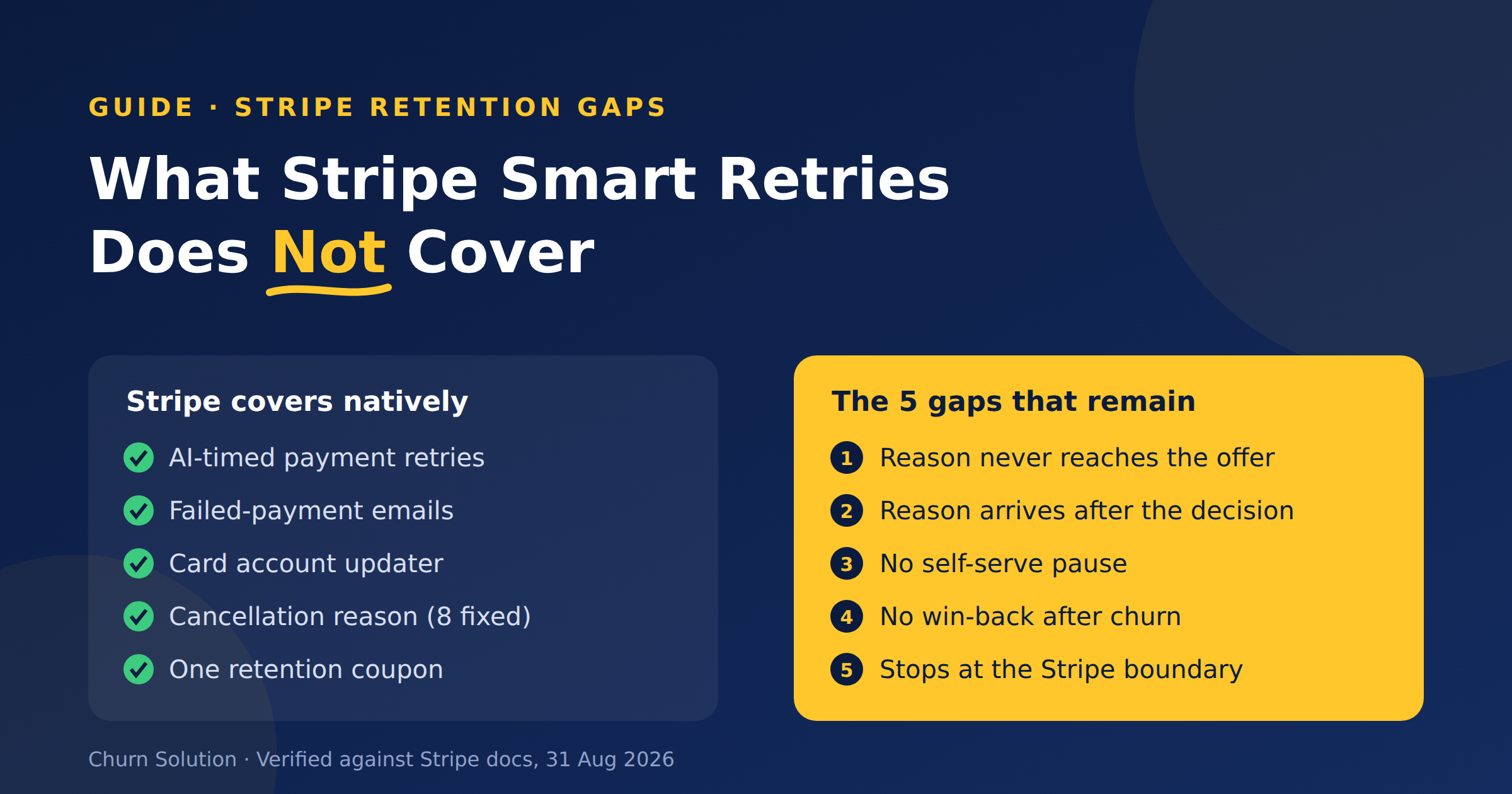
What Stripe Smart Retries Does Not Cover
Stripe Smart Retries recovers failed payments but doesn't run retention. Here are the five gaps that remain, sourced from Stripe's...


Membership Community Churn: The Members Who Quit Without Clicking Cancel
Quiet churn is the real leak: members who never clicked “cancel” at all. A card expires. A bank declines a...

Subscription Churn Dashboard: The 2026 Guide to Actionable Revenue Intelligence
Up to 40% of subscription churn is involuntary, meaning your customers aren't choosing to leave; they're being forced out by...