ARTICLE
Automated Customer Save Flows: The SaaS Playbook for Revenue Retention in 2026

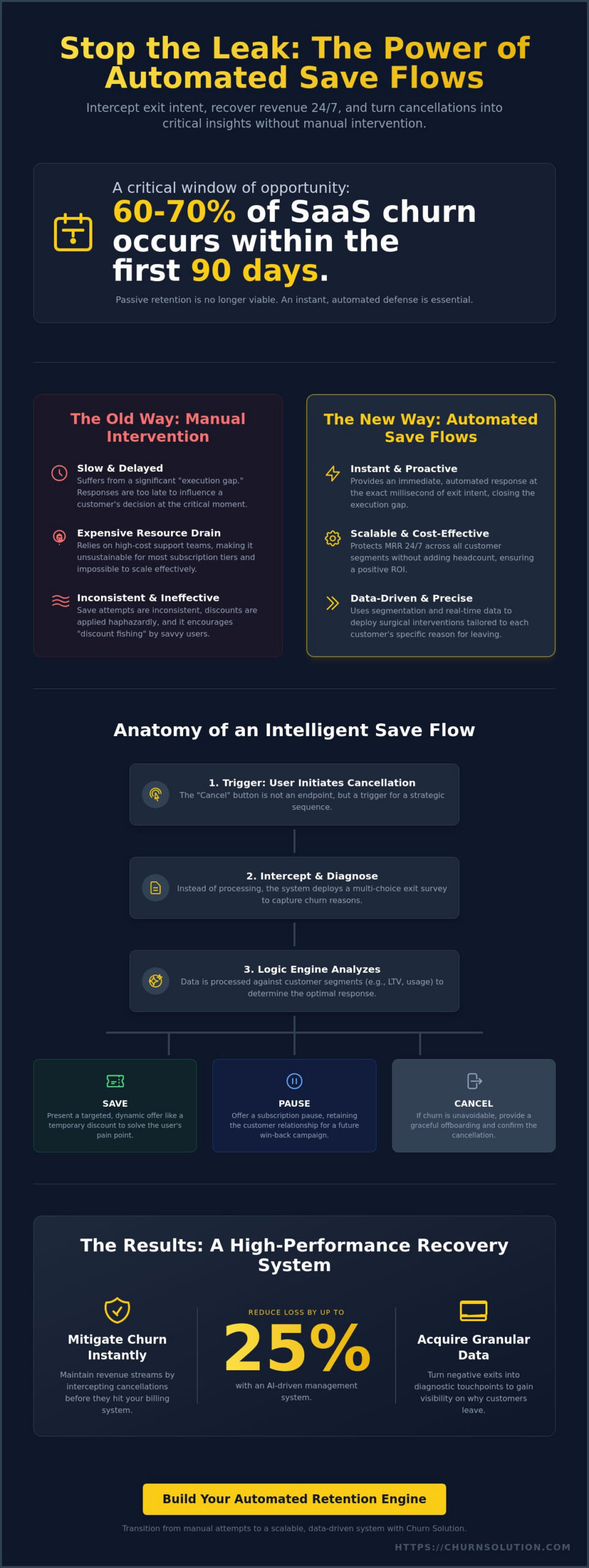
Every time a customer clicks “cancel” without a strategic intervention, you’re losing more than just a subscription; you’re forfeiting critical diagnostic data and recoverable MRR. In an industry where 60 to 70 percent of all SaaS churn occurs within the first 90 days, passive retention strategies are no longer viable. You’ve likely seen your support team struggle with inconsistent save attempts or felt the frustration of losing revenue to preventable cancellations. It’s time to stop the leak. By implementing automated customer save flows, you can intercept exit intent and protect your bottom line without manual intervention.
We agree that manual oversight is a bottleneck that scales poorly and leaves your revenue vulnerable. This playbook provides the strategic framework to master automated retention, allowing you to recover revenue 24/7 while gathering the precise feedback needed to optimize your product. We’ll explore how AI-driven churn management can reduce loss by up to 25 percent and break down the specific sequences required to turn departing users back into loyal advocates. From dynamic offers to intelligent feedback loops, you’ll learn to build a high-performance recovery system that operates with surgical precision.
Key Takeaways
- Transition from manual retention attempts to a scalable, data-driven system that intercepts cancellations automatically.
- Master the technical mechanics of automated customer save flows to trigger surgical interventions at the moment of exit intent.
- Deploy multi-choice diagnostic surveys to capture granular churn data and categorize reasons for departure.
- Differentiate between administrative cancellation paths and strategic save flows to optimize your recovery ROI.
- Integrate your retention engine with existing billing stacks to automate the full lifecycle from payment recovery to win-back campaigns.
What Are Automated Customer Save Flows in the Subscription Economy?
In the high-stakes environment of the subscription economy, a cancellation request isn’t a finality; it’s a critical decision point. Automated customer save flows represent a sophisticated sequence of digital interactions triggered the moment a user initiates a cancellation. Historically, companies relied on “retention specialists” to manually plead with departing users. This approach was slow, expensive, and impossible to scale. Today, top-tier SaaS organizations utilize data-driven software interventions to intercept exit intent in real-time, effectively automating the defense of their Monthly Recurring Revenue (MRR).
While some enterprise platforms define “save flows” merely as record-triggered database updates, this technical definition misses the strategic reality. A true save flow is an external, user-facing experience designed to solve the customer’s problem before they walk out the door. It bridges the gap between a user’s frustration and your product’s value proposition, ensuring that your churn rate remains under control through intelligent engagement rather than passive record keeping. By deploying automated customer save flows, you transform a binary “on/off” subscription model into a dynamic relationship that responds to user behavior with surgical precision.
The Core Objectives of an Automated Save Strategy
The primary goal is immediate churn mitigation. By intercepting a cancellation before it reaches your billing system, you maintain the revenue stream without manual effort. Beyond revenue, these flows serve as a vital source of data acquisition. By deploying non-intrusive exit surveys, you gain granular visibility into why customers leave. This turns a negative exit into a value-reinforcement touchpoint, allowing you to recover customer sentiment even if the subscription isn’t immediately saved. You’re not just stopping a cancellation; you’re conducting a real-time diagnostic on your product’s market fit.
Why Manual Interventions Fail to Scale
Relying on support teams for retention is a resource drain. The high cost of human intervention makes it unsustainable for lower-tier subscription plans where the customer lifetime value doesn’t justify the labor. Manual attempts also lack consistency. Support agents might apply discounts haphazardly, encouraging “discount fishing” by savvy users who learn to manipulate the system. Most importantly, manual processes suffer from a significant delay. In 2026, the “execution gap” is a revenue killer. Automation wins on timing, providing an immediate response at the exact millisecond of exit intent. This speed is essential, as research indicates that 60 to 70 percent of all SaaS customer churn happens within the first 90 days, requiring a proactive, instant defense mechanism that humans simply cannot provide at scale.
The Mechanics of an Intelligent Save Flow: Data, Triggers, and Logic
An effective retention strategy requires more than a simple confirmation prompt. It demands a sophisticated technical architecture that treats the “Cancel” button not as an end, but as a high-stakes trigger. When a user initiates this action, automated customer save flows activate a sequence of diagnostic and corrective measures. This transition from a system event to a strategic intervention is the foundation of modern revenue protection. You must intercept the user’s intent immediately to maintain control over the outcome.
The sequence begins with a diagnostic phase. Rather than processing the request instantly, the system deploys a multi-choice exit survey to categorize the reason for departure. This isn’t just administrative; it’s the data input for your logic engine. If a user selects “Price is too high,” the engine shouldn’t offer a technical tutorial. It should trigger a financial incentive. This alignment between the customer’s pain point and your response is what drives high-performance retention. The final outcome is no longer a binary choice. Users are guided toward a specific decision: cancel, pause their subscription, or accept a targeted retention incentive.
Segment-Driven Retention Logic
Success depends on customer segmentation. Your logic engine must distinguish between a high-LTV power user and a low-value “ghost” user who hasn’t logged in for months. Usage-based triggers allow you to tailor the intensity of your save offer. A power user leaving due to budget constraints might receive a deep, temporary discount, while a low-usage user is offered a subscription pause. By integrating real-time churn metrics, your system automates these complex decisions at the millisecond level. You can deploy these logic-based sequences to ensure every save attempt is mathematically optimized for ROI.
The Role of AI in Feedback Analysis
Static surveys often fail because users feel restricted by pre-defined options. Modern flows utilize AI feedback analysis to process open-ended responses, moving your data beyond the generic “Other” category. This technology identifies emerging churn trends before they become systemic revenue leaks. If multiple users mention a specific competitor or a missing feature, the AI flags this trend for your product team. This feedback loop ensures that your automated customer save flows do more than just stop current cancellations; they provide the intelligence needed to prevent future exit intent entirely. You’re building a defensive perimeter that evolves based on actual user sentiment.
Save Flows vs. Cancellation Flows: Strategic Differences and ROI
Distinguishing between a standard cancellation path and a strategic save flow is fundamental to revenue optimization. A cancellation flow is a purely administrative UX sequence designed to facilitate the end of a subscription. It focuses on the technical execution of record updates and billing cessation. Conversely, automated customer save flows act as a strategic layer on top of that path. They prioritize revenue recovery by presenting tailored interventions before the final database update occurs. Treating these two processes as interchangeable is a costly error that leads to silent revenue erosion and a lack of visibility into customer sentiment. Before committing to any approach, it’s worth evaluating the build vs buy cancellation flow decision to ensure you’re allocating engineering resources toward growth rather than infrastructure maintenance.
The ROI of these interventions is mathematically undeniable. Consider the impact of a modest 5 percent increase in your save rate. Across a mid-market SaaS customer base, this incremental gain compounds into significant MRR protection over a fiscal year. When you analyze the numbers, the leverage becomes clear. If your current churn is 5 percent and you deploy automated customer save flows that recover just one-fifth of those users, you’ve improved your net retention by a full percentage point every month. In the subscription economy, that small shift determines the difference between a stagnant business and one with a healthy growth trajectory. You aren’t just saving a single transaction; you’re preserving the entire future lifetime value of that cohort.
Friction is often viewed as a negative in UX design, but strategic friction is a necessity in revenue retention. A “one-click cancel” might satisfy a developer’s desire for clean code, but it fails the business. You must implement a diagnostic pause. This isn’t about making it impossible to leave; it’s about making it impossible to leave without being heard. While some advocate for a frictionless cancellation experience to avoid user frustration, making the exit completely silent is a missed opportunity for recovery. High-performance teams understand that while the exit should be clear, it must also be conversational. By integrating AI-driven tools like Chatterbots to handle these dialogues, you ensure that you don’t let a customer leave without first attempting to resolve the friction that prompted their departure.
Value-Based Saves vs. Price-Based Saves
Deploying discounts is a common but dangerous tactic. Offering 50 percent off to every departing user creates “Discount Churn,” where you essentially train customers to threaten cancellation to lower their bills. This erodes long-term LTV and devalues your brand. Instead, utilize dynamic offers to match the incentive to the specific churn reason. If a user cites a lack of time, offer a temporary account pause or a plan downgrade rather than a price cut. This approach protects your margins while addressing the actual user pain point with surgical precision.
The Psychology of the “Pause” Button
For seasonal or project-based SaaS products, the “Pause” button is a powerful retention tool. It reduces the cognitive load of a permanent exit by offering a temporary hiatus. Customers often want to stop paying but keep their data intact for future use. By providing a pause option, you maintain data integrity and significantly reduce future re-acquisition costs. It keeps the door open for a seamless return, turning a potential permanent loss into a controlled, temporary suspension of revenue. This mechanism respects the user’s current situation while preserving the long-term relationship.
How to Implement an Automated Save Flow That Actually Works
Execution is where most SaaS retention strategies fail. To build automated customer save flows that deliver measurable ROI, you must move beyond generic prompts and follow a structured engineering sequence. This process transforms the point of exit into a high-conversion opportunity by matching user frustration with immediate, logical solutions. Success requires a methodical approach that prioritizes data integrity and real-time response.
- Step 1: Map your exit intent triggers. Identify the specific user actions that precede a cancellation within your customer portal. You must know exactly where the friction occurs to intercept it effectively.
- Step 2: Design a 3-question exit survey. Capture granular churn data without causing survey fatigue. Focus on the primary driver of departure to inform your recovery logic.
- Step 3: Build a reason-based offer matrix. Create a decision tree that maps specific churn reasons to targeted retention incentives. This ensures your response is relevant to the user’s stated pain point.
- Step 4: Execute A/B experiments. Test different incentives, from temporary discounts to feature unlocks, to identify which offers yield the highest save rate for each segment.
- Step 5: Monitor Net Revenue Retention (NRR). Validate the long-term impact of your saved users. A “save” is only successful if the customer remains active and profitable for multiple billing cycles.
Designing the Perfect Exit Survey
Brevity is essential at the moment of exit. If your survey is too long, users will simply close the window and finalize the cancellation through other means. Focus on the top five churn reasons every SaaS should track: price sensitivity, product complexity, missing features, technical instability, and business pivots. Limit your survey to five to seven distinct options to maximize completion without overwhelming the user.
Deploying Dynamic Retention Offers
Your recovery system must be intelligent enough to offer the right incentive at the right time. If a user selects “Too Expensive,” the system should trigger a two-month discount or suggest a lower-tier plan. When “Missing Feature” is cited, provide a personalized demo or a specialized training resource to highlight existing functionality. For “Technical Issues,” bypass the save offer entirely and trigger an immediate high-priority ticket for your success team. This level of automation ensures that your automated customer save flows resolve the actual problem rather than just delaying the inevitable. You can build your automated save flow today to start protecting your MRR with surgical precision.
Scaling Your Retention Engine with Churn Solution
Scaling a retention strategy requires a unified infrastructure that bridges the gap between your raw billing data and the customer experience. Churn Solution integrates seamlessly with Stripe and other enterprise-grade billing stacks to ensure that automated customer save flows operate with full visibility into your financial metrics. This technical synergy allows the system to pull real-time subscription details, ensuring that every save offer is backed by accurate LTV and usage context. You aren’t operating in a vacuum; you’re deploying interventions backed by the full weight of your financial data.
Effective revenue retention isn’t a single event but a continuous lifecycle that demands total automation. By managing the entire process, from payment recovery for involuntary churn to strategic win-back campaigns, you close the structural loops that lead to revenue leakage. The implementation of smart retries in conjunction with active save flows ensures that your defense is multi-layered. While your save flows address intentional exit intent, smart retries handle the technical failures that often lead to silent churn. Pairing these mechanisms with dunning email best practices gives you a comprehensive shield for your MRR that covers both voluntary and involuntary churn scenarios.
Real-time reporting serves as the final pillar of a scalable retention engine. You need to see exactly how much MRR is being “saved” daily to justify your strategic decisions and refine your offer logic. Churn Solution provides granular dashboards that track the performance of every incentive, survey response, and recovery attempt. This visibility allows you to move beyond anecdotal evidence and manage your retention strategy with the same data-driven rigor you apply to customer acquisition. You can finally quantify the exact impact of your retention efforts on your bottom line.
From Cancellation to Reactivation
Even the most optimized automated customer save flows won’t save every user on the first attempt. When a save attempt fails, the system must transition immediately to automated reactivation campaigns. These value-driven win-back sequences maintain a strategic relationship with lapsed users, positioning your brand as an essential partner rather than just a service provider. By staying top-of-mind with relevant product updates and personalized re-entry offers, you significantly reduce the cost of future re-acquisition. A cancellation is merely a pause in the customer journey, not the end of the relationship.
Why Churn Solution is the Specialist Choice
Most billing engines treat retention as an afterthought, providing rudimentary exit pages that lack diagnostic depth. Churn Solution is built as revenue-critical infrastructure for the modern subscription economy. It provides the AI-driven analysis, dynamic offer logic, and technical stability that basic tools simply cannot match. You need a specialist platform that treats every exit intent as a high-stakes opportunity for recovery. Don’t leave your most valuable asset to chance. Start protecting your revenue with Churn Solution today.
Secure Your MRR with Intelligent Retention
Retention in 2026 requires more than a passive “cancel” button. It demands an active defense system that operates at the speed of your digital users. We’ve established that automated customer save flows provide the diagnostic depth needed to intercept churn and recover revenue 24/7. By transitioning from manual oversight to a logic-driven engine, you eliminate the execution gap and turn exit intent into actionable intelligence. This isn’t just about stopping a cancellation; it’s about optimizing your entire customer lifecycle for maximum durability.
Your MRR is your most valuable asset. Protecting it shouldn’t be an afterthought or a manual burden for your support team. With AI-powered feedback analysis and a dynamic offer engine for personalized retention, you can resolve customer pain points with surgical precision. Our platform ensures seamless integration with Stripe and major billing platforms, allowing you to deploy sophisticated recovery sequences without rebuilding your infrastructure. It’s time to take control of your growth trajectory and plug the leaks in your funnel. Automate your customer save flows with Churn Solution and start reclaiming your lost revenue today. You’re ready to build a more resilient, data-driven, and profitable SaaS business.
Frequently Asked Questions
What is the difference between a save flow and a cancellation flow?
A cancellation flow is a purely administrative sequence designed to process the technical end of a subscription. It focuses on record updates and billing cessation. Conversely, a save flow is a strategic intervention layered on top of that path to recover revenue. While the cancellation flow handles the exit, the save flow uses diagnostic data to offer a reason to stay.
Will an automated save flow frustrate my customers?
Strategic friction doesn’t frustrate users when it’s diagnostic and helpful. If your flow offers a relevant solution to a specific problem, customers perceive it as proactive support rather than a barrier to exit. The goal is to make the user feel heard through a brief, structured survey rather than trapping them in an endless loop of confirmation prompts.
How much can a save flow actually reduce churn?
Companies that deploy AI-driven churn management report revenue loss reductions of up to 25 percent. The efficacy of your automated customer save flows depends on the precision of your offers. By targeting the 60 to 70 percent of users who churn within the first 90 days, you can significantly improve your net retention metrics.
Is it better to offer a discount or a plan pause?
The optimal choice depends entirely on the user’s stated churn reason. Discounts address price sensitivity but can devalue your brand if overused. Pauses are superior for seasonal or project-based users who want to keep their data intact without paying for a temporary period of inactivity. Use your diagnostic data to match the incentive to the pain point.
Can I use save flows for involuntary churn caused by failed payments?
Save flows primarily target voluntary exit intent where a user actively clicks a cancel button. For involuntary churn, you should utilize smart retries and dunning email automation. While these are separate mechanisms, they must work in tandem within your retention engine to provide comprehensive MRR protection across all churn types.
How do I know if my retention offers are actually working?
You must conduct A/B experiments to compare your save offers against a control group. Success isn’t measured solely by the immediate save rate. You must track the subsequent retention period to ensure the user remains active and profitable for multiple billing cycles after the intervention occurs. This validates that you aren’t just delaying the inevitable.
What metrics should I track to measure the success of my save flows?
Focus on your Save Rate, Net Revenue Retention (NRR), and specific offer conversion rates. Monitoring these KPIs allows you to optimize your automated customer save flows based on real-world performance data. High-performance teams also track the “Time to Value” for saved users to ensure the retention incentive actually re-engaged the customer with the product’s core features.
- Key Takeaways
- Table of Contents
- What Are Automated Customer Save Flows in the Subscription Economy?
- The Mechanics of an Intelligent Save Flow: Data, Triggers, and Logic
- Save Flows vs. Cancellation Flows: Strategic Differences and ROI
- How to Implement an Automated Save Flow That Actually Works
- Scaling Your Retention Engine with Churn Solution
- Secure Your MRR with Intelligent Retention
- Frequently Asked Questions

Churn solution that turns your customers right around.
Related Articles
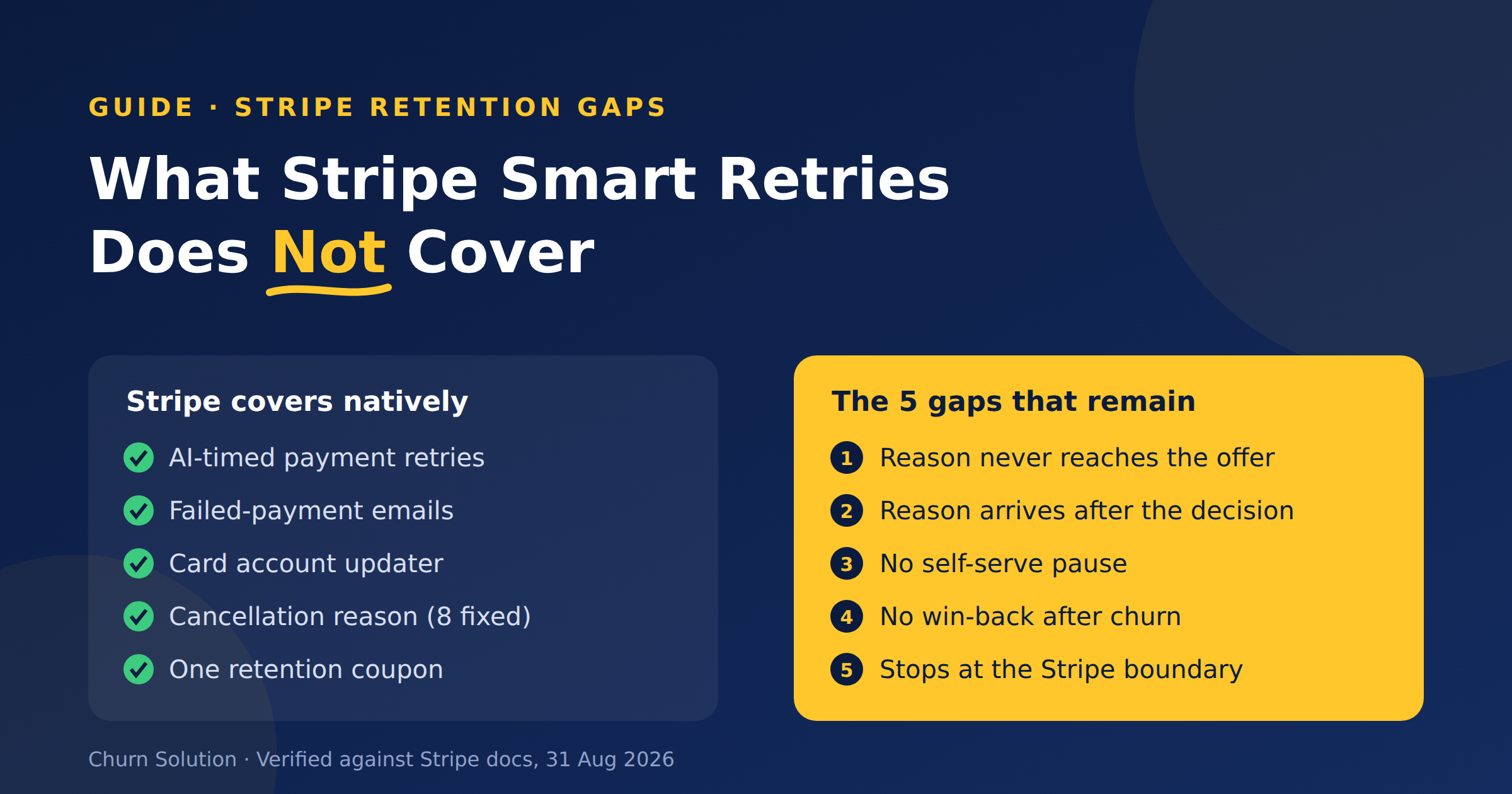
What Stripe Smart Retries Does Not Cover
Stripe Smart Retries recovers failed payments but doesn't run retention. Here are the five gaps that remain, sourced from Stripe's...

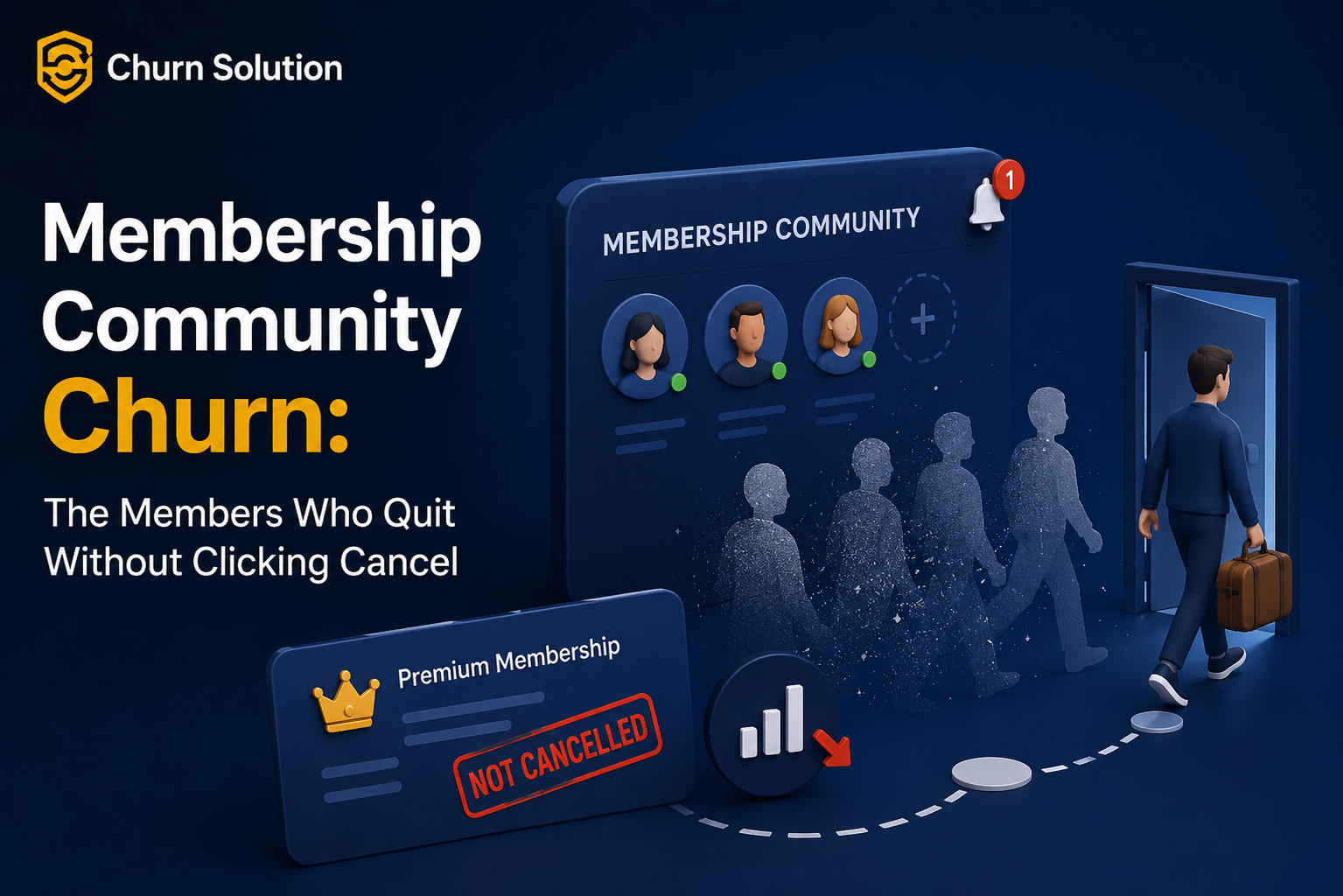
Membership Community Churn: The Members Who Quit Without Clicking Cancel
Quiet churn is the real leak: members who never clicked “cancel” at all. A card expires. A bank declines a...

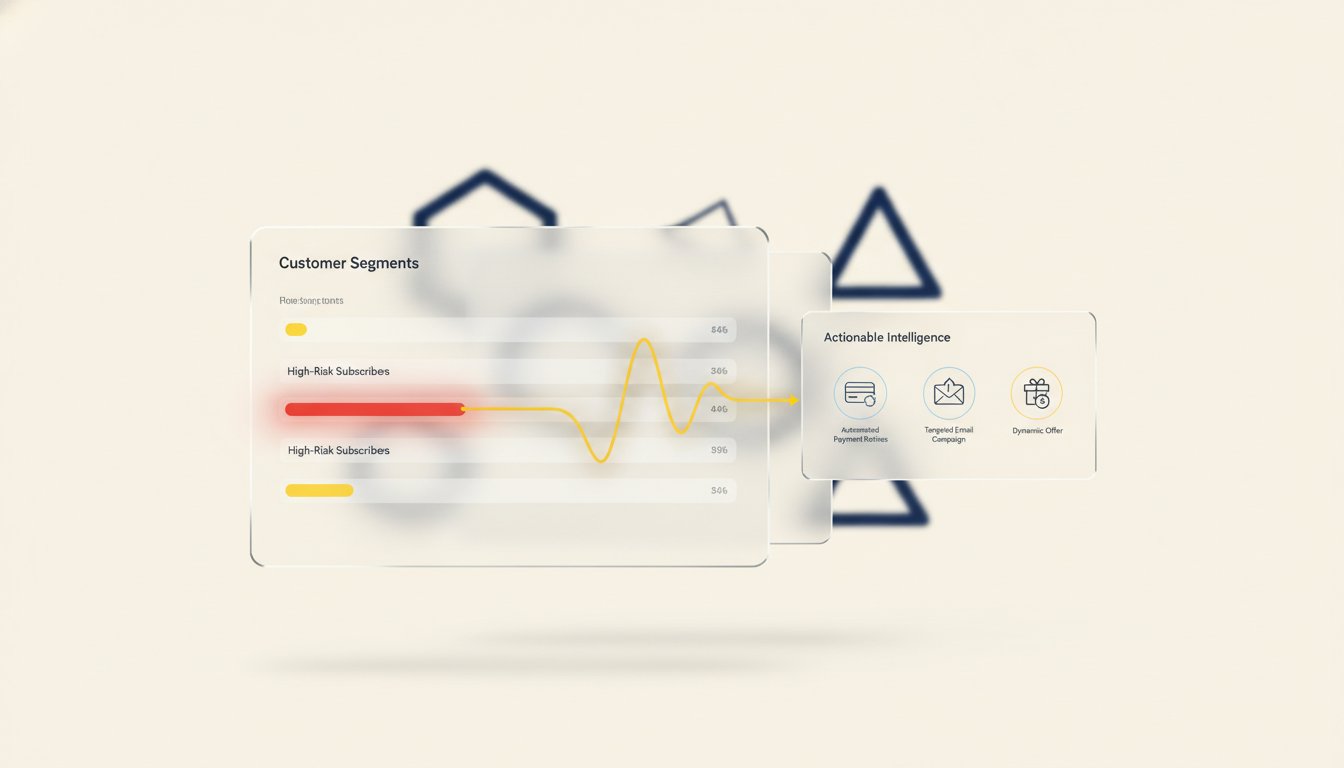
Subscription Churn Dashboard: The 2026 Guide to Actionable Revenue Intelligence
Up to 40% of subscription churn is involuntary, meaning your customers aren't choosing to leave; they're being forced out by...