ARTICLE
The Complete Guide to Churn Solution: Automating Revenue Recovery in 2026

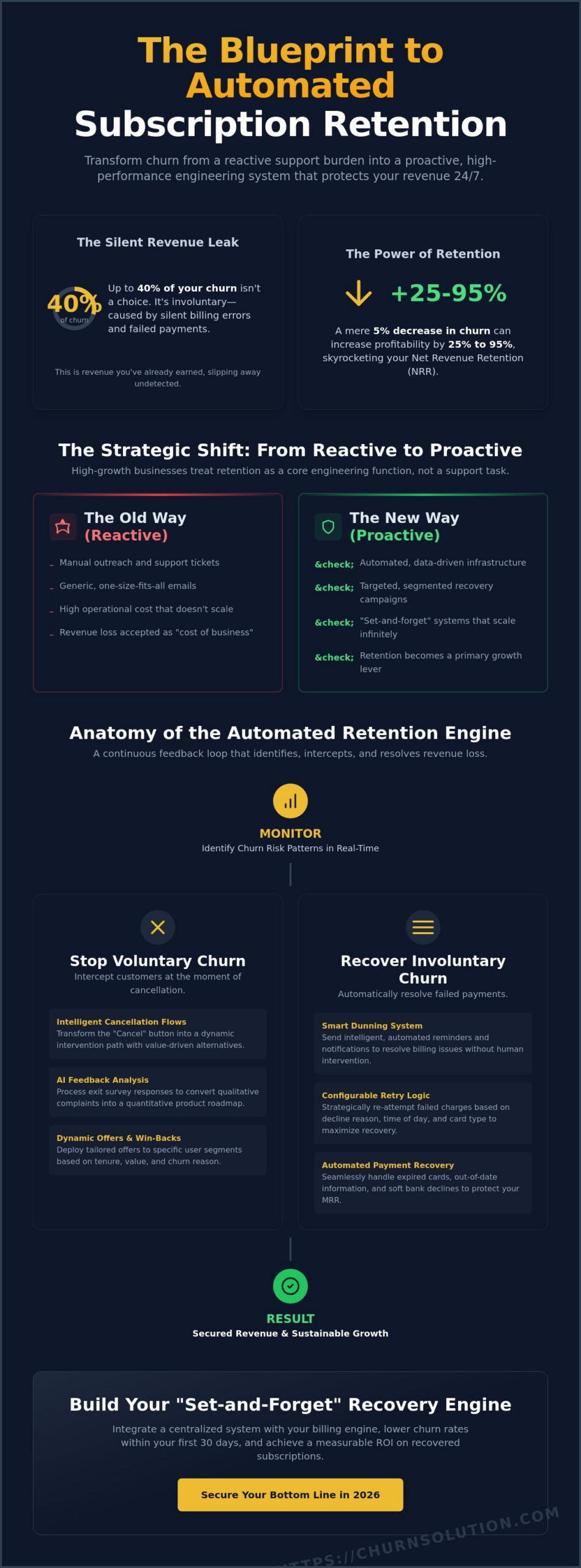
Did you know that up to 40% of your churn isn’t even a choice your customers are making? It’s the result of invisible failures like expired credit cards and silent billing errors that bleed your MRR every single month. This Complete guide to Churn Solution addresses the reality that manual outreach and generic emails don’t scale as your subscriber base grows. It’s frustrating to lose revenue you’ve already earned simply because your retention infrastructure isn’t as sophisticated as your product.
You need a system that operates with the same technical mastery as your core software. We’ll show you how to transform retention from a manual support burden into a high-performance engineering system. You’ll learn to deploy automated tools that protect your revenue around the clock and lower churn rates within your first 30 days. We’ll explore the mechanics of smart retries, AI-driven feedback analysis, and dynamic offers to build a “set-and-forget” recovery engine. By the end of this guide, you’ll have a clear blueprint for achieving a measurable ROI on recovered subscriptions and securing your business’s bottom line in 2026.
Key Takeaways
- Shift your retention strategy from reactive manual support to a proactive, data-driven infrastructure that treats revenue protection as a core engineering function.
- Intercept voluntary cancellations at the exact moment of exit using intelligent Cancellation Flows that present value-driven alternatives to churn.
- Recover lost revenue from failed payments automatically through smart retry logic and dunning systems that resolve billing errors without human intervention.
- Leverage this Complete guide to Churn Solution to deploy Dynamic Offers and win-back campaigns tailored to specific user segments and tenure.
- Accelerate your time-to-value by integrating a centralized Customer Portal with your billing engine for a seamless, “set-and-forget” recovery system.
Understanding the Churn Solution Framework for Subscription Growth
High-growth subscription businesses no longer rely on manual intervention to save customers. They deploy automated infrastructure. This Complete guide to Churn Solution defines the framework as a sophisticated suite of tools designed to identify, intercept, and resolve revenue loss before it impacts your balance sheet. The industry has shifted. We’ve moved past reactive support tickets toward a proactive, data-driven revenue protection model. You cannot scale a business while your bucket is leaking revenue at every seam. By categorizing loss into voluntary churn and involuntary churn, you can apply surgical fixes to specific failure points. This technical approach transforms retention from a cost center into a primary growth lever.
The High Cost of Customer Attrition in 2026
Acquisition costs are skyrocketing across every digital vertical. Every dollar spent on marketing is a sunk cost if you cannot stabilize customer attrition through systematic retention efforts. While logo churn tracks how many customers you lose, revenue churn measures the actual impact on your bottom line. Sophisticated operators prioritize Net Revenue Retention (NRR) as their most critical health indicator. Research indicates that a mere 5% decrease in churn can increase profitability by 25% to 95%. Churn Solution provides the essential layer to protect these margins. It’s the difference between a stagnating MRR and exponential growth in a crowded market.
The Anatomy of an Automated Retention System
An effective system operates on a continuous, automated feedback loop. It starts by monitoring churn metrics to identify risk patterns in real-time. When a user attempts to leave, exit surveys capture the “why” while dynamic offers attempt an immediate save. Simultaneously, payment recovery protocols handle the 20-40% of churn caused by technical failures like expired cards or bank declines. This isn’t about sending a single follow-up email. It’s about creating a logical ecosystem where every exit attempt becomes either a data point for product improvement or a successfully recovered subscriber. The goal is total revenue optimization through seamless, high-performance automation.
Stopping Voluntary Churn with Automated Cancellation Flows and AI Analysis
Watching a customer click “Cancel” is a failure of engagement, but it doesn’t have to be a failure of revenue. This Complete guide to Churn Solution emphasizes execution over simple observation. Most businesses provide a binary exit: the user clicks a button, and the subscription ends. This approach ignores the psychological window where a user is still open to alternatives. By deploying Cancellation Flows, you intercept users at the exact moment of exit, transforming a static goodbye into a dynamic intervention path.
The transition from a simple “Cancel” button to a value-driven path requires data. You must implement Exit Surveys to categorize precisely why a user is leaving. Is it the price? A missing feature? Poor onboarding? Once you have this data, use Customer Segmentation to tailor the experience. A high-value enterprise account should never see the same exit offer as a low-tier individual user. Forbes highlights that the most successful customer retention strategies treat different segments with different levels of urgency and incentive. You can configure these rules in minutes to start protecting your MRR immediately.
The Power of AI Feedback Analysis
Qualitative data is often messy and difficult to scale. AI Feedback Analysis solves this by processing thousands of open-ended exit responses into actionable insights. It converts subjective complaints into a quantitative product roadmap, showing you exactly which features or bugs are driving churn. AI models can now identify at-risk sentiment by monitoring behavioral patterns before the user even reaches the cancellation screen. This allows you to intervene with a proactive save offer before the intent to leave becomes a final decision.
A/B Testing Your Save Strategies
Optimization is impossible without experimentation. Use A/B Experiments to test which save offers resonate with your audience. You might discover that offering a “Pause” functionality for three months preserves more long-term MRR than a 50% discount. Testing these hypotheses ensures you aren’t leaving money on the table or devaluing your brand unnecessarily. Track your “Save Rate” as your primary KPI. This metric represents the percentage of users who initiated a cancellation but were successfully retained through your automated flow, providing a direct view of your recovery efficiency.
Recovering Failed Payments via Smart Dunning and Retry Logic
Involuntary churn is the silent killer of subscription revenue. It occurs when a customer wants to stay, but their payment fails due to expired cards, bank declines, or technical errors. This Complete guide to Churn Solution identifies these failures as solvable engineering problems rather than customer relationship issues. Unlike voluntary cancellations, which require behavioral intervention, Payment Recovery systems operate silently in the background to resolve these leaks without human friction. This is about protecting revenue you’ve already earned but haven’t yet collected.
The core mechanism of this recovery involves Smart Retries and automated dunning sequences. These tools don’t just blast generic emails. They orchestrate a logical, data-driven sequence of recovery attempts. By automating this process, you ensure that your team isn’t wasting hours on manual billing outreach. Your MRR remains protected from avoidable attrition while you focus on product growth. It is a high-leverage intervention that yields immediate results.
Reducing Involuntary Attrition with Dunning Automation
High-performing dunning campaigns follow a specific, data-backed sequence. The process starts with a subtle notification and escalates in urgency as the grace period nears its end. A critical component of this flow is the use of Customer Portals. These dedicated environments allow users to update their billing information in seconds without needing to log into the main application or contact support. Reducing this friction is essential. If the update process is difficult, you risk turning a simple technical failure into a voluntary cancellation because the user simply gives up. You must balance the urgency of the notice with a seamless user experience to maintain long-term trust.
Smart Retries: The Science of Timing
Retrying a failed charge isn’t a game of chance; it’s a science of timing. Retrying a card at 3:00 AM on a Tuesday often yields different results than 10:00 AM on a Friday. Bank processing algorithms and consumer liquidity levels fluctuate throughout the week. Churn Solution uses historical data and machine learning to analyze bank decline codes and identify the precise window when a charge is most likely to succeed. This intelligence allows you to bypass common soft declines and temporary processing errors. Industry data indicates that sophisticated smart retries can recover up to 25% of failed payments without requiring any action from the subscriber. This level of automation is a prerequisite for any SaaS business looking to scale efficiently in 2026.
Strategic Retention: Deploying Dynamic Offers and Win-Back Campaigns
Retention is not a one-size-fits-all endeavor. This Complete guide to Churn Solution emphasizes that the most effective saves are those tailored to individual user behavior and tenure. Static discounts are often a race to the bottom that devalues your product. Instead, you must deploy Dynamic Offers that react to the specific reasons a user is leaving. If a customer has been with you for two years, their loyalty deserves a different intervention than a trial user who hasn’t seen value yet. This logic ensures you protect your margins while maximizing the chances of a successful save.
A sophisticated save strategy follows a logical hierarchy of offers. You should prioritize preserving the subscription habit over slashing the price. The sequence typically moves from a Pause to an Extension, then to a Credit, and finally a Discount as a last resort. This methodical approach ensures you only give away as much as necessary to keep the account active. When a user does leave, the process isn’t over. Automated Reactivation campaigns target these lapsed users weeks or months later, using their specific history to pull them back into the ecosystem. This automation is essential for increasing long-term LTV without increasing your manual workload.
The Psychology of the Save: Pause vs. Discount
Offering a two-month pause is often superior to a 50% discount. A pause preserves the mental habit of using your product; it signals that the user is just taking a break rather than ending the relationship. Discounts, while effective in the short term, can lead to “Discount Fatigue” and permanent brand devaluation. Users who get used to lower prices rarely want to pay full price again. Use a “Free Month” when a user cites temporary budget issues, but suggest a “Plan Downgrade” if they feel they aren’t utilizing all your features. This framework keeps the user within your ecosystem at a price point that reflects their actual usage.
Automated Win-Back Playbooks
Timing is the most critical variable in a win-back campaign. A user is often most likely to return 30 to 60 days after departure, once they realize the competitor’s product lacks your specific advantages. Personalization is key here. Pull data from your Exit Surveys to address the exact reason they left. If they cited a missing feature that you’ve since launched, lead with that update. Integrating these win-back emails directly with your churn metrics dashboard allows you to see exactly which offers are driving the highest reactivation rates. Start building your automated win-back playbook today to recover lost revenue on autopilot.
Implementing Churn Solution: From Integration to Measurable ROI
Executing a retention strategy requires technical precision. This Complete guide to Churn Solution focuses on a seamless transition from data collection to automated recovery. Unlike legacy platforms that demand a total migration of your billing infrastructure, our framework integrates directly with your existing engine. Whether you use Stripe or another provider, you maintain control of your billing logic while we layer on the recovery intelligence. This approach eliminates the friction of switching providers and allows you to start protecting your MRR within hours rather than weeks.
We recommend a “Shadow Mode” approach during the initial phase. In this stage, the system analyzes your data and identifies risk patterns without triggering active interventions. It allows you to validate your assumptions and see exactly where revenue is leaking. Once you’ve mapped these vulnerabilities, you can deploy your first Customer Portal. This centralized hub empowers users to manage their own subscriptions and update payment methods, which significantly reduces the support burden on your team. You’ll monitor every save and recovery attempt through the Churn Metrics dashboard, providing a real-time view of your system’s performance.
Step-by-Step Integration Guide
- Step 1: Connect your billing provider via secure API to sync your customer data and transaction history.
- Step 2: Map your customer segments and churn reasons to ensure your save offers are logically aligned with user intent.
- Step 3: Design and launch your custom cancellation flow using our modular editor to intercept exit attempts.
- Step 4: Monitor and iterate based on A/B test results to continuously optimize your save rates and recovery efficiency.
Measuring the Impact on Your Bottom Line
ROI in retention is measured by “Recovered Revenue,” which is the total MRR preserved through automated interventions and payment retries. You must distinguish between Gross Churn and Net Revenue Retention (NRR) improvements. While Gross Churn tracks the volume of lost accounts, NRR reflects the total health of your revenue, including expansion and saves. Achieving an NRR of over 100% is the gold standard for high-growth SaaS companies. By deploying these automated pillars, you aren’t just slowing down losses; you’re building a foundation for sustainable, compounded growth. Ready to stop the leak? Start your Churn Solution implementation today and secure your revenue for 2026.
Future-Proof Your Revenue Infrastructure
Managing a subscription business in 2026 requires more than just a great product; it demands a sophisticated defense against revenue leakage. This Complete guide to Churn Solution has detailed how to transform retention from a reactive support task into a high-performance automated system. By deploying intelligent cancellation flows and AI-powered feedback analysis, you gain actionable product insights that prevent users from leaving in the first place. You no longer have to worry about the “leaky bucket” problem when your infrastructure is built to identify and plug every hole in real-time.
Success depends on execution. Our seamless integration with major billing providers like Stripe ensures that you can deploy proven payment recovery logic without disrupting your existing workflows. Smart retries and automated dunning sequences work silently in the background to maximize your MRR and protect your bottom line. It’s time to stop guessing why users leave and start recovering the revenue you’ve already earned. Take control of your business health and build a resilient foundation for sustainable growth.
Frequently Asked Questions
What is the difference between voluntary and involuntary churn?
Voluntary churn occurs when a user intentionally initiates a cancellation through your interface, usually due to price, missing features, or a change in needs. Involuntary churn is unintentional and happens when a subscription ends because of a payment failure, such as an expired credit card, a bank decline, or a technical processing error. Addressing both requires different strategies: behavioral intervention for voluntary exits and automated recovery logic for involuntary failures.
How long does it take to see results after implementing Churn Solution?
Most subscription businesses observe a measurable impact on their revenue recovery within the first 30 days. Because systems like smart retries and dunning automation begin working immediately upon integration, you can capture failed payments that would have otherwise resulted in churn. This Complete guide to Churn Solution emphasizes that while behavioral saves from cancellation flows accumulate over time, payment recovery offers an almost instant ROI.
Does Churn Solution work with Stripe and other billing platforms?
Yes, the platform is designed to integrate seamlessly with Stripe and other major billing engines via secure API connections. This architecture allows you to layer sophisticated retention tools on top of your existing infrastructure without the risk of a full billing migration. You maintain your current payment processor while gaining the advanced automation needed to protect your MRR effectively.
Can I customize the cancellation flow to match my brand’s look and feel?
You have full control over the aesthetic and messaging of your cancellation flows through a modular editor. You can adjust colors, typography, and layout to ensure the exit experience feels like a native part of your application. Maintaining brand consistency during this critical window is essential for building trust and increasing the likelihood that a user will accept a save offer.
Will automated dunning emails annoy my customers?
Automated dunning emails are perceived as helpful service notifications rather than intrusive marketing when they are timed logically. By providing a direct link to a frictionless customer portal, you make it easy for users to resolve billing issues before their service is interrupted. The goal is to provide a clear path to resolution that respects the user’s time and maintains the professional relationship.
Is it better to offer a discount or a pause during the cancellation flow?
A pause is generally superior to a discount because it preserves the user’s habit of using your product without devaluing your brand. Discounts can lead to long-term margin erosion and “discount fatigue,” where users refuse to return to full-price tiers. We recommend a hierarchy that prioritizes pauses and plan downgrades before offering financial incentives as a final save attempt.
How does AI feedback analysis help improve my product?
AI feedback analysis processes thousands of qualitative survey responses and categorizes them into quantitative data points. This technology identifies specific friction points and missing features that are driving users to leave, which allows your product team to prioritize the most impactful updates. It transforms subjective complaints into a clear, data-backed roadmap for long-term growth.
What is a good “Save Rate” for a SaaS cancellation flow?
A high-performing cancellation flow typically achieves a save rate between 15% and 30%. This metric represents the percentage of users who started the cancellation process but chose to stay after being presented with a dynamic offer or a pause option. Your specific rate will fluctuate based on your industry, customer segments, and the relevance of the incentives you deploy.
- Key Takeaways
- Table of Contents
- Understanding the Churn Solution Framework for Subscription Growth
- Stopping Voluntary Churn with Automated Cancellation Flows and AI Analysis
- Recovering Failed Payments via Smart Dunning and Retry Logic
- Strategic Retention: Deploying Dynamic Offers and Win-Back Campaigns
- Implementing Churn Solution: From Integration to Measurable ROI
- Future-Proof Your Revenue Infrastructure
- Frequently Asked Questions

Churn solution that turns your customers right around.
Related Articles
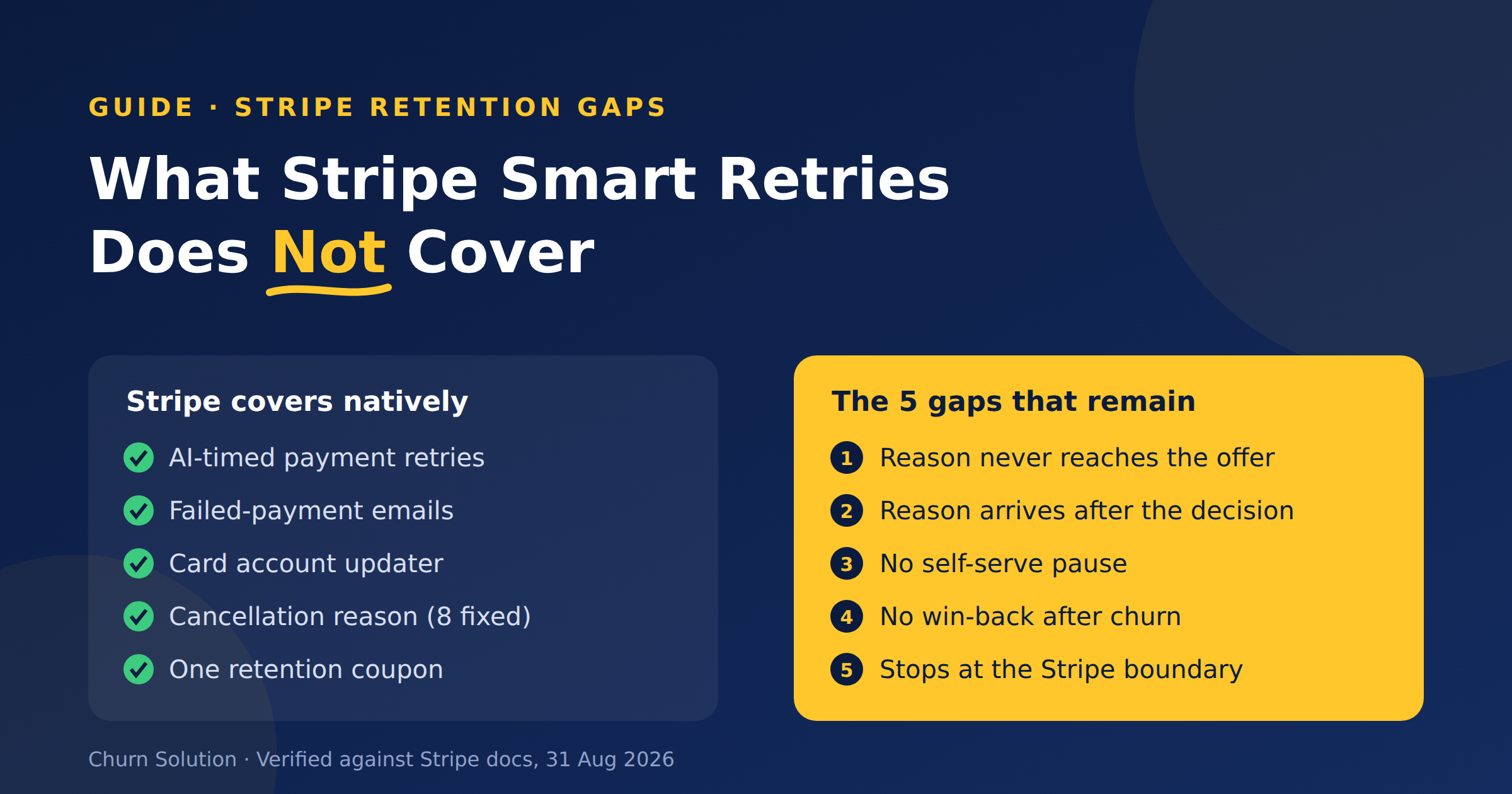
What Stripe Smart Retries Does Not Cover
Stripe Smart Retries recovers failed payments but doesn't run retention. Here are the five gaps that remain, sourced from Stripe's...

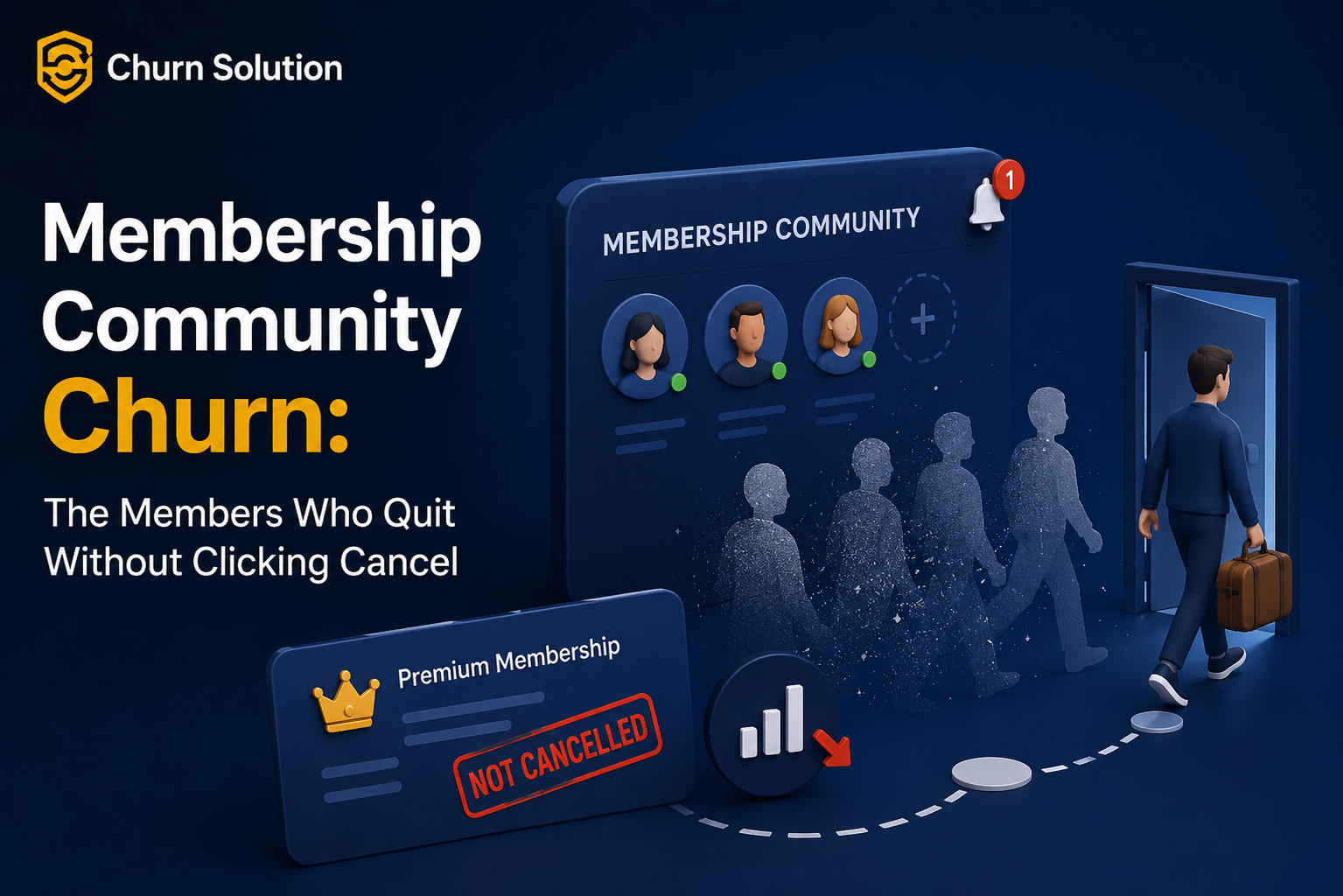
Membership Community Churn: The Members Who Quit Without Clicking Cancel
Quiet churn is the real leak: members who never clicked “cancel” at all. A card expires. A bank declines a...

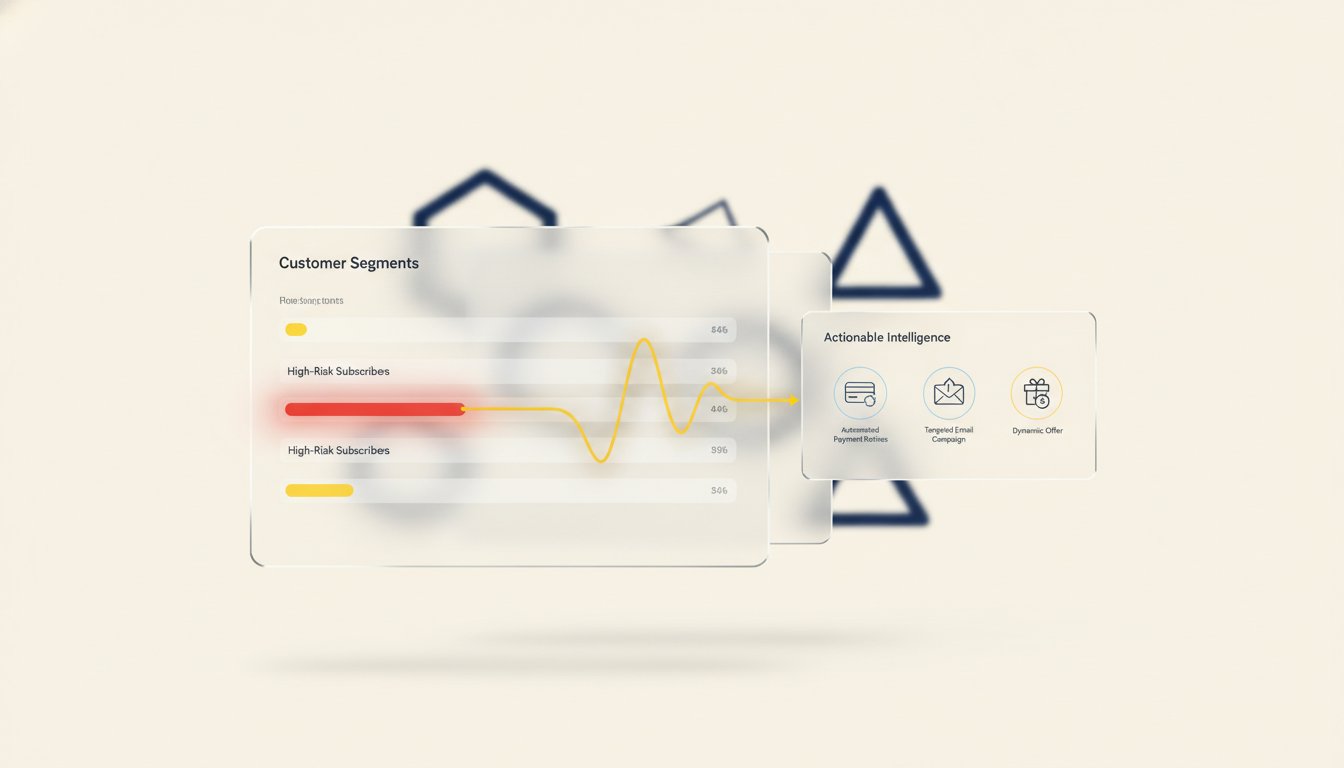
Subscription Churn Dashboard: The 2026 Guide to Actionable Revenue Intelligence
Up to 40% of subscription churn is involuntary, meaning your customers aren't choosing to leave; they're being forced out by...