ARTICLE
The Revenue Retention Playbook: 2026 Guide to Automated SaaS Growth

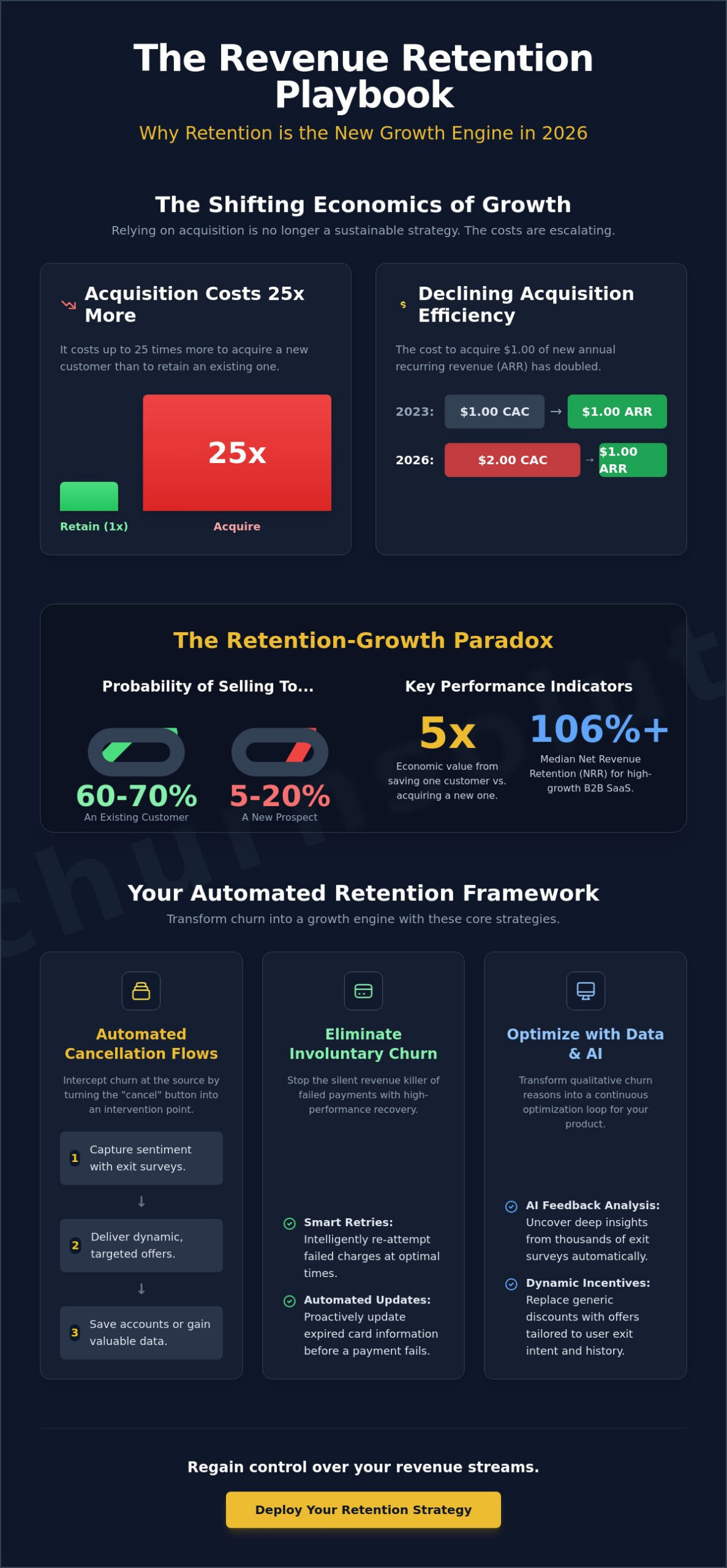
It currently costs up to 25 times more to acquire a new customer than to retain an existing one. With the median cost to acquire $1.00 of new annual recurring revenue rising to $2.00 in 2026, relying solely on top-of-funnel acquisition is no longer a viable strategy for sustainable scaling. This revenue retention playbook identifies the precise mechanisms required to stop the “invisible” revenue loss that occurs when failed payments and voluntary churn go unmanaged. You’re likely seeing acquisition costs climb while struggling with a lack of actionable data on why users leave. We understand that every lost subscriber represents a direct hit to your valuation and your bottom line.
This guide promises to help you master the automated frameworks that transform customer churn into a high-yield growth engine for your subscription business. You’ll learn how to regain control over your revenue streams using sophisticated technology rather than manual intervention. We will examine the specific deployment of automated dunning, AI feedback analysis, and dynamic cancellation flows that turn potential losses into expansion opportunities. By the end of this article, you’ll have a structured system to stabilize your net revenue retention and maximize your company’s performance metrics.
Key Takeaways
- Understand why Net Revenue Retention (NRR) has surpassed acquisition as the primary driver of SaaS valuation and long-term profitability in 2026.
- Implement this revenue retention playbook to deploy automated cancellation flows that use strategic friction and sentiment analysis to capture and prevent MRR loss.
- Eliminate involuntary churn by replacing outdated dunning emails with high-performance recovery mechanisms like smart retries and automated payment updates.
- Optimize margins by replacing generic discounts with dynamic offers and tiered incentives triggered by specific user exit intent and historical data.
- Leverage AI feedback analysis to transform qualitative churn reasons into a continuous optimization loop for your product and growth strategy.
The Retention-Growth Link: Why Churn is Your Biggest Growth Lever
Growth in 2026 requires a fundamental shift in perspective. The median cost to acquire $1.00 of new annual recurring revenue (ARR) has climbed to $2.00, representing a 14% increase since 2023. Acquisition is no longer the most efficient path to scale; it’s often the most expensive. High-performance SaaS organizations now treat retention as a proactive growth engine rather than a defensive necessity. This revenue retention playbook provides the automated frameworks required to capitalize on this shift. By deploying subscription revenue protection, you transform your existing customer base into a high-yield asset that compounds over time without the need for additional sales headcount.
The “Retention-Growth Paradox” highlights a critical market reality: saving one existing customer delivers five times the economic value of acquiring a new lead. This occurs because the initial customer acquisition cost (CAC) is already sunk, and the probability of selling to an existing customer sits between 60% and 70%. In contrast, the probability of converting a new prospect is only 5% to 20%. Automated retention frameworks protect this recurring revenue by identifying exit intent before it results in a loss, ensuring that your growth isn’t being neutralized by a leaky bucket.
From Logo Churn to Revenue Retention
Distinguishing between losing a user and losing Monthly Recurring Revenue (MRR) is essential for sophisticated financial management. While the Churn rate of your logo count matters, it’s often a lagging indicator that masks the true health of your business. High-growth companies prioritize Net Revenue Retention (NRR) as their North Star metric because it accounts for the total revenue impact, including expansion and contraction. Net Revenue Retention is the ultimate measure of product-market fit.
The CAC-to-LTV Equation
Reducing churn directly lowers the payback period for customer acquisition, allowing you to reinvest capital into the business faster. In the 2026 landscape, median NRR for B2B SaaS is 106%, but enterprise segments often reach 118%. You hit the profitability threshold when your retention mechanisms ensure that Lifetime Value (LTV) consistently exceeds CAC by a factor of three or more. Tracking granular churn metrics allows you to identify high-risk segments early, enabling you to deploy automated interventions where they will have the highest impact on your bottom line.
The Architecture of Automated Cancellation Flows
The moment a user clicks “cancel” is a high-stakes event that most SaaS companies treat as a final failure. In a high-performance revenue retention playbook, this event is actually a critical intervention point. By deploying automated cancellation flows, you replace manual, unscalable exit interviews with a sophisticated system that analyzes intent in real-time. Strategic friction at this stage is essential. It isn’t about obstructing the user; it’s about creating a moment of reflection to present alternatives that address the specific reason for departure. This methodology respects the value of keeping the right customers while systematically filtering those who are no longer a fit.
The architecture of a save flow follows a logical three-step sequence. First, capture sentiment feedback through integrated exit surveys to understand the underlying motive. Second, deliver targeted incentivization based on that feedback. Finally, facilitate the decision. This structured approach ensures that every cancellation attempt provides either a saved account or high-fidelity data that informs future strategy.
Intervention at the Brink: The Save Flow Mechanism
Intervention must occur immediately. Delaying the conversation until after the subscription has lapsed is a tactical error. High-growth firms use personalized messaging that acknowledges the user’s history and plan type. For example, a three-year enterprise client should receive a different save offer than a month-one SMB trialist. One of the most effective tools in this mechanism is the “pause” functionality. Many users cancel due to temporary budget constraints or seasonal project shifts. Offering a 30 or 60-day pause preserves the account relationship and prevents the total loss of MRR without forcing a hard stop.
AI Feedback Analysis: Turning Departure into Data
The qualitative data captured during the exit process is a goldmine for product strategy. Sophisticated feedback analysis tools categorize exit reasons into actionable themes. This allows engineering and product teams to prioritize the roadmap based on actual revenue leakage points rather than internal assumptions. AI identifies subtle patterns in cancellation text that human managers often overlook, such as specific feature frustrations or competitive mentions. You can start analyzing your churn data today to identify these hidden growth blockers and stop the leak before it spreads.
Involuntary Churn: The Silent Revenue Killer
Involuntary churn is a catastrophic leak that quietly erodes your Monthly Recurring Revenue (MRR). While voluntary cancellations often stem from product-market fit issues, failed payments are purely technical failures that should never lead to customer loss. Research shows that involuntary churn accounts for 20% to 40% of all churn in the SaaS sector. This revenue retention playbook treats these failures as a high-priority recovery opportunity rather than an inevitable cost of doing business. Standard dunning processes are often insufficient because they rely on repetitive, generic “update your card” emails that irritate users and increase the likelihood of a hard cancellation. A sophisticated strategy requires a payment recovery loop that operates as a technical optimization to secure revenue with zero manual intervention.
Positioning payment recovery as a purely technical optimization loop offers one of the highest ROIs in the subscription economy. It’s a low-effort, high-reward mechanism that directly impacts Net Revenue Retention (NRR). Unlike acquisition, which requires constant spend, an automated recovery system works continuously in the background to salvage revenue that has already been earned. This approach ensures that your growth isn’t being neutralized by preventable billing errors or outdated card information.
The Logic of Smart Payment Retries
Effective recovery begins with a deep analysis of bank response codes. Your billing logic must distinguish between a “hard” decline, such as a reported stolen card, and a “soft” decline like temporary insufficient funds or a network timeout. Automated smart retries use machine learning to execute transactions during optimal bank windows. Retrying a card on a common payday or during specific hours of high liquidity can significantly lift recovery rates. This technical precision eliminates the need for manual billing support. It removes customer friction by resolving the issue silently, ensuring the service remains uninterrupted and the relationship stays intact.
Dunning Email Automation: Beyond Generic Notifications
When technical retries reach their limit, your dunning email automation must intervene with a value-based narrative. Avoid the trap of sending purely transactional demands. Instead, use these touchpoints to remind the user of the specific product utility they risk losing if the account lapses. An escalating sequence of notifications should move from a gentle reminder to a final notice, maintaining brand authority throughout the process. These flows must integrate seamlessly with your existing billing engine, such as Stripe, to ensure that payment updates are reflected in real-time across your entire stack. By focusing on the value delivered rather than just the payment owed, you protect your revenue while reinforcing the product’s importance to the customer’s operations.
Executing Dynamic Offers and Strategic Win-Backs
A sophisticated revenue retention playbook prioritizes margin protection as much as revenue recovery. Blanket discounts are a blunt instrument that often erodes the perceived value of your product and unnecessarily sacrifices profit. Instead, high-performance SaaS teams deploy dynamic offers. These are context-aware incentives triggered by the specific exit intent captured during the cancellation flow. By matching the remedy to the ailment, you increase the probability of a save while maintaining the integrity of your pricing model. This level of precision requires deep customer segmentation to ensure that high-value enterprise accounts receive different treatment than low-tier SMB users based on their Lifetime Value (LTV) and historical usage patterns.
Stop guessing which incentives work. You must treat your retention strategy as a continuous optimization loop. You can deploy your first dynamic offer campaign today and begin capturing the data necessary to refine your approach. This transition from static “save” attempts to intelligence-driven interventions is a core pillar of any modern revenue retention playbook.
How to Deploy Dynamic Offers in 5 Steps
- Step 1: Segment your user base by lifetime value and product usage frequency to identify your most critical cohorts.
- Step 2: Map common exit reasons to specific incentives; for instance, a “Price” objection triggers a temporary discount, while “Complexity” leads to a personalized training offer.
- Step 3: Implement A/B testing via AB experiments to determine which incentives yield the highest save rates for different segments.
- Step 4: Automate the delivery of the offer within the cancellation flow interface to capture the user at the peak of their exit intent.
- Step 5: Monitor the “Save Rate” and “Margin Impact” metrics closely to ensure your incentives are driving profitable growth rather than just delaying churn.
Win-Back Campaigns: The Art of Reactivation
Retention doesn’t end when a user successfully cancels. Strategic win-back campaigns allow you to re-engage lapsed users through automated sequences timed at 30, 60, and 90 days post-churn. The catalyst for these messages should be high-value updates, such as major feature announcements or product optimizations that address the original reason for departure. “Welcome Back” offers should typically be more aggressive than “Save” offers because the cost to reactivate a known user is still significantly lower than the cost of acquiring a cold lead. This secondary recovery layer ensures that no revenue is permanently left on the table.
Scaling Growth with Churn Solution Revenue Protection
Churn Solution integrates directly with your existing billing infrastructure to operationalize the revenue retention playbook at scale. While traditional approaches often rely on slow, expensive consulting to build manual playbooks, we provide a high-performance technological remedy that works instantly. In the 2026 SaaS market, automated revenue protection is a fundamental competitive advantage. It shifts the burden from reactive customer support teams to a proactive, AI-driven recovery engine that monitors every transaction and user interaction. This transition ensures that your growth is built on a foundation of secured revenue rather than a constant cycle of replacing lost users.
Executives who implement professional-grade tools to secure their bottom line see immediate results in their Net Revenue Retention (NRR). You can’t afford to leave revenue recovery to chance or manual intervention. Our platform acts as the “expert in the room,” identifying leaks in your subscription lifecycle and providing the exact mechanism to plug them. This level of technical mastery is what separates market leaders from those struggling with rising acquisition costs and invisible revenue loss.
The Future of Retention: AI and Hyper-Personalization
Predictive churn modeling is the next critical frontier in the subscription economy. By 2026, successful organizations will use data to anticipate departure intent before a user even considers the cancel button. Churn Solution stays ahead of evolving bank-side logic and payment recovery protocols to ensure your payment recovery remains optimized against the latest decline codes. You must view retention as a continuous optimization loop rather than a one-time project. It’s an ongoing commitment to refining your save-rates and technical recovery through constant data analysis and technical adjustment.
Next Steps: Securing Your Subscription Revenue
Audit your current cancellation flow today to identify friction points and critical data gaps. If you don’t know exactly why your users are leaving or why your payments are failing, you’re losing revenue that has already been earned. We suggest a technical demo to see our automated save-flows and smart retries in action within your specific environment. This is the most direct path to stabilizing your MRR and maximizing your company’s valuation.
Stop the invisible revenue loss and implement a proactive growth strategy that compounds over time. Secure your bottom line and ensure your business is equipped for the high-stakes environment of 2026 and beyond.
Start Protecting Your Revenue with Churn Solution
Transform Churn into Your Most Efficient Growth Channel
The SaaS landscape of 2026 demands a transition from manual, reactive retention efforts to a sophisticated, automated infrastructure. This revenue retention playbook has identified the critical frameworks required to stabilize your MRR and maximize Net Revenue Retention. You now have the blueprint to replace generic save attempts with high-precision dunning automation and context-aware cancellation flows. By prioritizing technical optimization over manual intervention, you protect your margins while scaling your operations without additional headcount.
Churn Solution provides the exact tools needed to execute this strategy. Our platform offers automated payment recovery with smart retries and delivers AI-driven exit insights through comprehensive feedback analysis. With seamless integration for Stripe and major billing engines, you can begin recovering lost revenue immediately. Don’t let preventable churn neutralize your acquisition efforts or erode your company valuation. Take control of your subscription health and secure your bottom line today.
Start Protecting Your Revenue with Churn Solution
Frequently Asked Questions
What are the most effective revenue retention playbook strategies for 2026?
The most effective strategies prioritize Net Revenue Retention (NRR) through multi-layered, automated interventions. A modern revenue retention playbook integrates smart retries to stop technical payment failures and dynamic cancellation flows to engage at-risk users before they leave. High-growth firms focus on systemic recovery and margin protection rather than relying on manual customer success outreach. This approach ensures growth is built on a stable revenue foundation.
How does an automated cancellation flow actually save customers?
Automated cancellation flows save customers by intervening at the exact moment of exit intent to present relevant alternatives. By capturing sentiment feedback first, the system can offer a subscription pause or a targeted incentive that addresses the specific reason for departure. This process creates a high-conversion save opportunity that manual exit interviews can’t replicate at scale. It transforms a potential loss into a data-driven retention event.
Can I reduce churn without offering massive discounts?
You can reduce churn significantly without sacrificing your profit margins or offering massive discounts. Many users respond better to a temporary subscription pause or a specific training offer that resolves a product complexity issue. Dynamic offers allow you to reserve price-based incentives for your most price-sensitive segments. This ensures you maintain full value for the majority of your customer base while still preventing cancellations.
What is the difference between voluntary and involuntary churn?
Voluntary churn occurs when a customer proactively decides to end their subscription due to dissatisfaction or changing needs. Involuntary churn is a technical failure, typically a failed credit card payment, that results in an unintended service lapse. Research indicates involuntary churn represents 20% to 40% of total SaaS churn. It’s a purely technical leak that is entirely preventable through automated recovery systems and smart retry logic.
How do smart retries help with revenue recovery for SaaS?
Smart retries help recovery by using machine learning to analyze bank response codes and identify the optimal window for a transaction. Instead of retrying a card randomly, the system targets periods of high liquidity, such as common paydays or specific bank processing windows. This technical precision increases success rates and secures MRR without requiring any action from the customer. It eliminates the friction of manual billing updates.
Why is AI feedback analysis better than standard exit surveys?
AI feedback analysis is superior because it processes qualitative data at a scale and depth human managers can’t achieve. It identifies subtle patterns in cancellation text and sentiment that reveal systemic product issues or emerging competitive threats. This turns standard exit surveys into a high-fidelity roadmap for your engineering teams. It allows you to address the root causes of churn with precision rather than guesswork.
How long does it take to see results from automated dunning management?
You’ll typically see measurable results from automated dunning management within the first 30 days of deployment. Technical recoveries through smart retries happen in real-time as the system salvages failed payments that would have otherwise lapsed. This revenue retention playbook component provides immediate ROI. Behavioral improvements in voluntary retention usually stabilize over a 60 to 90-day period as you refine your dynamic offers and save-flow messaging.
- Key Takeaways
- Table of Contents
- The Retention-Growth Link: Why Churn is Your Biggest Growth Lever
- The Architecture of Automated Cancellation Flows
- Involuntary Churn: The Silent Revenue Killer
- Executing Dynamic Offers and Strategic Win-Backs
- Scaling Growth with Churn Solution Revenue Protection
- Transform Churn into Your Most Efficient Growth Channel
- Frequently Asked Questions

Churn solution that turns your customers right around.
Related Articles
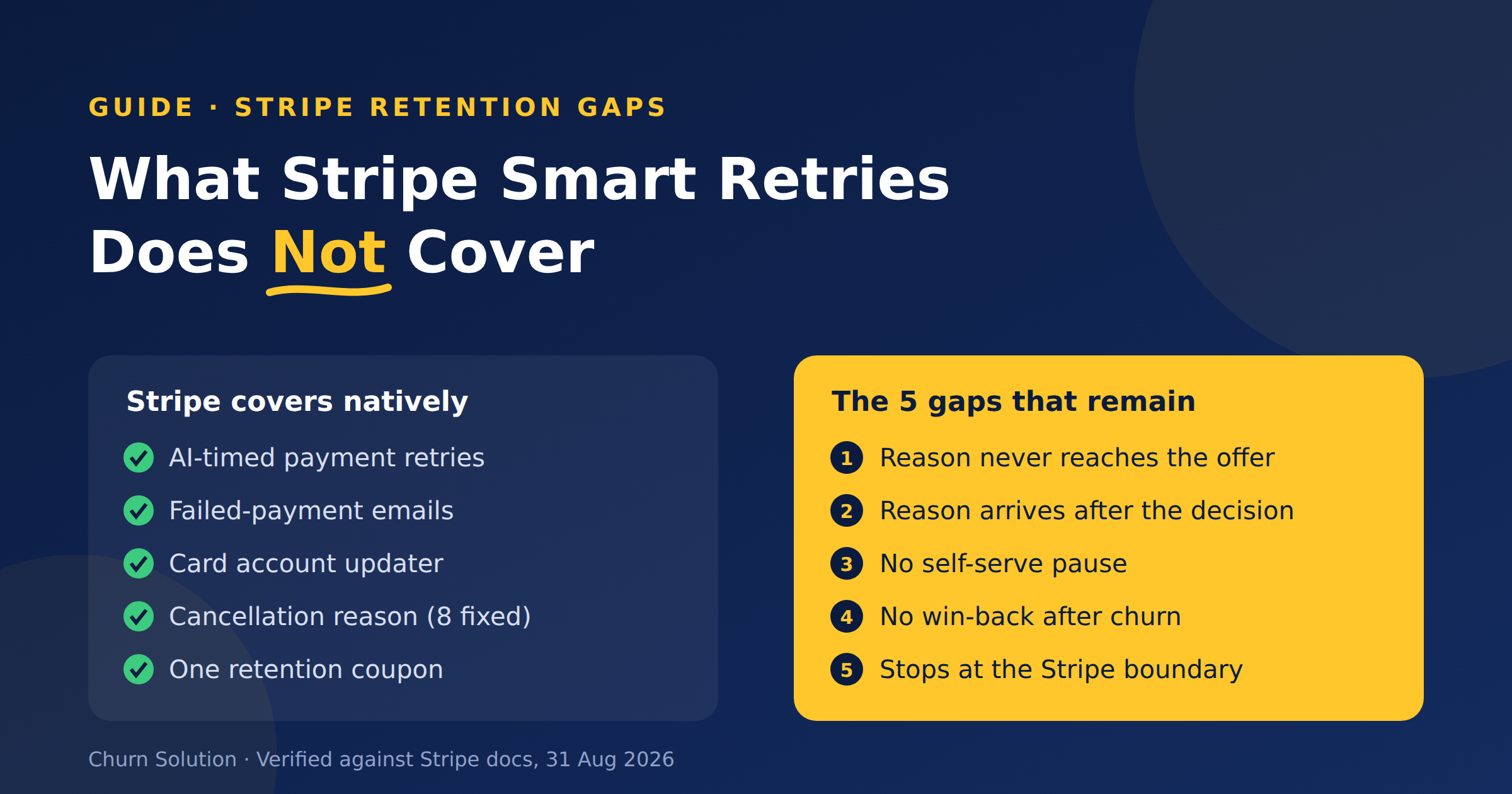
What Stripe Smart Retries Does Not Cover
Stripe Smart Retries recovers failed payments but doesn't run retention. Here are the five gaps that remain, sourced from Stripe's...

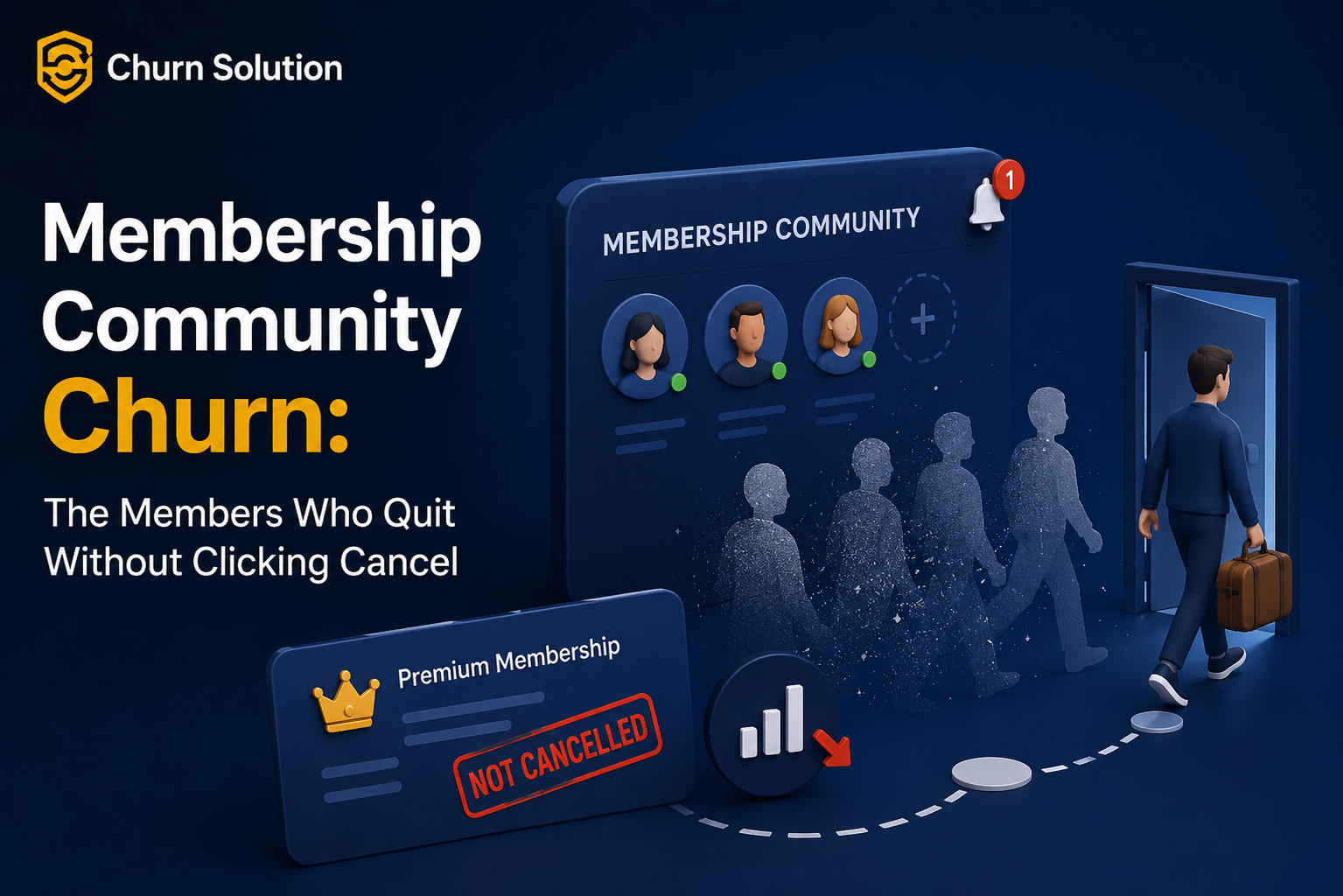
Membership Community Churn: The Members Who Quit Without Clicking Cancel
Quiet churn is the real leak: members who never clicked “cancel” at all. A card expires. A bank declines a...

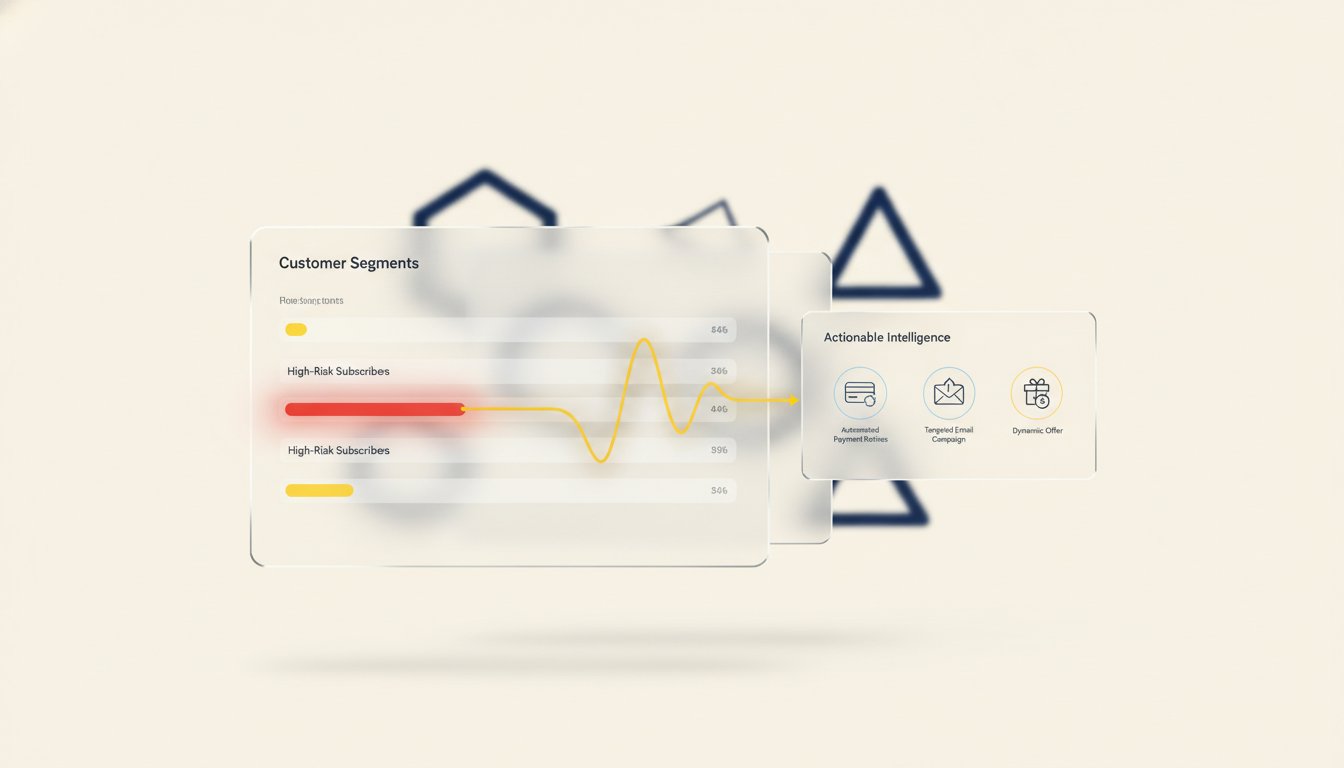
Subscription Churn Dashboard: The 2026 Guide to Actionable Revenue Intelligence
Up to 40% of subscription churn is involuntary, meaning your customers aren't choosing to leave; they're being forced out by...