ARTICLE
Build vs. Buy: The 2026 Guide to Cancellation Flow Infrastructure

A cancel button is a simple feature, but a retention engine is a permanent tax on your engineering roadmap. When you develop internal tools, you aren’t just writing code once; you’re committing your team to an endless cycle of maintenance, compliance updates, and manual data analysis. This guide provides a definitive framework for the build vs buy cancellation flow decision, ensuring you allocate resources toward growth rather than infrastructure maintenance.
You likely recognize the friction of engineering resources being spread thin on core features while churn data remains an unstructured black box. It’s difficult to justify pulling a senior developer off a high-impact project just to test a single retention experiment. This article reveals the hidden engineering costs of homegrown systems and provides a clear ROI comparison for your stakeholders. We will examine how AI-driven insights and automated workflows accelerate your speed-to-market for churn reduction tactics in the 2026 subscription economy.
Key Takeaways
- Identify why a simple “cancel button” isn’t a retention engine and how to avoid the common “weekend project” trap.
- Calculate the hidden engineering debt of billing API maintenance and the “experimentation tax” that stalls your product roadmap.
- Use a five-metric framework to finalize your build vs buy cancellation flow strategy based on opportunity cost and data integrity.
- Evaluate the ROI of speed-to-market versus custom flexibility to ensure your retention system scales with your business needs.
- Deploy dynamic offers and AI-driven feedback analysis to turn unstructured churn data into actionable revenue recovery strategies.
The ‘Weekend Project’ Trap: Why Build vs. Buy is the Wrong Question
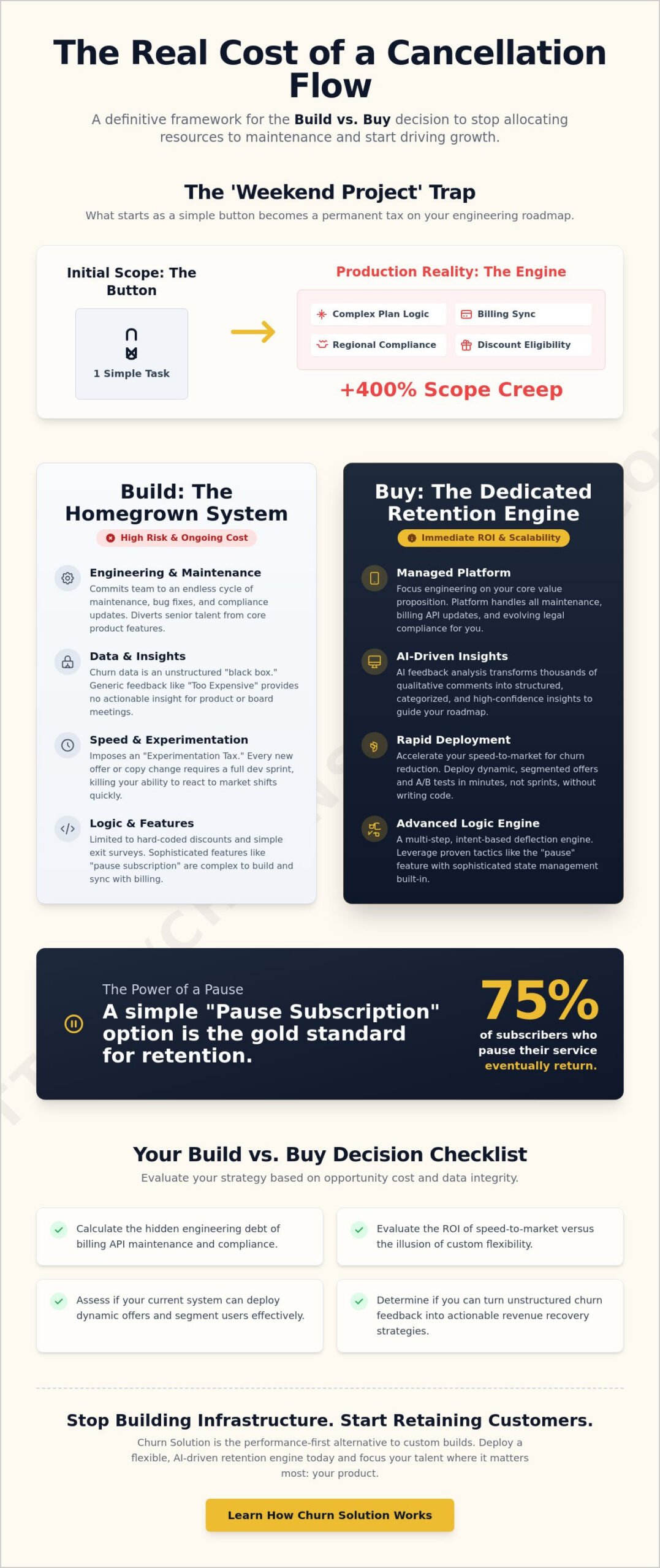
Engineering leaders often view the cancellation process as a simple UI task. They assign a junior developer to build a basic modal over a weekend, assuming the job is done once the “Cancel” button functions. This is the “Weekend Project” trap. By the time the project reaches production, the initial scope has usually ballooned by 400% as stakeholders demand complex logic for different plan types, regional compliance, and discount eligibility. The real conversation isn’t about a button; it’s about the Total Cost of Ownership for a system that must actively defend your recurring revenue.
Most homegrown systems fail because they stop at the surface. If your only churn insight is a generic “Reason: Too Expensive” tag, you’re flying blind. This unstructured feedback creates noise in board meetings and makes it impossible to identify which product gaps are actually driving revenue loss. A strategic build vs buy cancellation flow assessment must account for the value of structured, actionable data. Without it, you aren’t building a retention tool; you’re just building a faster way for customers to leave.
Defining the Modern Cancellation Flow
In 2026, a cancellation flow is a multi-step logic engine. It’s no longer an exit survey; it’s a conversation driven by intent-based deflection. Modern systems identify why a user is leaving and present a specific alternative before they finalize the decision. In high-churn industries, offering a “pause” option has become the gold standard for retention. Data shows that 75% of subscribers who pause their service eventually return. Implementing this requires sophisticated state management and billing synchronization that simple internal forms cannot support.
The True Scope of a Retention Engine
A true retention engine requires deep integration with your billing, CRM, and analytics stacks. It must handle entitlement management and complex prorated refund logic without manual intervention from your support team. To scale these efforts, you need AI Feedback Analysis to transform thousands of qualitative comments into categorized, high-confidence insights. Without this level of automation, your team will spend more time cleaning noisy data than using it to optimize your product and reduce churn.
The Hidden Engineering Debt of Homegrown Retention Systems
Building an internal retention tool creates a recurring liability. When evaluating the build vs buy cancellation flow dilemma, most teams underestimate the maintenance burden. Every time Stripe or Braintree updates their payment APIs, your custom code risks breaking. If a webhook fails, you lose critical churn data or leave a customer in billing limbo. This damages your brand reputation. You aren’t just building a feature; you’re committing to a permanent maintenance cycle that diverts senior talent from your core product roadmap.
Homegrown systems also impose an “Experimentation Tax.” Marketing and Product teams shouldn’t need a dev ticket to test a new offer. In a custom-coded environment, every minor change requires a full sprint cycle. This lag kills your ability to react to market shifts. Research from Harvard Business School on proactive churn prevention highlights that timing and relevance are critical. If your system is too rigid to adapt, it’s already obsolete. You can deploy a flexible retention engine today without draining your engineering resources.
The Maintenance Cycle You Didn’t Plan For
Your engineering team’s focus belongs on your unique value proposition, not on infrastructure that already exists. A custom flow requires constant manual intervention to keep up with:
- Updating logic for new pricing tiers, currency changes, and complex tax laws.
- Fixing synchronization errors between your internal database and the billing provider.
- Maintaining support for legacy plans that were deprecated years ago but still have active users.
Security and compliance add another layer of complexity. With state-level regulations in New York and Massachusetts requiring specific pre-renewal notices as of late 2025, a DIY system must be manually updated to avoid legal risk. Failure to sync this data creates silos where churn insights are trapped in unstructured logs.
The Logic Gap: Dynamic Offers and Segmentation
Hard-coded discounts are a blunt instrument. They often cannibalize revenue from high-LTV users who might have stayed for a simple plan adjustment. Building sophisticated Customer Segmentation into a homegrown tool is an immense technical challenge. Most internal builds lack the infrastructure for A/B testing, meaning you’re guessing what works instead of using data. This lack of precision leads to feedback that is useless for your product team.
Decision Framework: 5 Metrics to Evaluate Build vs. Buy
Deciding between an internal build and a third-party platform requires a cold, data-driven analysis of your business priorities. You must move beyond the “can we build it” mindset to “should we build it” by evaluating five critical performance pillars. The primary pillar is Opportunity Cost. Every hour your senior engineers spend debugging a build vs buy cancellation flow is an hour they aren’t spending on your core product’s unique value proposition. In a competitive SaaS market, sacrificing product velocity for infrastructure maintenance is a high-risk trade-off. Your second metric is Data Integrity. Homegrown systems often produce unstructured, “noisy” feedback that is difficult to analyze. A specialized platform provides structured data that flows directly into your decision-making process.
Time-to-Value and Flexibility are the next essential metrics. A professional retention engine can be deployed in hours; a custom build typically requires months of scoping, development, and QA. Once live, your marketing team needs the flexibility to run AB Experiments without opening a new dev ticket for every minor change. Finally, consider Regulatory Agility. As state-level laws evolve, your system must adapt instantly to remain compliant. If your internal roadmap can’t prioritize these five pillars, you’re building a liability rather than an asset.
Calculating the Total Cost of Ownership (TCO)
Calculate your TCO by factoring in senior developer hourly rates for the initial build phase, which often spans several sprints. Beyond the launch, industry benchmarks suggest estimating 5 to 10 hours of monthly maintenance to manage API updates and synchronization errors. The most significant hidden cost is “Lost Saves.” Every month spent in development is a month where customers churn without any intervention; this results in permanent revenue loss that often exceeds the cost of a premium software subscription.
Retention Intelligence Benchmarks
Evaluate your internal capabilities against modern standards. Does your roadmap support real-time Churn Metrics or automated win-back triggers? For most SaaS companies, the threshold for “buying” occurs when MRR exceeds $50,000. At this scale, the ROI of a specialized tool is undeniable. Even a marginal 1% to 2% increase in your save rate will cover the software costs while freeing your engineering team to focus on high-impact product features.
Implementation and ROI: Speed to Market vs. Custom Flexibility
Speed to market is the primary differentiator between market leaders and laggards. While a homegrown system might feel “good enough” for a basic launch, it rarely offers the optimization required to move the needle on net revenue retention. Choosing an optimized platform allows you to bypass months of development and immediately begin capturing revenue that would otherwise leak out of your funnel. When analyzing the build vs buy cancellation flow equation, consider that a professional system typically achieves a save rate between 15% and 30% within the first 30 days. An internal build, lacking dynamic offers and sophisticated logic, often struggles to reach double digits.
Measuring this impact requires immediate visibility into save rates and offer performance. You aren’t just looking for a button; you’re looking for a mechanism that turns a negative intent into a positive business outcome. By the end of the first month, an optimized purchase provides the granular data necessary to refine your 2026 product roadmap. It identifies precisely why users are leaving. This allows you to address systemic issues rather than guessing at churn drivers. A data-driven strategist prioritizes these actionable insights over the perceived control of a custom build.
Integrating a Third-Party Customer Portal
Maintaining brand consistency is a common concern for engineering teams. Modern retention platforms eliminate this risk through deep white-labeling and CSS customization. You can deploy a Customer Portal that feels like a native part of your application. This ensures a seamless UX for the end user while connecting directly to your existing billing logic. The transition should be zero-friction. You don’t have to sacrifice aesthetic control for technical efficacy. A sophisticated integration preserves your brand identity while leveraging a high-performance backend.
From Data to Action: The ROI of Feedback
The real value of a retention engine lies in the feedback loop. Automated systems categorize exit data to distinguish between ‘Product Churn’ and ‘Price Churn’ without manual intervention. This allows you to trigger targeted Reactivation campaigns that speak directly to the user’s reason for leaving. To maximize these results, consult The Definitive Guide to Automated Cancellation Flows in 2026. Once you have categorized your churn drivers, you can implement high-performance recovery tactics. Start your revenue recovery journey now to stop the leak in your subscription funnel.
Churn Solution: The Performance-First Alternative to Custom Builds
The build vs buy cancellation flow debate concludes where performance begins. While internal teams struggle with API maintenance and static logic, Churn Solution provides a specialized retention engine designed for immediate revenue recovery. Our Dynamic Offers outperform static discounts by adapting to the specific intent of the user. Instead of offering a blanket percentage off, the system identifies the churn driver and presents the exact incentive needed to secure a save. This precision maximizes your profit margins while protecting your customer base. You aren’t just stopping a cancellation; you’re optimizing the entire offboarding experience.
Automation is the core of our infrastructure. We eliminate the manual burden of data cleanup by using AI-driven thematic analysis to categorize every piece of user feedback. This transforms a “black box” of unstructured comments into a clear roadmap for your product team. To ensure comprehensive coverage, we integrate Payment Recovery and dunning email best practices and dunning automation directly into the workflow. This unified approach captures both voluntary and involuntary churn. It allows you to deploy a world-class retention system without a single dev ticket, ensuring your engineering resources remain focused on your core product.
The Power of Smart Retention Infrastructure
Predictive intelligence is the standard for 2026. We leverage AI to identify high-risk segments before the cancellation request is even finalized. Our Smart Retries complement your cancellation flow by recovering failed payments through machine learning. These combined technologies allow Churn Solution to achieve save rates between 15% and 30%, which is a documented improvement over the single-digit performance of most homegrown systems. You gain a sophisticated partner that identifies the leak and provides the precise tool to plug it.
Getting Started with Churn Solution
Efficiency defines our implementation process. You can transition from a legacy system to an optimized flow in approximately 15 minutes, bypassing the typical 15-day development cycle required for basic internal builds. This speed allows you to start recovering revenue immediately. Customize your logic for specific customer segments and refer to Automated Customer Save Flows: The SaaS Playbook for advanced strategies. Stop sacrificing your engineering velocity for infrastructure maintenance and start scaling your retention today.
Master Your Retention Roadmap
The build vs buy cancellation flow decision determines whether your team focuses on high-impact product innovation or perpetual infrastructure maintenance. We’ve established that homegrown systems often become a permanent tax on your engineering velocity. They lack the sophisticated logic required to turn churn data into actionable insights. By choosing a specialized platform, you eliminate the “experimentation tax” and empower your product team to iterate on retention tactics without opening a single dev ticket.
Implementing a dedicated retention engine allows you to recover up to 30% of canceling subscribers through dynamic, intent-based offers. You gain immediate access to AI-powered feedback analysis and a no-code experimentation engine that scales with your business. Stop sacrificing your roadmap for basic offboarding features. You can deploy a world-class system today that transforms unstructured feedback into a strategic growth lever.
Stop building buttons and start saving revenue with Churn Solution. Take back control of your churn metrics and secure your recurring revenue for the long term.
Frequently Asked Questions
Is it cheaper to build a cancellation flow in-house?
Building in-house is rarely cheaper when you factor in the long-term total cost of ownership. While the initial development hours might seem manageable, the ongoing maintenance and missed revenue from lower save rates create a significant financial deficit. A specialized platform pays for itself by capturing revenue that a basic internal tool would lose through lack of optimization and structured data analysis.
How long does it take to build a custom cancellation flow?
Building a custom flow often takes significantly longer than initially estimated, with many teams experiencing a 400% creep in development time. You must account for scoping, UI design, and complex billing API integrations. When you evaluate the build vs buy cancellation flow timeline, a third-party solution allows you to deploy in minutes and start recovering revenue immediately rather than waiting months for a custom launch.
What are the most important features of a retention engine?
The most critical features include dynamic segmentation, intent-based offers, and automated feedback analysis. You need a system that identifies why a customer is leaving and responds with a specific alternative. Without structured data and the ability to run A/B experiments without dev tickets, your retention efforts will remain stagnant and ineffective. Specialized tools provide these advanced capabilities out of the box.
Can third-party cancellation flows integrate with Stripe?
Yes, leading retention platforms offer native, deep integrations with Stripe, Braintree, and Paddle. These integrations ensure that your subscription data remains synchronized in real time. This eliminates the risk of webhook failures or billing errors that often plague a manual build vs buy cancellation flow implementation. You maintain data integrity across your entire tech stack while benefiting from specialized retention logic.
How do dynamic offers reduce churn compared to flat discounts?
Dynamic offers reduce churn by matching the incentive to the customer’s specific reason for leaving, potentially saving 15-30% of customers who would otherwise cancel. A flat discount often cannibalizes revenue from users who might have stayed for a simple plan downgrade. By using intent-based logic, you protect your profit margins while providing the exact solution the customer needs to remain active and satisfied.
Should I offer a pause option or a discount first?
Offering a “pause” option is typically more effective than a discount because it addresses the temporary needs of the user without devaluing your service. Research shows that 75% of subscribers who pause eventually return to active status. You should prioritize this flexibility in your flow. It allows customers to retain their data while stopping billing, which significantly increases the likelihood of a future reactivation.
How do I measure the ROI of buying retention software?
You measure ROI by comparing the increase in your save rate against the monthly subscription cost of the software. Calculate the lifetime value of the customers you’ve recovered and subtract the software fees. Most SaaS companies see a positive return within the first 30 days by capturing just a handful of high-value subscribers who would have otherwise churned without a sophisticated intervention.
Will using a third-party tool hurt my brand experience?
No, modern retention engines provide full white-labeling capabilities to ensure a seamless brand experience. You can customize the CSS, copy, and layout to match your existing application perfectly. This ensures that the user never feels like they’ve left your ecosystem, maintaining trust while providing a superior offboarding journey. You don’t have to sacrifice aesthetic control for high-performance technical efficacy. Beyond voluntary cancellations, it’s equally critical to have a strategy for preventing churn from failed payments, since up to 40% of subscription losses stem from technical payment failures rather than deliberate customer decisions.
- Key Takeaways
- Table of Contents
- The 'Weekend Project' Trap: Why Build vs. Buy is the Wrong Question
- The Hidden Engineering Debt of Homegrown Retention Systems
- Decision Framework: 5 Metrics to Evaluate Build vs. Buy
- Implementation and ROI: Speed to Market vs. Custom Flexibility
- Churn Solution: The Performance-First Alternative to Custom Builds
- Master Your Retention Roadmap
- Frequently Asked Questions

Churn solution that turns your customers right around.
Related Articles
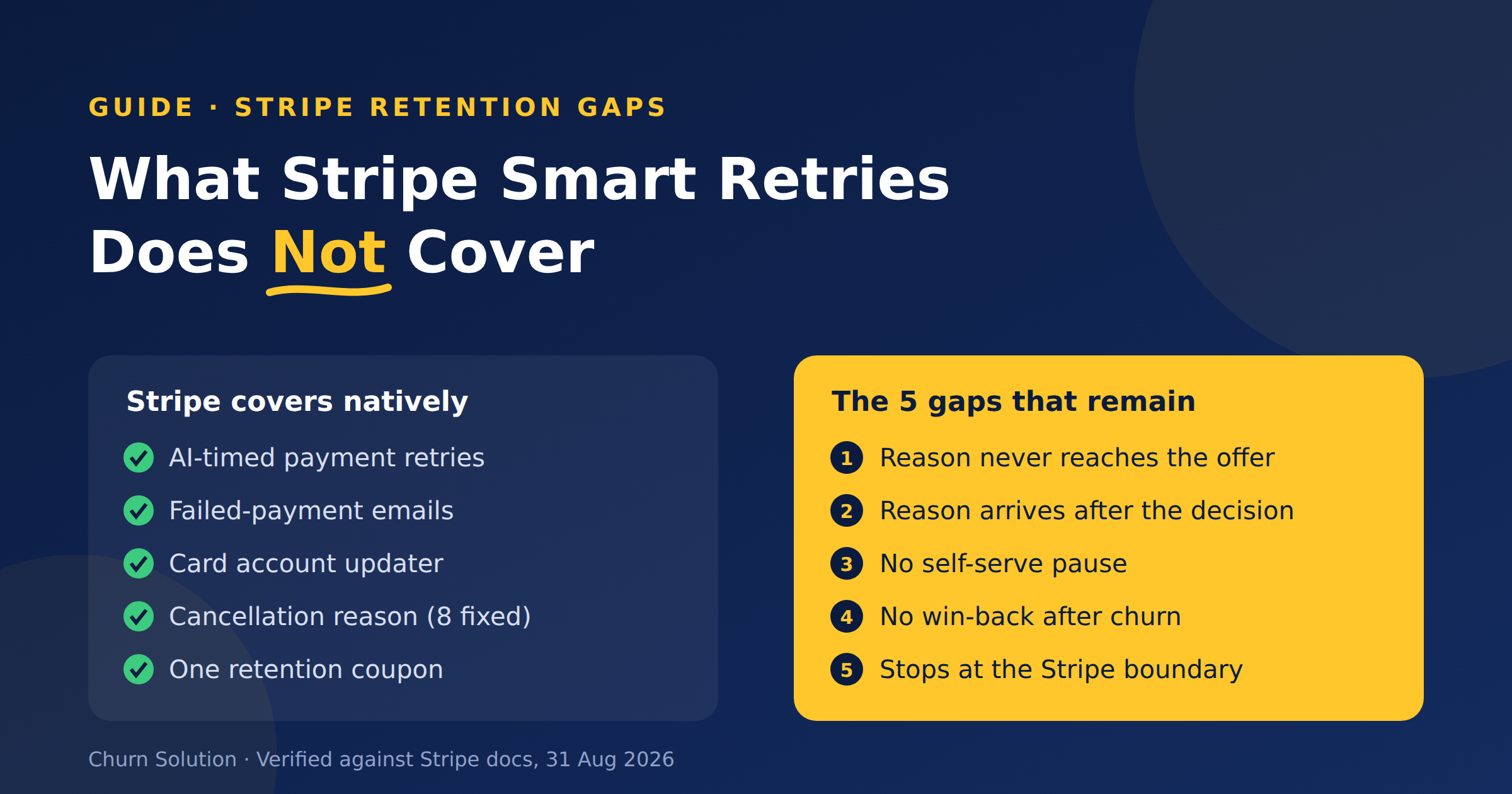
What Stripe Smart Retries Does Not Cover
Stripe Smart Retries recovers failed payments but doesn't run retention. Here are the five gaps that remain, sourced from Stripe's...

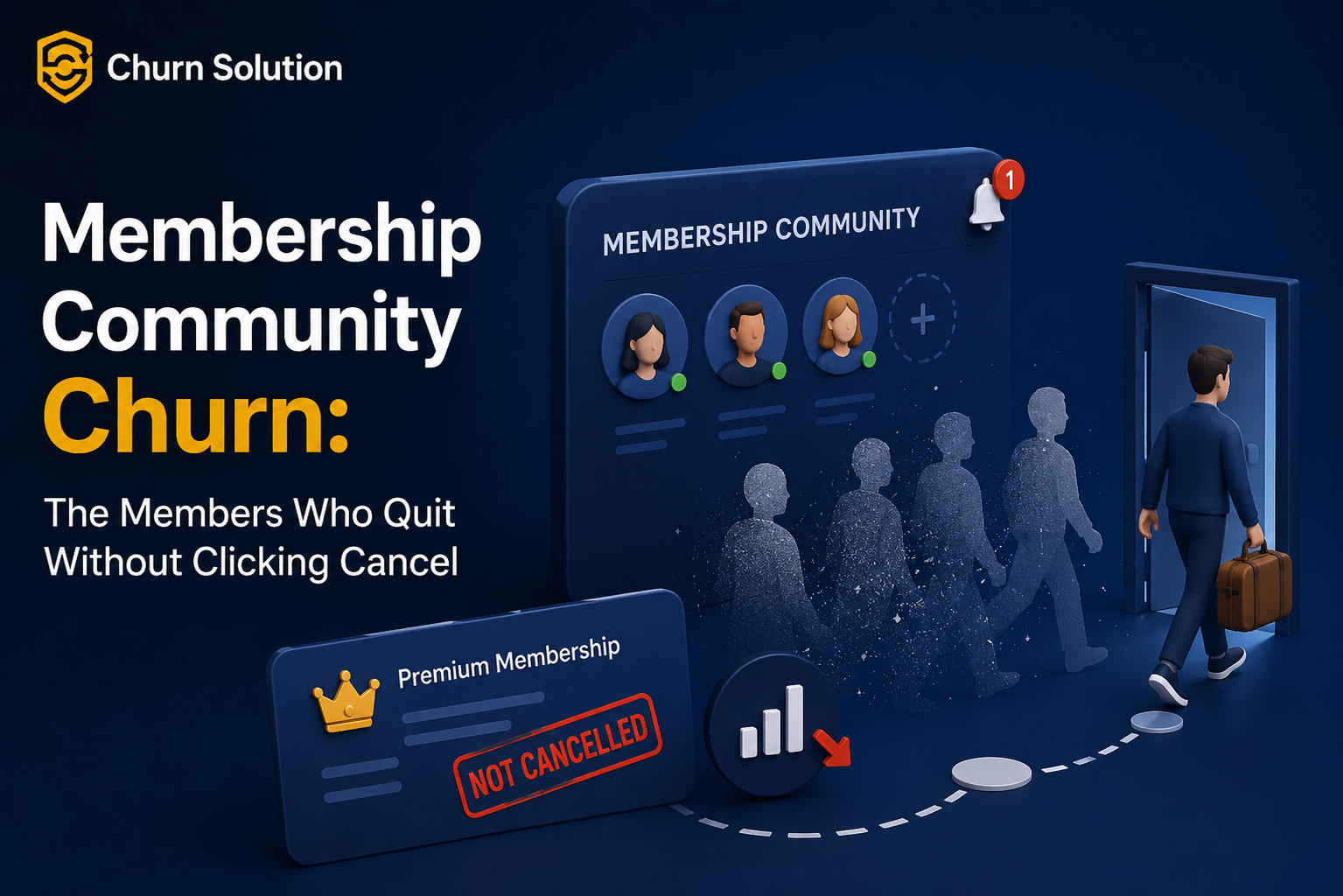
Membership Community Churn: The Members Who Quit Without Clicking Cancel
Quiet churn is the real leak: members who never clicked “cancel” at all. A card expires. A bank declines a...

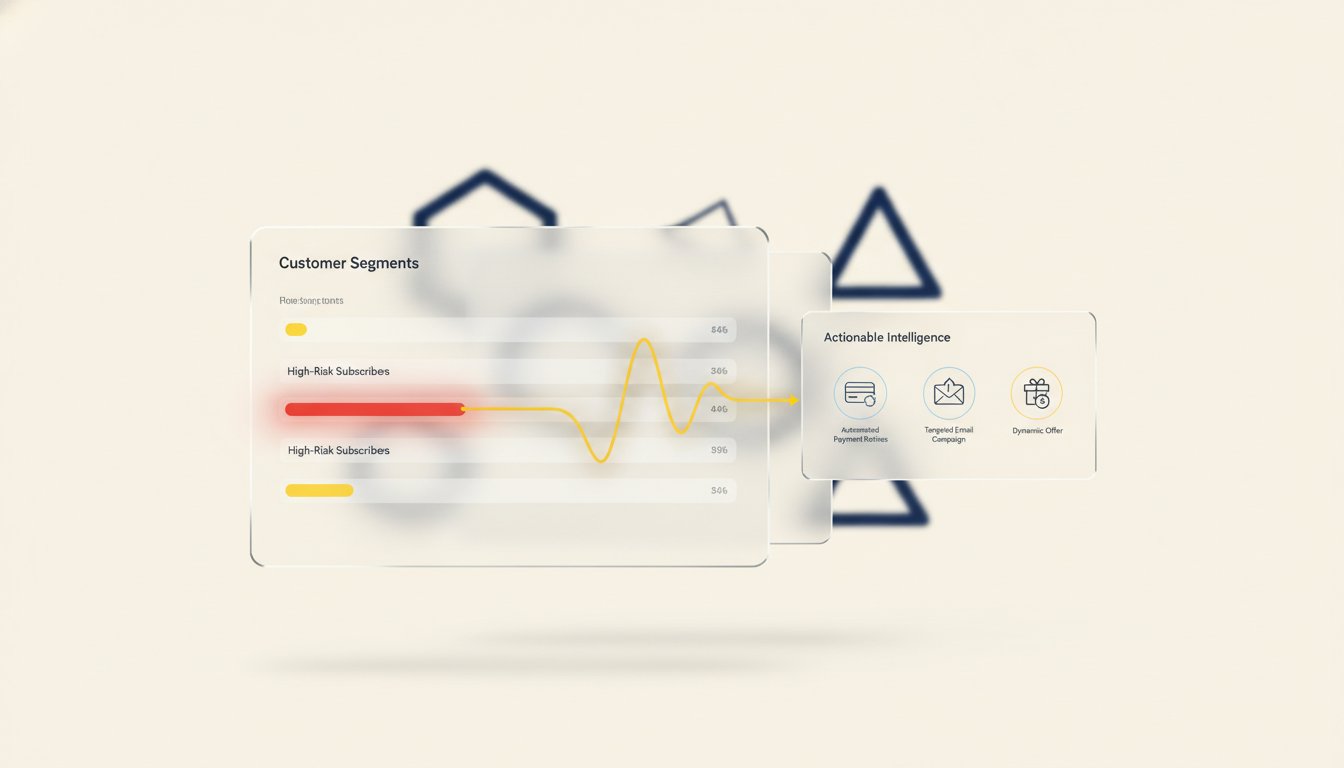
Subscription Churn Dashboard: The 2026 Guide to Actionable Revenue Intelligence
Up to 40% of subscription churn is involuntary, meaning your customers aren't choosing to leave; they're being forced out by...