ARTICLE
11 Best Dunning Tools for SaaS in 2026: Recovering Lost Revenue with AI

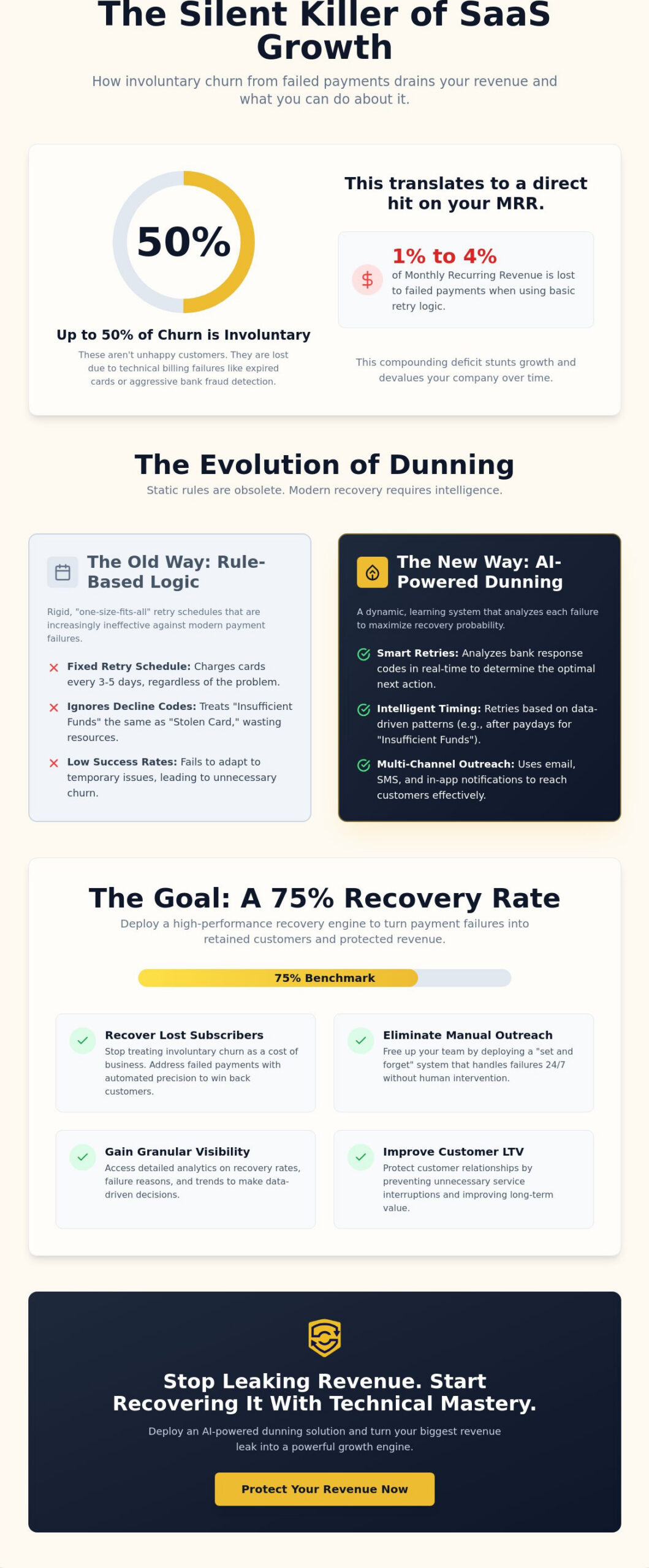
Involuntary churn accounts for up to 50% of total subscription losses, yet many founders treat failed payments as an unavoidable tax on growth. Relying on basic retry logic often leaves 1% to 4% of your monthly recurring revenue on the table every single month. Identifying the best dunning tools for saas is no longer a luxury; it is a strategic necessity to protect your bottom line. Manual outreach is unscalable and creates unnecessary friction, while standard processor retries lack the algorithmic sophistication required to handle complex decline codes in 2026.
You deserve a system that operates with technical mastery, turning payment failures into recovery opportunities without manual intervention. This article examines eleven high-performance platforms designed to stop involuntary churn and recover lost revenue automatically through AI. You will learn how intelligent timing and multi-channel sequences can push your recovery rates toward the 75% benchmark. We will analyze the top-rated dunning solutions to help you deploy a set and forget recovery engine that provides detailed analytics and improves long-term customer value.
Key Takeaways
- Stop treating involuntary churn as a fixed cost and recover up to 50% of lost subscribers by addressing failed payments with automated precision.
- Identify the best dunning tools for saas that utilize AI-driven smart retries to analyze decline codes and optimize recovery timing in real-time.
- Evaluate critical selection criteria like bi-directional billing synchronization and portal accessibility to ensure your recovery system scales without friction.
- Integrate cancellation flows with your dunning strategy to capture feedback and prevent “silent” churn during the payment recovery process.
- Deploy a high-performance recovery engine to eliminate manual outreach while gaining granular visibility into recovered revenue and customer lifetime value.
What is Dunning Management and Why Does SaaS Need It in 2026?
Dunning management is the strategic, automated intervention required to recover failed subscription payments and secure enterprise revenue. In its modern form, the Dunning (process) utilizes sophisticated retry logic and multi-channel communication to resolve billing errors without human interference. For a scaling SaaS, this is no longer a back-office function. It’s a high-performance growth lever. When a payment fails, your system must act instantly to diagnose the cause and implement a remedy before the customer even notices a disruption.
Failed payments represent an invisible leak in the subscription economy. Industry data suggests that involuntary churn accounts for up to 50% of total churn for most software companies. These aren’t customers who decided your product lacked value; they’re users who were ejected from your ecosystem because of a technical failure. In 2026, this problem has intensified. Global banks now deploy aggressive fraud detection algorithms that trigger a surge in legitimate transaction declines. Without the best dunning tools for saas, your business remains vulnerable to these strict banking protocols that prioritize security over your recurring revenue.
Involuntary vs. Voluntary Churn: The Revenue Gap
Distinguishing between churn types is critical for accurate financial modeling. Voluntary churn occurs when a user actively cancels their subscription. Involuntary churn is passive. It happens when a credit card expires, a limit is reached, or a bank triggers a false fraud alert. Unrecovered failed payments are the most expensive type of churn because they represent lost revenue from customers who still intend to use your service. Dunning specifically targets this passive churn segment to ensure technical friction doesn’t dictate your retention rates.
The ROI of Specialized Dunning Software
The financial argument for dedicated recovery systems is undeniable. Losing 2% of your monthly recurring revenue to simple billing errors creates a compounding deficit that stunts long-term growth. Implementing specialized software transforms this loss into recovered capital. These tools protect customer relationships by preventing the service interruptions that occur when a subscription is unnecessarily terminated. Today, subscription revenue protection has evolved into a board-level metric that directly influences company valuation. Deploying the best dunning tools for saas ensures that your recovery efforts are data-driven rather than reactive, providing the technical mastery needed to scale in a complex payment environment.
The Evolution of Recovery: AI-Driven vs. Rule-Based Dunning
Legacy dunning systems operate on rigid, rule-based logic that is increasingly ineffective in the 2026 payment environment. These “Standard Retries” typically follow a linear schedule, attempting to charge a card every three to five days regardless of the specific decline code received from the bank. This blunt approach ignores the technical reality of payment failures. Retrying a “stolen card” decline is a waste of resources, while retrying an “insufficient funds” decline at 3:00 AM on a Tuesday is statistically unlikely to succeed. The best dunning tools for saas have abandoned these static cycles in favor of dynamic, responsive systems.
The modern standard is defined by Smart Retries. These systems analyze bank response codes in real-time to determine the immediate next step. If a bank returns a temporary soft decline, the system might retry within hours. If the code suggests a more systemic issue, the tool triggers a multi-channel outreach sequence. As highlighted in the Forbes analysis on Transforming Failed Payments Into Revenue, the transition to machine-learning models allows businesses to capture revenue that traditional systems simply abandon. This evolution extends beyond email, incorporating SMS and in-app notifications to reach customers where they are most active. By leveraging AI Feedback Analysis, companies can finally understand the root causes of failure and adjust their recovery logic accordingly.
How AI Optimizes Retry Timing
Machine learning identifies the exact moment a transaction is most likely to clear. Instead of arbitrary intervals, AI analyzes historical data to implement “Payday” logic, aligning retry attempts with regional wealth cycles and typical payroll dates. It accounts for time-zone optimization, ensuring that charges and notifications hit the bank and the customer’s device during peak liquidity windows. Rules are static; AI is fluid. This intelligence ensures that you don’t exhaust your retry limit on low-probability windows, preserving your ability to collect when funds are actually available.
Dynamic Dunning Sequences
Effective recovery requires messaging that reflects the customer’s value and the failure’s severity. An enterprise client experiencing a “soft decline” should receive a different sequence than a prosumer with a “hard decline” due to an expired card. You should utilize Mastering Dunning Email Automation to build these sophisticated paths. High-performance tools segment these audiences automatically, ensuring the tone remains professional while the urgency escalates logically. If you’re ready to modernize your recovery stack, you can start building your automated sequence today.
The 5 Best Dunning Tools for SaaS: 2026 Comparison
Selecting the right architecture for revenue recovery determines whether you merely slow churn or actively reverse it. While many platforms claim to offer recovery, the best dunning tools for saas differentiate themselves through algorithmic depth and integration quality. The value of automated dunning is maximized when the tool fits your specific billing stack and customer volume. In 2026, the market has consolidated into a few high-performance leaders.
- Churn Solution: This platform is the most comprehensive choice for teams that want to solve churn holistically. It merges sophisticated payment recovery with automated cancellation flows, ensuring you capture revenue at every possible exit point.
- Paddle Retain: For those utilizing Paddle as their Merchant of Record, this tool is the logical extension. It leverages massive cross-network data to optimize retry success rates without requiring third-party integrations.
- Chargebee Retention: Built specifically for enterprise-level subscription management, it provides the complex logic needed for multi-currency, multi-entity organizations.
- Churn Buster: This remains a reliable mid-market staple for businesses running on Stripe. It focuses on high-deliverability email sequences and SMS outreach to bridge the gap between bank declines and successful charges.
- Baremetrics Recover: A streamlined option for smaller teams. It integrates recovery directly into your financial dashboard, making it easy to see the direct impact of dunning on your MRR.
Feature Comparison Matrix
Your audit should prioritize technical capability over simple interface design. A high-performance recovery stack must include AI-driven retries that analyze bank response codes in real-time. While “Stripe-native” dunning offers basic functionality, it lacks the multi-channel depth of specialized tools. You should look for platforms that integrate in-app notices and exit surveys directly into the recovery window. This allows you to differentiate between a customer with a technical payment issue and one who is using a failed card as a “silent” way to cancel their service.
Which Tool Fits Your Growth Stage?
Early-stage startups typically rely on default processor retries to conserve resources. However, as you scale toward the mid-market, the limitations of these basic rules become a liability. Success at scale requires customer segmentation, where enterprise accounts receive high-touch recovery paths while prosumers follow automated AI sequences. This necessity is why the Stripe Recovery vs. Churn Solution debate is so common for growing companies. Moving to a dedicated tool isn’t just about sending emails; it’s about deploying a sophisticated revenue protection engine that secures your long-term valuation.
Critical Selection Criteria: How to Audit Your Recovery Stack
Auditing your recovery stack requires a focus on technical interoperability. The best dunning tools for saas must sync bi-directionally with your billing engine, whether you use Stripe, Recurly, or Braintree. This ensures that when a payment is recovered, your subscription engine updates instantly to restore service. Without this real-time communication, you risk false positives where a customer pays but remains locked out of your application. You must also prioritize customization. If you can’t white-label the entire recovery experience, you risk losing customer trust at the most sensitive stage of the relationship.
Security is non-negotiable. Ensure any platform you evaluate maintains SOC2 compliance and follows rigorous standards for handling sensitive payment data. Beyond the technical basics, your audit should focus on the user’s path to resolution. If the recovery process feels like an obstacle, your customers will treat it as one. High-performance tools remove these hurdles, allowing the recovery engine to operate as a silent, efficient protector of your monthly recurring revenue.
The Importance of the Customer Portal
A friction-less customer portal is a primary driver of successful recovery. Modern systems utilize magic links that allow users to update their credit card details without the friction of a full password login. This approach increases recovery rates by removing the psychological and technical barriers to payment. It also reduces the load on your customer support team, as users can resolve billing issues independently. If a user has to navigate a complex login process just to pay you, they’re more likely to abandon the subscription entirely.
Reporting and Churn Metrics
You need granular visibility into your recovery performance. Effective reporting must distinguish between Gross Recovered and Net Recovered revenue to account for processing fees and subsequent failures. You should track specific churn metrics like Recovery Rate, Days to Recover, and Saved LTV to understand the long-term health of your customer base. It’s vital to separate involuntary data from voluntary cancellations to identify where the leak actually exists. Recovery Rate is a vanity metric without Cohort Retention data; it doesn’t tell you if those recovered customers remain active three months later. You can start auditing your recovery metrics today to identify exactly where your revenue is slipping through the cracks.
Beyond Failed Payments: Integrating Churn Solution for Total Retention
Dunning management is only half the battle. While recovering a failed payment secures immediate revenue, it doesn’t guarantee long-term loyalty. Many users utilize a failed credit card as a friction-less, “silent” method of cancellation. If your recovery strategy stops at the transaction level, you’re missing the psychological context of why the payment failed in the first place. When evaluating the best dunning tools for saas, you must prioritize platforms that bridge the gap between involuntary failure and voluntary intent. Integrating sophisticated cancellation flows into your dunning sequence allows you to capture this intent before the customer slips away.
You should deploy exit surveys at the exact moment a user attempts to update or remove their payment method. This data identifies whether a decline was a simple bank error or a calculated decision to churn. If the feedback suggests the user is unhappy with the price or a specific feature, you can trigger dynamic offers immediately after they update their billing info. This proactive approach transforms a technical recovery into a strategic win-back opportunity, ensuring the user doesn’t just pay their bill but remains a committed subscriber. Churn Solution operates as a unified platform that manages both the algorithmic retry logic and the active retention sequences required to protect your NRR.
Automating the Win-Back Process
Recovery is the start of a new lifecycle phase. Once a payment is secured, you must transition the user into targeted subscription win-back campaigns to reinforce the product’s value. You can use specific reactivation triggers for customers who previously churned due to unrecovered payment failures. By leveraging AI feedback analysis, your system learns which incentives work best for specific segments, allowing you to refine your future retention strategy with mathematical precision. This feedback loop ensures your dunning emails aren’t just annoying reminders but are part of a sophisticated customer success engine.
Getting Started with Churn Solution
The transition from a leaky bucket to a resilient revenue engine requires a shift toward automation. You can deploy Churn Solution to protect your revenue today and stop the 5% to 10% MRR bleed caused by involuntary churn. Don’t settle for static sequences; instead, run A/B experiments on your dunning copy and retry timing to find the optimal recovery path for your unique audience. The result is a more stable business with higher Net Revenue Retention and a lower overall churn rate. Protecting your bottom line isn’t about sending more emails. It’s about deploying a smarter, integrated system that treats every payment failure as a chance to prove your product’s value.
Secure Your Revenue Infrastructure for 2026
Protecting your MRR requires more than passive observation; it demands a technical infrastructure that anticipates payment failures and resolves them before they impact your churn metrics. You’ve seen how involuntary churn accounts for half of your losses, yet these technical leaks are entirely preventable with the right automation. Identifying the best dunning tools for saas is the definitive move toward reclaiming revenue that belongs to your business. It’s about moving from a reactive stance to a position of total control over your billing health.
Churn Solution provides the technological mastery needed to stop the bleed. Our AI-driven Smart Retries are optimized for 2026 bank logic, enabling you to recover up to 70% of failed payments automatically. Whether you use Stripe, Chargebee, or Recurly, our seamless integration ensures your recovery engine is operational in minutes. Don’t let technical friction dictate your growth trajectory any longer. You have the tools to plug the leak and ensure every legitimate transaction clears successfully. It’s time to prioritize your bottom line and build a more resilient subscription model.
Start Recovering Your Lost MRR with Churn Solution
Frequently Asked Questions
What is the average recovery rate for SaaS dunning software?
Dedicated dunning software typically achieves recovery rates between 55% and 75% of failed payments. This performance significantly exceeds the capabilities of standard processor retries, which generally recover only 30% to 40% of transactions. High-performance tools reach these benchmarks by utilizing intelligent retry timing and multi-channel outreach rather than relying on a single, static email sequence.
How many dunning emails should I send before cancelling a subscription?
Most high-growth SaaS companies send between three and five dunning emails over a 21 to 30-day period. This timeframe provides a sufficient window for the customer to resolve bank issues or update card details without feeling harassed. The best dunning tools for saas automate this frequency based on the specific decline code, ensuring you don’t over-communicate for temporary technical glitches.
Can I use dunning software with Stripe or do I need a separate billing engine?
You can use specialized dunning software as a sophisticated overlay on your existing Stripe account; you don’t need to replace your billing engine. These tools sync via API to manage the communication and retry logic while Stripe continues to handle the core transaction processing. This modular approach allows you to deploy advanced recovery features without the friction of migrating your entire billing database.
What is the difference between dunning and debt collection?
Dunning is a proactive, automated process used to resolve failed payments and maintain the active subscription relationship. Debt collection is a reactive, often manual process used to recover funds from accounts that have already been terminated or written off. Dunning focuses on retention and service continuity, whereas debt collection is primarily concerned with recouping past-due capital from former users.
How does AI improve payment recovery compared to standard retries?
AI improves recovery by analyzing decline codes and historical data to determine the optimal moment for a retry attempt. Standard retries follow a fixed schedule, such as every three days, which often misses the window of highest liquidity. AI-driven systems adapt in real-time, increasing the probability of a successful charge by aligning with customer behavior and regional banking cycles.
Will dunning emails hurt my customer satisfaction (CSAT) scores?
Professional dunning sequences actually protect customer satisfaction by preventing unannounced service interruptions. When you white-label your outreach and provide a friction-less update portal, customers perceive the communication as a helpful service reminder rather than a nuisance. High-performance tools ensure the tone remains supportive, which preserves the relationship while securing the necessary payment updates.
What is a “soft decline” vs a “hard decline” in credit card processing?
A soft decline occurs when a bank rejects a transaction due to temporary issues like insufficient funds or a network timeout. These are recoverable through intelligent retries. A hard decline is a permanent failure caused by a stolen card, a closed account, or an invalid number. Hard declines require immediate customer intervention and cannot be resolved through automated retries alone.
Does dunning software help with involuntary churn for mobile apps?
Specialized dunning software is effective for mobile apps that manage subscriptions through web-based billing portals or hybrid payment stacks. While Apple and Google handle their own in-app dunning, third-party tools are essential for the best dunning tools for saas that offer cross-platform subscriptions. These systems ensure that payment updates on the web reflect across all mobile devices, maintaining consistent access for the user.
- Key Takeaways
- Table of Contents
- What is Dunning Management and Why Does SaaS Need It in 2026?
- The Evolution of Recovery: AI-Driven vs. Rule-Based Dunning
- The 5 Best Dunning Tools for SaaS: 2026 Comparison
- Critical Selection Criteria: How to Audit Your Recovery Stack
- Beyond Failed Payments: Integrating Churn Solution for Total Retention
- Secure Your Revenue Infrastructure for 2026
- Frequently Asked Questions

Churn solution that turns your customers right around.
Related Articles
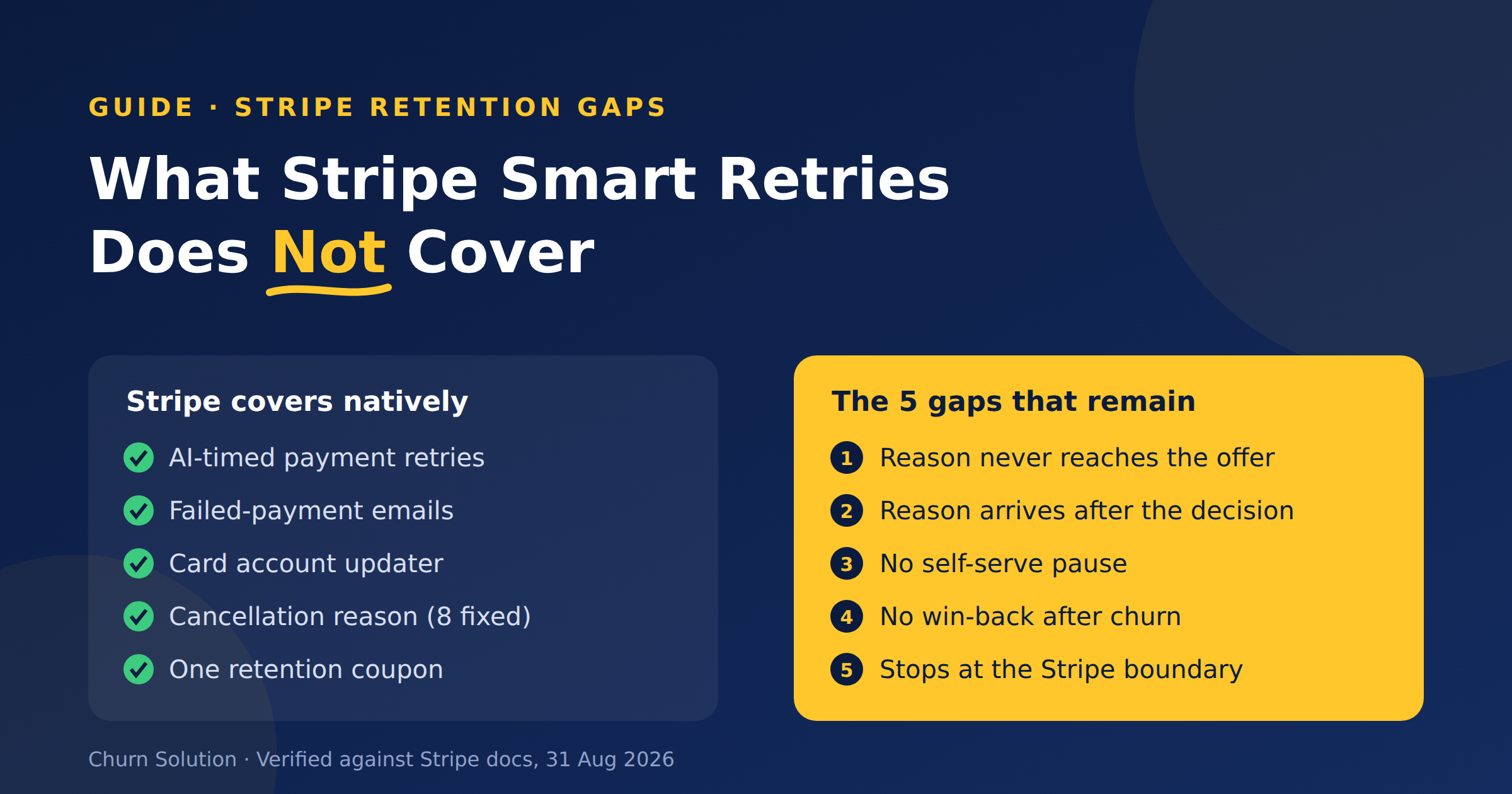
What Stripe Smart Retries Does Not Cover
Stripe Smart Retries recovers failed payments but doesn't run retention. Here are the five gaps that remain, sourced from Stripe's...


Membership Community Churn: The Members Who Quit Without Clicking Cancel
Quiet churn is the real leak: members who never clicked “cancel” at all. A card expires. A bank declines a...


Subscription Churn Dashboard: The 2026 Guide to Actionable Revenue Intelligence
Up to 40% of subscription churn is involuntary, meaning your customers aren't choosing to leave; they're being forced out by...