ARTICLE
Customer Retention Costs: Founder’s ROI Guide
You already feel this pressure if you run a SaaS or subscription business. Revenue is coming in, churn is eating part of it every month, and every retention idea looks like another cost center. A discount costs margin. A retention hire adds payroll. Payment recovery software adds another vendor bill. Win-back campaigns take time from growth and lifecycle teams.
That framing is where businesses often err.
Customer retention costs shouldn't be managed like overhead you squeeze to zero. They should be managed like capital allocation. You are deciding where to spend money to protect recurring revenue, extend lifetime value, and avoid the much heavier burden of replacing lost customers. That matters because acquiring a new customer costs 5 to 25 times more than retaining an existing one, and increasing retention by 5% can raise profits by 25% to 95%, according to this retention economics summary.
Founders and finance leaders don't need another article telling them to "delight customers." They need a tighter way to count retention spend, judge whether it's paying back, and decide which interventions deserve more budget.
Table of Contents
What Actually Goes Into Customer Retention Costs?
Many teams undercount customer retention costs because they only include the obvious line items. They count save discounts and maybe the salary of a retention manager, then call it done. That misses the full cost structure.
If you're serious about profit, CRC is the total cost to keep paying customers engaged, recovered, renewed, or reactivated. It includes visible incentives and the quieter operating expenses that make retention work in the first place.
CRC is bigger than discounts
A founder often asks, "What did we spend to stop churn?" The better question is, "What did the company spend to keep revenue from walking out the door?"
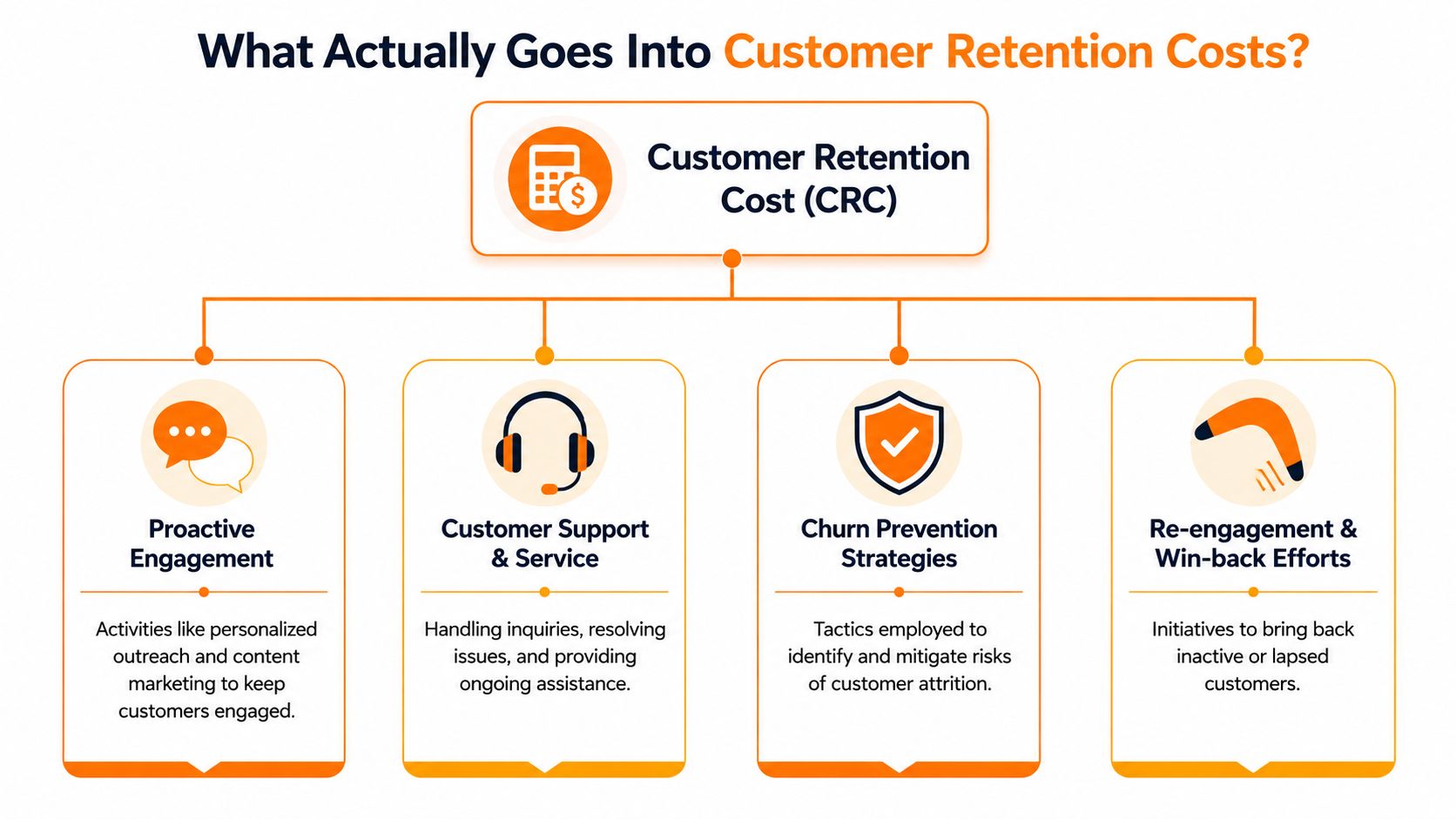
That number usually spans four buckets.
Proactive engagement costs include lifecycle emails, in-app messaging, onboarding check-ins, educational webinars, and customer marketing programs designed to keep usage high.
Support and service costs include the share of support time spent on cancellation objections, billing issues, account rescue, and escalation handling.
Churn prevention costs include cancellation-flow tooling, save offers, dunning systems, payment update prompts, and retention analytics.
Re-engagement costs include win-back campaigns, reactivation discounts, outbound follow-up, and audience segmentation work for canceled users.
Practical rule: If a cost exists because you're trying to keep a customer paying, it's a retention cost even if accounting stores it in another bucket.
There's also a strategic reason to count broadly. Retention is often more profitable than replacing churned users through acquisition. If you want a useful comparison point for spend efficiency, this SaaS acquisition cost guide helps frame what you're avoiding when retention works.
A practical CRC cost checklist
Finance teams usually get the cleanest CRC when they build it from existing systems instead of inventing a new dashboard. Pull from payroll, support tooling, marketing software, billing systems, and incentive spend.
A clean checklist looks like this:
| Cost category | What to include |
|---|---|
| Retention labor | Retention specialists, lifecycle marketers, renewal managers, and the retention share of CSM time |
| Support allocation | Save tickets, billing problem resolution, cancellation chats, refund-prevention work |
| Incentives | Discounts, credits, pauses with operational cost, loyalty rewards, downgrade processing |
| Software and ops | Dunning tools, cancellation-flow tools, email automation, analytics, CRM workflows |
| Product allocation | Engineering or product work tied directly to retention features or billing recovery |
| Reactivation | Win-back emails, outbound campaigns, re-subscribe offers, churn cohort analysis |
A common mistake is excluding engineering time because it feels like "product," not retention. If your team built a failed-payment update flow, a subscription pause option, or a cancellation reason workflow, part of that cost belongs in CRC. Not forever. But during the build window, it absolutely affects the economics.
The hidden retention budget usually sits in support, success, and engineering. Ignoring those costs doesn't make retention cheaper. It just makes your model inaccurate.
How to Calculate CRC With a Real SaaS Example
A useful CRC model has to survive contact with your P&L. If the formula only works in a slide deck, it won't help a CFO decide whether to add budget or cut it.
The core formula
The base formula is simple:
CRC = Total retention costs / Retained customers
That unit-economics framing is the right one. This guide to customer retention cost describes CRC as total retention spending divided by retained customers, which is how most operators should think about it.
What matters is discipline around the inputs.
Pick a time window. Monthly is fine for fast-moving subscription businesses. Quarterly is often better because it smooths campaign and staffing noise.
Total every retention cost in that window. Use the checklist from the section above.
Define retained customers clearly. In practice, that means customers who were at risk of leaving or up for renewal during the period and remained active at the end, or your broader active base that stayed through the window, depending on how you run reporting.
Keep the definition consistent. A slightly imperfect definition used every month beats a perfect one that changes every quarter.
A realistic SaaS example without fake precision
Take a fictional subscription company with roughly $100k MRR. The exact customer count doesn't matter here. The process does.
For one quarter, the team pulls these retention-related costs from its systems:
Retention payroll allocation from one specialist and part of a customer success manager's time
Support allocation for billing rescue, cancellation chat handling, and save-ticket work
Save offers such as discounts, credits, and selected downgrade concessions
Lifecycle tooling for win-back emails and in-app retention messaging
Payment recovery tooling tied to failed-payment follow-up
A small product allocation for a cancellation-flow update and billing UX improvement
They total those costs for the quarter. Then they count how many relevant customers stayed active under the company's reporting definition. Divide the first number by the second and you have CRC per retained customer.
If you want to pressure-test whether that spend makes sense, compare the result against customer value. A practical place to start is with customer lifetime value calculation methods for subscription businesses.
Here's the part most dashboards miss. CRC is not just a reporting metric. It's a decision metric.
If your retained customers come mostly from expensive discounts, your CRC may be high even if saves look strong. If the same retained customers come from payment recovery, pause offers, and targeted win-back automation, your CRC may be lower while margin stays healthier.
Don't ask whether your retention team "saved accounts." Ask which spend category saved the most gross margin per dollar invested.
That's why I prefer a second cut after the basic CRC number:
CRC by intervention type
CRC by segment
CRC by billing failure vs voluntary cancellation
CRC by plan tier
A blended CRC tells you the total cost of retention. Those cuts tell you where to put the next dollar.
Is Your CRC Too High? Benchmarks and KPIs to Watch
Your head of finance sees CRC rising 18% quarter over quarter. Your retention lead says saves are up. Both can be right.
CRC only becomes useful when you judge it against the value and margin those saves protect. In SaaS, the goal is not to force retention cost down at all times. The goal is to spend in places where automation, billing recovery, and cancellation intervention preserve more profit than they cost.
Judge CRC against LTV, margin, and churn pressure
Start with CRC as a share of LTV. That gives founders and finance teams a fast way to ask a hard question. Are we protecting valuable recurring revenue efficiently, or are we overspending to hold onto weak accounts?
A useful rule is simple. The higher the customer value, gross margin, and expected remaining tenure, the more retention spend you can justify. The lower those numbers are, the more disciplined you need to be.
That means the same CRC can be healthy in one company and reckless in another.
| Scenario | What it usually means |
|---|---|
| Low CRC, low retention | Underinvestment, weak targeting, or retention problems being ignored until churn shows up in the P&L |
| High CRC, high LTV | Often acceptable if the spend protects strong gross margin and long-tenure accounts |
| High CRC, weak LTV | Risky. You're spending heavily to keep revenue with limited payback |
| Moderate CRC, strong margin preservation | Usually the healthiest pattern for subscription businesses |
Churn context matters too. A company with high churn may need to spend more in the short term while it fixes billing failure, onboarding gaps, or cancellation friction. Benchmarks for what operators consider a good SaaS churn rate help you judge whether CRC is compensating for a temporary problem or covering up a structural one.
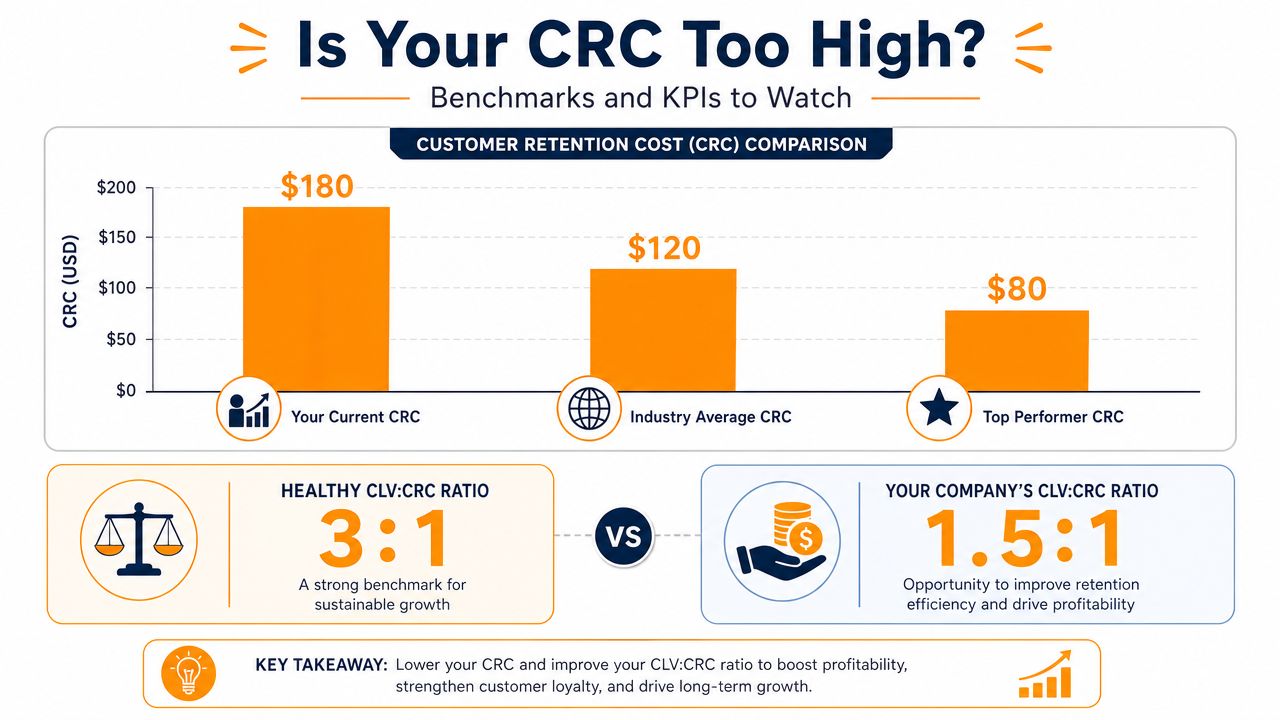
A quick visual can help align the team on what "too high" looks like in practice.
KPIs finance should review every month
CRC is one line item. The operating picture needs a tighter set of companion metrics.
LTV to CRC ratio shows whether retention spend is reasonable relative to customer value.
Gross margin preserved per retained customer shows whether saves are profitable after incentives, support time, and tooling costs.
Recovery rate by churn type separates involuntary churn, where automation often scales well, from voluntary churn, where save rates can come with heavier concession costs.
Discount-driven saves as a share of total saves reveals whether the team is protecting logos or protecting margin.
Retention cost by segment or plan tier shows where added spend produces the best financial return.
I also look for one pattern that gets missed in board reporting. If CRC is rising because you invested in automated dunning, smarter cancellation flows, or billing UX that scales without adding headcount, that is often a good trade. If CRC is rising because account managers are manually rescuing low-value customers one by one, that is usually a warning sign.
A healthy retention program keeps profitable customers in the base at a cost that leaves meaningful gross margin after intervention expense.
If your CRC looks high, do not cut retention budget on instinct. Identify what is driving the increase. More labor, poor targeting, excessive credits, and weak payment recovery do not deserve the same response. Some costs should be reduced. Some should be reallocated. Some are worth increasing because they produce better revenue retention with better margins.
How to Prove the ROI of Your Retention Program
Most retention debates get stuck because the team talks about churn in percentages while the CFO thinks in payback. You fix that by evaluating each retention motion like an investment.
The practical formula is straightforward:
ROI = (Financial gain from retention investment – Cost of retention investment) / Cost of retention investment
Measure retained gross margin, not vanity saves
A saved customer isn't automatically a profitable save. If you rescue an account with a steep concession, extra support time, and repeated billing trouble, the headline save can look better than the economics underneath it.
I prefer three filters before calling any retention activity successful:
Was the customer likely to churn without the intervention? If not, you may be crediting the tactic for a save that would've happened anyway.
What revenue remained after the incentive cost? Discounts and credits reduce real gain.
What servicing cost came with the save? A labor-heavy rescue can erase the benefit fast.
That means your retention dashboard should tie each save path to expected remaining value, support burden, and offer cost. If you don't have exact attribution yet, start directional and tighten it over time.
A simple ROI model for one retention motion
Take a cancellation-flow offer as an example. A user reaches the cancel page, selects price as the reason, and receives a targeted save option. You then compare two scenarios: customer churns now, or customer accepts the save path and remains active long enough to generate additional contribution.
To judge the investment:
Estimate the financial gain from the recovered subscription period.
Subtract the direct offer cost, such as the discount or credit.
Subtract any variable servicing cost, if the save required manual follow-up.
Divide by the retention investment cost to get ROI.
This isn't theoretical. It's the exact framework finance uses to approve spend elsewhere in the business. Retention should be held to the same standard.
For teams that want a simpler working model, this customer retention ROI calculator guide is a useful way to structure the conversation internally.
What usually works:
Targeted offers tied to cancellation reasons
Low-friction save paths like pause or downgrade when appropriate
Automated recovery motions that don't require human labor on every account
What usually fails:
Blanket discounts to everyone
Manual rescue for low-value users
Win-back campaigns with no cohort logic
Reporting saves as wins without checking downstream margin
Finance doesn't need retention to save every account. It needs proof that the accounts you do save generate more value than the effort and incentives required to keep them.
Once you start showing ROI by tactic, the budget conversation changes. Retention stops looking like defensive spend and starts looking like a profit engine with measurable returns.
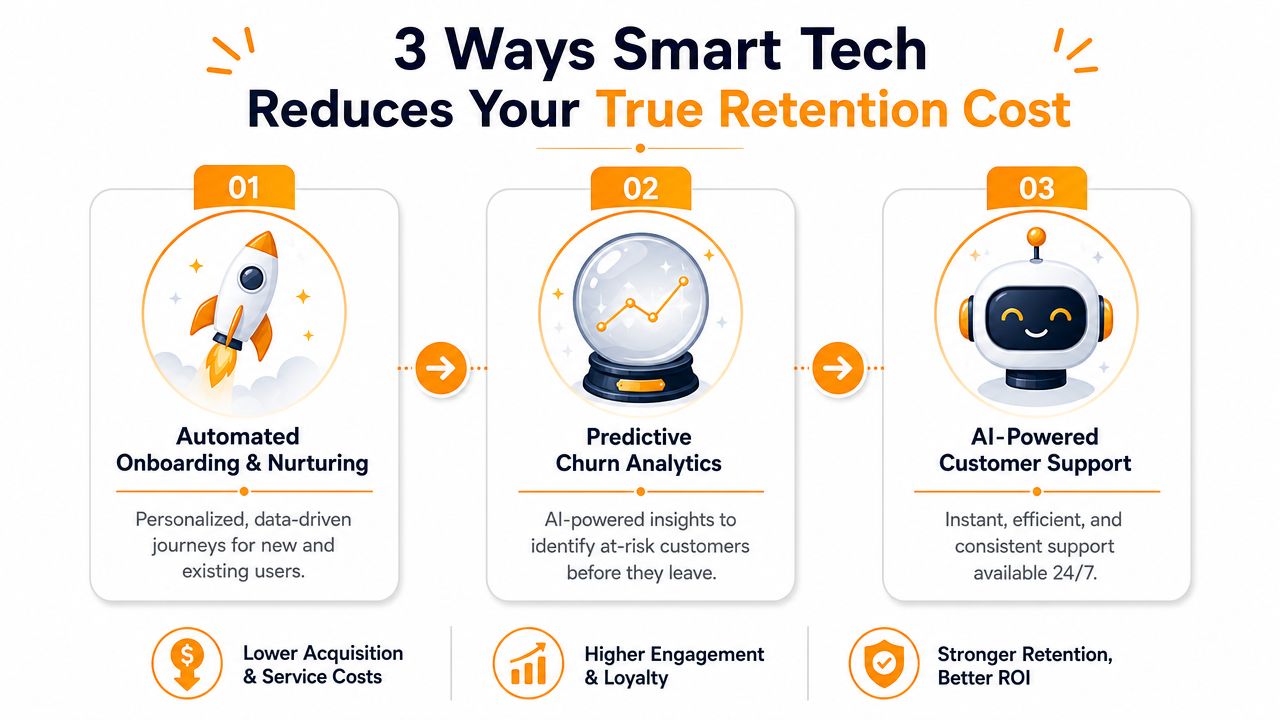
3 Ways Smart Tech Reduces Your True Retention Cost
Manual retention scales badly. A human-heavy process can save important accounts, but it often pushes customer retention costs up faster than recovered margin. The strongest systems lower the cost per successful intervention while improving consistency.
Cancellation flows that protect margin
Not every at-risk customer needs the same offer. That sounds obvious, but many teams still route everyone to one generic discount.
That's expensive. Discount offers convert at 62%, while pause subscriptions convert at 22% and plan downgrades at 8%. The lesson isn't that discounts are always better. It's that intervention economics differ sharply, so the best path depends on what revenue you're protecting and what concession you're giving up.
A smart cancellation flow should do three things:
Collect reason data so the business knows whether the issue is price, missing features, temporary non-use, or billing friction.
Route by likely willingness to pay so a pause or downgrade can preserve more margin when a full discount isn't necessary.
Log outcomes by path so you can compare save rate against concession cost.
One option in this category is Churnsolution's smart retries and retention tooling, which focuses on cancellation intervention and failed-payment recovery inside subscription workflows.
Payment recovery that stops preventable churn
Involuntary churn deserves more budget than many teams give it. If a user didn't intend to leave and the account is recoverable through retries, reminders, or payment update prompts, that's often a cleaner recovery motion than trying to win the same user back later.
This is also where retention economics have become more demanding. Recent guidance on customer retention strategies highlights automated follow-ups, smart dunning, and payment recovery as core levers, and it frames the key executive question this way: is the marginal cost of recovering the customer below the expected remaining lifetime value after all related costs are included?
That's the right test. Not "Can we recover this user?" but "Should we keep spending to recover this user?"
Payment recovery is one of the few retention motions that can defend revenue without teaching customers to wait for a discount.
Win-back automation that scales without headcount
Win-back campaigns are where manual teams often burn time on low-probability accounts. Smart tech fixes that by segmenting churned customers before outreach begins.
The pattern that works is selective reactivation. Message former annual users differently from former monthly users. Treat users who churned after a failed payment differently from users who canceled after poor onboarding. Separate discount-sensitive customers from customers who left because they weren't using the product.
That lowers true retention cost in two ways. It reduces wasted touches, and it prevents your team from spending human effort where automation can handle the first pass.
Good retention software doesn't eliminate judgment. It reserves judgment for the accounts where judgment is worth paying for.
Frequently Asked Questions About Customer Retention Costs
How does CRC differ between B2B and B2C SaaS
CRC should rise and fall with remaining customer value.
In B2B SaaS, a higher CRC is often rational because each account carries more revenue, longer contract terms, and more expansion potential. Retention spend may include customer success time, renewal management, implementation support, and targeted rescue plays for at-risk accounts. If one saved account protects a meaningful amount of ARR, human involvement can produce a strong return.
In B2C SaaS, that math changes fast. Lower ACVs and thinner contribution margins push teams toward systems that scale, such as cancellation deflection flows, failed-payment recovery, in-app save offers, and segmented win-back campaigns. The goal is not to spend less at all costs. The goal is to spend in ways that preserve margin.
When is a high CRC a good sign
A high CRC can be a healthy signal when the spend is tied to valuable customers or to infrastructure that improves retention efficiency over time.
That includes moving upmarket, protecting annual plans, fixing preventable failed-payment churn, or building cancellation flows that reduce avoidable loss month after month. In those cases, CRC rises first and profit follows later if the retained revenue outlasts the upfront investment.
Founders and finance leaders should judge CRC the same way they judge acquisition spend. Measure the payback. Compare incremental retention cost to the gross profit from customers kept on the books longer. If the return clears your hurdle rate, the spend is doing its job.
Should product and engineering costs be included
Yes, if the work is clearly built to reduce churn or recover revenue.
If engineering ships smart retry logic, a billing update flow, cancellation deflection, pause options, or renewal-risk alerts, part of that cost belongs in CRC for the period you incur it. If the team is making broad product improvements with mixed goals, only allocate the share you can defend.
A simple standard helps:
Include it when the feature exists mainly to reduce churn, recover failed payments, or improve renewals.
Partially allocate it when retention is one of several defined outcomes.
Exclude it when the retention impact is too indirect to measure with confidence.
CRC's nature as an investment metric, rather than a vanity efficiency metric, carries significant implications: if retention-focused product work sits outside CRC, the program looks cheaper than it is, and capital allocation gets worse.
If you want to turn customer retention costs into a controllable profit lever, Churnsolution is built for subscription teams that need structured cancellation flows, payment recovery, and automated win-back campaigns without managing those systems manually.
- Table of Contents
- What Actually Goes Into Customer Retention Costs?
- How to Calculate CRC With a Real SaaS Example
- Is Your CRC Too High? Benchmarks and KPIs to Watch
- How to Prove the ROI of Your Retention Program
- 3 Ways Smart Tech Reduces Your True Retention Cost
- Frequently Asked Questions About Customer Retention Costs
- If you want to turn customer retention costs into a controllable profit lever, Churnsolution is built for subscription teams that need structured cancellation flows, payment recovery, and automated win-back campaigns without managing those systems manually.

Churn solution that turns your customers right around.
Related Articles
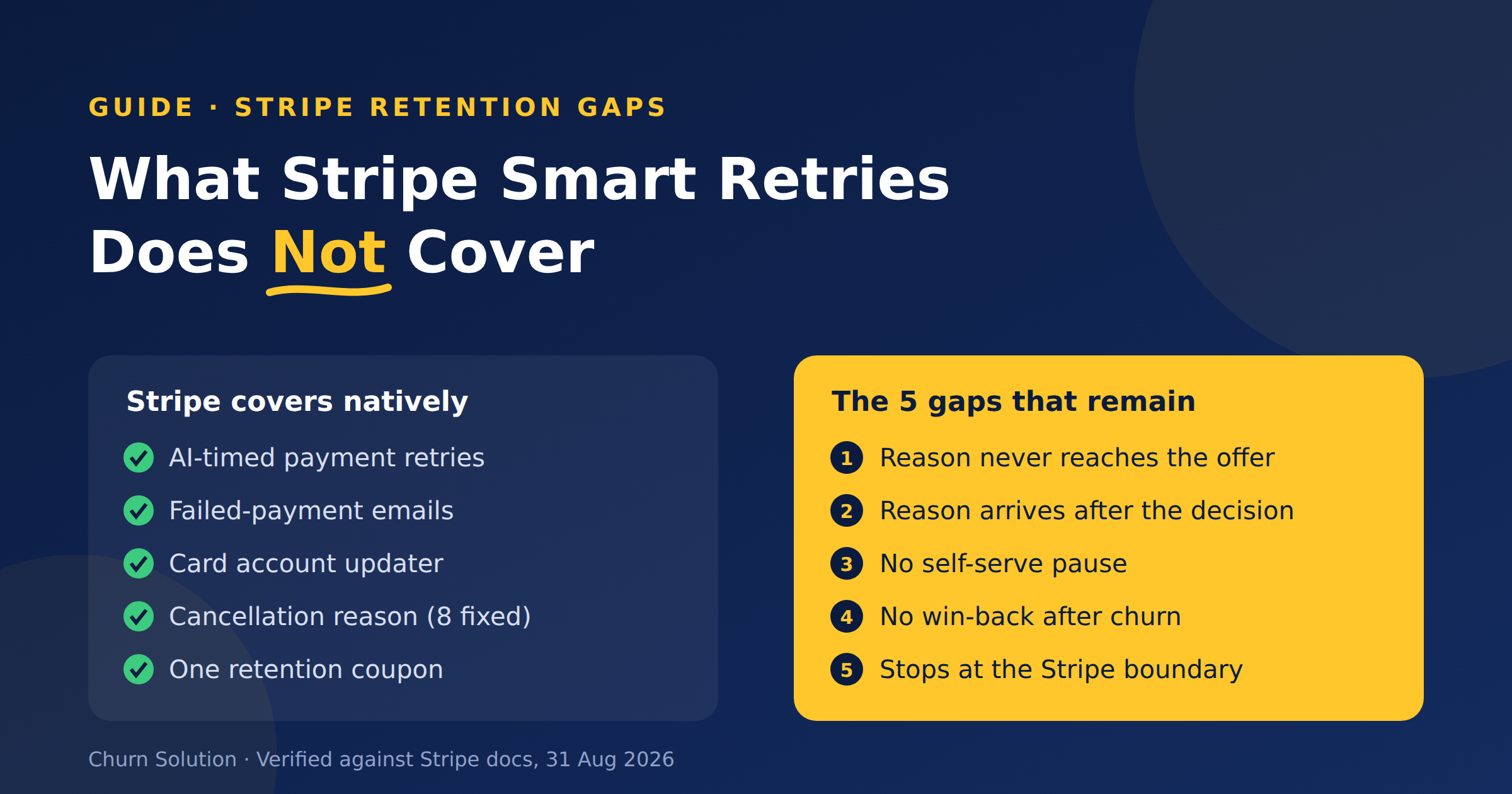
What Stripe Smart Retries Does Not Cover
Stripe Smart Retries recovers failed payments but doesn't run retention. Here are the five gaps that remain, sourced from Stripe's...

Membership Community Churn: The Members Who Quit Without Clicking Cancel
Quiet churn is the real leak: members who never clicked “cancel” at all. A card expires. A bank declines a...

Subscription Churn Dashboard: The 2026 Guide to Actionable Revenue Intelligence
Up to 40% of subscription churn is involuntary, meaning your customers aren't choosing to leave; they're being forced out by...