ARTICLE
Churn Prevention for Apps: A Strategic How-To Guide for 2026
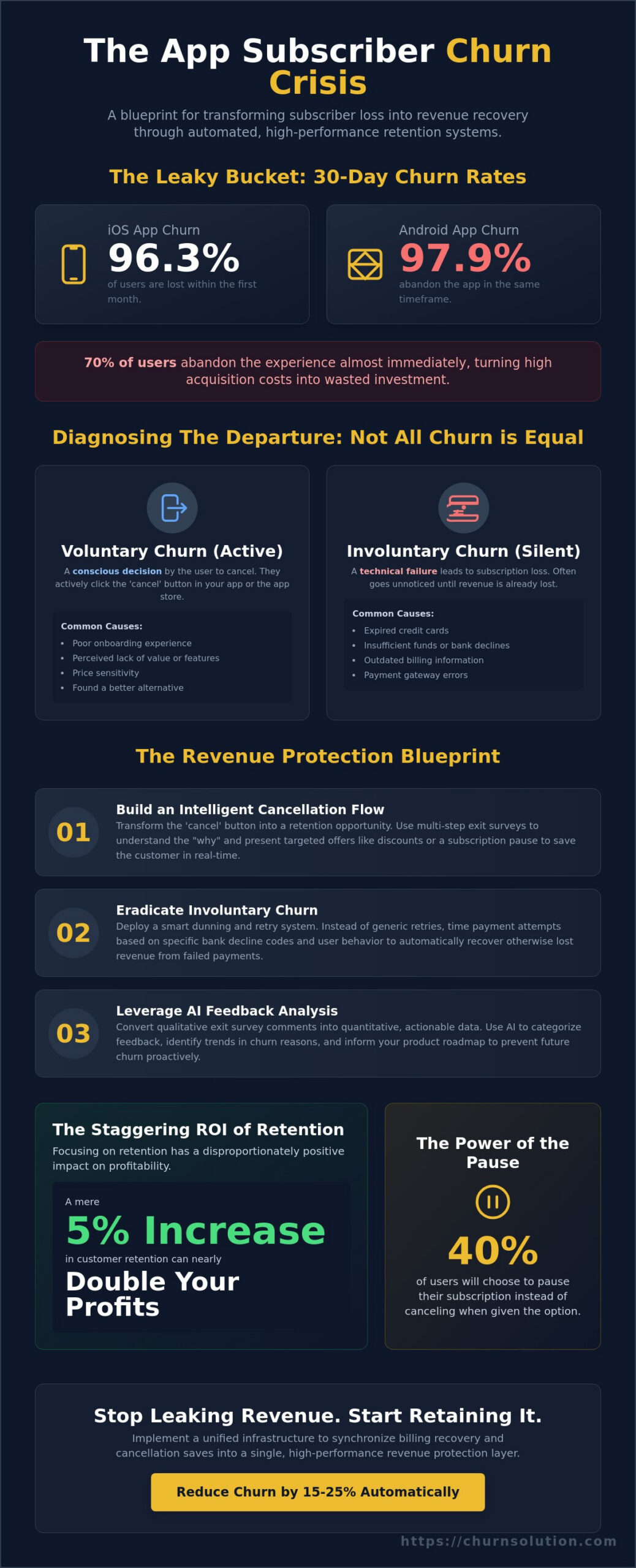
Did you know that as of 2026, iOS apps face a 96.3% churn rate within the first 30 days while Android apps see that number climb to 97.9%? Most developers are funneling high acquisition costs into a bucket where 70% of users abandon the experience almost immediately. This isn’t just a marketing failure; it’s a structural leak in your revenue engine. Effective churn prevention for apps requires more than a simple notification. It demands a sophisticated, technical framework that addresses both active cancellations and the silent drain of involuntary churn from failed credit cards.
You likely feel the frustration of watching hard-earned subscribers slip away because of a lack of visibility into why they’re leaving. This guide provides the strategic blueprint to reduce your churn rate by at least 15-25% through automated systems that require zero manual effort. We’re going to master the technical and psychological pillars needed to stop subscriber loss and recover leaking revenue automatically. You’ll explore how to deploy high-performance cancellation flows, smart retries, and AI feedback analysis to transform your retention metrics and secure your bottom line.
Key Takeaways
- Distinguish between silent disengagement and active cancellations to deploy targeted interventions that address the specific root cause of subscriber loss.
- Implement intelligent cancellation flows that leverage multi-step exit surveys to capture the “why” behind every departure and provide immediate save opportunities.
- Eliminate involuntary churn by deploying smart retries that time payment attempts based on specific bank behaviors, recovering leaking revenue automatically.
- Utilize AI feedback analysis to transform open-ended exit comments into categorized, actionable data points for long-term product development.
- Establish a unified infrastructure for churn prevention for apps to synchronize billing recovery and cancellation saves into a single, high-performance revenue protection layer.
Understanding the App Churn Crisis: Silent vs. Active Departures
App churn is the total loss of subscribers within a specific billing cycle. It represents a direct erosion of your Monthly Recurring Revenue (MRR) and a failure to realize the lifetime value of your acquired users. To implement effective churn prevention for apps, you must first categorize the loss. Not all departures look the same. Active churn occurs when a user explicitly clicks cancel within your interface or app store settings. Silent churn, however, is a far more insidious threat. This is where users simply stop opening the app without formally terminating their subscription, eventually leading to a cancellation or a payment failure down the line.
The financial impact of retention is staggering. Current 2026 benchmarks indicate that a mere 5% increase in retention can nearly double your bottom-line profits. This happens because the cost to acquire a new user far exceeds the cost of maintaining an existing one. Most abandonment occurs within the “Critical 100 Days” window. If you haven’t cemented value by day 30, where retention rates typically hover between 5% and 15%, your chances of long-term recovery drop significantly. Success requires a proactive stance that identifies these patterns before they become permanent losses; for example, to see how a Student OS provides continuous value to families, check out DormWay.
Voluntary vs. Involuntary Churn
Voluntary churn is a conscious decision. The user has evaluated your price or perceived value and decided to leave. This often stems from poor onboarding or a lack of feature depth. In contrast, involuntary churn is a technical failure. This occurs when revenue is lost to expired credit cards, bank declines, or billing errors. This “silent killer” of app revenue often goes unmonitored, yet it represents a massive percentage of total losses for subscription services. Unmanaged billing failures create a constant revenue leak that sabotages growth even when user satisfaction remains high.
Predicting the “Exit Intent” Signal
Users rarely cancel on a whim. They leave a trail of behavioral triggers long before they reach the exit. Reduced session frequency and feature neglect are the primary indicators of a cooling relationship. By monitoring data through customer segmentation, you can flag high-risk accounts based on these specific patterns. Implementing advanced customer churn metrics acts as a vital health check for your ecosystem. These metrics allow you to intervene with automated engagement strategies or dynamic offers before the user makes the final decision to depart. Identifying these signals early is the only way to transform a reactive support culture into a proactive revenue protection engine.
How to Build an Intelligent Cancellation Flow that Saves Subscribers
Most developers view the cancel button as the end of the road. It’s actually the most critical touchpoint for churn prevention for apps. Providing a friction-free, one-click exit might seem user-friendly, but it’s a strategic mistake that ignores the psychology of the subscriber. A passive approach to cancellation is a direct invitation for revenue loss. An intelligent flow creates a “Revenue Protection” layer that identifies the specific reason for departure before the subscription actually terminates. This is your final opportunity to re-establish value and secure your bottom line.
The process begins by implementing a multi-step exit survey. This isn’t just a compliance hurdle; it’s a diagnostic tool. By capturing the “Why” behind the departure, you gain the intelligence needed to deploy dynamic offers. These offers present alternatives based on the user’s specific feedback in real-time. Testing “Pause” vs. “Discount” functionality allows you to preserve the subscription relationship without permanently slashing your margins. Finally, you must deploy rigorous A/B testing to optimize which “save” offer performs best for specific customer segments. This systematic approach transforms a standard exit into a high-conversion retention event.
The Power of the Subscription Pause
Strategic data indicates that roughly 40% of users choose to pause their subscription instead of canceling when the option is presented correctly. This mechanism preserves the customer relationship without forcing them to pay for a service they aren’t currently using. Successful technical implementation requires setting specific duration limits and automated reactivation triggers. These triggers ensure the revenue stream resumes without manual intervention. For a more granular look at these mechanics, read our definitive guide to automated cancellation flows.
Dynamic Incentives and Win-back Offers
Effective churn prevention for apps requires more than just a generic “stay” message. Retention success depends on matching the offer to the pain point. A user citing “too expensive” should receive a temporary discount. A user who feels they’re “not using it” should be offered a personalized tutorial or a plan downgrade. Use A/B experiments to find the “Sweet Spot” where your save rate maximizes without eroding long-term LTV. Your customer portal must remain user-friendly while being highly persuasive. Every interaction is a chance to recover revenue. You can configure your first save flow to begin protecting your MRR immediately.
Eradicating Involuntary Churn with Automated Payment Recovery
Credit card declines are the silent killer of app MRR. Unlike active cancellations, where a user makes a conscious choice to leave, involuntary churn is a purely technical failure. It occurs when a legitimate subscriber is forcibly removed from your ecosystem due to an expired card, a temporary bank decline, or a technical billing error. Structural failures in the billing cycle often result in permanent subscriber loss even when the user intended to remain active. Comprehensive churn prevention for apps must address these failures with an automated, data-driven recovery layer to prevent this compounding revenue leak.
Deploying a robust payment recovery system is the most efficient way to protect your bottom line. By automating the response to failed transactions, you eliminate the need for manual customer support intervention. This system works in the background to identify why a payment failed and applies the appropriate remedy immediately. Whether the issue is a soft decline or a hard card error, your recovery infrastructure ensures that the relationship continues without service interruption, maintaining both user satisfaction and predictable cash flow.
Optimizing Dunning Email Logic
Timing is everything when a payment fails. The first 24 hours after a decline are critical for successful recovery. Structure your dunning sequence in three parts: an immediate, soft-tone notification; a high-urgency follow-up at the 48-hour mark; and a final notice before service suspension. Use app-specific branding and personalized messaging to build trust, ensuring the user feels secure when updating their billing details. For a deeper dive into these tactics, consult our guide on mastering dunning email automation.
Smart Retries vs. Basic Retries
Standard retry logic is often “dumb,” attempting to charge a card daily until it either succeeds or hits a hard limit. This repetitive approach often triggers bank fraud filters and leads to permanent card blocks. In contrast, smart retries use AI-optimized windows to time attempts based on specific bank behavior and typical payday cycles. This logic avoids “insufficient funds” declines by executing transactions when the likelihood of approval is highest. Smart retries reduce card fatigue and prevent permanent blocks by intelligently spacing attempts to avoid triggering aggressive bank fraud algorithms. If you’re evaluating whether your current billing processor provides sufficient recovery capabilities, understanding the differences in Stripe recovery vs Churn Solution can help you determine whether a specialized retention engine is necessary for your revenue stack. For a comprehensive comparison of platforms purpose-built for this challenge, explore our analysis of the best dunning tools for SaaS in 2026 to identify which solution aligns with your recovery goals.
Leveraging AI Feedback Analysis to Prevent Future Churn
The “Other” category in your cancellation survey is a graveyard for actionable intelligence. If you’re relying on static drop-down menus, you’re missing the specific nuances that drive users away. True churn prevention for apps in 2026 requires the ability to process thousands of open-ended comments at scale. By deploying AI feedback analysis, you can extract meaningful themes from qualitative noise. This technology uses natural language processing to categorize sentiment; it allows you to distinguish between “Product Gaps,” such as missing features, and “Pricing Gaps,” where users perceive a lack of value relative to cost.
Closing the loop is essential for long-term health. Use the intelligence gathered from exit surveys to inform your product roadmap directly. When you understand the specific friction points that lead to departure, you can prioritize engineering resources to fix the leaks that cost the most revenue. This data-driven approach ensures that your development team isn’t guessing what users want; they’re responding to the exact reasons users are leaving. It transforms a loss into a strategic asset for future retention.
Turning Qualitative Data into Quantitative Action
Stakeholders don’t react to anecdotes; they react to hard data. AI allows you to transform vague complaints like “the app is too expensive” into hard metrics such as “32% of churned users cite price as the primary exit factor.” This level of precision is necessary for strategic decision-making. Map these feedback categories to specific customer segmentation groups to see if certain demographics are more prone to specific issues. These insights also allow you to trigger automated reactivation campaigns. If a user left because a specific feature was missing, you can win them back automatically once that feature is launched, creating a personalized recovery path that feels relevant rather than desperate.
The Feedback-to-Retention Loop
Retention is not a one-time fix. It is a continuous cycle of optimization. Implement real-time alerts for high-value account cancellations to allow for immediate high-touch intervention. Advanced AI models can now predict which current users are likely to submit negative feedback next month based on their current engagement patterns and feature usage. This predictive capability allows you to address the problem before the user even considers the cancel button. Establish a culture where retention metrics are as vital as acquisition numbers. Protecting your revenue requires a proactive stance that treats every exit comment as a blueprint for future growth. You can start analyzing your customer feedback today to build a more resilient and profitable subscription business.
Scaling Your App Revenue with a Unified Retention Infrastructure
Fragmented point solutions are the primary obstacle to sustainable growth. If your dunning automation doesn’t communicate with your cancellation flows, you’re operating with a significant blind spot. A unified approach to churn prevention for apps ensures that every component of your retention stack works in concert. Shared data between billing recovery and exit surveys allows for a more sophisticated response to subscriber loss. When a system understands that a user with a failed card was also showing signs of disengagement, it can trigger a more persuasive recovery sequence. Churn Solution acts as the expert in the room, providing a high-performance framework that identifies leaks and plugs them automatically. Integration is designed to be seamless, allowing you to deploy these sophisticated tools without draining your internal engineering resources or distracting from your core product roadmap.
Relying on manual “save” attempts is a strategy built for failure in the high-velocity subscription economy. Humans are slow, inconsistent, and expensive. Automated infrastructure, however, operates with 100% consistency and zero latency. It captures every opportunity to preserve revenue, regardless of the time of day or the volume of cancellations. By consolidating your retention efforts into a single, intelligent layer, you create a stable foundation for scaling. This categorical approach to revenue protection ensures that no subscriber slips through the cracks due to technical oversight or data silos.
The ROI of Automated Revenue Protection
The financial impact of a unified system is most visible through your Net Revenue Retention (NRR). Reducing your churn rate by even 10% has a compounding effect on your long-term valuation and immediate cash flow. Automated systems outperform manual efforts because they apply data-driven logic to every transaction in real-time. For a comprehensive breakdown of these mechanics, see our Subscription Revenue Protection Guide. Investing in automation is not just about saving individual subscribers; it is about optimizing the entire revenue lifecycle for maximum efficiency.
Future-Proofing Your App for 2026 and Beyond
The 2026 market demands a shift toward value-based retention. It’s no longer enough to simply offer a generic discount. You must demonstrate ongoing value through every stage of the customer lifecycle. Future-proofing your app means ensuring your stack is ready for AI-driven management that predicts and prevents churn before it happens. Control your business outcomes by moving away from reactive support and toward proactive revenue optimization. Protect your app revenue with Churn Solution today and secure your position in an increasingly competitive landscape.
Secure Your App’s Financial Future
The window for reactive retention has closed. To thrive in the 2026 subscription economy, you must deploy a unified infrastructure that addresses the dual threats of active and involuntary loss. Implementing sophisticated churn prevention for apps isn’t just about stopping a single cancellation; it’s about building a resilient revenue engine that operates with technical precision. By combining a no-code cancellation flow builder with AI-driven feedback categorization, you transform qualitative exits into strategic growth data.
Structural leaks like failed credit cards require automated intervention. Our smart retry logic is engineered to recover 20% more revenue by timing attempts based on specific bank behaviors. This level of automation removes the burden from your engineering team while delivering measurable results to your bottom line. Stop letting valuable subscribers slip through technical gaps. Empowerment starts with total visibility and automated control over your subscriber lifecycle.
Start Protecting Your App Revenue Today and build the high-performance retention layer your business deserves.
Frequently Asked Questions
What is a good churn rate for a mobile app in 2026?
A monthly churn rate between 5% and 12% is considered typical for mobile subscription apps in 2026. Top-tier performers aim for sub-5% by deploying aggressive optimization and automated recovery systems. If your monthly loss exceeds 15%, your acquisition costs are likely unsustainable. Achieving effective churn prevention for apps at this scale requires a transition from reactive support to automated retention infrastructure that identifies risk before the billing cycle ends.
Can I prevent app churn without offering deep discounts?
Yes, you can preserve the subscriber relationship by utilizing alternative incentives like subscription pauses or plan downgrades. Pausing is a high-performance alternative that maintains the customer connection without eroding your price integrity. You might also offer extended trials of premium features or personalized tutorials. These methods address “lack of value” perceptions without resorting to margin-slashing discounts that can devalue your brand in the long term.
How do I identify “silent churn” in my user base?
Identify silent churn by monitoring behavioral triggers such as decreased session frequency and feature neglect. When a user stops opening the app but hasn’t cancelled, they’ve effectively disengaged. Use customer segmentation to flag accounts that haven’t logged in for 14 to 30 days. This data allows you to trigger automated re-engagement campaigns or win-back offers before the subscription reaches its next renewal date and inevitably fails.
What is the most common reason for involuntary churn in apps?
Expired credit cards and temporary bank declines are the primary drivers of involuntary churn. These technical failures account for a significant portion of lost MRR across the subscription economy. Unlike active cancellations, these users often intend to stay but are removed due to billing errors. Implementing automated payment recovery systems and smart retry logic is essential to capture this revenue without requiring manual customer service intervention.
How many steps should an app cancellation flow have?
An optimal cancellation flow typically consists of three distinct steps. First, an exit survey captures the specific reason for departure. Second, a dynamic offer presents a tailored alternative based on that feedback. Third, a confirmation screen finalizes the action if the offer is declined. This structure provides enough friction to present a “save” opportunity without frustrating the user or violating app store compliance regulations regarding easy exits.
Is it better to offer a free month or a discount to save a customer?
The choice depends on the specific reason identified in your exit survey. If a user cites financial constraints, a percentage-based discount is often more effective for long-term retention. If the issue is a temporary lack of usage, a free month provides the necessary window to re-establish value. Use A/B experiments to determine which incentive yields the highest Net Revenue Retention for your specific customer segments.
How often should I retry a failed subscription payment?
Avoid daily “dumb” retries, as they often trigger bank fraud filters and permanent card blocks. Instead, use smart retries that space attempts based on bank behavior and typical payday cycles. A strategic sequence might attempt recovery on day 1, 3, 7, and 15. This methodical approach increases the approval probability while reducing card fatigue and protecting your standing with major payment processors.
How does AI improve churn feedback analysis?
AI improves churn prevention for apps by categorizing thousands of open-ended exit comments into actionable product data. It moves beyond static drop-down menus to identify specific sentiment and emerging product gaps. By automating this analysis, you can identify exactly why users are leaving at scale. This intelligence allows your engineering team to prioritize fixes that directly correlate with increased subscriber lifetime value and reduced abandonment.
- Key Takeaways
- Table of Contents
- Understanding the App Churn Crisis: Silent vs. Active Departures
- How to Build an Intelligent Cancellation Flow that Saves Subscribers
- Eradicating Involuntary Churn with Automated Payment Recovery
- Leveraging AI Feedback Analysis to Prevent Future Churn
- Scaling Your App Revenue with a Unified Retention Infrastructure
- Secure Your App's Financial Future
- Frequently Asked Questions

Churn solution that turns your customers right around.
Related Articles
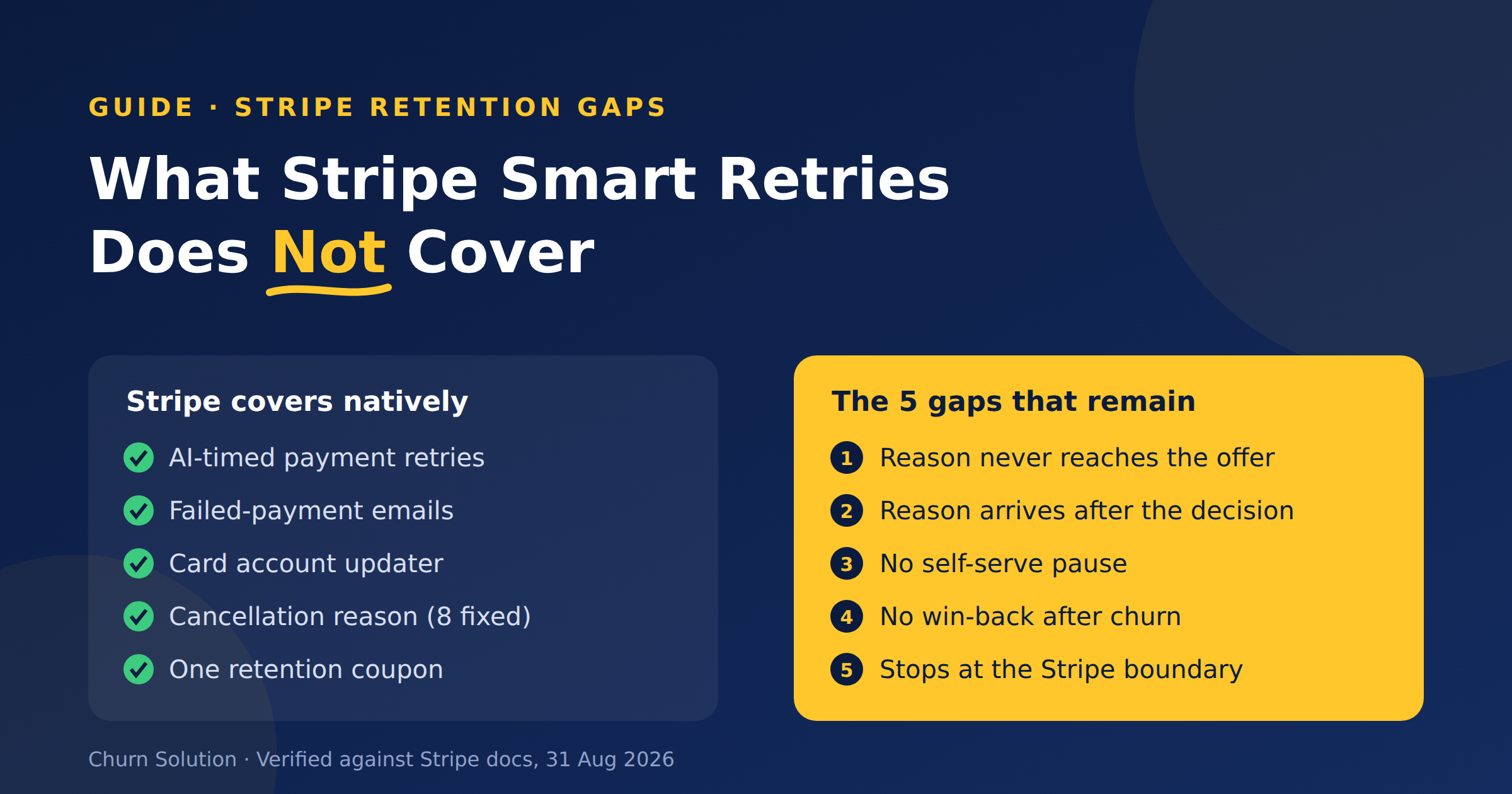
What Stripe Smart Retries Does Not Cover
Stripe Smart Retries recovers failed payments but doesn't run retention. Here are the five gaps that remain, sourced from Stripe's...

Membership Community Churn: The Members Who Quit Without Clicking Cancel
Quiet churn is the real leak: members who never clicked “cancel” at all. A card expires. A bank declines a...

Subscription Churn Dashboard: The 2026 Guide to Actionable Revenue Intelligence
Up to 40% of subscription churn is involuntary, meaning your customers aren't choosing to leave; they're being forced out by...