ARTICLE
Gross vs. Net Churn: The Definitive SaaS Guide to Revenue Metrics
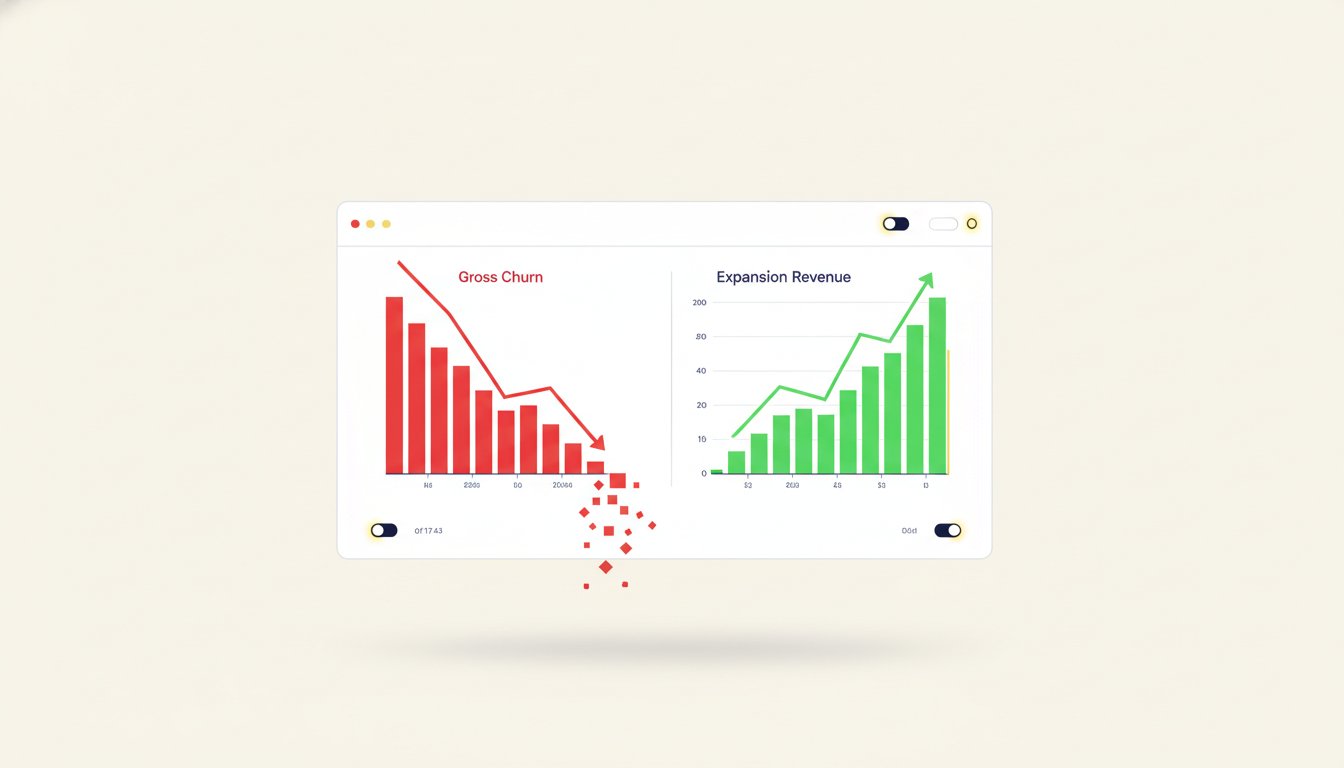
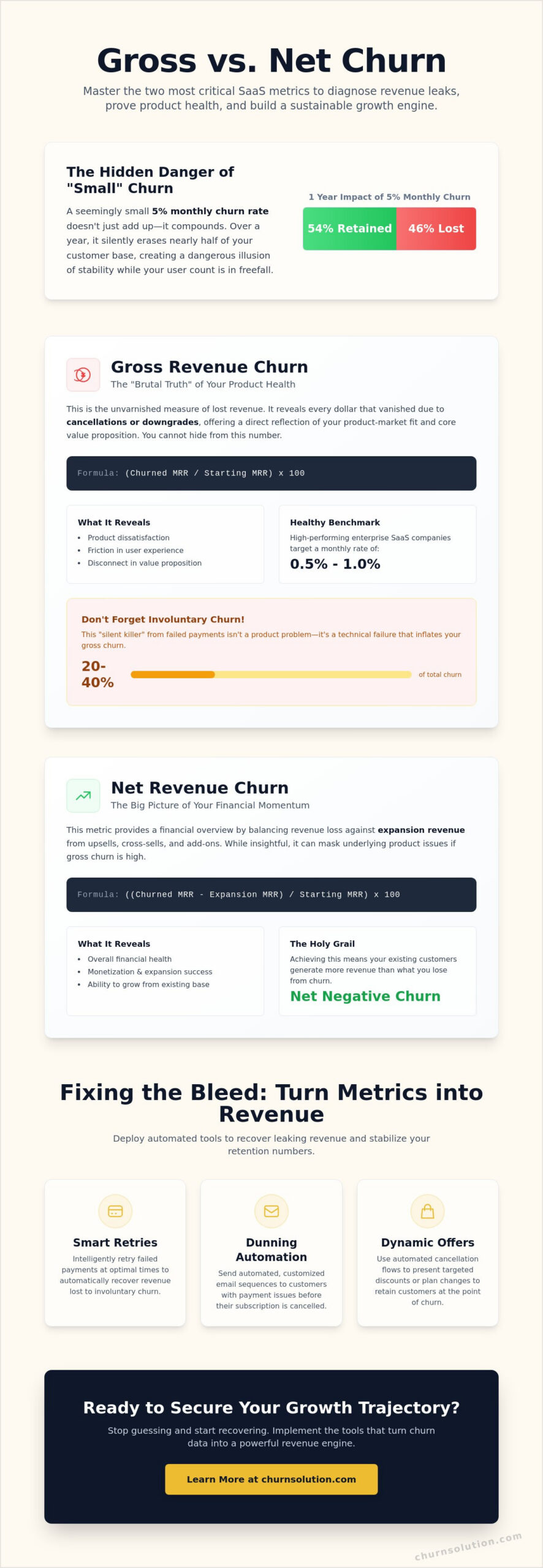
A 5% monthly churn rate erases 46% of your customer base every single year. You might see stable revenue figures on your dashboard, yet your actual user count is in freefall. This disconnect often triggers internal confusion and investor skepticism during high-stakes valuation rounds. You’re likely struggling to reconcile high customer turnover with expansion revenue while trying to determine which version of the truth matters most for your bottom line. Understanding the nuances of gross vs net churn is no longer optional; it’s a requirement for survival in the 2026 subscription economy.
We’ll help you master these critical metrics to identify exactly where your revenue is leaking and how to recover it. This guide provides clear formulas for both gross and net churn while explaining the strategic importance of Net Revenue Retention (NRR). You’ll learn how to reach the “Net Negative Churn” milestone through expansion-friendly pricing and technical optimizations. We’ll also detail actionable ways to improve your numbers using automated tools like smart retries, dunning email automation, and dynamic offers to secure your growth trajectory.
Key Takeaways
- Identify the technical distinction between gross vs net churn to determine if revenue loss stems from product dissatisfaction or missed expansion opportunities.
- Expose the “brutal truth” of your product health by isolating gross revenue churn from the masking effects of upsells and seat expansion.
- Master the mechanics of Net Revenue Retention to transform your existing customer base into a self-sustaining growth engine.
- Determine the strategic moments to report specific metrics to your board versus your product team for maximum operational impact.
- Deploy automated cancellation flows and dynamic offers to recover leaking revenue and stabilize your retention numbers.
Gross vs. Net Churn: Defining the Two Pillars of SaaS Retention
Revenue protection in 2026 requires a surgical understanding of how money leaves your ecosystem. You can’t fix a leak you don’t fully understand. Most SaaS leaders look at a single retention number and assume they have the full picture. They’re wrong. The distinction between gross vs net churn represents the difference between a business that’s scaling and one that’s merely treading water. While gross churn exposes the raw efficiency of your product, net churn reveals the ultimate sustainability of your financial model. Mastering both allows you to deploy precise interventions exactly where they’ll have the most impact.
What is Gross Revenue Churn?
Gross revenue churn is the unvarnished measurement of lost Monthly Recurring Revenue (MRR). It accounts for every dollar that vanished due to cancellations or plan downgrades. The formula is: (Churned MRR / Starting MRR) x 100. This metric is the ultimate truth-teller for product-market fit. High customer attrition at the gross level indicates a “leaky bucket” that acquisition cannot fix. There’s nowhere to hide; it’s a direct reflection of your core value proposition. High-performing enterprise SaaS companies in 2026 target a monthly gross churn of 0.5% to 1% to maintain a healthy baseline.
What is Net Revenue Churn?
Net revenue churn factors in expansion revenue to provide a financial health overview. It balances lost revenue against gains from upsells, cross-sells, or seat expansion. The formula is: ((Churned MRR – Expansion MRR) / Starting MRR) x 100. This can be deceptive as expansion often masks underlying product issues. Achieving “Net Negative Churn” is the holy grail; it means your existing base grows faster than your losses. This allows your revenue to scale even without adding a single new customer. You must stabilize gross churn before you can safely rely on net growth. Understanding the precise relationship between GRR vs NRR and how these retention metrics interact is essential for building a durable expansion strategy.
Success in the current market demands a dual-track strategy. Analyzing gross vs net churn helps you identify if your problem is a product failure or a missed monetization opportunity. By isolating these figures, you can implement targeted solutions like AI feedback analysis to address gross losses or dynamic offers to drive expansion. This clarity ensures your 2026 revenue protection strategy is built on data, not assumptions.
Gross Revenue Churn: The “Brutal Truth” of Product Health
Gross revenue churn acts as the ultimate filter for product-market fit. It doesn’t care about your sales team’s ability to upsell or your marketing team’s acquisition efficiency. It simply measures how much water is leaking out of the bucket. If you’re losing 5% of your revenue every month, you’re effectively replacing 46% of your total customer base every year just to stay flat. This is why investors in early-stage SaaS prioritize gross metrics when evaluating gross vs net churn. They want to see if the core product provides enough value to keep users paying. High gross churn indicates a fundamental disconnect between your promise and your delivery. You cannot ignore this number by pointing to growth elsewhere.
The Impact of Involuntary Churn on Gross Metrics
Passive revenue loss is the most frustrating component of your gross numbers. Research indicates that involuntary churn accounts for 20% to 40% of total churn for most SaaS businesses. This isn’t a product problem; it’s a technical failure. This silent killer inflates your gross churn rate and artificially suppresses your Customer Lifetime Value (LTV) projections. Implementing dunning email automation and smart retries is the most direct way to recover this revenue. By fixing the billing layer, you gain a clearer view of your true product health without technical noise. Recovering these failed payments directly stabilizes your gross revenue baseline.
Why You Cannot “Expand” Your Way Out of Poor Gross Churn
Relying on a few “whale” accounts to mask high turnover is a dangerous strategy. While expansion revenue might make your net numbers look respectable, it creates a fragile ecosystem. If your gross churn remains high, you’re essentially building on a foundation of sand. You cannot rely on upsells to compensate for a product that users are actively abandoning. High gross churn signals deep-seated friction in the user experience or a lack of ongoing utility. It forces your acquisition team into a perpetual cycle of replacement rather than growth. Your gross churn rate represents the absolute ceiling on your ability to scale your business sustainably.
Net Revenue Churn: Measuring the Growth Engine
If gross churn represents the floor of your business, net churn is the engine. It measures your efficiency in maximizing the value of the customers you’ve already acquired. High-performance SaaS organizations treat retention as an offensive strategy rather than a defensive one. By focusing on the “land and expand” model, you shift your focus from merely preventing cancellations to actively driving expansion revenue through upsells, add-ons, and seat expansion. This metric serves as the primary indicator of your business sustainability. It’s a central component of the SaaS Rule of 40, where growth and profitability must exceed a combined 40% threshold for top-tier valuation.
Achieving Net Negative Churn: The SaaS Holy Grail
Net negative churn occurs when expansion revenue from your existing base exceeds the revenue lost from cancellations and downgrades. It’s the ultimate growth lever. By 2026, verified data shows that 40% of SaaS companies with $15 million to $30 million in ARR have achieved this milestone through expansion-friendly pricing models. When you reach this state, your revenue compounds automatically. Your existing accounts become a source of “free” growth that doesn’t require additional customer acquisition costs. This creates a powerful financial flywheel that accelerates valuation multiples into the 8x to 12x ARR range.
The Limitations of Net Churn as a Standalone Metric
Relying exclusively on net churn is a strategic trap. A single large enterprise upgrade can easily mask a mass exodus of smaller users, creating a false sense of security. You might see stable net revenue while your underlying customer satisfaction is eroding. This is why evaluating gross vs net churn in tandem is non-negotiable. If expansion revenue is masking high gross churn, you’re essentially burning through your market’s total addressable audience. Stable net figures can be a leading indicator of future gross churn spikes if the core product friction isn’t addressed through interventions like AI feedback analysis or targeted win-back campaigns.
Gross vs. Net Churn: A Side-by-Side Comparison
Understanding the interplay of gross vs net churn requires a strategic decision matrix. While gross churn provides a clear window into customer satisfaction, net churn dictates your financial health. These metrics move in tandem; a spike in gross churn often precedes a collapse in net retention. Your product team must own the gross numbers to eliminate friction points. Conversely, your board will focus on net figures to evaluate capital efficiency and long-term valuation. Allocating your retention budget depends on which metric is underperforming. If your gross churn is high, invest in product utility and user experience. If your net churn is stagnant despite low gross losses, focus on your monetization and expansion strategy.
Which Metric Matters More for Your Stage?
- Early-stage (Seed/Series A): Companies under $1M ARR typically face monthly gross churn between 5% and 7%. At this stage, gross churn is the only metric that matters. You must prove product-market fit before expansion revenue becomes a viable growth lever.
- Growth-stage (Series B+): You must balance net retention with gross stability. Mid-market companies at this stage aim for 1% to 2% monthly churn. You need to protect your base while starting to scale account values.
- Enterprise SaaS: Net Revenue Retention (NRR) is the dominant metric. Enterprise leaders target 0.5% to 1% monthly churn and aim for a median NRR of 114%. At this scale, expansion revenue is the primary driver of valuation. Understanding how to calculate NRR accurately is essential for benchmarking your performance against top-tier SaaS companies.
Setting Benchmarks for 2026
Setting benchmarks for 2026 requires looking at verified industry data. SMB-focused SaaS businesses currently see monthly churn rates of 3% to 5%. In contrast, enterprise-focused companies target 0.5% to 1%. High churn rates severely penalize your valuation; companies with annual churn above 8% often see multiples drop to 3-5x ARR. Maintaining annual churn below 3% can command valuation multiples of 8-12x ARR. Use these figures to set realistic internal targets and allocate your resources based on your specific customer segment.
To stabilize these metrics, you must deploy targeted interventions at the moment of friction. Implementing automated cancellation flows allows you to capture feedback and offer dynamic incentives before the revenue is lost. This proactive approach protects your gross baseline while creating pathways for future win-back campaigns. By addressing the root cause of the exit, you turn a potential loss into an opportunity for recovery and optimization.
Fixing the Bleed: Turning Churn Metrics into Revenue Recovery
Monitoring gross vs net churn is a passive exercise unless those metrics trigger immediate, automated interventions. Data without action is simply overhead. To protect your valuation, you must transition from observation to recovery. This shift requires a technological layer that identifies revenue leakage in real-time and deploys the specific remedy needed to plug it. Whether the loss is voluntary or involuntary, your retention strategy must operate at the same speed as your subscription engine. You don’t just need to know your numbers; you need to change them.
Automating the “Save” with Dynamic Cancellation Flows
Stop letting customers leave through a simple, friction-free “cancel” button. Replace that exit point with a value-driven cancellation flow that captures intent and offers alternatives. By presenting dynamic offers tailored to the user’s specific reason for leaving, you can save 15% to 30% of potential cancellations before they ever impact your gross churn report. Implementing a pause functionality allows users to suspend their subscription rather than terminating it. This preserves your long-term customer relationship without damaging your immediate metrics. This mechanism turns a binary exit into a nuanced negotiation that favors retention.
Closing the Loop with AI Feedback Analysis
Understanding the “why” behind your churn is critical for long-term product health. AI feedback analysis automatically categorizes churn reasons. This allows you to identify systemic friction points that your product team must address to stabilize gross revenue. This intelligence identifies “at-risk” segments based on behavior patterns, enabling you to intervene before they reach the cancellation stage. Integrating this data into your win-back campaigns ensures your outreach to lapsed subscribers is relevant and highly personalized. You move from guessing why users leave to knowing exactly how to bring them back into the ecosystem.
The Churn Solution Advantage
Churn Solution provides the specialized infrastructure needed to automate the recovery of both gross and net revenue. Our platform leverages smart retries and dunning email automation to eliminate billing failures, which verified research shows account for 20% to 40% of total churn. By deploying sophisticated cancellation flows and win-back campaigns, you gain total control over your retention ecosystem. Stop losing revenue to preventable technical errors and voluntary exits. Protect your revenue with Churn Solution’s automated flows and stabilize your growth trajectory today.
Dominate Your Retention Strategy and Secure Long-Term Growth
Analyzing the variance between gross vs net churn is the first step toward building a resilient SaaS business. You’ve seen how gross churn exposes fundamental product friction while net retention highlights your expansion efficiency. Relying on acquisition alone is a failing strategy in the current economy. You must optimize your existing revenue base by eliminating involuntary losses and intelligently managing voluntary exits. High-performance teams don’t just watch these numbers; they deploy automated systems to influence them in real-time.
Churn Solution provides the technical intervention needed to secure your bottom line. Our platform utilizes AI-driven feedback analysis to categorize churn reasons and deploys smart cancellation flows that reduce churn by up to 30%. Our automated dunning system recovers over 60% of failed payments to protect your gross revenue baseline. These tools ensure your retention strategy is proactive rather than reactive.
Stop the bleed and automate your revenue recovery with Churn Solution. Take command of your metrics and transform your retention into a sustainable competitive advantage. You have the data; now it’s time to act.
Frequently Asked Questions
Is gross churn or net churn more important for SaaS valuation?
Valuation depends on both metrics, but net revenue retention (NRR) is the primary driver for high multiples. Investors analyze gross vs net churn to distinguish between a healthy product base and a business masking losses with heavy upsells. High-growth SaaS companies that maintain low gross churn while achieving net negative churn command the highest market valuations in 2026.
Can net churn be a negative number?
Yes, net churn becomes negative when expansion revenue exceeds the revenue lost from cancellations and downgrades. This state is known as “Net Negative Churn.” It indicates that your existing customer base is growing on its own without new acquisition. Top-tier SaaS companies achieve this through usage-based pricing and aggressive seat expansion strategies.
How does expansion revenue affect my churn calculations?
Expansion revenue acts as a financial counterbalance in your net churn calculation. It includes all revenue from upsells, cross-sells, and add-ons. While expansion does not improve your gross churn figure, it directly lowers your net churn rate. Strong expansion revenue proves that your product provides increasing value to your remaining users over time. For a deeper breakdown of how these figures diverge at the retention level, reviewing the definitive comparison of GRR vs NRR as SaaS revenue retention metrics will sharpen your analytical framework.
What is a “good” gross churn rate for a B2B SaaS company?
A “good” gross churn rate varies by your target market segment. For 2026, enterprise-focused companies target 0.5% to 1% monthly. Mid-market organizations aim for 1% to 2%. Companies serving SMBs typically see higher rates between 3% and 5% due to the higher market volatility inherent in that customer segment.
How do I calculate churn if I have both monthly and annual plans?
You must normalize all contracts to Monthly Recurring Revenue (MRR) for accurate calculations. Divide the total value of annual plans by 12 to determine their monthly contribution. This ensures your gross vs net churn metrics remain consistent regardless of the billing cycle. It prevents artificial spikes in your data when annual contracts expire.
Does gross churn include downgrades or just cancellations?
Gross revenue churn includes both total cancellations and the revenue lost from plan downgrades. It measures the total contraction of your existing revenue base before any expansion is factored in. While customer churn only tracks lost logos, gross revenue churn provides a more precise look at the financial impact of customer dissatisfaction.
How can I automate the reduction of my gross churn rate?
You can automate recovery by implementing technical interventions like smart retries and dunning email automation. These tools recover a significant portion of failed payments that cause involuntary churn. Additionally, deploying automated cancellation flows with dynamic offers can save up to 30% of users who intended to leave your platform voluntarily.
What is the difference between revenue churn and customer churn?
Customer churn tracks the number of accounts lost, while revenue churn tracks the specific dollars lost. Revenue churn is a more sophisticated metric because it accounts for the varying sizes of your contracts. Losing one enterprise account has a much larger impact on your financial health than losing multiple small SMB accounts.
- Key Takeaways
- Table of Contents
- Gross vs. Net Churn: Defining the Two Pillars of SaaS Retention
- Gross Revenue Churn: The "Brutal Truth" of Product Health
- Net Revenue Churn: Measuring the Growth Engine
- Gross vs. Net Churn: A Side-by-Side Comparison
- Fixing the Bleed: Turning Churn Metrics into Revenue Recovery
- Dominate Your Retention Strategy and Secure Long-Term Growth
- Frequently Asked Questions

Churn solution that turns your customers right around.
Related Articles

Membership Community Churn: The Members Who Quit Without Clicking Cancel
Quiet churn is the real leak: members who never clicked “cancel” at all. A card expires. A bank declines a...

Subscription Churn Dashboard: The 2026 Guide to Actionable Revenue Intelligence
Up to 40% of subscription churn is involuntary, meaning your customers aren't choosing to leave; they're being forced out by...
Dynamic Retention Offers: The 2026 Guide to Automated Revenue Recovery
Did you know that acquiring a new customer in 2026 costs up to 25 times more than retaining an existing...