ARTICLE
How to Recover Failed Payments for a Subscription Business: The Netflix System (And the 3-Step Playbook Any Team Can Copy)
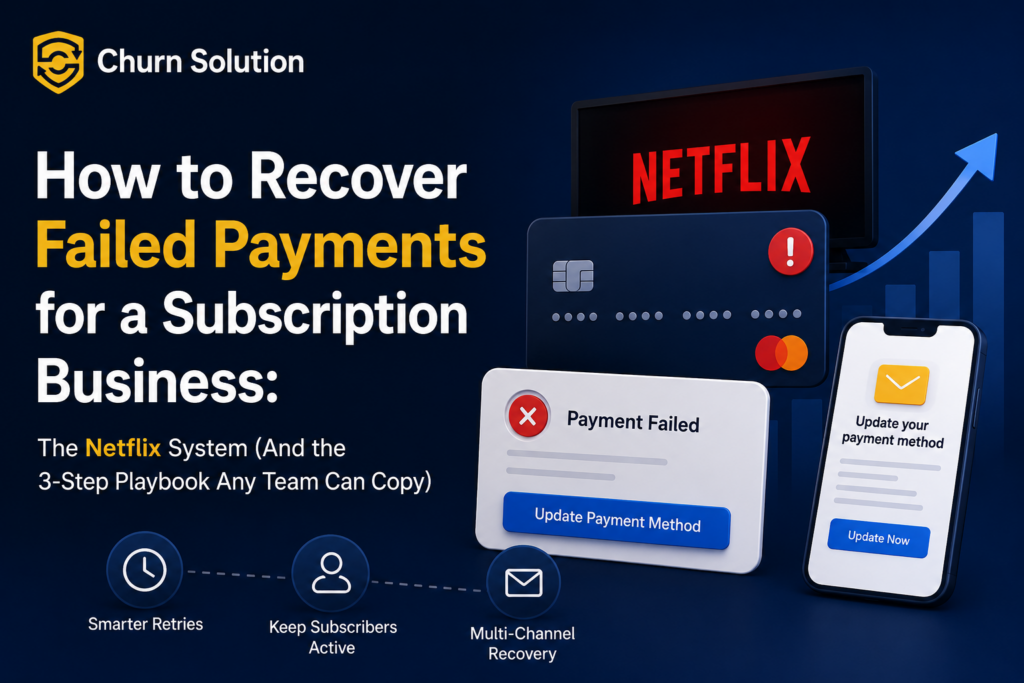
If you run a subscription business on Stripe, between 5% and 15% of your MRR fails every month at the card network.
Most of it is recoverable. Most teams never recover it.
Netflix does. So do Spotify, Disney+, and every other subscription company operating at scale. They’ve built internal systems that quietly claw back millions in failed charges — revenue that smaller subscription businesses write off as “involuntary churn” and move on.
This article breaks down exactly how to recover failed payments for a subscription business the way Netflix does it, the three layers that make their system work, and how to replicate all three without an engineering team.
The Real Cost of Failed Payments
Card declines aren’t a small problem. The industry baseline:
– 5–15% of subscription charges fail every billing cycle
– ~40% of those failures are recoverable with the right retry logic
– 70% of cancellations at scale aren’t intentional — they’re failed payments that never got recovered
If you do $200K MRR and lose 8% to failed payments, that’s $16K a month walking out the door. Over 12 months, with compounding LTV loss, you’re closer to a $250K problem.
This is the gap Netflix engineered around.
How Netflix Recovers Failed Payments at Scale
Netflix doesn’t think about failed payments as a billing issue. They treat it as a retention surface — three coordinated layers, not one.
Layer 1: Smart Retry Logic (Not Just Immediate Retry)
When a Netflix charge fails, the system doesn’t hammer the card 24 hours later and give up. It retries on a schedule built around how consumer cash flow actually works:
– Retry timed around payday cycles (1st and 15th of the month in the US)
– Retry timed around weekday vs. weekend balance patterns
– Different retry cadences by decline reason code — insufficient funds is treated differently from “do not honor” or expired card
– Retries spread across 3 to 14 days, not stacked in the first 48 hours
Stripe’s default retry settings do none of this. They retry on a fixed schedule and stop. That’s why most teams leave 30–50% of recoverable revenue on the table.
Layer 2: Account Hold State Instead of Instant Cancellation
This is the layer most subscription businesses skip entirely.
When a payment fails repeatedly, Netflix doesn’t immediately cancel the subscription. The account moves into a hold state:
– The subscriber keeps logging in
– They see a soft prompt to update billing
– Their data, watch history, and preferences stay intact
– The door stays open for 14–30 days
The reason is simple. A cancelled subscriber requires reactivation — a new decision, a new credit card entry, a new psychological barrier. A held subscriber just needs to update a card to keep watching what they were already watching.
Hold states convert dramatically better than cancel-then-win-back flows.
Layer 3: Multi-Channel Recovery Prompts
Netflix doesn’t rely on one channel to recover a failed payment. They sequence across three:
1. In-app banners the moment the subscriber opens the product — highest intent, lowest friction
2. Email sequence spaced over the retry window, escalating from soft to firm
3. Win-back campaign if the account fully lapses, often with a tailored offer to reactivate
Each channel does a different job. In-app catches active users. Email catches dormant ones. Win-back catches the ones who already left.
Together, the three layers compound. Smart payment retries recover the easy wins. Hold states catch the next tier. Multi-channel prompts recover the rest.
Why Most Subscription Businesses Don’t Have This
Building this internally takes serious engineering effort:
– Retry orchestration on top of Stripe (Stripe’s defaults aren’t enough)
– A hold-state model that doesn’t exist in most billing schemas
– An email infrastructure tied to billing events in real time
– In-app surfaces tied to subscription status
– Win-back logic with offer testing
For a company with a 50-person engineering team, this is a quarter of work. For a subscription business between $5K and $5M MRR — typically 1 to 5 engineers — it’s never the priority. Acquisition usually wins the roadmap fight.
So failed payment recovery stays at Stripe defaults. And the revenue leak stays open.
How to Replicate All 3 Layers With Churn Solution
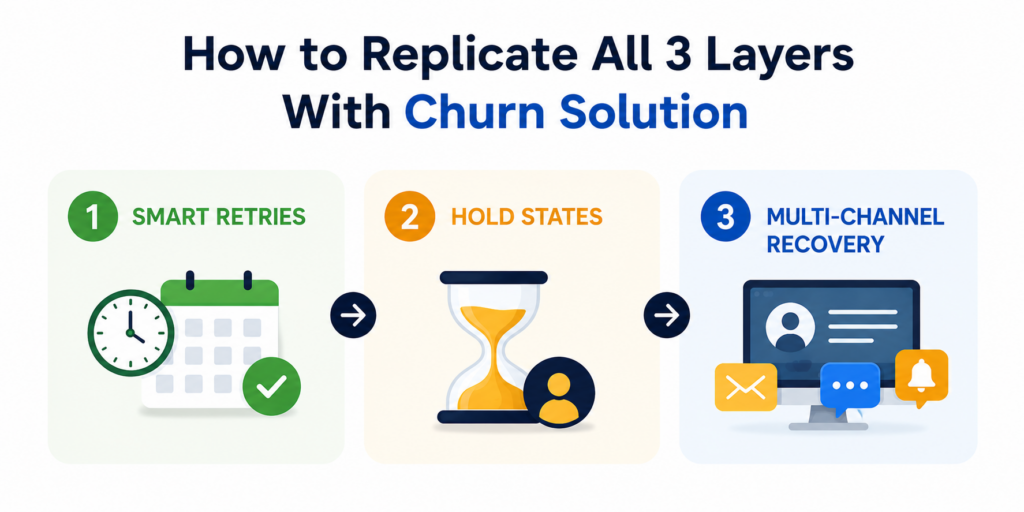
Churn Solution was built to give growing subscription businesses the same recovery stack large companies build internally — without the engineering quarter.
Here’s the layer-by-layer mapping.
Replicating Layer 1: Smart Retries
Inside Churn Solution, retries are driven by decline reason, card type, time zone, and historical recovery patterns — not a fixed Stripe schedule. You can:
– Set retry windows that align with payday cycles in your customer base
– Route different decline codes through different retry strategies
– Add SMS and email touchpoints between retry attempts so the customer can self-correct before the next charge
This typically lifts payment recovery rates well above Stripe defaults within the first 30 days.
Replicating Layer 2: Hold States
Churn Solution lets you configure a hold window between final retry and cancellation. During hold:
– The subscriber stays active in Stripe
– They get a self-serve billing update link
– You can gate or limit product access depending on your model
– Recovery prompts continue running across channels
The result is the same conversion logic Netflix uses, configured in hours instead of built in months.
Replicating Layer 3: Multi-Channel Recovery
Churn Solution sequences in-app prompts, email, and SMS off the same billing event timeline. If recovery still fails, the subscriber moves into a win-back campaign automatically — with offer logic you control.
No glue code. No Zapier. No engineering ticket.
Real Results From Churn Solution Customers
This isn’t theory. The recovery stack produces measurable revenue inside the first month.
– 30% churn reduction after deploying the full recovery flow
– $750K+ in revenue recovered across the customer base
– 67% reactivation rate on win-back campaigns
– 31% LTV increase for customers running the full recovery stack (retries + hold + win-back)
– Customers typically see meaningful recovered revenue within the first 30 days
The pattern is consistent. Failed payment recovery is the highest-ROI retention work most subscription businesses haven’t done yet — and it’s the fastest to deploy.
The Math On Doing Nothing
If your business is leaking 8% of MRR to failed payments and you recover even half of that with a proper system:
– At $100K MRR, that’s $48K/year recovered
– At $500K MRR, that’s $240K/year recovered
– At $1M MRR, that’s $480K/year recovered
These numbers compound through LTV. A subscriber retained today keeps paying for months — every month of failed payment recovery saves multiple months of revenue downstream.
The teams that win the retention game in 2026 won’t be the ones with the biggest ad budgets. They’ll be the ones who plugged the leaks first.
Book a Demo
See exactly how much revenue your subscription business is leaking to failed payments — and how fast Churn Solution can recover it.
[Book a demo] — 20 minutes, walk through your Stripe data, leave with a recovery estimate specific to your MRR.

Churn solution that turns your customers right around.
Related Articles
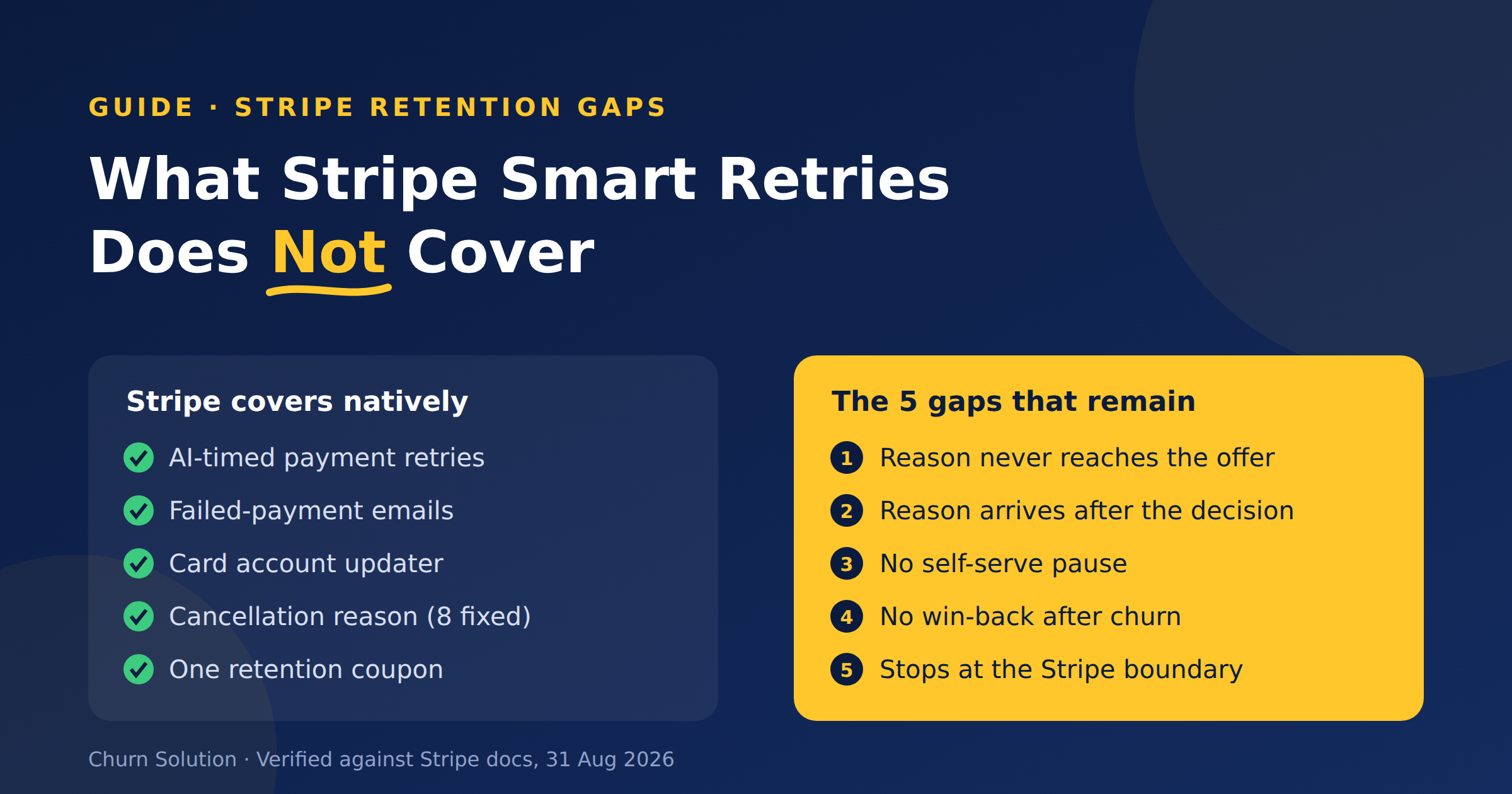
What Stripe Smart Retries Does Not Cover
Stripe Smart Retries recovers failed payments but doesn’t run retention. Here are the five gaps that remain, sourced from Stripe’s…


Membership Community Churn: The Members Who Quit Without Clicking Cancel
Quiet churn is the real leak: members who never clicked “cancel” at all. A card expires. A bank declines a…

Subscription Churn Dashboard: The 2026 Guide to Actionable Revenue Intelligence
Up to 40% of subscription churn is involuntary, meaning your customers aren’t choosing to leave; they’re being forced out by…
Nice post. I learn something totally new and challenging on websites
Nice post. I learn something totally new and challenging on websites