ARTICLE
Best SaaS Churn Analysis Tools: How to Predict and Prevent Revenue Loss in 2026

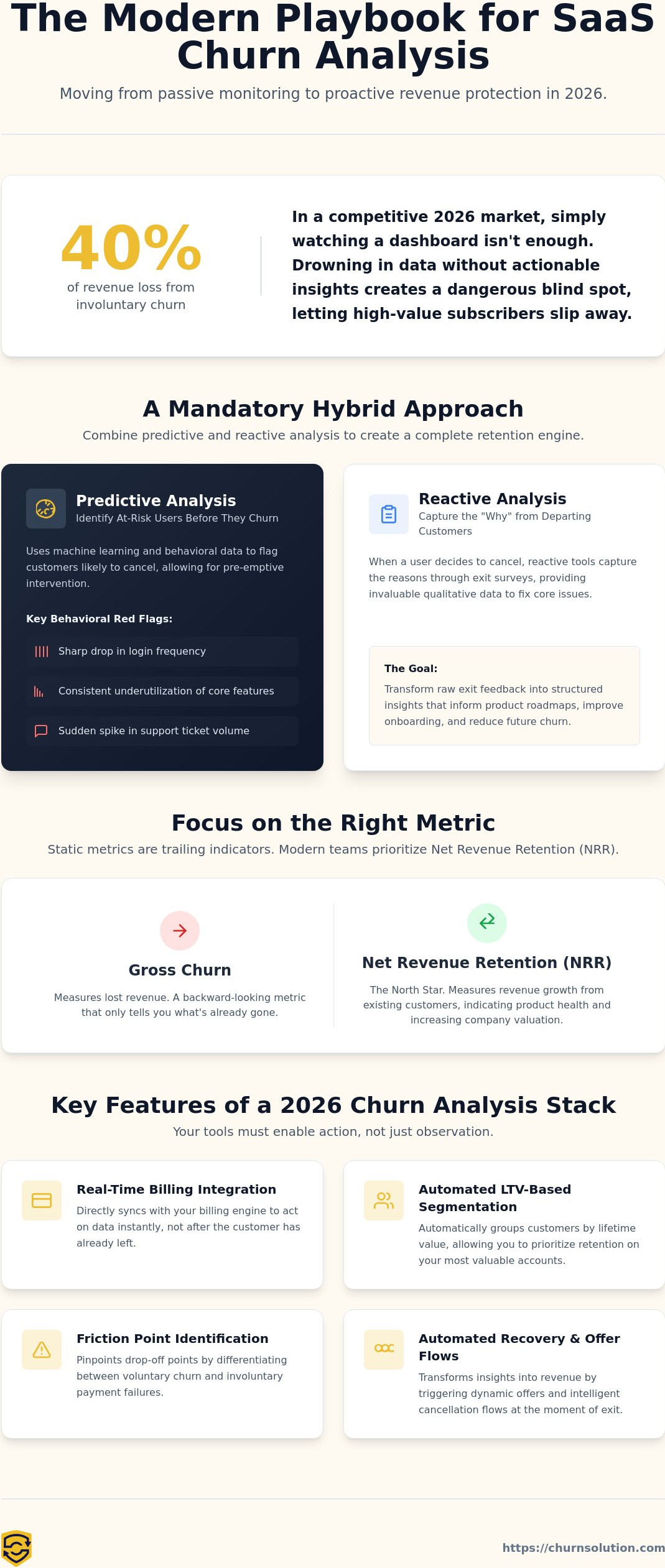
With involuntary churn accounting for up to 40% of total revenue loss in 2026, simply monitoring a dashboard is no longer an acceptable strategy for growth. You’re likely facing the high stakes of losing high-value subscribers without a clear mechanism to intervene. Drowning in raw data while lacking actionable insights creates a dangerous blind spot in your business health. Selecting the most effective saas churn analysis tools is the only way to transform passive observation into proactive revenue protection.
This guide delivers a clear map of the premier churn analysis platforms and demonstrates how to turn technical data into an automated recovery engine. You’ll learn to predict at-risk customer behavior and implement feedback loops that finally explain why users depart. We will break down the essential features needed to reduce both voluntary and involuntary churn through smart automation and dynamic offers. Prepare to move beyond post-mortem reports and start securing your MRR with precision.
Key Takeaways
- Modern churn analysis requires moving beyond static health scores to pinpoint exactly why and when customers stop paying in a hyper-competitive 2026 landscape.
- Deploy a dual-layered strategy using saas churn analysis tools to predict behavioral risks before cancellation while utilizing reactive feedback loops for those exiting.
- Ensure your technology stack integrates directly with billing engines and automates segmentation based on high-value metrics like customer lifetime value (LTV).
- Identify the specific friction points in your customer journey by auditing the split between voluntary cancellations and involuntary payment failures.
- Transform raw insights into measurable revenue recovery by implementing automated cancellation flows and dynamic offers that intervene at the point of exit.
The Evolution of SaaS Churn Analysis in 2026
Churn analysis is the systematic process of identifying exactly why and when customers stop paying for your service. In a 2026 market defined by saturation and intense competition, maintaining a low customer churn rate is the difference between sustainable scaling and total stagnation. Traditional health scores, which often rely on surface-level product usage, no longer provide the granularity required to save high-value accounts. You need to understand the underlying drivers of attrition before the final cancellation request arrives.
The industry is moving away from descriptive analytics that merely report what happened in the past. Sophisticated saas churn analysis tools now prioritize prescriptive insights, telling you exactly which levers to pull to retain a specific user segment. This shift is powered by AI feedback analysis that processes qualitative exit data at a scale previously impossible for human teams. By analyzing thousands of open-ended survey responses and support tickets, these systems identify patterns in user frustration and suggest immediate interventions.
Why Static Metrics Fail Modern SaaS Teams
Trailing indicators like Gross Churn are insufficient. They only tell you about revenue that has already left the building. Modern growth leaders focus on Net Revenue Retention (NRR) as their North Star metric. NRR measures your ability to grow revenue from your existing customer base, accounting for upgrades and expansions minus any churned accounts. High NRR indicates a healthy product-market fit. It significantly increases company valuation by demonstrating capital efficiency. If your current stack focuses only on logins and clicks, you’re missing the financial context of your customer relationships.
The High Cost of Inaction: Revenue Leaks
Acquiring a new customer costs significantly more than retaining an existing one. Revenue leaks are expensive. Many teams still over-invest in the top of the funnel while ignoring the leaks at the bottom. Effective churn analysis directly optimizes your LTV:CAC ratio by extending the lifetime of your most profitable users. When you ignore the signals of disengagement, you throw away the hard-earned capital spent on original acquisition. Data alone isn’t enough. To master these dynamics, consult our Customer Churn Analysis: The 2026 Guide to Data-Driven Revenue Retention. Utilizing saas churn analysis tools allows you to identify these leaks and deploy automated recovery strategies before the revenue is lost forever.
Predictive vs. Reactive Churn Analysis: Choosing Your Strategy
Analysis without intervention is merely a post-mortem. To secure your revenue in 2026, you must decide between identifying a fire before it starts or understanding why the building burned down. Predictive analysis uses behavioral data to flag at-risk users before they hit cancel. Reactive analysis captures the qualitative reasons behind a departure through exit surveys. For companies scaling beyond $1M ARR, choosing one over the other is a strategic mistake. A hybrid approach is mandatory to maintain a competitive edge. As you calculate churn rate for your quarterly reports, you’ll find that high-level numbers often mask the granular behavioral patterns that drive attrition.
Your analysis stack must sync in real-time with your billing engine. Delayed data leads to missed opportunities. When a user stops engaging, the clock starts ticking. If your saas churn analysis tools don’t communicate instantly with Stripe or your primary subscription database, you’re trying to save customers who have already moved on to a competitor. Efficiency is the priority. You need a system that moves rapidly from identifying a pain point to presenting a logical solution.
Predictive Tools: Identifying Behavioral Red Flags
Predictive models forecast risk by monitoring specific usage signals. Look for three primary red flags: a sharp drop in login frequency, consistent underutilization of core features, and sudden spikes in support ticket volume. Modern platforms like Gainsight, ChurnZero, and Pendo use machine learning to weigh these signals against historical cohorts. They generate a risk score that empowers your team to act. However, prediction is only half the battle. Knowing a user is at risk doesn’t stop them unless you have a mechanism to intervene. You can protect your subscription revenue today by bridging the gap between data and action.
Reactive Tools: Capturing the Voice of the Departing Customer
Reactive analysis focuses on the “Why.” When a user decides to leave, they provide your most valuable product-market fit data. Exit surveys are the primary mechanism for this capture. They shouldn’t be static forms; they must be dynamic components of your cancellation flow. AI feedback analysis now allows you to categorize these qualitative responses automatically. This identifies whether your churn is driven by pricing, missing features, or poor onboarding. Understanding these trends allows you to refine your product roadmap with precision. Learn more about Churn Solution Feedback Analysis to see how automated categorization turns departing users into actionable intelligence.
Essential Features of a 2026 Churn Analysis Stack
A sophisticated revenue protection strategy requires more than just a dashboard. It demands an execution layer. In 2026, the most effective saas churn analysis tools function as the central nervous system of your retention efforts. These tools must integrate seamlessly with Stripe and your primary subscription management platforms to ensure data flows without latency. When your analysis tool understands your financial data, it can automate complex segmentation based on customer lifetime value (LTV) and specific plan types. This allows you to deploy high-touch interventions for your most valuable accounts while using automated flows for smaller segments.
Execution is the priority. You can’t rely on guesswork when revenue is at stake. High-performance stacks utilize A/B testing capabilities to refine retention offers and save flows in real-time. By testing a 20% discount against a 30-day credit, you identify the exact mechanism that resonates with your users. Predictive churn analysis provides the foresight needed to trigger these tests before the user reaches the point of no return. This proactive approach transforms your data from a historical record into a strategic weapon.
AI-Powered Feedback and Sentiment Analysis
Nuance is the new standard for qualitative data. Traditional surveys that offer generic options like “Price too high” fail to capture the true drivers of attrition. Modern AI-categorized insights move beyond these surface-level labels to identify specific product gaps or onboarding friction. Sentiment analysis now flags frustrated users based on their interaction history and support tickets long before they initiate a cancellation. This early warning system allows your team to intervene with surgical precision. To see this in action, you should explore Exit Survey tools that turn qualitative complaints into structured, actionable data.
Involuntary Churn Recovery: The Technical Layer
Involuntary churn is a technical failure, not a product one. It accounts for a massive portion of revenue loss that is entirely preventable. Your stack must include smart payment retries that use machine learning to time card charges when they are most likely to succeed. This isn’t about persistence; it’s about intelligence. Automated dunning sequences complement this by communicating with users in a way that prioritizes recovery without damaging the brand relationship. You can see how Smart Retries work to understand the impact of machine learning on successful payment collection. Recovering these failed payments is the fastest way to improve your bottom line without acquiring a single new lead.
How to Implement Churn Analysis Tools for Maximum Recovery
Implementation is the critical transition from observation to intervention. You cannot fix what you haven’t categorized. Start by auditing your existing churn data to identify the precise split between voluntary and involuntary departures. Research indicates that involuntary churn accounts for between 20% and 40% of total revenue loss. Addressing a failed credit card requires a different technical response than addressing a user who finds the product too complex. Effective saas churn analysis tools allow you to separate these cohorts immediately so your recovery efforts aren’t wasted on the wrong strategy.
Next, map your customer journey to pinpoint friction points where users disengage. Disengagement isn’t random. It follows specific behavioral patterns like a drop in session frequency or the abandonment of core features. Once these points are identified, deploy automated cancellation flows. These flows serve a dual purpose: they capture qualitative feedback and present dynamic alternatives to cancellation. You move the user from a definitive exit to a consideration phase. Finally, iterate on these interventions. Use data from your save rates to refine your offers. Optimization is a continuous loop of testing and recovery.
Segmenting Your Retention Efforts
Treating every customer identically is a recipe for margin erosion. You shouldn’t offer a generic discount to a high-value enterprise account when a white-glove support session would be more effective. Utilize Customer Segmentation to categorize users by LTV and plan type. This allows you to tailor win-back campaigns based on previous usage patterns. High-value segments deserve specific interventions that protect the relationship while smaller accounts can be managed through efficient automation.
Running A/B Experiments on Retention Offers
Guesswork has no place in revenue retention. You must test which offers actually keep users around long-term. Is a three-month discount more effective than a one-month pause period? Use A/B Experiments for Retention to find the answer. Don’t just measure the immediate save; track the customer health for six months following the intervention. This ensures you aren’t just delaying the inevitable but actually restoring the user’s value. You can start building your recovery engine today to stop the revenue leak.
Turning Analysis into Action with Churn Solution
Prediction is merely a diagnostic; Churn Solution is the cure. While many saas churn analysis tools identify the leak, they often fail to provide the plug. Analysis without a corresponding action plan is just a post-mortem. You need a dedicated execution layer that translates risk scores into immediate, automated interventions. By automating the transition from “at-risk” to “saved,” you remove the manual burden from your success teams and ensure no account slips through the cracks. This strategic shift transforms retention from a defensive cost center into a high-performance profit center that actively compounds your growth.
Control requires total visibility across your entire ecosystem. Churn Solution integrates directly with Stripe for billing accuracy, HubSpot for CRM context, and Slack for real-time internal coordination. This unified view ensures that your retention data is never siloed. When a high-value account enters a cancellation flow, your team receives an immediate alert to intervene. This level of technical mastery allows you to manage the subscription lifecycle with confidence, knowing that every data signal is connected to a recovery mechanism.
The Automated Cancellation Flow Advantage
Static “cancel” buttons represent a massive failure in user engagement. Dynamic flows allow you to intervene at the exact moment of departure, turning an exit into a negotiation. Implementation of these automated sequences can reduce voluntary churn by up to 30% by providing immediate, relevant alternatives. These flows utilize Dynamic Offers to incentivize users to stay based on their specific, AI-categorized reasons for leaving. If a user cites price, the system presents a targeted discount; if they cite missing features, it offers a tutorial or a strategic plan downgrade. For a deeper technical breakdown of this process, consult The Definitive Guide to Automated Cancellation Flows in 2026.
Winning Back Lapsed Subscribers Automatically
The customer relationship doesn’t end at the exit point. Sophisticated AI insights from departure feedback identify which lapsed users are prime candidates for a return. You can trigger perfectly timed Reactivation campaigns that address the original reason for churn with surgical precision. Closing this loop ensures that your saas churn analysis tools don’t just record losses; they facilitate recovery. By turning departing feedback into a win-back strategy, you maximize the long-term value of every lead and reclaim lost MRR. Protect your revenue with Churn Solution today.
Secure Your Revenue Engine for 2026
The subscription economy in 2026 demands a shift from passive observation to proactive revenue protection. You’ve identified that the most effective saas churn analysis tools are those that do more than just report numbers. They must serve as the foundation for an automated execution layer. By integrating predictive behavioral data with reactive feedback loops, you create a resilient system that captures every possible save. Retention is no longer a support function; it’s a core growth driver.
Empower your team with a solution trusted by high-growth subscription businesses to recover up to 20% of failed payments automatically. You can reduce voluntary churn with AI-driven save flows that respond to user needs in real-time. You have the map to navigate customer attrition. Now you need the engine to drive recovery. Start Protecting Your SaaS Revenue with Churn Solution. Act today. Stop the leaks and start compounding your MRR.
Frequently Asked Questions
What is the difference between churn analysis and churn prediction?
Churn analysis identifies the underlying reasons behind customer attrition by examining historical and current behavior patterns. In contrast, churn prediction utilizes machine learning models to flag specific users who exhibit at-risk behaviors before they finalize a cancellation. While analysis provides the strategic knowledge of why users leave, prediction identifies the specific accounts that require immediate intervention.
How do churn analysis tools integrate with Stripe?
Most premier saas churn analysis tools connect to Stripe via secure API keys or webhooks to sync billing data in real-time. This integration allows the system to monitor failed payments, plan changes, and cancellation requests instantly. High-performance platforms use this connection to trigger automated dunning or reactivation sequences without requiring manual oversight from your team.
Can AI really tell me why my customers are leaving?
Yes, AI feedback analysis processes qualitative data from exit surveys and support tickets to categorize specific reasons for departure automatically. By using Natural Language Processing (NLP), the system identifies recurring themes like missing features or onboarding friction that traditional metrics often miss. This provides a granular understanding of product-market fit gaps at a scale that manual review cannot match.
What is a good churn rate for a B2B SaaS company in 2026?
The average monthly churn rate for B2B SaaS companies is 3.8% as of 2026. Top-tier enterprise organizations typically aim for a target below 1% to maintain high Net Revenue Retention and maximize company valuation. SMB-focused SaaS companies often see higher rates, which generally range between 3% and 7% depending on their specific market segment and price point.
How much engineering time is required to set up churn analysis software?
Setup time depends on the depth of integration your strategy requires. Basic billing-level analysis often requires less than an hour of engineering time to connect APIs like Stripe or Chargebee. More advanced implementations that track specific in-app behavioral events may require one to three days of developer resources to ensure accurate data mapping across your entire tech stack.
Do retention tools work for mobile apps as well as web apps?
Modern retention platforms support both mobile and web-based ecosystems through dedicated SDKs. These tools track user engagement across iOS and Android, allowing you to deploy cancellation flows and dynamic offers directly within the mobile interface. This ensures a consistent recovery experience regardless of the device the customer uses to manage their subscription.
What are the most important metrics to track in churn analytics?
Focus on Net Revenue Retention (NRR) as your primary indicator of business health and capital efficiency. You should also track Gross Revenue Churn to monitor total losses and Customer Lifetime Value (LTV) to understand the long-term impact of your retention efforts. High-performance saas churn analysis tools prioritize these metrics to provide a clear view of your revenue stability.
Is it better to offer a discount or a pause to a cancelling user?
The optimal choice depends on the specific reason for the departure. A subscription pause is often more effective for users facing temporary budget constraints or seasonal usage drops. Conversely, a targeted discount works better for price-sensitive segments. You should utilize A/B experiments to determine which offer delivers the highest long-term save rate for your specific audience segments.
- Key Takeaways
- Table of Contents
- The Evolution of SaaS Churn Analysis in 2026
- Predictive vs. Reactive Churn Analysis: Choosing Your Strategy
- Essential Features of a 2026 Churn Analysis Stack
- How to Implement Churn Analysis Tools for Maximum Recovery
- Turning Analysis into Action with Churn Solution
- Secure Your Revenue Engine for 2026
- Frequently Asked Questions

Churn solution that turns your customers right around.
Related Articles
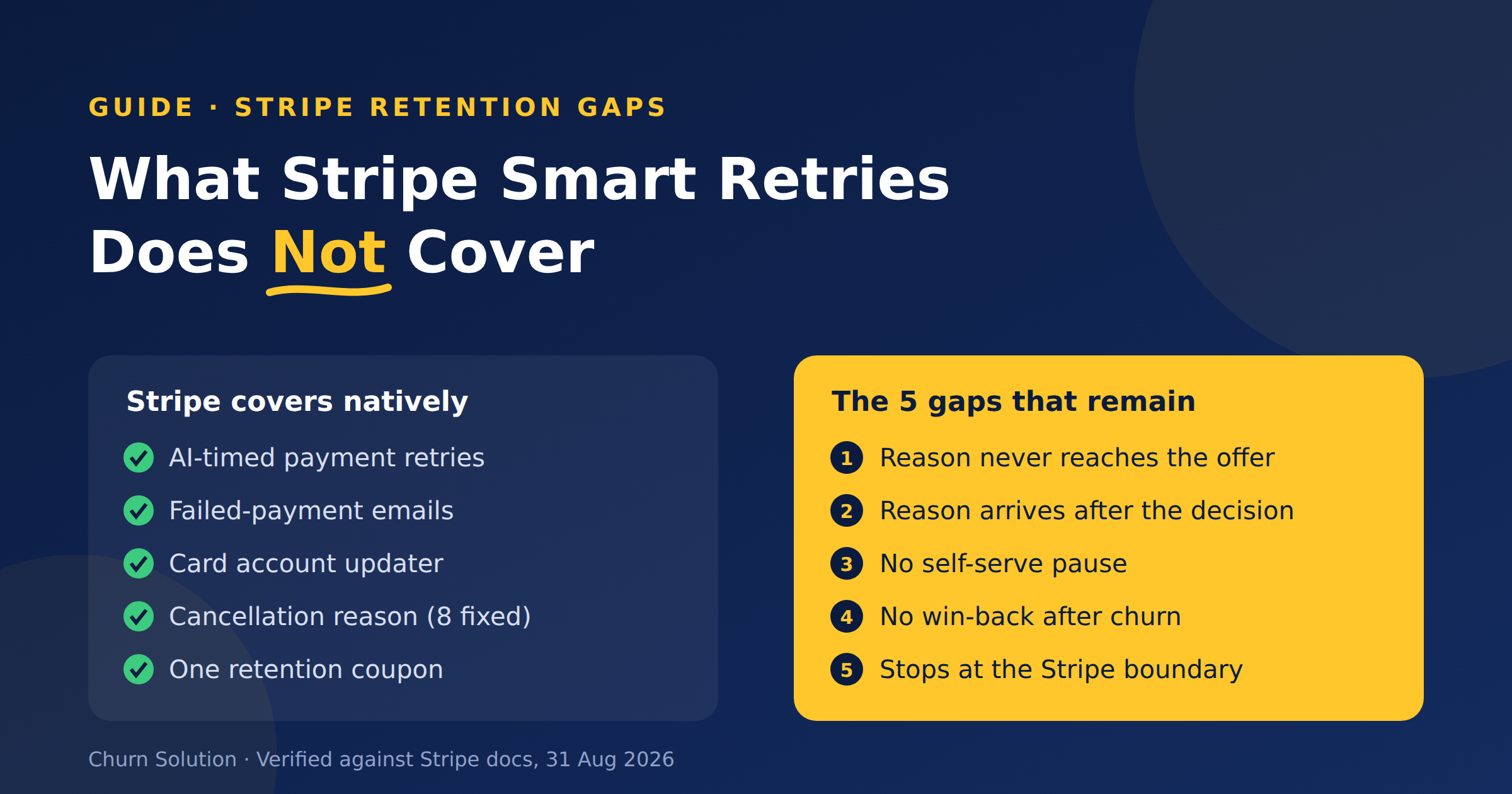
What Stripe Smart Retries Does Not Cover
Stripe Smart Retries recovers failed payments but doesn't run retention. Here are the five gaps that remain, sourced from Stripe's...

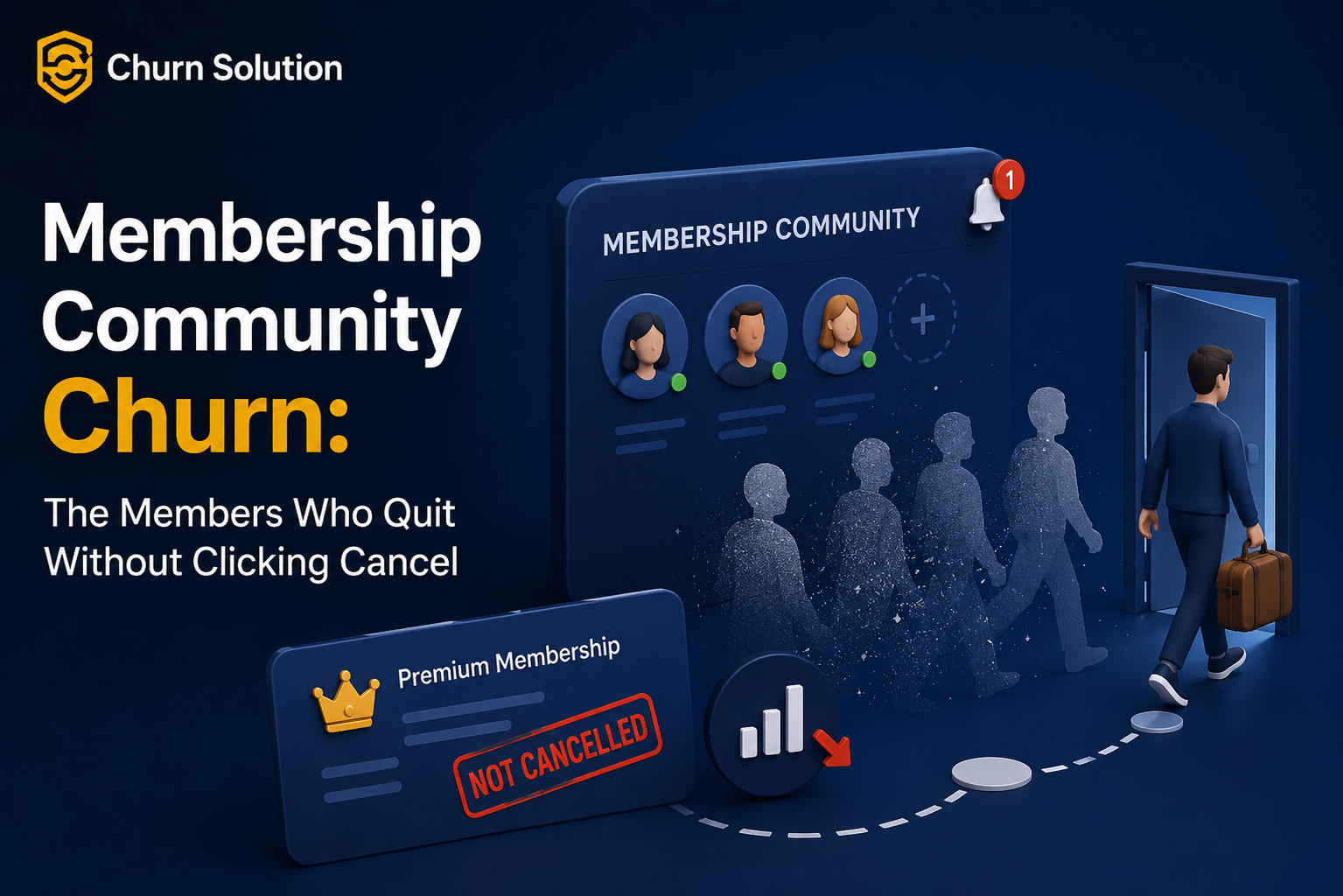
Membership Community Churn: The Members Who Quit Without Clicking Cancel
Quiet churn is the real leak: members who never clicked “cancel” at all. A card expires. A bank declines a...

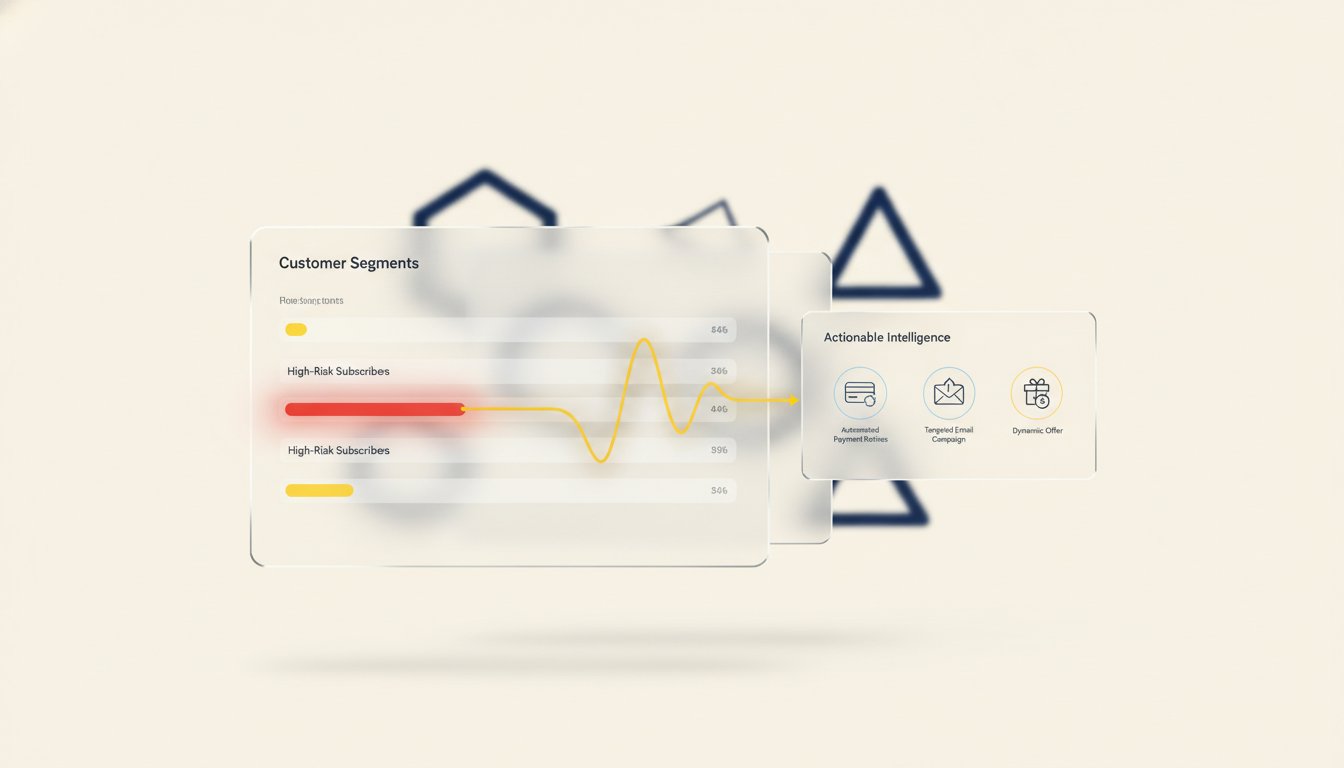
Subscription Churn Dashboard: The 2026 Guide to Actionable Revenue Intelligence
Up to 40% of subscription churn is involuntary, meaning your customers aren't choosing to leave; they're being forced out by...