ARTICLE
Mastering Win-Back Campaign Automation: The 2026 Revenue Recovery Playbook
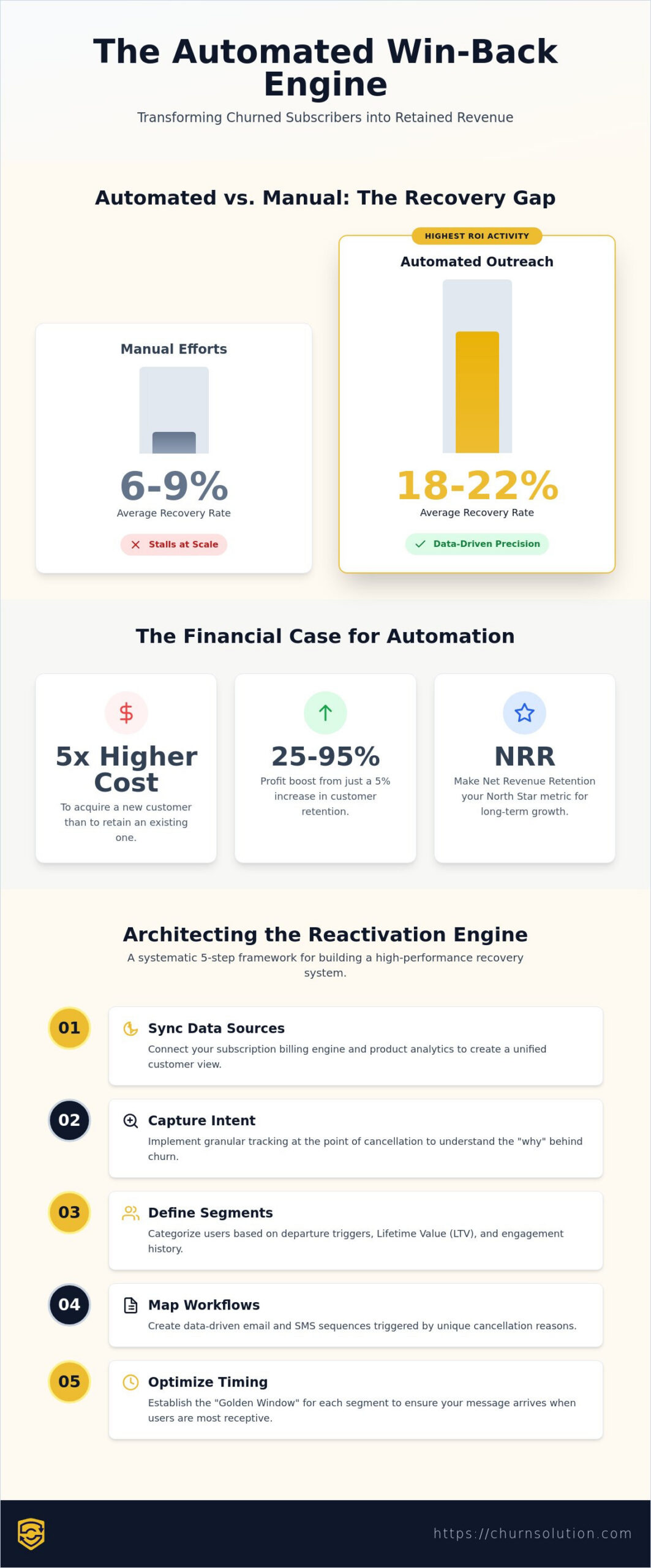
Organizations that automate lapsed-customer outreach recover 18-22% of churned accounts on average, while manual efforts typically stall at 9%. In an era where customer acquisition costs are skyrocketing, letting a “saveable” subscriber walk away is more than a missed opportunity; it’s a direct hit to your bottom line. You’ve likely seen your generic, discount-heavy emails ignored by the very users you need to reach. Relying on margin-killing offers to buy back loyalty only erodes brand value. Sophisticated win-back campaign automation requires a data-driven approach that identifies why users left and offers a precise reason to return.
We’ll show you how to architect a high-performance recovery engine that protects your margins and secures your long-term growth. This playbook covers the systematic identification of reactivatable segments, strategies to improve Net Revenue Retention (NRR), and the implementation of automated feedback loops. You’ll learn to transform your cancellation process into a sophisticated data loop that reactivates lapsed subscribers and prevents future churn. It’s time to move beyond the discount trap and start recovering revenue with technical precision.
Key Takeaways
- Understand why automated interventions recover up to 22% of churned accounts and why this is the highest ROI activity in your 2026 growth stack.
- Discover how to identify “saveable” churn by segmenting users based on specific departure triggers during the critical “Golden Window” for re-engagement.
- Architect a sophisticated win-back campaign automation engine that uses data-driven sequences to reactivate subscribers without relying on margin-killing discounts.
- Leverage AI Feedback Analysis to categorize churn reasons and deploy dynamic offers that address the root cause of a user’s departure.
- Master the transition to Net Revenue Retention (NRR) as your North Star metric to quantify the long-term impact of your reactivation efforts.
The Economics of Automated Win-Back Campaigns in 2026
A win-back campaign is a systematic, automated series of interventions designed to reactivate lapsed or churned subscribers. In 2026, this system isn’t a luxury; it’s a financial necessity. As customer acquisition costs (CAC) continue to climb, the ability to recover lost users represents the highest ROI activity in your growth stack. Research indicates that increasing customer retention by just 5% can boost profits by 25% to 95%. When you consider that acquiring a new customer costs up to five times more than keeping an existing one, the math for win-back campaign automation becomes undeniable.
The industry is shifting. We’re seeing a fundamental transition from simple “Save Flows” to sophisticated “Reactivation Engines.” While save flows attempt to prevent the initial departure, win-back automation captures the revenue that has already leaked. This strategy is about protecting your Net Revenue Retention (NRR) and extending the Lifetime Value (LTV) of users who have already demonstrated a need for your product. By treating churned users as a high-intent lead source rather than lost causes, you turn your exit door into a revolving one.
Why Manual Win-Back Efforts Fail at Scale
Most manual recovery attempts suffer from a critical latency problem. If your team waits 30 days to reach out to a churned account, the user has likely already integrated a competitor’s solution. Manual efforts are also notoriously inconsistent. Messaging varies between team members, and offer delivery lacks the precision needed for different customer segments. Without a direct feedback loop between the reason for departure and the reactivation offer, these manual emails are often dismissed as generic spam. Scale requires a level of speed and personalization that human teams simply cannot maintain without technological assistance.
Reactivation as a Revenue Protection Pillar
Implementing a dedicated reactivation module is a core component of a modern subscription revenue protection strategy. Instead of relying on blunt-force marketing, top-tier SaaS organizations use surgical, automated interventions to stabilize MRR during periods of market volatility. According to Gartner 2024 Customer Retention Research, organizations that automate their lapsed-customer outreach recover 18-22% of churned accounts on average over a 90-day period. This is a significant leap from the 6-9% recovery rates seen in manual efforts. Automation ensures that every “saveable” user receives the right message at the exact moment they are most likely to return, protecting your bottom line from avoidable erosion.
Architecting the Automation Engine: Triggers and Segmentation
Precision is the cornerstone of a high-performance win-back campaign automation engine. Sending a generic “We miss you” email to every churned user is an inefficient use of your brand’s digital real estate. Effective recovery requires a system that deciphers the specific signals left behind at the moment of departure. By analyzing churn metrics and historical usage patterns, you can predict which users have the highest probability of reactivation and tailor your outreach accordingly.
Building this engine requires a methodical approach to data orchestration. Follow this five-step setup to establish your recovery framework:
- Sync Data Sources: Connect your subscription billing engine and product analytics to your automation platform.
- Capture Intent: Implement granular tracking at the point of cancellation to identify the “why” behind the churn.
- Define Segments: Categorize users based on their Lifetime Value (LTV) and engagement history.
- Map Workflows: Create specific email and SMS sequences triggered by unique cancellation reasons.
- Optimize Timing: Establish the “Golden Window” for each segment to ensure your message arrives when the user is most receptive.
Timing is as critical as the message itself. For B2B SaaS, re-engagement campaigns targeting former clients close at 3-5 times the rate of cold outreach, but only if the intervention is timed correctly. Reaching out too early feels desperate; reaching out too late allows a competitor to solidify their position. Most successful engines launch their first automated touchpoint within 72 hours of the subscription ending, followed by a strategic sequence over the next 90 days. You can start building your first automated sequence today to capture these high-intent opportunities.
High-Intent Triggers for Reactivation
The most powerful trigger in your arsenal is the exit survey. When a user explicitly states they are leaving due to a missing feature or temporary budget constraints, your automation engine should immediately tag them for a specific follow-up workflow. Involuntary churn, caused by failed payments or expired cards, requires a “Billing Success” trigger that reactivates the account the moment payment details are updated. Finally, use “Feature Launch” triggers to automatically notify former users when you ship the specific functionality they requested before leaving.
Advanced Customer Segmentation for Win-Back
Effective win-back campaign automation relies on sophisticated customer segmentation to protect your margins. You must prioritize recovery efforts for high-LTV accounts while avoiding the trap of over-incentivizing users who were likely to return on their own. Segment your audience by churn reason to distinguish between price-sensitive users and those who left due to a lack of perceived value. This distinction allows you to deploy education-based content for the latter and targeted, dynamic offers for the former, ensuring your recovery strategy remains both surgical and profitable.
Escaping the ‘Discount Trap’ with AI Feedback Analysis
The “discount trap” is a recurring failure point in legacy recovery strategies. By defaulting to a generic 50% off coupon, you effectively train your users to churn whenever they want a deal. This behavior erodes brand equity and destroys your margins. Modern win-back campaign automation relies on intelligence rather than desperation. By leveraging AI feedback analysis, you can decode the specific reasons behind a user’s departure and respond with a targeted, value-based intervention.
Intelligence-led recovery requires you to match the “save” to the “gripe” automatically. Instead of a blunt-force discount, use dynamic offers that align with the user’s stated friction points. If a user left because they lacked the time to implement your tool, offering a price cut won’t solve their problem. However, offering a three-month account pause might. Data shows that providing a pause functionality often outperforms a 20% discount for long-term retention. It keeps the user’s data intact and removes immediate financial pressure without devaluing the service.
Matching Offers to Churn Reasons
Precision is everything in high-stakes revenue recovery. When your system identifies a “too expensive” reason, the automated response should trigger a downgrade to a lighter tier or a temporary price adjustment. If the reason is “missing features,” your automation should offer exclusive beta access or a personalized walkthrough of your latest product updates. For users who simply have “no time,” the “Pause” alternative ensures they remain in your ecosystem without active billing. This makes it significantly easier to reactivate them when their schedule clears, as their existing configurations remain ready for use.
Using AI to Predict Offer Efficacy
Static sequences are a relic of the past. High-performance teams use A/B experiments to test which incentives resonate most with specific segments. AI layers can now analyze sentiment data from exit surveys to refine your reactivation copy in real-time. This transition toward reinforcement learning allows your engine to predict which offer has the highest probability of success based on historical outcomes. You’re no longer guessing. You’re deploying the exact mechanism required to recover the account based on verified data signals.
Orchestrating the Multi-Channel Sequence
Successful win-back campaign automation is a choreographed multi-channel experience. It isn’t a single email; it’s a 60-day roadmap designed to stay top-of-mind without becoming a nuisance. You must guide the lapsed user through a logical progression of value and incentives. This strategy ensures that your brand remains the obvious choice when the user’s circumstances change or their current alternative fails to deliver. By maintaining a structured cadence, you prevent the account from going cold while respecting the user’s decision to depart.
- The ‘Soft Nudge’ (Day 1-3): Acknowledge the departure with professional grace. Provide a ‘no-strings’ value add, such as an industry benchmark report or a curated list of resources, to maintain a positive brand association without asking for anything in return.
- The ‘Value Re-Discovery’ (Day 7-10): Shift the focus to product evolution. Showcase specific improvements, new integrations, or ROI benchmarks the user might have missed during their final months of activity to demonstrate that the product is growing with the market.
- The ‘Incentivized Return’ (Day 20-30): Introduce a time-bound reactivation offer. This is the moment to deploy the dynamic incentives discussed in previous sections, ensuring the offer directly addresses the original churn reason captured in your exit data.
- The ‘Sunset’ Message (Day 60): Finalize the sequence. Acknowledge that you’ll stop active outreach while leaving the door open for a future return, ensuring your brand remains accessible if their needs change later.
You can deploy your multi-channel sequence within minutes to start capturing lost revenue with professional precision.
Beyond the Inbox: Push and In-App Reactivation
Email is only one pillar of a robust recovery strategy. For mobile-first SaaS, push notifications offer a direct line to the user’s device, bypassing crowded inboxes entirely. You should synchronize these notifications with retargeting ads on professional networks to create a surround-sound effect that reinforces your value proposition. The customer portal plays a vital role here; it must serve as a frictionless destination where reactivation is a single-click experience. When a user clicks a retargeting ad or a push alert, they should land on a page that already knows their history and has their specific reactivation offer pre-loaded for immediate execution.
Best Practices for Win-Back Copy and Creative
Stop using the “We Miss You” cliché. It’s self-centered and fails to address the user’s business needs. Instead, focus on user-centric benefits and specific milestones they achieved while using your platform. Personalization at scale requires dynamic fields that reference their past usage data or specific ROI targets they hit, proving that you understand their unique business context. A breakup email serves as a strategic tool for list hygiene and final conversion by forcing a definitive decision from the user. It signals that your active pursuit is ending, which often triggers a response in users who were on the fence about returning but needed a final nudge to take action.
Measuring Success and Scaling Your Win-Back Strategy
Net Revenue Retention (NRR) is the North Star metric for any subscription business. It provides the ultimate validation of your growth strategy by quantifying how much revenue you retain from your existing customer base over time. Implementing win-back campaign automation is the most direct lever you have to influence this number. While acquisition focuses on the top of the funnel, reactivation protects the core. To scale effectively, you must move beyond viewing win-back as a reactive tactic and start treating it as a primary revenue driver.
Calculating the ROI of these campaigns requires a rigorous approach to data. You must factor in the cost of incentives, such as temporary discounts or service credits, against the recovered Lifetime Value (LTV) of the reactivated account. A successful campaign doesn’t just bring a user back; it does so at a cost that is significantly lower than your standard CAC. Integrating this data into your broader customer churn analysis allows you to identify which segments are most profitable to recover and which should be sunsetted to protect your margins.
Key Performance Indicators (KPIs) for Reactivation
To quantify the efficacy of your recovery engine, track these three essential KPIs. The Reactivation Rate measures the percentage of churned users who return within a 90-day window, providing a high-level view of your campaign’s reach. Time-to-Reactivate is equally critical; it measures how fast your automation works to close the revenue gap before the user’s habit of using your tool completely fades. Finally, focus on Incremental LTV. This metric calculates the additional revenue generated by reactivated users compared to their original acquisition cost, ensuring that your win-back efforts are contributing to long-term profitability rather than just inflating short-term user counts.
Continuous Optimization of the Retention Loop
A sophisticated retention strategy is a closed loop. The insights you gain from successful win-back campaigns should be fed directly back into your automated cancellation flows to prevent churn earlier in the lifecycle. If you find that a specific “Pause” offer is highly effective at winning back users who left due to a lack of time, move that offer into your exit survey as a pre-emptive save. Furthermore, you must address the technical leaks in your revenue bucket. Use smart retries and payment recovery to stop involuntary churn before it ever requires a win-back intervention. Churn Solution serves as the definitive partner for this end-to-end revenue protection, transforming your data into a fortified ecosystem of retention and recovery.
Secure Your Revenue Future with Precision Recovery
Dominating the subscription economy in 2026 requires more than just aggressive acquisition. It demands a sophisticated engine that plugs revenue leaks and reactivates lost users with surgical accuracy. By moving beyond the generic “discount trap” and leveraging AI-driven feedback analysis to personalize every offer, you transform your exit flow into a high-performance growth channel. You’ve seen how data-driven triggers and multi-channel orchestration can stabilize your MRR and protect your brand equity.
Implementing a robust win-back campaign automation strategy ensures that your brand remains the logical choice for lapsed subscribers. This playbook has detailed how to orchestrate sequences and prioritize high-LTV segments to maximize Net Revenue Retention. Success is no longer about guessing why users leave; it’s about using those insights to build a more resilient and predictable business model.
You don’t have to let saveable revenue walk away. With seamless integration into Stripe and major billing engines, our technology is proven to recover up to 40% of churned subscribers. It’s time to take control of your retention loop. Start recovering lost revenue with Churn Solution’s automated win-back engine today and build a more profitable future. Your recovered revenue is waiting.
Frequently Asked Questions
What is the difference between a re-engagement campaign and a win-back campaign?
The primary distinction is the lifecycle stage of the target user. A re-engagement campaign focuses on current subscribers who have stopped using the product, whereas a win-back campaign targets users who have already cancelled. Re-engagement aims to prevent churn before it happens. Win-back efforts are designed to reactivate revenue that has already leaked from your ecosystem. Both are essential, but they require different messaging strategies and incentive structures.
How long should I wait before starting an automated win-back sequence?
Launch your first automated touchpoint within 72 hours of a subscription ending to capitalize on the “Golden Window.” This immediate acknowledgement keeps your brand relevant while the user’s workflow transition is still fresh. Following this, distribute subsequent messages over a 90-day period. Waiting longer than 30 days significantly reduces the probability of recovery as users integrate competitor solutions.
Is it better to offer a discount or a free month in a win-back email?
Neither is universally better; you must match the incentive to the specific churn reason. AI feedback analysis reveals whether a user left due to price sensitivity or lack of time. Price-sensitive users respond well to discounts or lighter tiers. Users with limited time often prefer a “Pause” functionality or a free month that allows them to re-evaluate the product without immediate financial commitment.
How can I automate win-back campaigns for involuntary churn?
Integrate dunning email automation and smart retries into your billing stack to address involuntary churn before it requires a manual win-back. These tools automatically handle failed payments and expired cards. If a payment remains unrecovered after the retry cycle, trigger a specific billing-recovery sequence that directs the user to a frictionless payment update portal to reactivate their access.
What are the best triggers for a SaaS win-back automation?
The most effective triggers are exit survey responses, feature releases, and billing failures. When a user cites a missing feature as their reason for leaving, an automated notification of that feature’s launch acts as a high-intent reactivation signal. Win-back campaign automation should also trigger based on high-LTV status to prioritize high-margin account recovery while protecting your overall margins.
How do I measure the ROI of my reactivation efforts?
Measure success by tracking Net Revenue Retention (NRR) and the incremental LTV of reactivated users. Calculate the total recovered revenue over a 90-day period and subtract the cost of incentives and campaign operations. This provides a clear view of your reactivation ROI. Compare this to your standard customer acquisition cost to validate the efficiency of your recovery engine compared to cold outreach.
Should I use SMS for B2B win-back campaigns?
SMS is highly effective for B2B win-back campaigns when used for high-urgency alerts or high-LTV account recovery. It bypasses crowded email inboxes and sees significantly higher open rates. However, ensure your SMS outreach is synchronized with your email sequences to avoid overwhelming the user. Keep the messaging professional, concise, and focused on direct value or urgent account updates.
How often should I refresh my win-back campaign content?
Refresh your campaign creative and offers at least once per quarter to prevent content decay and engagement fatigue. Use A/B testing to identify when reactivation rates begin to stall. You should also update your sequences whenever you launch significant product improvements or change your pricing model. Continuous optimization ensures your messaging remains aligned with the current market reality and your latest product value.
- Key Takeaways
- Table of Contents
- The Economics of Automated Win-Back Campaigns in 2026
- Architecting the Automation Engine: Triggers and Segmentation
- Escaping the 'Discount Trap' with AI Feedback Analysis
- Orchestrating the Multi-Channel Sequence
- Measuring Success and Scaling Your Win-Back Strategy
- Secure Your Revenue Future with Precision Recovery
- Frequently Asked Questions

Churn solution that turns your customers right around.
Related Articles
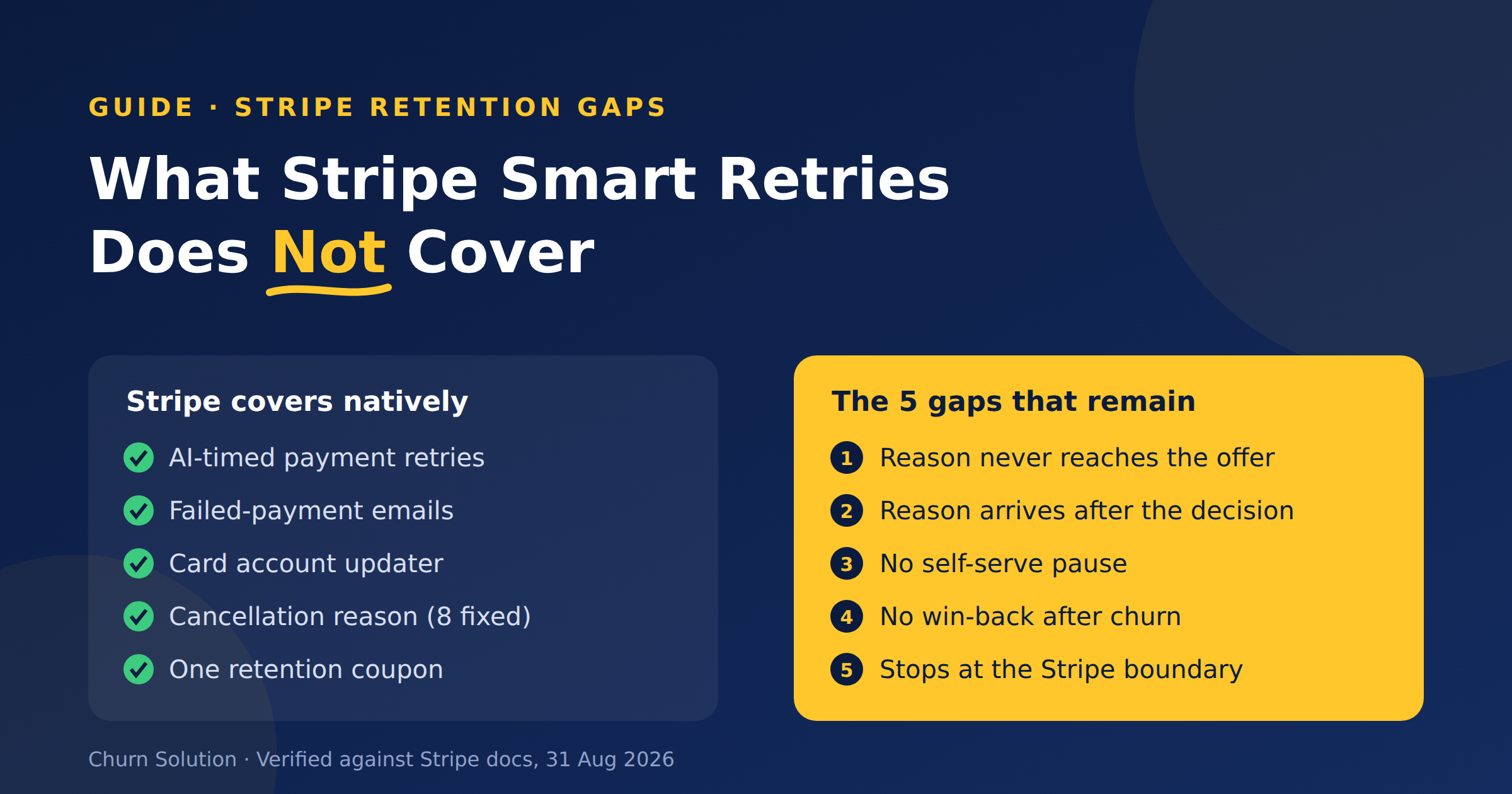
What Stripe Smart Retries Does Not Cover
Stripe Smart Retries recovers failed payments but doesn't run retention. Here are the five gaps that remain, sourced from Stripe's...

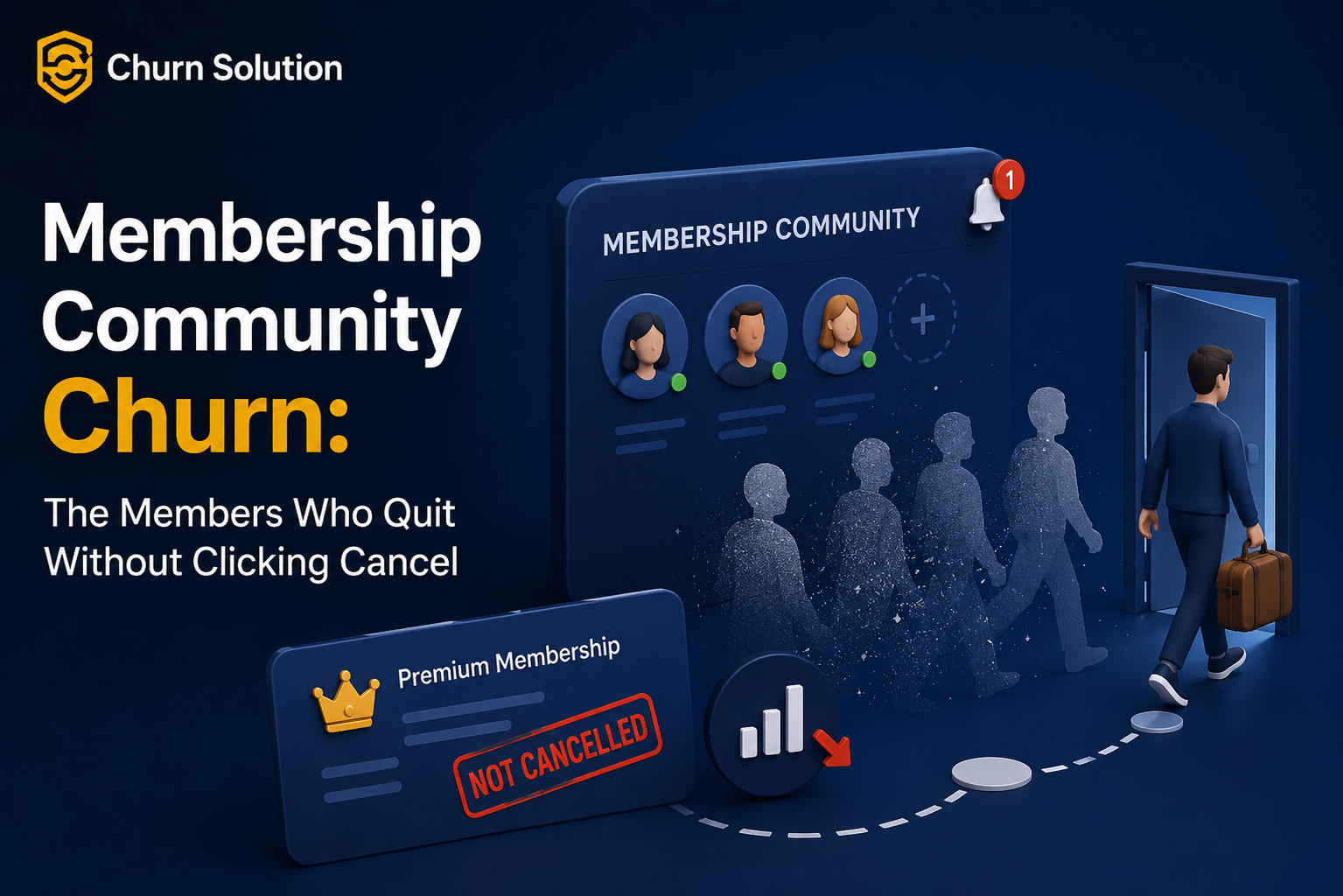
Membership Community Churn: The Members Who Quit Without Clicking Cancel
Quiet churn is the real leak: members who never clicked “cancel” at all. A card expires. A bank declines a...

Subscription Churn Dashboard: The 2026 Guide to Actionable Revenue Intelligence
Up to 40% of subscription churn is involuntary, meaning your customers aren't choosing to leave; they're being forced out by...