ARTICLE
Reasons for Customer Churn: The 2026 Guide to Revenue Retention

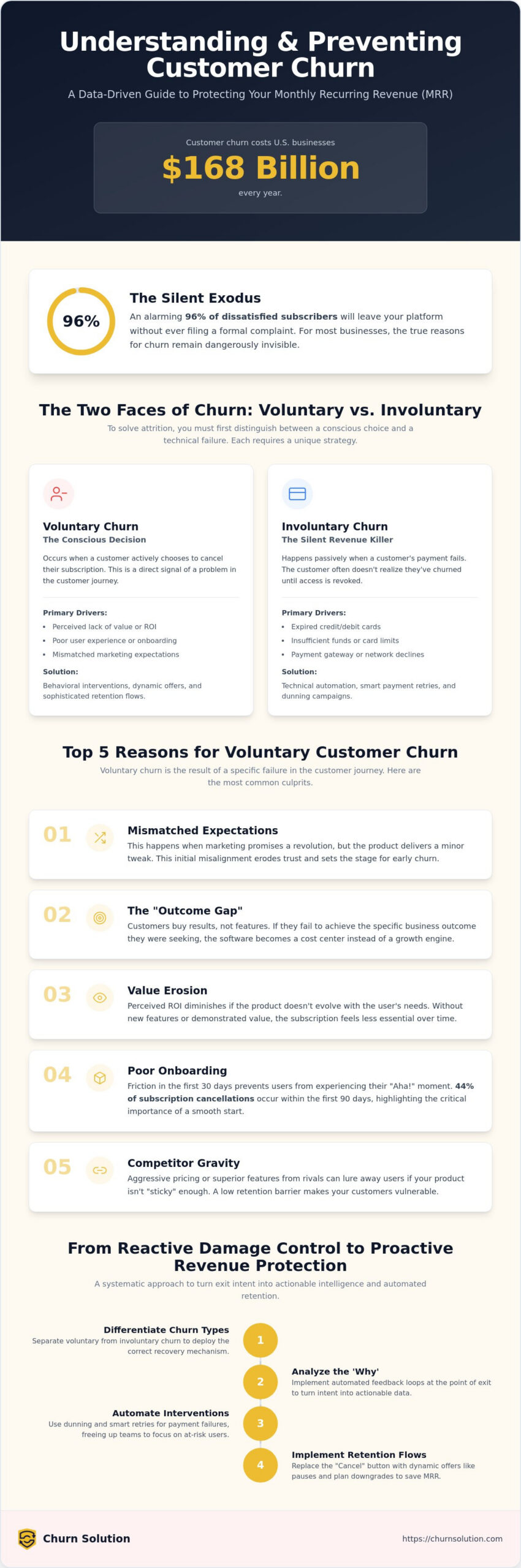
Customer churn costs U.S. businesses $168 billion per year, yet 96% of dissatisfied subscribers will leave your platform without ever filing a formal complaint. For most subscription leaders, the true reasons for customer churn remain obscured by a lack of actionable data. You’ve likely seen your customer acquisition costs climb while your MRR becomes increasingly unpredictable. It’s exhausting to watch manual win-back efforts fail to move the needle at scale.
You need a system that acts as a strategist, identifying leaks and plugging them before they drain your bottom line. We’ll show you how to move from reactive damage control to proactive revenue protection. This guide identifies the hidden drivers of subscriber loss and teaches you how to deploy automated interventions to protect your MRR. We will analyze a clear taxonomy of churn, explore automated systems to recover failed payments, and show you how to turn every departure into a data-driven insight.
Key Takeaways
- Differentiate between voluntary dissatisfaction and involuntary payment failures to deploy the correct recovery mechanism for every lost dollar.
- Identify the primary reasons for customer churn, from mismatched marketing expectations to the critical “Outcome Gap” where users lose sight of product value.
- Combat the silent revenue drain of involuntary churn by optimizing for the technical complexities of the modern global payment ecosystem.
- Convert exit intent into actionable intelligence by implementing automated feedback loops that reveal exactly why subscribers are departing.
- Replace traditional “Cancel” buttons with sophisticated retention flows that use dynamic offers like pauses and downgrades to protect your MRR.
Categorizing Churn: Voluntary vs. Involuntary Revenue Loss
Churn is not a single metric. It’s a complex set of behaviors and technical failures that erode your MRR. To solve for high attrition, you must first dissect the two primary categories: voluntary and involuntary revenue loss. Treating them as a single line item is a strategic mistake that masks the actual reasons for customer churn. This distinction is critical because it defines your intervention strategy. You can’t outpace a leaky bucket with aggressive acquisition; the “Churn Gap” will eventually consume your margins if your retention systems aren’t as sophisticated as your marketing engine. The Churn Gap represents the point where the cost of replacing lost users exceeds the profit generated by new ones, making sustainable growth impossible.
Voluntary churn occurs when a user makes a conscious decision to leave. They interact with your interface, navigate to the settings, and initiate a cancellation. This is often driven by dissatisfaction, a perceived lack of value, or changing business needs. In contrast, involuntary churn is the “silent killer” of the subscription economy. It happens when a payment fails due to an expired card, insufficient funds, or a network decline. The customer often doesn’t even know they’ve left until their access is revoked. In 2026, high-growth companies must track these as separate KPIs to deploy targeted interventions that address the root cause of the loss.
The True Cost of a Lost Subscriber
Every departing user represents more than just a dip in monthly revenue. Churn directly impacts your Lifetime Value (LTV) and extends the timeline for recovering your Customer Acquisition Cost (CAC). When a subscriber leaves before the CAC break-even point, you’re effectively paying to lose money. Beyond the balance sheet, high Customer attrition rates damage investor confidence and suppress SaaS valuations by signaling a lack of product-market fit. In the context of Net Revenue Retention (NRR), churn rate is the percentage of recurring revenue lost from your existing customer base over a specific period.
Identifying Active vs. Passive Cancellations
Distinguishing between active and passive cancellations is the first step toward recovery. Active cancellations require a behavioral intervention, such as a specialized cancellation flow or a dynamic offer. Passive churn, however, is a technical problem that requires technical solutions. While a user who hits “cancel” might be gone for good, a user whose card simply expired is often easy to retain with the right dunning automation and smart retries. By automating these recovery workflows, you can stabilize your revenue health and focus your manual efforts on the complex psychological reasons for customer churn that require human-centric strategy.
The Top 5 Reasons for Voluntary Customer Churn
Voluntary churn isn’t a random event. It’s the calculated result of a specific failure in the customer journey. When a user actively cancels, they’re signaling that the cost of your solution now outweighs its perceived utility. To protect your MRR, you must master the primary reasons for customer churn that drive users to the exit. These drivers are often psychological, yet they require technical, automated responses to mitigate at scale. Identifying these friction points early allows you to intervene before the cancellation becomes permanent.
- Mismatched Expectations: This occurs when your marketing promises a revolution, but the product delivers a spreadsheet. This misalignment creates immediate friction and erodes trust.
- The “Outcome Gap”: Users don’t buy features; they buy results. If they don’t achieve the specific business outcome they sought, your software becomes a line-item expense rather than a growth engine.
- Value Erosion: Perceived ROI diminishes over time if the product doesn’t evolve with the user’s needs. This leads to the “Commodity Trap” where price becomes the only differentiator.
- Poor Onboarding: Friction in the first 30 days prevents “Aha!” moments. Statistics show that 44% of subscription box cancellations occur within the first 90 days of the lifecycle.
- Competitor Gravity: Aggressive pricing or superior feature parity from rivals can lure away even satisfied users if your retention barriers are low and your “stickiness” is weak.
Mismatched Expectations and the Onboarding Trap
A lack of clear guidance during the first user session leads to immediate exit intent. You have a narrow window to prove utility. This is your “Time to Value” (TTV). If TTV is too long, the user stalls and churns before they ever realize the product’s potential. High-performance teams Conquer Customer Churn with AI by analyzing early behavior patterns and deploying automated interventions when a user disengages. Personalizing the early journey based on user intent ensures that every subscriber sees the most relevant features first, effectively shortening the path to success.
Value Erosion and the “Commodity” Trap
Feature fatigue is a silent revenue killer. Users often feel they’re overpaying for a massive suite of tools when they only use a fraction of the functionality. This leads to the perception that your product is a commodity. Product-led retention strategies combat this by highlighting unused features that solve the user’s specific pain points. Implementing advanced customer_segmentation ensures you deliver targeted value propositions that resonate with specific user cohorts rather than relying on a “one-size-fits-all” approach. If you’re ready to stop the bleed, you can start building your retention flow today.
Involuntary Churn: The Silent Revenue Killer in 2026
While voluntary dissatisfaction is a visible threat, involuntary payment failure is the true silent killer of subscription growth. Research indicates that involuntary churn accounts for 20% to 40% of total subscriber loss across the subscription economy. In the subscription box sector, this figure can escalate to 68%. These aren’t users who decided to leave; these are “Accidental Cancellers” who intended to stay but were forced out by technical friction. In the 2026 landscape, the technical reasons for customer churn are more complex than ever, requiring more than just a basic billing engine to solve.
The modern payment ecosystem is a minefield of potential failure. Between Strong Customer Authentication (SCA) mandates and fluctuating regional banking regulations, the path from card swipe to settled revenue is fraught with risk. Relying on manual outreach to resolve these failures is a legacy strategy that fails to scale. It’s high-friction and often alerts the customer to a subscription they might have otherwise kept on autopilot. You need an automated, invisible layer of protection that fixes the transaction before the user even realizes there’s a problem.
Expired Cards and Network Declines
Soft declines, such as temporary insufficient funds or processing timeouts, require a different recovery logic than hard declines like a reported stolen card. You must optimize your payment recovery process by deploying automated dunning emails that notify users before the card actually expires. This proactive stance keeps revenue flowing without requiring a manual support ticket. By categorizing declines accurately, you can apply the correct retry logic to every failed attempt, ensuring you don’t burn through your merchant account’s reputation or lose a salvageable customer.
The Friction of Manual Payment Updates
Users hate navigating complex billing portals. If updating a credit card takes more than two clicks, many subscribers will simply abandon the process. This friction is one of the primary technical reasons for customer churn. Implementing smart retries allows you to bypass temporary bank outages by timing the retry attempt for when the transaction is most likely to succeed. This isn’t guesswork; it’s a data-driven intervention. The timing of your dunning sequence is equally critical. Sending a recovery email at 3:00 AM on a Tuesday is significantly less effective than reaching the user when they’re likely to have their wallet handy.
Analyzing the ‘Why’: Turning Exit Intent into Actionable Data
Stop treating churn as an inevitable tax on growth. When a subscriber leaves without providing feedback, you lose more than their MRR; you lose the intelligence required to prevent the next departure. Most businesses operate in a “Black Box” where users vanish into a void of data-less silence. This lack of visibility is the primary reason why teams struggle to address the actual reasons for customer churn. Every cancellation event must be anchored to a specific, categorized reason to transform a subjective loss into an objective data point for your product team.
High-conversion exit surveys are the mechanism for this transformation. They shouldn’t be a friction point; they should be a strategic conversation. By presenting users with structured choices and open-ended fields, you capture the sentiment behind the exit. Research indicates that 96% of dissatisfied customers don’t complain; they simply leave. Capturing feedback from the remaining 4% provides a representative sample that can be used to predict behavior across your entire at-risk population. This allows you to move from reactive guessing to data-driven intervention.
The Strategic Role of Exit Surveys
A well-designed survey moves beyond surface-level excuses like “it’s too expensive.” Often, price is merely a proxy for a lack of perceived value or a specific technical hurdle. Implementing sophisticated exit surveys allows you to trigger real-time, conditional retention offers based on the user’s specific grievance. If a user selects “missing features,” you can immediately highlight a recent product update or offer a guided tour. AI feedback analysis identifies churn trends before they spike, allowing your leadership to prioritize roadmap items that have the highest direct impact on revenue retention.
Segmenting Churn Reasons for Targeted Recovery
Treating every departure the same is an inefficient use of resources. A user leaving due to a technical bug requires a different intervention than one leaving because of a budget cut. Use A/B experiments to determine which “save” tactics resonate with specific segments. For example, a “budget” segment might respond to a temporary discount, while a “technical” segment might stay if offered a direct line to an engineer. This creates a closed feedback loop between your cancellation desk and your product roadmap. This level of granularity ensures your retention efforts are surgical rather than scattershot. If you’re ready to stop the mystery and start the recovery, start capturing actionable churn data today.
Beyond Identification: Implementing Automated Retention Flows
Identifying the reasons for customer churn is a diagnostic exercise; implementing automated retention flows is the cure. In the 2026 market, a static “Cancel” button is a liability that signals a surrender of revenue. You must transform this exit point into a dynamic Retention Portal. This system acts as an automated strategist, presenting the right save offer at the exact moment of highest friction. By moving from a binary choice to a structured “Save Hierarchy,” you protect your MRR without devaluing your brand through generic discounting.
- The Pause: The most effective save tactic for users facing temporary budget or time constraints.
- The Discount: A targeted reduction to bridge the gap for price-sensitive segments.
- The Extension: Offering additional time or credits to allow the user to reach their “Aha!” moment.
- The Downgrade: Transitioning the user to a lower tier to maintain the relationship and the data flow.
Deploying dynamic offers ensures that your intervention matches the specific driver identified in the exit survey. If a user cites “lack of use,” a discount is irrelevant; they need a pause or a guided feature walkthrough. This strategic alignment is what separates high-performance retention engines from basic billing systems. Don’t settle for a passive loss when you can automate a recovery.
The Psychology of the ‘Pause’ Functionality
Offering a 1-3 month pause is often more effective than a steep discount. Research indicates that 27% of subscribers would choose to cancel outright if they weren’t given the option to pause or skip an order. Subscriptions that provide these flexible options experience 15% to 30% less churn than rigid ones. Reducing friction within your customer portal keeps the user in control, making it easier for them to stay than to leave. For a deeper dive into the mechanics of these systems, consult our Guide to Automated Cancellation Flows.
Automating Reactivation and Win-Backs
The relationship doesn’t end when the subscription lapses. Successful brands treat churned users as high-intent prospects for the future. Use automated reactivation triggers to reach out when a former user shows new intent, such as logging back into the portal or interacting with marketing content. Your “Lapsed User” playbook should include a sequence of touchpoints at 30, 60, and 90 days. Each message must offer a new value proposition, not just a plea to return. You’ll find specific messaging templates in our Subscription Win-Back Playbook to help you recover lost revenue at scale.
Secure Your MRR with Data-Driven Intervention
Identifying the specific reasons for customer churn is only the first step toward building a resilient subscription business. You’ve seen how voluntary dissatisfaction and involuntary payment failures require distinct, automated interventions. By moving from a “Black Box” model to a data-rich retention portal, you transform every departure into a strategic opportunity for platform optimization. The difference between stagnant growth and a high-performance engine lies in your ability to act on these insights in real time.
It’s time to stop the passive drain on your bottom line. You can recover up to 40% of failed payments automatically while gaining deep insights with AI Feedback Analysis. Automate your recovery with Smart Retries and deploy dynamic offers that actually save subscribers. Stop losing revenue to churn; deploy your automated cancellation flow with Churn Solution today.
Your path to sustainable growth starts with total control over your retention metrics. Start plugging the leaks and watch your revenue scale as it should.
Frequently Asked Questions
What are the most common reasons for customer churn in SaaS?
The primary reasons for customer churn in SaaS include mismatched expectations, a failure to reach the “Aha!” moment during onboarding, and the “Outcome Gap” where users don’t achieve their desired results. Feature fatigue and aggressive competitor pricing also contribute to voluntary loss. Identifying these drivers allows you to deploy targeted interventions at the point of exit, turning a potential cancellation into a data-driven save opportunity.
How do you calculate customer churn rate accurately?
To calculate customer churn rate accurately, divide the total number of subscribers lost during a specific timeframe by the total number of active subscribers at the start of that period. Multiply the result by 100 to get a percentage. For a comprehensive view of revenue health, you should also track Net Revenue Retention (NRR) to account for upgrades and downgrades within your existing customer base.
What is the difference between voluntary and involuntary churn?
Voluntary churn occurs when a user makes a conscious decision to cancel their subscription due to dissatisfaction or changing needs. Involuntary churn is a technical failure, typically caused by expired credit cards, insufficient funds, or network declines. While voluntary loss requires behavioral interventions, involuntary churn is a silent revenue killer that is best solved through automated dunning and smart retries.
Can automated cancellation flows actually reduce churn without annoying users?
Automated cancellation flows reduce churn by replacing a binary “cancel” button with a sophisticated retention portal. Instead of forcing an exit, these flows offer personalized alternatives such as account pauses, temporary discounts, or plan downgrades. When executed correctly, these interventions empower the user and provide them with a path to remain active, effectively protecting your MRR without increasing support overhead.
How does AI feedback analysis help in reducing customer churn?
AI feedback analysis processes thousands of qualitative responses from exit surveys to identify hidden patterns in subscriber behavior. It categorizes raw text into actionable insights, allowing your product team to prioritize roadmap items that address the most frequent reasons for customer churn. This technology moves your strategy from reactive damage control to proactive revenue protection based on real user sentiment.
What is a good churn rate for a B2B subscription business in 2026?
As of May 2026, the average monthly churn rate for B2B SaaS businesses is approximately 3.8%. While benchmarks vary by vertical, maintaining a rate below 4% is generally considered a sign of healthy product-market fit. Businesses should aim for “negative churn,” where expansion revenue from existing customers exceeds the revenue lost from those who depart.
How can I recover failed credit card payments automatically?
You can recover failed credit card payments automatically by implementing a combination of smart retries and dunning email automation. Smart retries time the transaction attempts for when they are most likely to succeed based on bank uptime and user behavior. Dunning sequences notify the user of the failure before their access is revoked, allowing them to update their payment method through a low-friction portal.
Should I always offer a discount to customers who try to cancel?
You shouldn’t always lead with a discount; instead, follow a structured “Save Hierarchy.” Start by offering a 1-3 month pause, which research indicates can save up to 30% of at-risk subscribers. If a pause doesn’t work, consider a plan downgrade or a credit extension. Reserve discounts for price-sensitive segments to avoid devaluing your product and training users to expect lower rates.
- Key Takeaways
- Table of Contents
- Categorizing Churn: Voluntary vs. Involuntary Revenue Loss
- The Top 5 Reasons for Voluntary Customer Churn
- Involuntary Churn: The Silent Revenue Killer in 2026
- Analyzing the 'Why': Turning Exit Intent into Actionable Data
- Beyond Identification: Implementing Automated Retention Flows
- Secure Your MRR with Data-Driven Intervention
- Frequently Asked Questions

Churn solution that turns your customers right around.
Related Articles
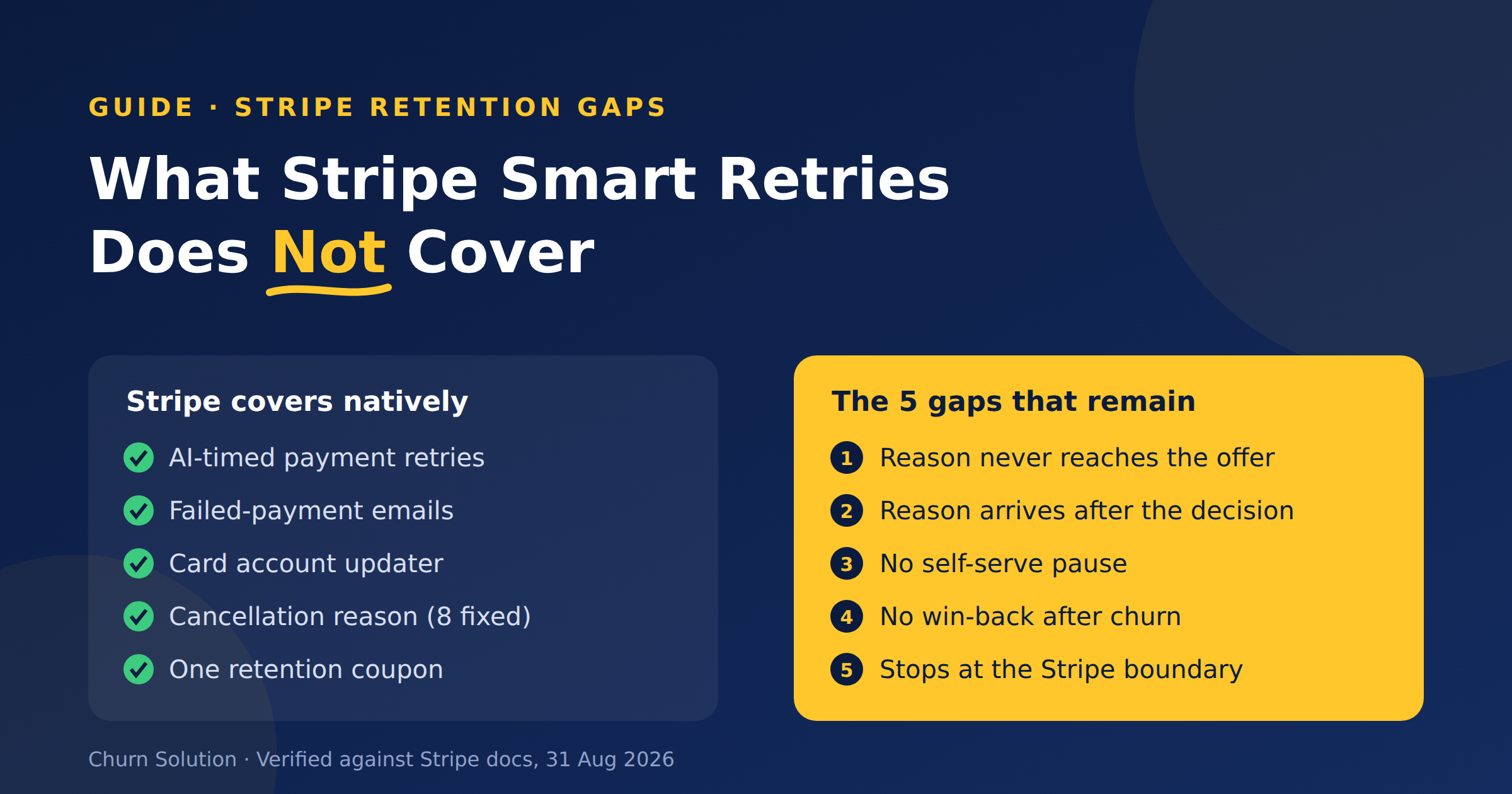
What Stripe Smart Retries Does Not Cover
Stripe Smart Retries recovers failed payments but doesn't run retention. Here are the five gaps that remain, sourced from Stripe's...

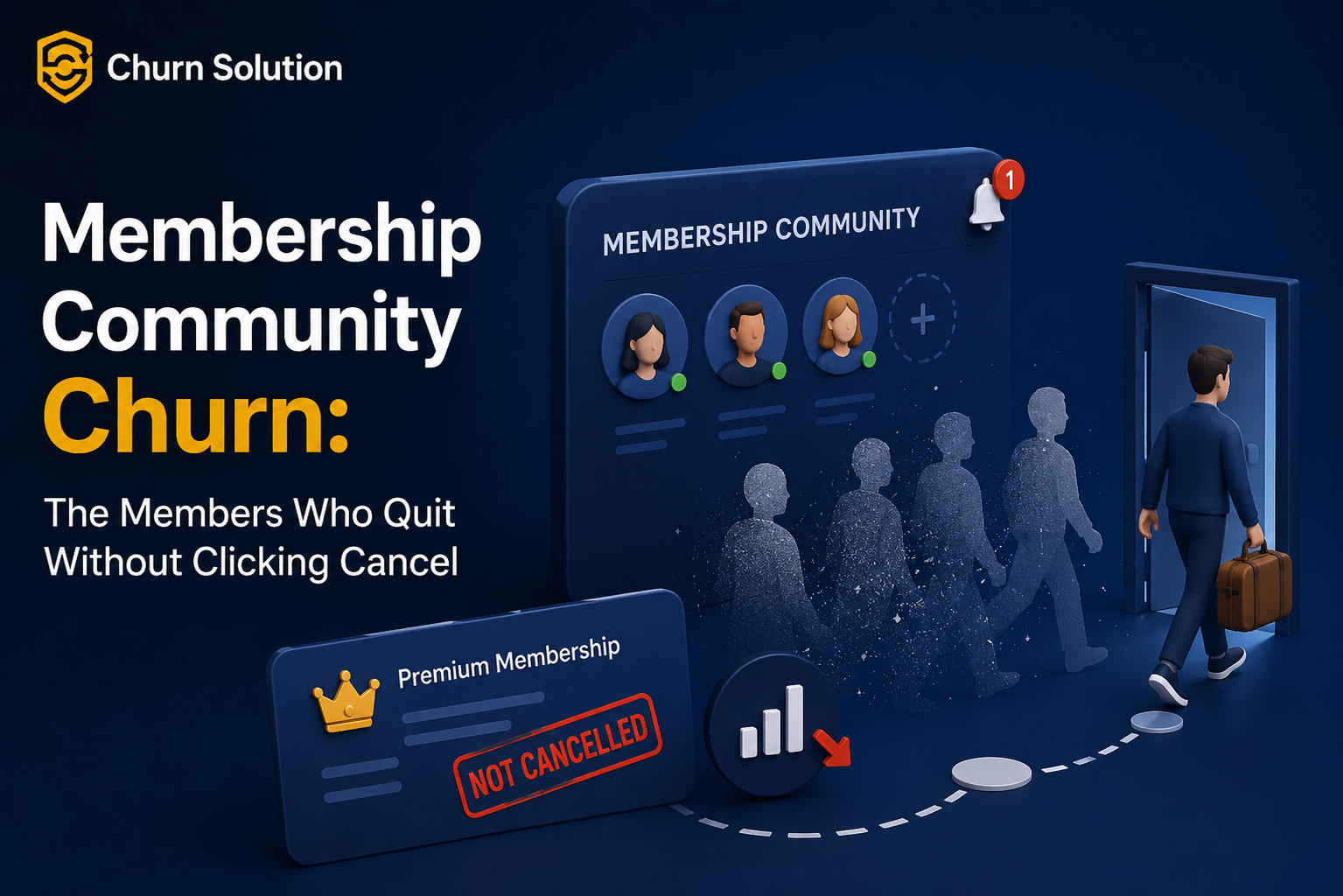
Membership Community Churn: The Members Who Quit Without Clicking Cancel
Quiet churn is the real leak: members who never clicked “cancel” at all. A card expires. A bank declines a...

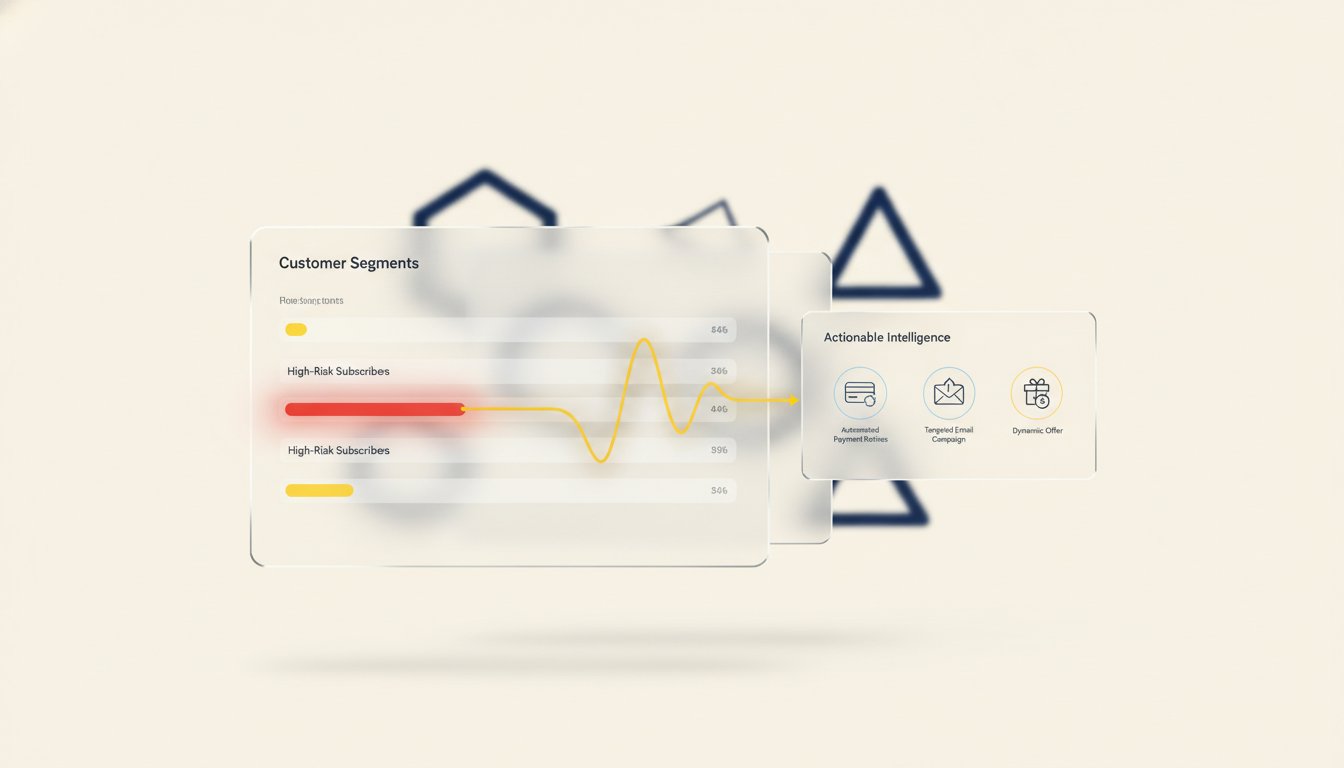
Subscription Churn Dashboard: The 2026 Guide to Actionable Revenue Intelligence
Up to 40% of subscription churn is involuntary, meaning your customers aren't choosing to leave; they're being forced out by...