ARTICLE
Dunning Email Deliverability Issues: Protecting Your Revenue Recovery in 2026
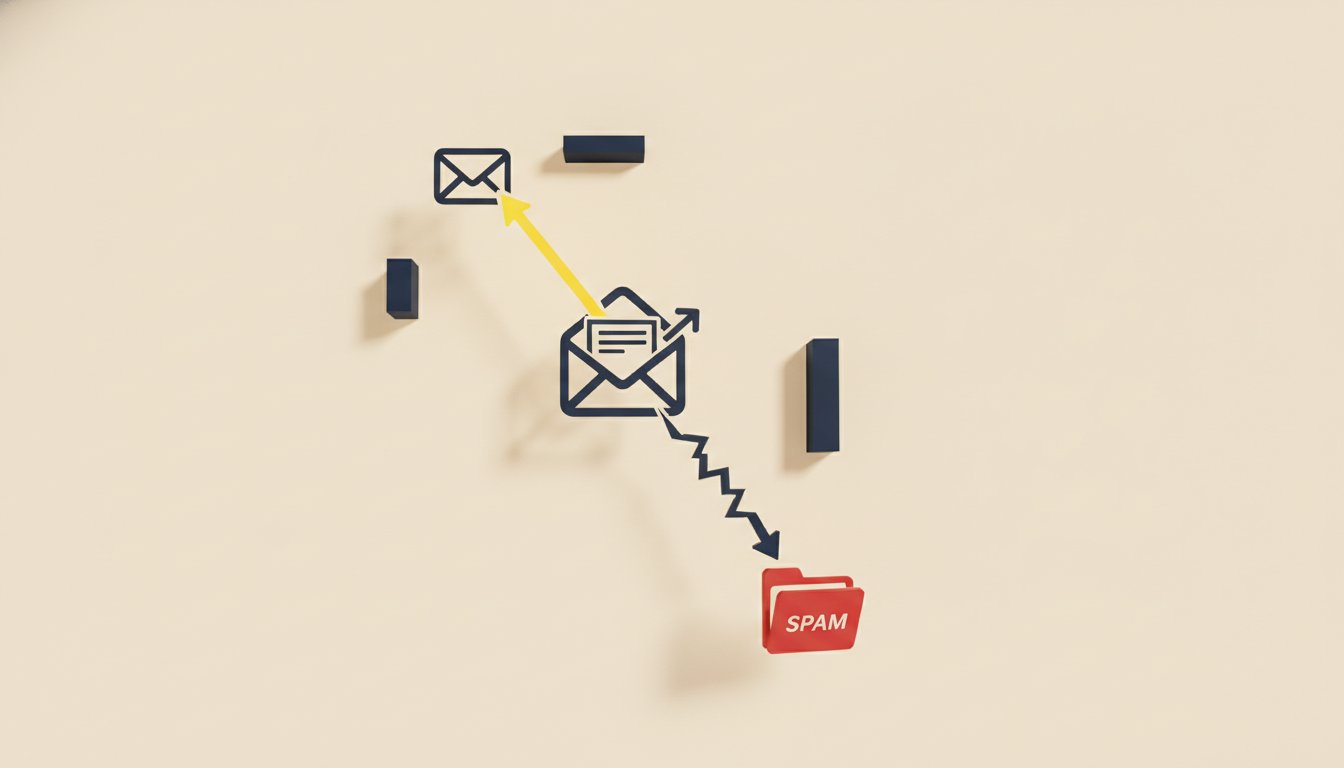
Involuntary churn accounts for up to 40% of all subscription revenue loss, yet the most sophisticated recovery sequence is worthless if it never reaches the customer. If you are noticing high churn despite sending automated notices, you are likely facing critical dunning email deliverability issues that bypass your filters and land straight in the spam folder. Mailbox providers like Google and Yahoo have moved beyond simple filtering. As of 2026, they are outright rejecting emails from senders who fail to meet strict authentication and engagement thresholds.
You understand that every missed inbox placement is a direct hit to your MRR. This article will teach you how to identify and resolve the technical and strategic deliverability bottlenecks that prevent your dunning emails from reaching the inbox and recovering lost revenue. We will analyze the mandatory DMARC enforcement levels, the 0.3% spam complaint threshold, and the specific automated interventions required to protect your sender reputation and secure your growth.
Key Takeaways
- Secure your sender reputation by implementing full SPF, DKIM, and DMARC authentication to meet the strict rejection thresholds enforced by mailbox providers in 2026.
- Eliminate algorithmic rejections by optimizing subject lines and body copy to avoid the common spam triggers associated with aggressive or poorly formatted billing notifications.
- Identify and resolve the technical dunning email deliverability issues that cause critical revenue recovery notices to bypass the inbox and land in the spam folder.
- Integrate Smart Retries with your automated dunning sequences to minimize email frequency and reduce recipient fatigue while maximizing the probability of successful transaction recovery.
- Utilize AI-driven churn metrics to monitor domain health and predict potential deliverability bottlenecks before they impact your bottom line.
The High Cost of Dunning Email Deliverability Failures
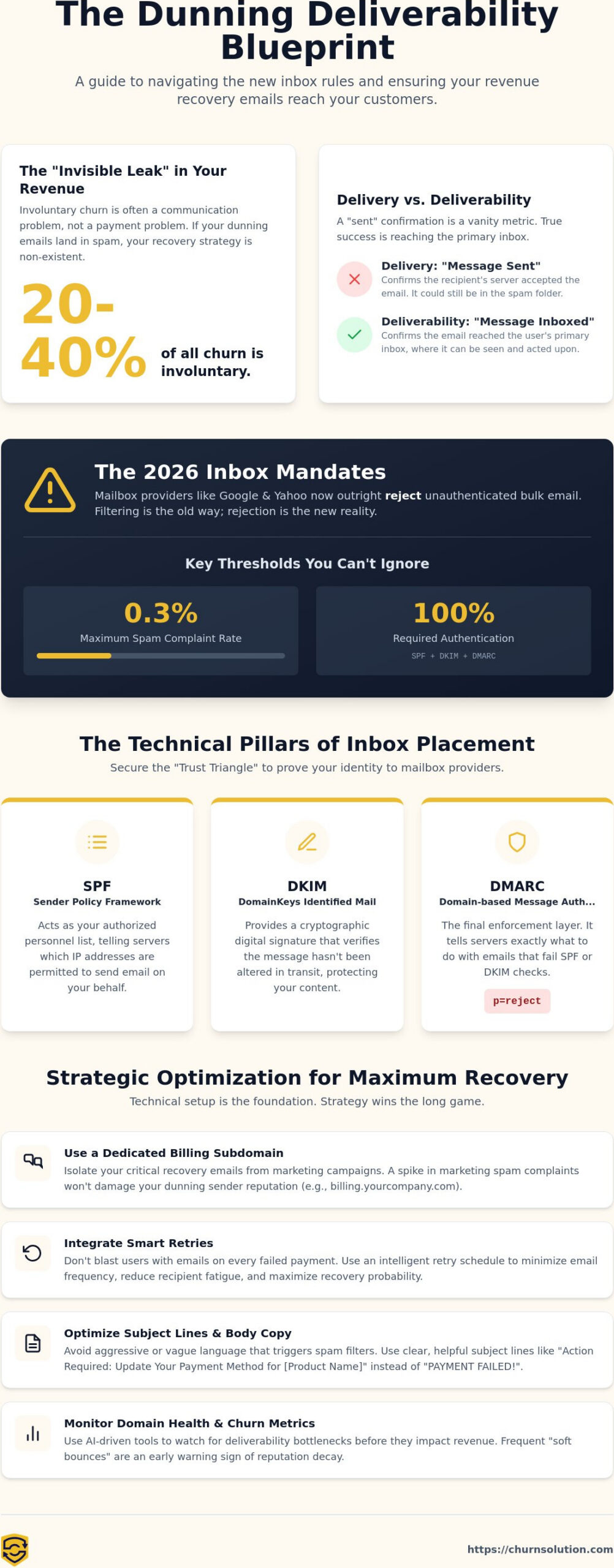
Revenue recovery is a technical battle fought in the inbox. While many SaaS leaders focus on the mechanics of credit card retries, they often ignore the “invisible leak” caused by dunning email deliverability issues. If your billing notifications land in the spam folder, your recovery strategy is non-existent. Research indicates that involuntary churn accounts for 20% to 40% of all customer attrition in the subscription economy. A significant portion of this loss stems from customers who never realized their payment failed because the notification was suppressed by aggressive filters.
The 2026 email ecosystem has no tolerance for high-volume senders with low engagement. Mailbox providers now track how recipients interact with financial alerts. If your “Action Required” emails are consistently ignored or marked as spam, your entire domain reputation suffers. This creates a destructive feedback loop where even your critical transactional mail is eventually rejected. Beyond the technical damage, there is a psychological cost. When a customer’s service is interrupted without a visible warning, they don’t blame their bank; they assume your platform is unreliable. This perceived instability makes them less likely to reactivate, even if you eventually reach them.
Effective Dunning requires more than just a functional billing engine. It requires a sophisticated communication strategy that treats every message as a high-stakes intervention. Using advanced tools to monitor your churn metrics alongside inbox placement data is the only way to ensure your recovery engine remains functional and profitable.
Involuntary Churn vs. Deliverability Gaps
Involuntary churn is often misdiagnosed as a payment processing problem. In reality, it is frequently a communication failure. Standard billing engines are designed to generate invoices, not to navigate the complex reputation requirements of modern ISPs. When these systems fail to achieve high inbox placement, the resulting deliverability gap leads to permanent revenue loss. For a B2B SaaS company, even a 1% increase in involuntary churn can severely depress long-term valuation and burn through customer acquisition costs.
Delivery vs. Deliverability: Why “Sent” is a Vanity Metric
Your dashboard might show a 99% “sent” rate, but this is a vanity metric that hides the truth. Delivery only confirms that the recipient’s server accepted the data packet. Deliverability determines if that packet reached the primary inbox or was buried in a junk folder. Frequent “soft bounces” in your dunning sequences act as early warning signals of reputation decay. Deliverability is the measure of trust between sender and recipient.
The Technical Pillars of Inbox Placement for Payment Notices
Technical integrity is the non-negotiable price of admission to the inbox. Many businesses mistakenly treat dunning email deliverability issues as a creative or timing problem. If your DNS records are incomplete, your content is irrelevant. In 2026, mailbox providers like Google and Yahoo have transitioned from filtering to outright rejection for unauthenticated bulk senders. You must secure the “Trust Triangle” by aligning your sending domain, the receiving server, and the cryptographic protocols that prove your identity.
SPF, DKIM, and DMARC: Your Recovery Foundation
SPF (Sender Policy Framework) acts as your authorized personnel list. It tells the receiving server exactly which IP addresses are permitted to send billing notices on your behalf. DKIM (DomainKeys Identified Mail) provides a digital signature that verifies the integrity of the message. It ensures that no third party has altered the payment link or sensitive account data during transit. DMARC (Domain-based Message Authentication, Reporting, and Conformance) is the final layer. While many firms still use a “p=none” policy for monitoring, 2026 standards demand a “p=reject” setting to achieve maximum trust. This tells ISPs to block any message that fails authentication, protecting your brand from spoofing and ensuring your legitimate notices receive priority placement.
Sender Reputation and Domain Health Management
Using your primary marketing domain for dunning is a high-risk strategy. If a marketing campaign triggers a spike in spam complaints, your critical billing notices will be collateral damage. Isolate your recovery traffic on a dedicated billing subdomain. This separation allows you to maintain a pristine sender score specifically for transactional revenue. If you send more than 5,000 emails per day, a dedicated IP address is essential. It prevents your reputation from being tethered to the poor habits of other senders on a shared pool. Before launching a full recovery sequence on a new subdomain, you must perform a structured “warm-up” by gradually increasing volume over several weeks to establish a baseline of positive engagement.
Adhering to CAN-SPAM Act requirements is not just about avoiding fines; it is a deliverability signal. Clear headers and valid physical addresses are markers of a legitimate sender that ISPs recognize and reward. To ensure your technical setup is optimized for revenue, you can secure your recovery domain today.
Analyzing Common Dunning Spam Triggers and Pitfalls
Content is a primary signal used by modern mailbox providers to distinguish legitimate billing alerts from malicious phishing attempts. Many dunning email deliverability issues arise because businesses inadvertently trigger algorithmic filters designed to protect users from financial fraud. In 2026, AI-driven security layers analyze the relationship between your subject lines, your link density, and your overall message tone. If your recovery sequence looks like a debt collection scam, it will never reach the customer’s eyes.
Keyword lethality is a real threat to your MRR. While “Payment Failed” or “Urgent Action Required” seem like logical choices for clarity, they are frequently flagged as high-risk by Gmail and Outlook. These phrases are overused by bad actors, leading filters to treat them with extreme suspicion. Similarly, an overly aggressive “Debt Collector” tone can backfire. Modern filters use natural language processing to identify high-pressure tactics. When your copy feels threatening, it triggers a defensive response from both the recipient and the algorithm. This results in higher spam reports and lower placement rates.
The visual format of your message also dictates its success. While marketing teams prefer high-gloss HTML templates, plain-text or “hybrid” emails often perform better for transactional trust. A message that looks like a personal note from a billing manager feels more authentic and less like a mass-produced solicitation. Furthermore, link overload is a common pitfall. Including multiple “Update Card” buttons or redundant links increases the probability of being flagged as a phishing attempt. One clear, secure call-to-action is the gold standard for high-performance recovery.
Content-Based Triggers and the “Phishing” Aesthetic
Modern filters are trained to detect the “phishing aesthetic,” which includes excessive urgency combined with suspicious link patterns. To maintain high deliverability, you must balance your brand personality with filter-friendly elements. Avoid using all-caps in subject lines or excessive punctuation. When you implement payment recovery links, ensure they are hosted on your authenticated subdomain. This alignment proves to the ISP that the destination is safe and legitimate.
Engagement Signals: The Silent Reputation Killers
Mailbox providers track how users interact with your billing notices. If a customer consistently deletes your emails without opening them, it signals to the ISP that your content is irrelevant or unwanted. This “Delete Without Opening” metric is a silent reputation killer. If your first dunning notice has a low open rate, your subsequent attempts are much more likely to be throttled or blocked. To combat this, you must optimize your “From” name and subject lines to encourage positive engagement from the very first failure notification.
Strategic Optimization for Maximum Recovery Rates
Optimization requires a shift from mass communication to precision targeting. Many dunning email deliverability issues stem from “email fatigue,” where high-frequency messaging causes recipients to ignore or report notifications as spam. To protect your revenue, you must align your communication cadence with the underlying technical recovery process. This ensures that you only reach out when human intervention is strictly necessary, preserving your sender reputation and the customer experience.
The most effective way to minimize noise is by aligning your communication with smart retries. If an automated retry successfully recovers a transaction behind the scenes, you must suppress the scheduled dunning notice immediately. This “silent recovery” prevents unnecessary friction and ensures that your emails remain high-signal events. Furthermore, you should implement frequency capping across your recovery sequences. Sending more than three or four notifications for a single billing event significantly increases the risk of being flagged by automated filters as a nuisance sender.
Prioritization is equally critical. Use customer segmentation to treat high-LTV accounts with a more personalized, white-glove approach while automating standard flows for lower tiers. Finding the exact balance between urgency and deliverability requires continuous testing. Leverage A/B experiments to refine your subject lines and send times, ensuring your messages arrive when they are most likely to be opened and acted upon.
Sequence Logic and Email Fatigue
Your “Day 0” email should function as a soft notification rather than a hard decline notice. Many payment failures are temporary or technical; a gentle nudge is often enough to prompt action without triggering a defensive response. As the sequence progresses, you can gradually increase the urgency of the language. However, you must know when to stop. If a customer has not engaged after several attempts, continuing to send mail will only damage your domain health. At this stage, it is safer to pause the sequence and rely on in-app notifications or manual outreach.
Personalization Beyond the First Name
Deep personalization is a deliverability signal. By including specific details such as the last four digits of the card on file or the exact plan name, you provide immediate proof of authenticity. This specific data helps the recipient distinguish your legitimate request from the flood of generic phishing attempts that populate modern inboxes. Personalized billing data reduces phishing fears and builds the trust necessary for a customer to enter their financial details. To begin optimizing your recovery cadence and plugging these leaks, you can access our strategic toolkit today.
Solving Deliverability with Churn Solution’s Recovery Engine
Modern retention strategies require a specialized technological layer that standard billing engines simply cannot provide. Churn Solution integrates directly with your existing stack to eliminate the root causes of dunning email deliverability issues. By combining technical authentication management with behavioral data, we ensure that your recovery attempts are treated as high-priority transactional mail rather than bulk noise. This precision-engineered approach secures your revenue while protecting your long-term domain health.
Our engine uses AI to analyze churn metrics in real-time, providing a granular view of how deliverability impacts your bottom line. This allows you to predict bottlenecks before they compromise your MRR. If the system detects a spike in rejection rates or a drop in engagement signals from specific mailbox providers, it automatically recalibrates your sending parameters to maintain peak inbox placement. This proactive monitoring transforms your dunning process into a controlled, high-performance ecosystem. You’re no longer reacting to lost customers; you’re anticipating and preventing the technical friction that leads to involuntary churn.
Automated Recovery and Smart Retry Synergy
The most effective way to solve deliverability problems is to send fewer emails. Churn Solution achieves this through a deep synergy between dunning and smart retries. By optimizing payment attempts at the gateway level, we recover up to 20% of failed transactions without ever sending a notification. This reduction in volume decreases the risk of recipient fatigue and spam reports. We also manage the technical overhead of SPF, DKIM, and DMARC alignment. This ensures every message you do send carries the maximum trust signal. For a comprehensive look at this strategy, see our guide on Subscription Revenue Protection.
AI-Driven Insights and Feedback Loops
High-performance recovery requires understanding the “why” behind the failure. We utilize feedback analysis to decode why customers ignore specific billing notices or fail to complete the payment update. This data allows you to deploy dynamic offers directly within the recovery flow. By presenting a localized discount or a temporary credit at the moment of friction, you incentivize immediate payment through personalized rewards. Every failed delivery attempt or ignored email becomes a data point for future optimization. This closed-loop system ensures that a failed payment is not the end of the customer lifecycle, but an opportunity to reactivate your subscriber base through intelligent, automated intervention.
Future-Proof Your Retention Infrastructure
The transition from “sent” metrics to actual inbox placement is the defining challenge of modern revenue recovery. You now understand that ignoring dunning email deliverability issues is equivalent to accepting a permanent leak in your MRR. As mailbox providers enforce stricter authentication and engagement thresholds in 2026, your ability to reach the customer is no longer guaranteed. It is a technical privilege that must be maintained through rigorous standards and intelligent automation.
Success requires a shift toward specialized tools designed for the subscription economy. By integrating advanced dunning automation with AI-powered smart retries, you can solve payment failures at the source and reduce unnecessary email volume. Real-time revenue recovery dashboards ensure you always have the data needed to optimize your strategy and protect your sender reputation. Empower your business with a system that turns technical compliance into a competitive advantage.
Stop losing revenue to deliverability issues; recover more MRR with Churn Solution.
Your growth depends on the reliability of your communication infrastructure. Start plugging the leaks today and ensure your recovery engine performs at its peak potential.
Frequently Asked Questions
Why are my dunning emails being marked as spam?
Your emails are likely failing due to a combination of low engagement signals and high spam complaint rates. If your complaint rate exceeds the 0.3% threshold, mailbox providers will automatically deprioritize your domain. In 2026, filters also analyze “Delete Without Opening” metrics; if users ignore your billing notices, your reputation suffers. Correcting this requires optimizing your “From” name and removing aggressive subject line triggers.
How many dunning emails should I send before giving up?
The optimal sequence consists of 3 to 4 notifications sent over a 14 to 21 day period. Exceeding this frequency triggers email fatigue and increases the probability of a permanent block. Focus on quality over quantity. Use the first two attempts for soft reminders and the final two for high-urgency alerts before pausing the sequence to prevent reputation damage.
Should I use a different domain for my billing and dunning emails?
Yes, isolating your recovery traffic on a dedicated billing subdomain is a strategic necessity. This separation ensures that a high-volume marketing campaign does not compromise your critical transactional delivery. It allows you to maintain a specialized sender score for revenue-critical mail, ensuring your payment notices receive priority inbox placement even if your marketing domain faces temporary issues.
What is the best subject line for a payment failure email?
The most effective subject lines are personalized and transparent, such as “Action required for your [Company Name] subscription.” Avoid using “Urgent” or “Immediate” as these frequently trigger AI-driven phishing filters. Brand recognition is your strongest asset. Including the specific plan name or account identifier provides the authenticity needed to bypass modern security layers and encourage an open.
How do I check my dunning email deliverability rate?
Monitor your domain health using Google Postmaster Tools and Microsoft SNDS to see your actual inbox placement. Your billing dashboard only shows “sent” and “delivered” statuses, which are vanity metrics that hide spam folder placement. You must track your spam complaint rate and reputation score weekly. Aim for a consistent spam rate below 0.1% to maintain peak deliverability.
Can I use plain text emails for dunning instead of HTML?
Plain text or hybrid “minimalist” HTML emails often outperform high-gloss templates in transactional sequences. They appear more personal and authentic, which helps them bypass the “Promotions” tab in Gmail. Minimalist designs also reduce the “phishing aesthetic” that modern filters look for. A simple, text-based note from a billing manager often yields higher trust and faster payment updates.
What is the difference between a hard decline and a soft decline in dunning?
A soft decline is a temporary issue, such as a temporary hold or a network timeout, that you can often resolve without contacting the customer. A hard decline is a permanent failure, such as a canceled card or an expired account. You should only trigger your dunning sequence for hard declines or after multiple failed retry attempts to minimize unnecessary email volume.
How does DMARC affect my dunning email placement?
DMARC tells mailbox providers how to handle mail that fails authentication checks. Moving to a “p=reject” policy is the strongest signal of trust you can send to an ISP. This configuration eliminates many dunning email deliverability issues by proving your messages are legitimate. It ensures that unauthorized spoofing attempts are blocked while your authentic billing notices are fast-tracked to the primary inbox.
- Key Takeaways
- Table of Contents
- The High Cost of Dunning Email Deliverability Failures
- The Technical Pillars of Inbox Placement for Payment Notices
- Analyzing Common Dunning Spam Triggers and Pitfalls
- Strategic Optimization for Maximum Recovery Rates
- Solving Deliverability with Churn Solution’s Recovery Engine
- Future-Proof Your Retention Infrastructure
- Frequently Asked Questions

Churn solution that turns your customers right around.
Related Articles
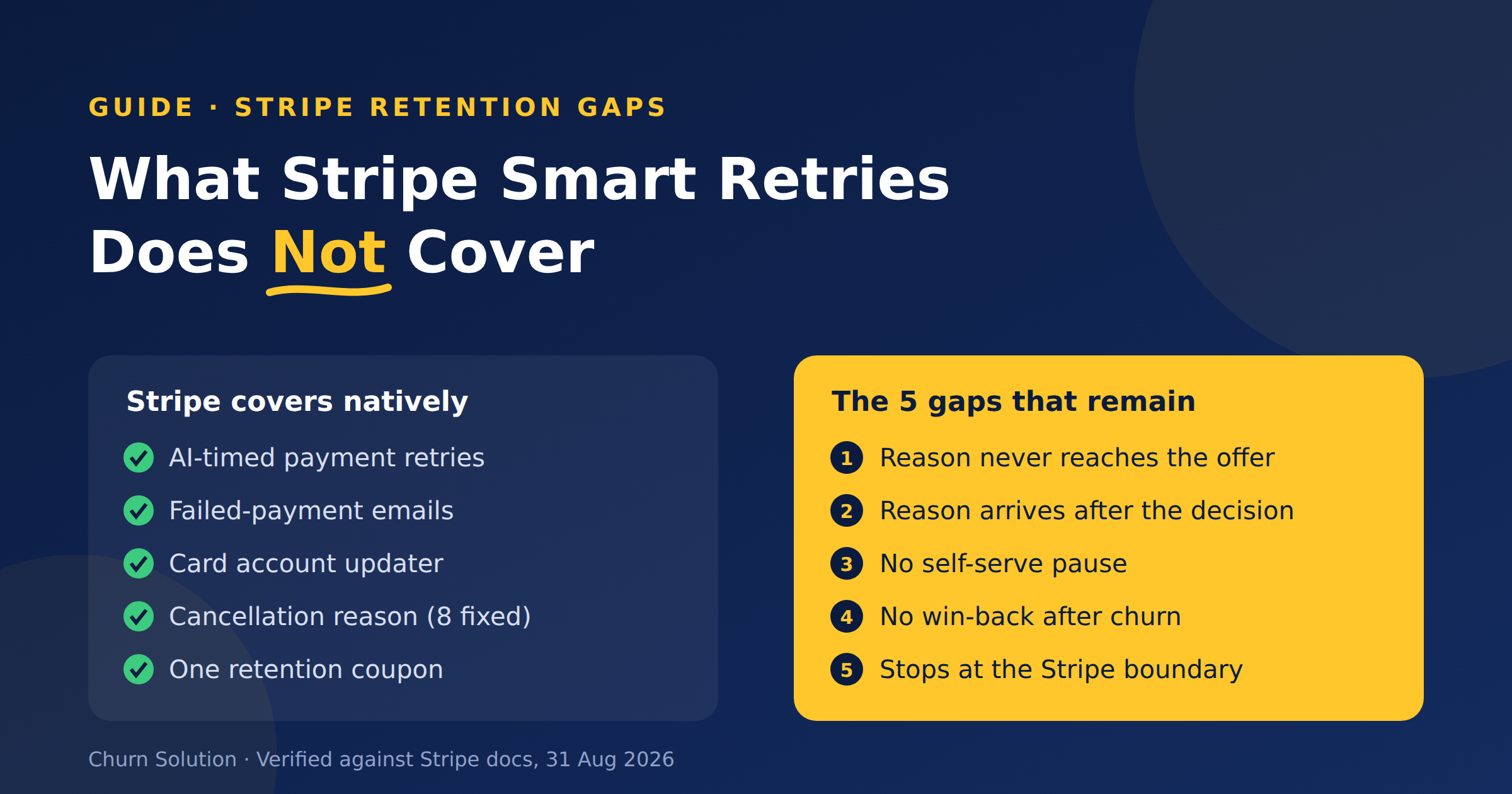
What Stripe Smart Retries Does Not Cover
Stripe Smart Retries recovers failed payments but doesn't run retention. Here are the five gaps that remain, sourced from Stripe's...

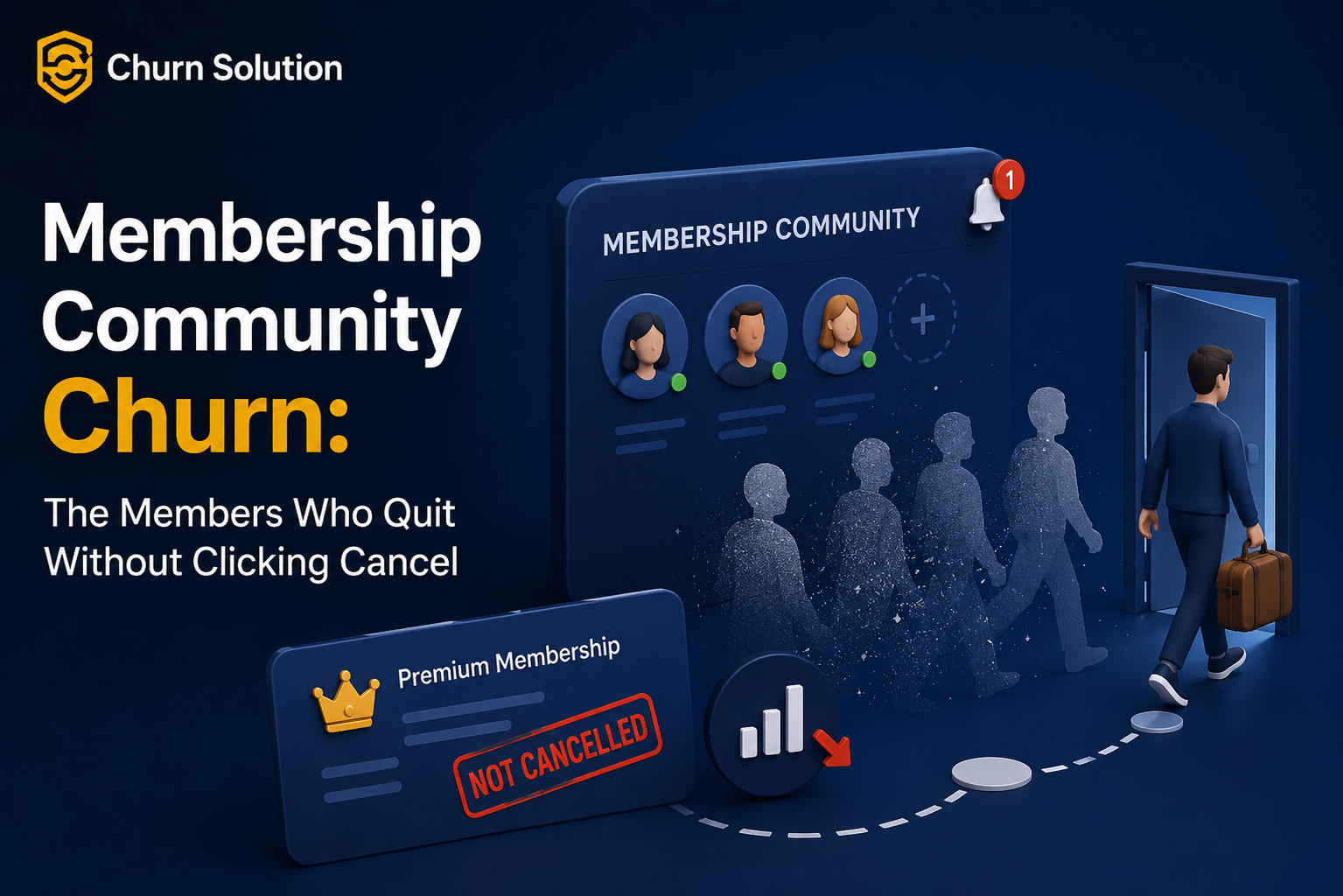
Membership Community Churn: The Members Who Quit Without Clicking Cancel
Quiet churn is the real leak: members who never clicked “cancel” at all. A card expires. A bank declines a...

Subscription Churn Dashboard: The 2026 Guide to Actionable Revenue Intelligence
Up to 40% of subscription churn is involuntary, meaning your customers aren't choosing to leave; they're being forced out by...