ARTICLE
What Are Smart Payment Retries? The 2026 Guide to Intelligent Revenue Recovery
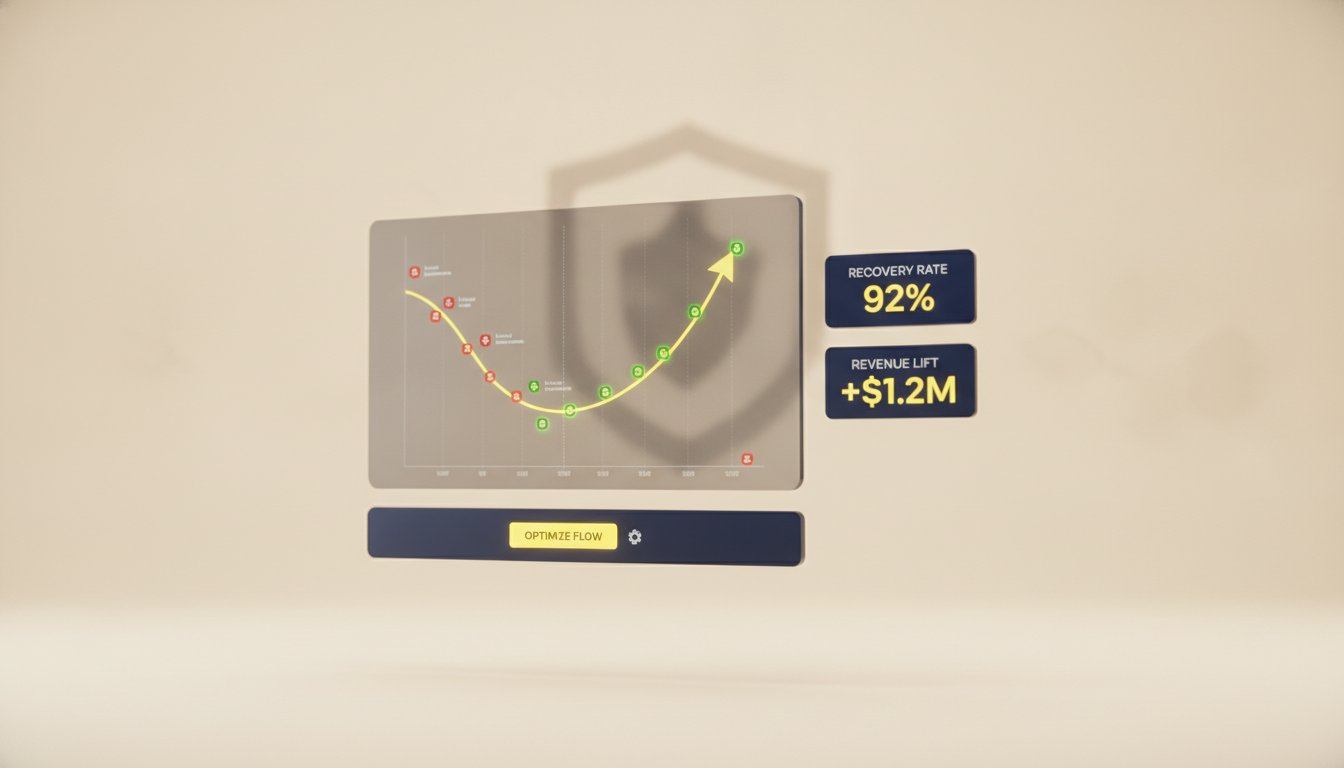
In 2026, your payment gateway’s basic retry logic isn’t just failing to recover revenue; it’s actively draining your bottom line through Mastercard’s $0.50 per-retry penalty fees. You likely see involuntary churn rates stuck between 5% and 10%, watching helplessly as soft declines trigger revenue leakage you can’t seem to plug. Understanding what are smart payment retries is no longer an optional optimization; it’s a critical defensive maneuver against aggressive card network monitoring and escalating financial penalties.
You understand that every failed transaction is a lost relationship, yet the fear of being flagged for excessive retries often leads to passive recovery strategies. This guide promises to show you how machine learning transforms these failures into recovered revenue by timing every attempt with surgical precision. We’ll explore the technical mechanisms that decrease involuntary churn by at least 20% and provide a blueprint for an autonomous recovery stack that operates within the strict 1.5% Visa VAMP threshold.
Key Takeaways
- Replace archaic, static retry schedules with machine learning models that synchronize with global banking cycles and payday patterns.
- Define exactly what are smart payment retries by mastering the distinction between temporary soft declines and permanent hard decline walls.
- It’s critical to mitigate the financial risk of the 2026 network rules by implementing logic that avoids excessive retry penalties and merchant account suspension.
- Orchestrate a comprehensive recovery stack where smart retries, dunning automation, and AI feedback analysis work together to maximize customer lifetime value.
Understanding the Shift: From Static to Smart Payment Retries
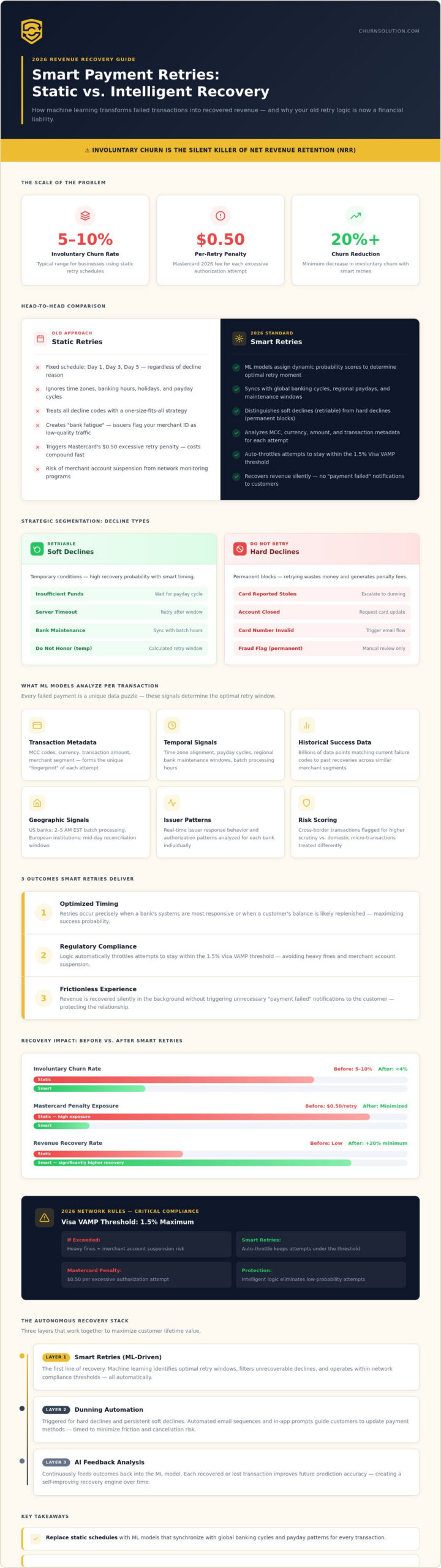
Involuntary churn is the silent killer of Net Revenue Retention (NRR). When a transaction fails, it isn’t just a technical glitch; it’s a potential end to a customer relationship. For years, businesses relied on basic, fixed-interval schedules to recover these funds. These static systems operate on a “best guess” basis, re-attempting payments at arbitrary intervals like every three or seven days. This approach is no longer viable in a 2026 landscape defined by aggressive network monitoring and escalating fees. To survive, companies must understand what are smart payment retries: a machine learning driven mechanism that determines the optimal millisecond to re-attempt a failed transaction based on historical success data and real-time issuer patterns.
The failure of static schedules lies in their rigidity. They ignore the complex variables of global banking, such as time zones, regional holidays, and payday cycles. When a payment service provider processes a transaction, it receives specific response codes. A static system treats these codes with a one-size-fits-all strategy. In contrast, 2026 revenue recovery requires a precision layer that distinguishes between a temporary server timeout and a strategic window of liquidity. Implementing smart retries transforms payment recovery from a passive background process into an active, high-frequency trading strategy for your bottom line.
The Mechanics of Static Retries
Traditional retry logic follows a linear path. It attempts a recovery on Day 1, Day 3, and Day 5, regardless of why the initial payment failed. This lack of intelligence creates “bank fatigue,” where issuing banks begin to view your merchant ID as a source of low-quality traffic. Under the updated 2026 Mastercard rules, this behavior is now a direct financial liability. Every excessive authorization attempt can trigger a $0.50 penalty fee. Static systems don’t just lose revenue; they actively generate costs. Finance teams are then left with the manual burden of reconciling these failed attempts and managing the fallout of merchant account suspensions.
The Smart Retry Advantage
The transition to intelligent recovery replaces fixed intervals with dynamic probability scores. By analyzing transaction metadata, such as currency, amount, and merchant category codes, machine learning models predict the exact moment a transaction is most likely to succeed. This surgical precision provides three distinct outcomes:
- Optimized Timing: Retries occur when a bank’s systems are most responsive or when a customer’s balance is likely replenished.
- Regulatory Compliance: Logic automatically throttles attempts to stay within the 1.5% Visa VAMP threshold, avoiding heavy fines.
- Frictionless Experience: Revenue is recovered in the background without triggering unnecessary “payment failed” notifications to the user.
Ultimately, smart retries act as a sophisticated filter. They eliminate low-probability attempts that damage your reputation with card networks while aggressively capturing every dollar that is recoverable. This isn’t just about technical efficiency; it’s about reclaiming control over your business outcomes.
The Anatomy of Logic: Variables That Drive Successful Recovery
The underlying intelligence of a recovery engine determines its total efficacy. To truly understand what are smart payment retries, you must look at the specific data points that inform the “when” and “how” of each attempt. It’s not enough to simply re-submit a transaction; you must orchestrate a recovery based on transaction metadata, temporal signals, and historical success probability. A sophisticated system treats every failed payment as a unique data puzzle rather than a generic error code.
Every transaction carries metadata that serves as a digital fingerprint. Merchant Category Codes (MCC) inform the issuing bank about the nature of the purchase, while currency and amount influence the risk scoring of the authorization. Large cross-border transactions often trigger higher scrutiny, requiring a more calculated retry window than a domestic $10 micro-transaction. By leveraging billions of historical data points, a precision recovery layer predicts the likelihood of a “soft” fix by matching current failure codes with past successful recoveries across similar merchant segments.
Banking and Geographic Signals
Banking infrastructure is far from uniform. While Tier 1 US banks typically execute batch processing and system maintenance during early morning hours (2 AM to 5 AM EST), European institutions often utilize mid-day windows to reconcile card transactions. Geographic signals also include localized holiday schedules. Attempting a retry during a regional bank holiday is a wasted effort that risks network penalties and “bank fatigue.” Currency volatility further complicates this, as cross-border authorizations fluctuate in success rate based on real-time exchange stability and issuer-specific risk appetites.
Customer and Subscription Metadata
The identity of the customer provides the final layer of precision. Research into consumer payment behavior suggests that income cycles and demographic variables dictate liquidity patterns, making payday-aware retries essential for B2C models. Subscription age also acts as a powerful predictor. A long-term subscriber with years of successful billing history represents a different risk profile than a trial user on day seven. High-value accounts with significant Monthly Recurring Revenue (MRR) demand a conservative, high-precision approach to avoid triggering a hard decline that could end a lucrative contract.
Understanding these variables allows you to build a payment recovery strategy that operates like a surgical intervention rather than a blunt instrument. If your current system ignores these signals, you are leaving recoverable revenue on the table. You can start optimizing your recovery logic today to capture that lost MRR and stabilize your growth metrics.
Strategic Segmentation: Hard Declines vs. Soft Declines
Effective revenue recovery hinges on the ability to categorize failure responses instantly. A soft decline represents a temporary obstacle; it’s an invitation for a calculated re-attempt. These failures usually stem from insufficient funds, transient technical glitches, or “try again later” issuer signals. In contrast, a hard decline is a permanent barrier. Stolen cards, closed accounts, and “do not honor” responses fall into this category. Retrying a hard decline is not just a waste of computational resources. It’s a strategic error that triggers network penalties and risks merchant account termination.
Understanding what are smart payment retries requires mastering the “Grey Area” codes. These ambiguous responses don’t clearly state the failure reason, leaving standard gateways in a loop of failed attempts. An intelligent system tests these limits by cross-referencing the response with historical issuer behavior. It determines if a recovery is viable or if the account should be flagged for manual intervention. This segmentation ensures that your recovery efforts are focused only on transactions with a high success probability.
Optimizing for Soft Declines
Soft declines are the primary target for machine learning optimization. The “Payday Effect” is a critical variable. Timing retries around the 1st and 15th of the month captures liquidity when it is highest for consumer segments. Micro-timing also plays a role. Data often shows that a 4 AM retry succeeds more frequently than a 4 PM attempt for consumer cards. Many banks process automated reconciliations during these low-traffic windows. You must balance recovery speed with card network limits to maximize capture without triggering excessive retry alerts.
Handling Hard Declines with Dunning
When the logic identifies a hard decline, the system must pivot immediately. Continuing to retry a closed account is futile and costly. Instead, trigger an immediate escalation to dunning email automation to prompt the user for new payment details. This transition should be seamless, directing the customer to a secure customer portal where they can update their credentials. Proactive systems go further by automating the “Card Expired” workflow weeks before the actual expiration date. This prevents the failure before it ever impacts your NRR.
By splitting your recovery strategy into these distinct paths, you eliminate wasteful processing and focus on the highest-value actions. Precision in segmentation is the difference between a 2% recovery rate and a 20% recovery rate. Stop treating all failures the same and start applying logic that respects the reality of the banking ecosystem.
Implementation Framework: Building a 2026 Recovery Stack
Building a resilient revenue recovery stack requires moving beyond the default settings of your billing engine. Start with a rigorous audit of your baseline metrics. You must measure your current recovery rate and identify the specific percentage of involuntary churn eroding your NRR. Once you establish these benchmarks, configure your gateway-level basics in platforms like Stripe or Braintree. These provide the necessary foundation; however, they lack the granular intelligence required for maximum capture. To bridge this gap, deploy a precision layer like Churn Solution to handle advanced AI orchestration. This ensures that you aren’t just guessing what are smart payment retries, but actually executing them based on real-time data. Synchronize this logic with your communication workflows. Retries and dunning emails shouldn’t overlap. Sending a failure notice while a background retry is pending creates unnecessary customer anxiety and support tickets.
Setting Your Retry Window
Data across the subscription economy suggests a 21 to 30 day rule for recovery. Most successful transactions occur within this first three-week window. Beyond 30 days, the probability of recovery drops significantly while the risk of network penalties rises. Balance your grace periods with revenue protection goals. While you want to keep the service active to maintain goodwill, an indefinite grace period invites service abuse. Finding the point of diminishing returns is vital. If a card has failed ten times over 25 days, an eleventh attempt is statistically unlikely to succeed. It may even flag your merchant ID for excessive authorization attempts under the 2026 network rules.
A/B Testing Your Logic
Don’t assume your initial configuration is optimal. Use A/B experiments to compare different retry frequencies and timing intervals. Monitor your cohorts for “forced churn.” This occurs when a retry successfully captures funds, but the aggressive nature of the attempt triggers the customer to manually cancel their subscription. Your goal is silent recovery, not high-friction collection. Track “Recovery Lift” as a core FinOps KPI to justify the investment in your recovery stack. This metric represents the delta between your gateway’s native recovery rate and the performance of your intelligent orchestration layer.
Ready to stop the leak? Create your Churn Solution account and deploy a high-performance recovery stack in minutes.
The Churn Solution Edge: Beyond the Basic Gateway
Standard billing engines provide a binary outcome: success or failure. This limited perspective is why basic gateway settings fail to capture the significant revenue lift available through intelligent orchestration. To truly understand what are smart payment retries in the 2026 economy, you must view them as the core of a synchronized recovery ecosystem. Churn Solution provides this precision layer. It ensures that every re-attempt is informed by global intelligence that goes far beyond simple response codes. We position payment recovery as a growth lever rather than a cost center, transforming technical failures into predictable cash flow.
Knowing what are smart payment retries is the first step, but executing them at scale requires a platform that manages the entire lifecycle of a failed transaction. Our platform doesn’t just retry cards; it creates an AI-driven feedback loop. By utilizing feedback analysis, the system learns why specific payments fail and identifies patterns in customer behavior. This data allows you to improve product value and billing terms for high-risk segments. The best part is the seamless integration. You can deploy our advanced recovery logic without changing your existing billing engine or disrupting your current financial workflows. It’s a plug-and-play precision layer designed for immediate NRR impact.
Synchronized Revenue Recovery
We eliminate the risk of “Double Jeopardy” in your recovery process. This occurs when a system triggers an automated retry on the same day it sends a dunning email, which creates a confusing and aggressive experience for your customers. Churn Solution synchronizes these actions perfectly. You can monitor the results in real-time through our dashboard, seeing exactly which churn metrics are improving as the logic executes. If an account eventually fails all smart retries, the system triggers automated win-back flows to preserve the long-term relationship before the customer is lost for good.
Next Steps for Your Retention Strategy
It’s time to move from reactive fixes to proactive subscription revenue protection strategies. The complexity of 2026 network rules and shifting consumer liquidity requires an expert partner that understands the high stakes of revenue leakage. Don’t let involuntary churn dictate your growth trajectory. Book a demo today to see the Churn Solution precision layer in action and discover how we can stabilize your MRR. Optimize your payment recovery with Churn Solution today.
Secure Your Revenue Infrastructure for 2026
The era of passive revenue recovery is over. Merchants who cling to static, “every three days” schedules face escalating network fees and avoidable involuntary churn that erodes Net Revenue Retention. By mastering what are smart payment retries, you replace outdated guesswork with AI-driven timing logic that respects global banking realities and payday cycles. This precision layer doesn’t just capture funds; it protects your merchant reputation by staying within strict network thresholds and avoiding punitive authorization penalties.
You can now deploy a high-performance recovery stack with seamless Stripe and Braintree integration. Automated dunning synchronization ensures your customer communication remains frictionless, preventing the “double jeopardy” of simultaneous retries and failure notices. Stop letting soft declines and technical glitches dictate your growth trajectory. It’s time to transform your recovery process from a cost center into a powerful engine for predictable cash flow. Your revenue is recoverable; you simply need the orchestration layer that knows exactly when to capture it.
Recover up to 20% more revenue with Smart Retries and stabilize your business outcomes today.
Frequently Asked Questions
How many times should I retry a failed payment?
You must limit retries to a maximum of 15 attempts per card within a rolling 30 day window to remain compliant with 2026 Visa and Mastercard regulations. Most successful recoveries occur within the first 4 to 6 attempts. Beyond this point, the statistical probability of success plummets while the risk of triggering network penalties increases. Intelligent systems prioritize the timing of these attempts over the sheer volume of requests.
Will smart retries negatively impact my merchant standing with banks?
Smart retries actually protect your merchant standing by eliminating wasteful authorization traffic that banks flag as high risk. By filtering out hard declines and timing attempts to match issuer processing windows, you stay safely below the 1.5% Visa VAMP threshold. This proactive management prevents the aggressive $0.50 per retry penalties and potential account suspensions associated with unintelligent, high-volume retry strategies.
What is the difference between smart retries and dunning emails?
Smart retries are invisible, background attempts to capture funds without requiring customer intervention. Dunning emails are active communications that require the customer to manually update their payment details. When you understand what are smart payment retries, you realize they serve as your first line of defense; dunning sequences should only trigger when background orchestration fails to resolve the soft decline.
Can smart retries recover revenue from expired credit cards?
Smart retries cannot resolve a hard decline caused by an expired card on their own. They must work in tandem with Account Updater services that refresh card metadata automatically behind the scenes. If a card is permanently invalid and no update is available, the recovery engine should immediately halt retry attempts and pivot to a dunning sequence to secure new payment information from the user.
How much revenue can I expect to recover with smart retry logic?
Merchants typically recover at least 20% more revenue when transitioning from static gateway schedules to intelligent timing logic. This lift directly targets involuntary churn, which often accounts for 5% to 10% of total revenue leakage in the subscription economy. Capturing these failed transactions early stabilizes your Net Revenue Retention without requiring additional marketing spend or customer acquisition costs.
Does Stripe’s built-in smart retry feature replace the need for specialized software?
Stripe’s native features provide a functional baseline, but they often lack the cross-platform orchestration required for sophisticated tech stacks. Specialized software acts as a precision layer that synchronizes retries with dunning emails and AI-driven cancellation flows. This ensures a unified customer experience that a single gateway’s “black box” logic cannot replicate across multiple payment methods or providers.
How do smart retries handle multi-currency subscriptions?
The logic adjusts for regional banking “quiet hours” and localized payday cycles specific to each currency and geographic region. A smart system knows that a JPY transaction has a different success window than a USD transaction due to issuer batching schedules. By analyzing what are smart payment retries in a global context, the engine optimizes for time zones and regional bank behavior to maximize cross-border authorization success.
What happens if a smart retry succeeds after the customer has already canceled?
Sophisticated orchestration prevents “zombie” charges by synchronizing your billing engine with your retention flows in real time. If a customer completes a cancellation flow, the system must immediately terminate all pending retry attempts for that billing cycle. This prevents unnecessary chargebacks and protects your merchant reputation by ensuring you never collect funds from a customer who has legally terminated their contract.
- Key Takeaways
- Table of Contents
- Understanding the Shift: From Static to Smart Payment Retries
- The Anatomy of Logic: Variables That Drive Successful Recovery
- Strategic Segmentation: Hard Declines vs. Soft Declines
- Implementation Framework: Building a 2026 Recovery Stack
- The Churn Solution Edge: Beyond the Basic Gateway
- Secure Your Revenue Infrastructure for 2026
- Frequently Asked Questions

Churn solution that turns your customers right around.
Related Articles
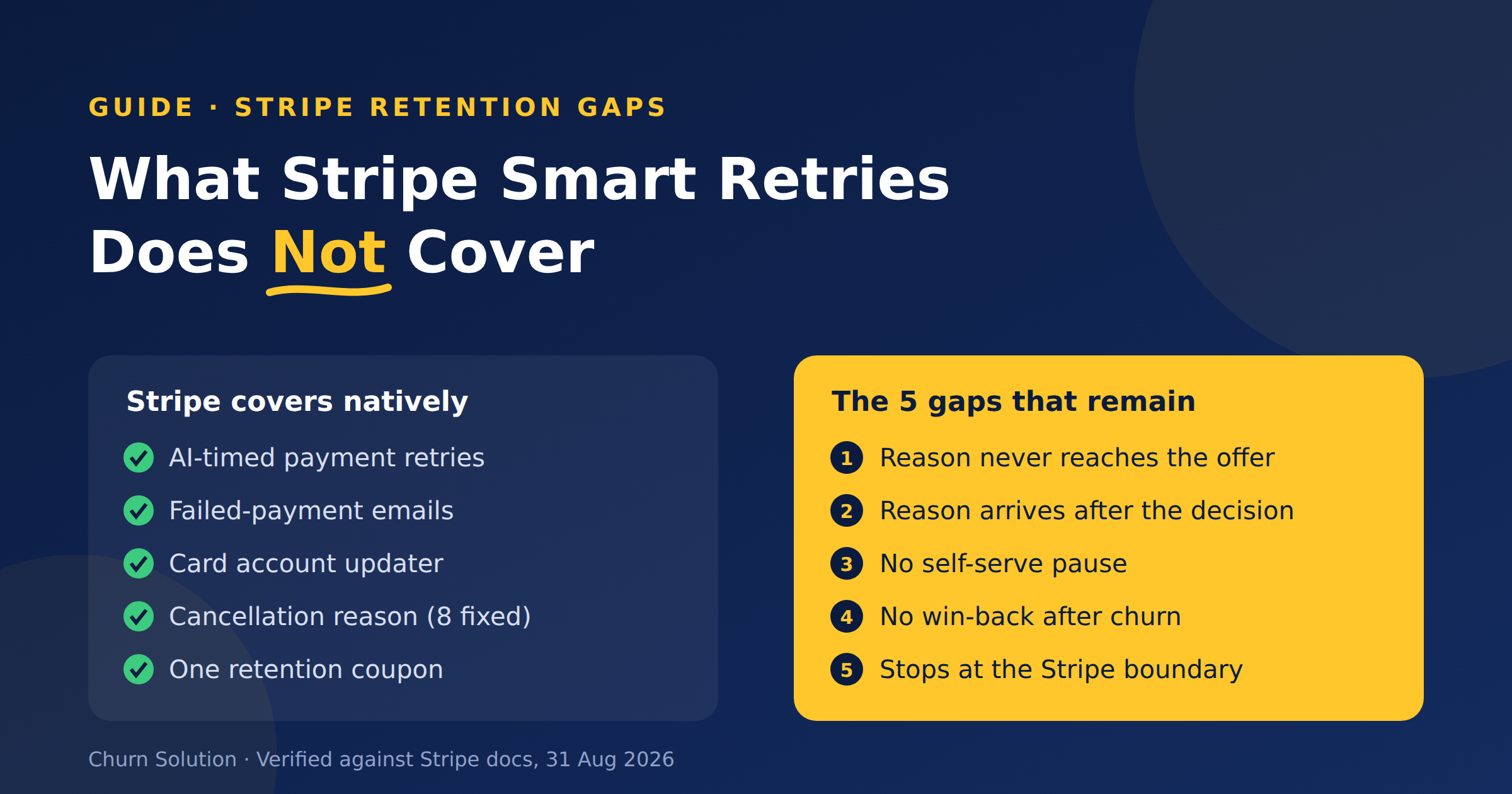
What Stripe Smart Retries Does Not Cover
Stripe Smart Retries recovers failed payments but doesn't run retention. Here are the five gaps that remain, sourced from Stripe's...


Membership Community Churn: The Members Who Quit Without Clicking Cancel
Quiet churn is the real leak: members who never clicked “cancel” at all. A card expires. A bank declines a...


Subscription Churn Dashboard: The 2026 Guide to Actionable Revenue Intelligence
Up to 40% of subscription churn is involuntary, meaning your customers aren't choosing to leave; they're being forced out by...