ARTICLE
The Financial Impact of Failed Payments: Quantifying the Invisible Leak in Your SaaS Revenue
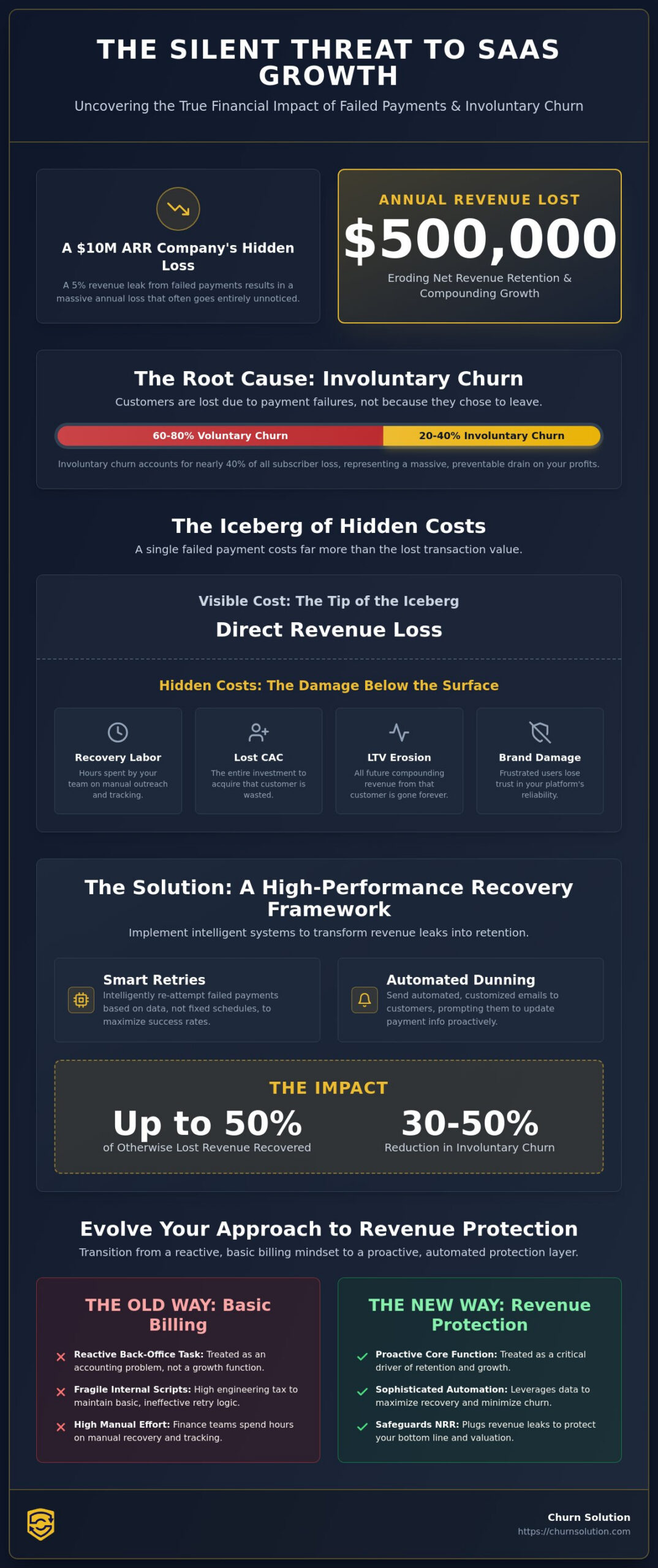
For a SaaS company generating $10 million in ARR, a 5% revenue leak represents a $500,000 annual loss that often goes entirely unnoticed. This isn’t just a series of failed transactions. It’s a structural failure that erodes your Net Revenue Retention and destroys compounding growth. Involuntary churn, driven primarily by payment declines, accounts for 20% to 40% of all customer loss. To protect your bottom line, you must quantify the total financial impact of failed payments and treat recovery as a core business function rather than a back-office technicality.
You likely recognize that payment failures are a nuisance, yet viewing them as a simple engineering problem ignores the massive impact on your customer lifetime value. This article provides the data-driven frameworks you need to recover lost revenue and secure your growth trajectory. We’ll break down the formula for calculating your true losses and introduce a framework to reduce involuntary churn by 30% to 50%. You’ll discover how smart retries and automated dunning can transform a passive revenue leak into a proactive engine for retention and long-term stability.
Key Takeaways
- Identify the structural threat of involuntary churn, which currently accounts for nearly 40% of all subscriber losses in the SaaS industry.
- Calculate the true financial impact of failed payments by factoring in direct revenue loss, manual recovery labor, and the compounding erosion of customer lifetime value.
- Categorize payment failures into soft and hard declines to implement segmented intervention paths that minimize card network penalties.
- Implement high-performance recovery frameworks using Smart Retries and automated dunning to capture up to 50% of otherwise lost revenue.
- Transition from basic billing logic to a sophisticated revenue protection layer to safeguard your Net Revenue Retention and long-term growth.
Beyond the Decline: Why Failed Payments are the #1 Threat to SaaS NRR in 2026
Failed payments are the silent killers of the subscription economy. In a high-velocity SaaS environment, a failure isn’t just a transaction error; it’s a systemic breakdown. These failures manifest as credit card declines, expired tokens, or insufficient funds. While they appear as minor administrative hurdles, the financial impact of failed payments is massive. Recent data from Digital Applied in June 2026 indicates that involuntary churn now accounts for nearly 40% of all subscriber loss. This represents a staggering amount of revenue that is simply vanishing from your balance sheet without a single customer choosing to leave.
Most standard billing engines are designed for processing, not recovery. They offer basic retry windows that lack the sophisticated, data-driven logic required to handle high-volume declines effectively. To combat this, leading organizations are shifting their perspective. They no longer view recovery as a back-office accounting task. Instead, they treat Revenue Protection as a core business function. By implementing advanced Smart Retries and specialized recovery layers, businesses can stop the bleeding before it impacts their long-term viability.
The Silent Churn Phenomenon
Involuntary churn is fundamentally more dangerous than voluntary churn because it severs a relationship that both parties intended to maintain. When a customer is forced out against their will due to a technical error, the damage to your brand reputation is immediate. These “accidental cancellations” frustrate users and erode trust in your platform’s reliability. Furthermore, the cost of re-acquiring a customer who left due to a payment error is significantly higher than the cost of a proactive recovery strategy. This type of customer churn rate is entirely preventable, yet many companies continue to let it drain their resources.
Why Net Revenue Retention (NRR) is the Only Metric That Matters
Net Revenue Retention measures the health of your existing revenue base and serves as a primary indicator of long-term success. Failed payments create a “leaky bucket” effect that makes it impossible to achieve high NRR targets. Even a minor leak of 3% to 5% of your ARR, as reported by LeakShield AI in April 2026, compounds over time to stunt your growth. Conversely, a 5% improvement in payment recovery can lead to a 20% or greater increase in company valuation over time because of how that recovered revenue compounds. Net Revenue Retention is the ultimate measure of product-market fit and operational efficiency.
Quantifying the Damage: Direct Revenue Loss vs. Compounding LTV Erosion
Calculating the true financial impact of failed payments requires looking far beyond the immediate transaction decline. Most SaaS leaders focus on the surface level loss, yet the real damage occurs beneath the waterline. To understand the total cost of a decline, you must apply the ‘Hidden Cost’ formula: Direct Loss + Recovery Labor + Customer Acquisition Cost (CAC) + Compounding LTV. When a payment fails, you aren’t just losing today’s revenue; you’re losing the entire investment you made to acquire that customer in the first place.
Consider the operational drain. Every hour your finance team spends on manual outreach or spreadsheet tracking is an hour stolen from strategic growth. If you’re still maintaining internal dunning scripts or custom retry logic, you’re paying a heavy ‘engineering tax.’ This diverts your most expensive resources away from product innovation to maintain a fragile, secondary system. These internal frameworks often lack the intelligence to navigate the complexities of Electronic Fund Transfers (Regulation E) while simultaneously maximizing recovery rates.
Direct Costs: Fees, Fines, and Foregone Revenue
Each failed attempt carries hidden baggage. Beyond the foregone revenue, you face transaction fees for failed attempts and increased chargeback risks. LexisNexis reports an industry average cost of $12.10 for every single repaired payment. This figure accounts for the administrative overhead and banking fees associated with fixing a broken transaction. There is also the issue of ‘gray area’ access. This occurs when users continue to consume server resources and support time without a valid payment method on file because your billing engine’s cancellation logic is too slow or uncoordinated to react immediately.
Indirect Costs: The Erosion of Customer Lifetime Value (LTV)
The most devastating loss is compounding. Losing a $100 per month subscriber today isn’t a minor $100 setback. If that customer had an expected lifecycle of four years, you’ve just permitted a $5,000+ loss in lifetime value to walk out the door. Payment friction also serves as a catalyst for future voluntary churn. When a service is interrupted, it forces the user to re-evaluate the software’s necessity. This often breaks the daily product habit permanently, leading the customer to realize they can live without your tool. You can use Churn Metrics to visualize how these individual failures snowball into a massive revenue gap. Stop leaving your growth to chance. Begin quantifying your recovery potential today.
The Anatomy of a Decline: Identifying Technical vs. Financial Failures
Understanding the specific reason behind a transaction failure is the first step toward effective recovery. Treating every decline as a generic error is a strategic mistake that worsens the financial impact of failed payments. In the subscription economy, failures generally fall into two distinct categories: soft declines and hard declines. Soft declines represent temporary issues like insufficient funds or transient network errors. Hard declines are permanent; they result from expired cards, closed accounts, or stolen credentials. A “one-size-fits-all” retry strategy ignores these nuances, leading to excessive churn and costly card network penalties.
Modern failures are also influenced by regulatory and behavioral shifts. Strong Customer Authentication (SCA) and 3D Secure protocols have added layers of friction that can lead to drop-offs during the verification stage. Additionally, “Subscription Fatigue” is a growing reality in 2026. Banks now allow users to prioritize certain payments, meaning your service might be deprioritized at the issuer level if the account balance is low. You must segment your response based on these variables to maintain a healthy billing ecosystem.
Soft Declines: The Low-Hanging Fruit of Recovery
Soft declines are the most recoverable segment of your lost revenue. Success here depends on precision timing. Retrying a transaction at 10 AM on a Friday might yield different results than 2 AM on a Tuesday, depending on when customers typically receive paychecks or when banks process batches. Utilizing Smart Retries allows you to leverage historical success data to hit the optimal processing window automatically. However, you must be careful. Excessive retries without logical intervals can trigger fraud flags from card networks, which often results in blacklisting or increased processing fees.
Hard Declines: When Automation Must Meet Communication
Hard declines require a different tactical approach. Since the card data is fundamentally invalid, additional retry attempts are futile and expensive. This is where automation must meet communication. You need a frictionless Customer Portal that allows users to update their credentials in seconds. If the user fails to update their information, Feedback Analysis can determine if the decline was actually a “passive cancellation.” This insight helps you decide whether to trigger a targeted win-back campaign or accept the churn as a voluntary decision. Stop guessing why your revenue is leaking and start segmenting your recovery path.
Strategic Recovery: Building a High-Performance Dunning & Retry Framework
Moving from manual intervention to a systematic recovery framework is the only way to mitigate the financial impact of failed payments at scale. A high-performance strategy requires a multi-layered approach that addresses failures based on their specific root cause. You cannot rely on the basic retry logic provided by standard billing engines. Instead, you must build a sophisticated engine that prioritizes the most recoverable revenue first. This transition transforms your billing operations from a cost center into a proactive revenue protection layer.
To implement a framework that yields measurable results, follow these five strategic steps:
- Step 1: Segment by Error Code. Analyze your decline data to distinguish between technical, financial, and administrative failures.
- Step 2: Deploy Smart Retries. Use machine learning to determine the optimal processing window for soft declines based on the cardholder’s bank and regional data.
- Step 3: Trigger Multi-Channel Dunning. Orchestrate email, SMS, and in-app notifications to reach the user where they are most active.
- Step 4: Utilize Dynamic Offers. Incentivize immediate card updates by providing targeted discounts or extended trial periods within your dunning communications.
- Step 5: Measure and Iterate. Continuously monitor your recovery rates and adjust your sequences based on performance data.
Optimizing the Dunning Sequence
The first 48 hours after a failure represent the “Golden Window” for recovery. During this period, the customer is most likely to resolve the issue before their service habit is broken. Your dunning email copy must be authoritative, helpful, and entirely frictionless. Avoid flowery language; state the problem clearly and provide a direct link to the update portal. Use A/B Experiments to refine your subject lines and call-to-action placement. Small adjustments in messaging often lead to significant gains in overall recovery efficiency.
Leveraging AI for Intelligent Interventions
AI is the primary driver of sophisticated Payment Recovery in 2026. Advanced algorithms can now predict the best time to retry a transaction by analyzing millions of historical data points from specific banks and regions. This precision reduces the financial impact of failed payments by maximizing successful authorizations while minimizing network penalties. Furthermore, AI can identify “at-risk” payments before they fail by monitoring card expiration dates and historical behavior patterns. This allows you to intervene proactively, securing the revenue before the decline ever occurs. Optimize your recovery framework today.
Protecting Your Bottom Line: Automating Revenue Recovery with Churn Solution
Relying on manual outreach to resolve billing errors is a high-cost, low-yield strategy. To neutralize the financial impact of failed payments, you need a dedicated technological intervention that operates at the speed of your business. Churn Solution is engineered specifically for the subscription economy, providing a sophisticated layer of protection that standard billing engines simply cannot match. By automating the entire recovery lifecycle, our partners recover up to 50% of failed payments without human intervention. This shift moves your team from reactive firefighting to proactive growth management.
The “Set and Forget” nature of our platform is a critical advantage for scaling SaaS companies. Your engineering teams shouldn’t waste cycles building internal billing logic; your finance team shouldn’t spend hours on manual dunning. Churn Solution handles the complexity of retry timing, multi-channel communication, and offer optimization. This efficiency frees up your most expensive resources to focus on product innovation while the system protects your MRR in the background. You gain total control over your revenue outcomes without the operational overhead of manual maintenance.
Why Native Billing Tools Aren’t Enough
Most SaaS organizations start with the basic recovery features found in Stripe or Braintree. While these tools are sufficient for basic processing, they lack the deep customization and AI-driven analytics required for high-performance retention. Standard engines often apply a rigid retry schedule that ignores the nuances of bank behavior and regional success rates. In contrast, a dedicated retention layer provides the granular control necessary for true Subscription Revenue Protection. You gain the ability to segment users, A/B test messaging, and deploy dynamic offers that native tools don’t support. This specialized focus is the difference between surviving a decline and thriving through recovery.
Start Your Recovery Journey Today
Integration is seamless. You can connect your existing billing stack to Churn Solution in minutes, allowing the platform to begin identifying and plugging revenue leaks immediately. Most businesses see a positive ROI within the first 30 days as recovered payments begin to compound and protect your Net Revenue Retention. Don’t let invisible declines continue to erode your valuation. Take control of your revenue stream, stabilize your cash flow, and secure your company’s future. Book a demo to see Churn Solution in action.
Secure Your Revenue Infrastructure for Compounding Growth
Treating payment failures as simple transaction errors costs SaaS companies millions in lost lifetime value. You’ve identified the specific mechanisms of involuntary churn and the data-driven frameworks required to reverse them. Mitigating the financial impact of failed payments requires a transition from manual firefighting to an automated, intelligent recovery layer. This shift stabilizes your growth engine and allows your technical teams to focus on product innovation rather than internal billing logic.
Our platform functions as a dedicated retention specialist, utilizing AI-powered smart retry logic to recover up to 50% of failed payments automatically. We analyze millions of data points to ensure your revenue remains protected without human intervention. Stop permitting invisible declines to dictate your company’s valuation. Take total control of your billing ecosystem and build a more resilient subscription business.
Protect your MRR and recover failed payments with Churn Solution. Success starts with a secure revenue base.
Frequently Asked Questions
What is the average failure rate for subscription payments in 2026?
The average payment decline rate for SaaS companies in 2026 typically falls between 5% and 10%. Rates exceeding 10% are considered poor and indicate a critical need for specialized intervention. These failures contribute directly to the financial impact of failed payments by eroding monthly recurring revenue. Monitoring these benchmarks allows you to identify whether your current billing logic is performing within industry standards or if it requires a sophisticated recovery layer.
How does involuntary churn differ from voluntary churn?
Voluntary churn occurs when a customer actively chooses to cancel their subscription; involuntary churn happens passively due to payment failures. Involuntary churn is often more damaging because it removes users who intended to remain active. In 2026, this passive loss accounts for nearly 40% of all subscriber turnover. Addressing this segment is the fastest way to improve Net Revenue Retention without increasing your customer acquisition budget.
Is it better to retry a failed payment immediately or wait?
Immediate retries are often ineffective for soft declines like insufficient funds. Waiting for a strategic window, such as a typical payday or a specific time of day based on regional banking behavior, significantly increases authorization success. A data-driven retry schedule prevents your account from being flagged for fraud by card networks. Using automated logic ensures you capture the revenue when the funds are most likely to be available.
How many dunning emails should be sent before cancelling a subscription?
Most high-performing SaaS companies send between three and five dunning emails over a 14 to 30 day period. The first message should trigger immediately upon failure to capture the “Golden Window” of recovery. Subsequent emails should increase in urgency while remaining helpful. Over-communicating can lead to spam reports, while under-communicating allows the customer habit to break. Balancing frequency with frictionless update links is the key to maximizing recovery.
Can smart retries actually improve my credit card processing reputation?
Yes, smart retries improve your processing reputation by reducing your decline to success ratio. Card networks monitor how often a merchant attempts to charge invalid or empty accounts. By using machine learning to time attempts precisely, you avoid the brute force patterns that trigger fraud alerts. This proactive management keeps your merchant account in good standing and can lead to lower processing fees and higher authorization rates over time.
What are the most common reasons for credit card declines in SaaS?
Approximately 50% of SaaS declines are soft failures, such as insufficient funds or temporary technical errors. Hard declines, including stolen cards or closed accounts, make up about 25% to 30% of failures. The remaining 10% to 15% usually stem from expired card data or incorrect billing information. Categorizing these failures is essential for determining whether to deploy an automated retry or trigger a dunning sequence for a manual update.
How much revenue can be recovered through automated dunning?
Optimized dunning and retry strategies can recover between 70% and 85% of failed payments. While the median industry recovery rate is 47.6%, specialized automation tools significantly bridge this gap. This recovered revenue has a compounding effect on your company’s valuation. By capturing these lost transactions, you effectively eliminate a major portion of the financial impact of failed payments while protecting your long-term customer lifetime value.
Do I need to change my billing provider to use Churn Solution?
No, you don’t need to change your existing billing provider to utilize Churn Solution. Our platform acts as a sophisticated revenue protection layer that sits on top of standard engines like Stripe or Braintree. It integrates directly with your current stack to manage dunning and retries more effectively than native tools. This allows you to maintain your existing infrastructure while gaining the advanced recovery logic required to protect your MRR.
- Key Takeaways
- Table of Contents
- Beyond the Decline: Why Failed Payments are the #1 Threat to SaaS NRR in 2026
- Quantifying the Damage: Direct Revenue Loss vs. Compounding LTV Erosion
- The Anatomy of a Decline: Identifying Technical vs. Financial Failures
- Strategic Recovery: Building a High-Performance Dunning & Retry Framework
- Protecting Your Bottom Line: Automating Revenue Recovery with Churn Solution
- Secure Your Revenue Infrastructure for Compounding Growth
- Frequently Asked Questions

Churn solution that turns your customers right around.
Related Articles
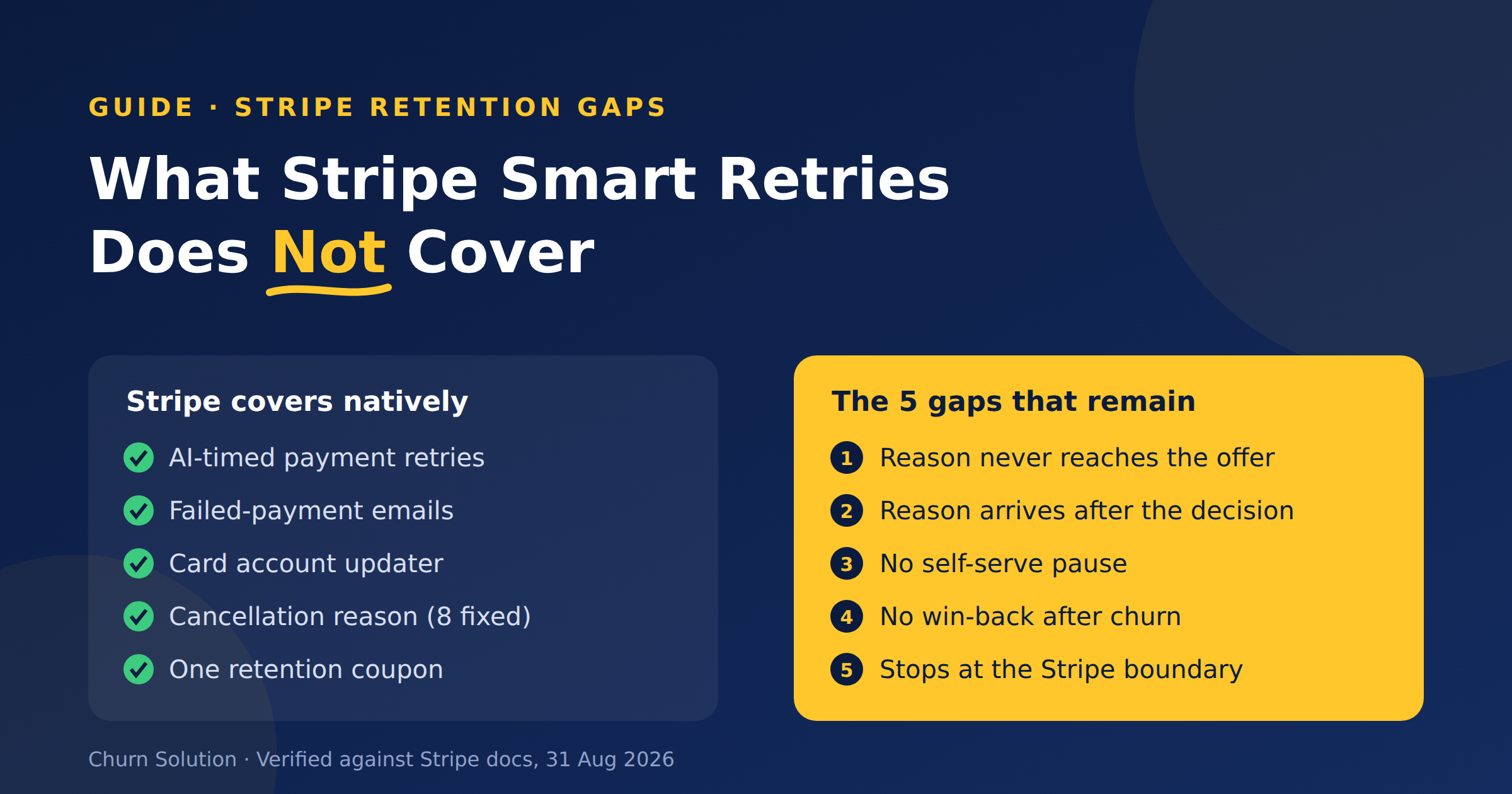
What Stripe Smart Retries Does Not Cover
Stripe Smart Retries recovers failed payments but doesn't run retention. Here are the five gaps that remain, sourced from Stripe's...


Membership Community Churn: The Members Who Quit Without Clicking Cancel
Quiet churn is the real leak: members who never clicked “cancel” at all. A card expires. A bank declines a...

Subscription Churn Dashboard: The 2026 Guide to Actionable Revenue Intelligence
Up to 40% of subscription churn is involuntary, meaning your customers aren't choosing to leave; they're being forced out by...