ARTICLE
Customer Save Rate Optimization: The 2026 Guide to Exit-Intent Retention
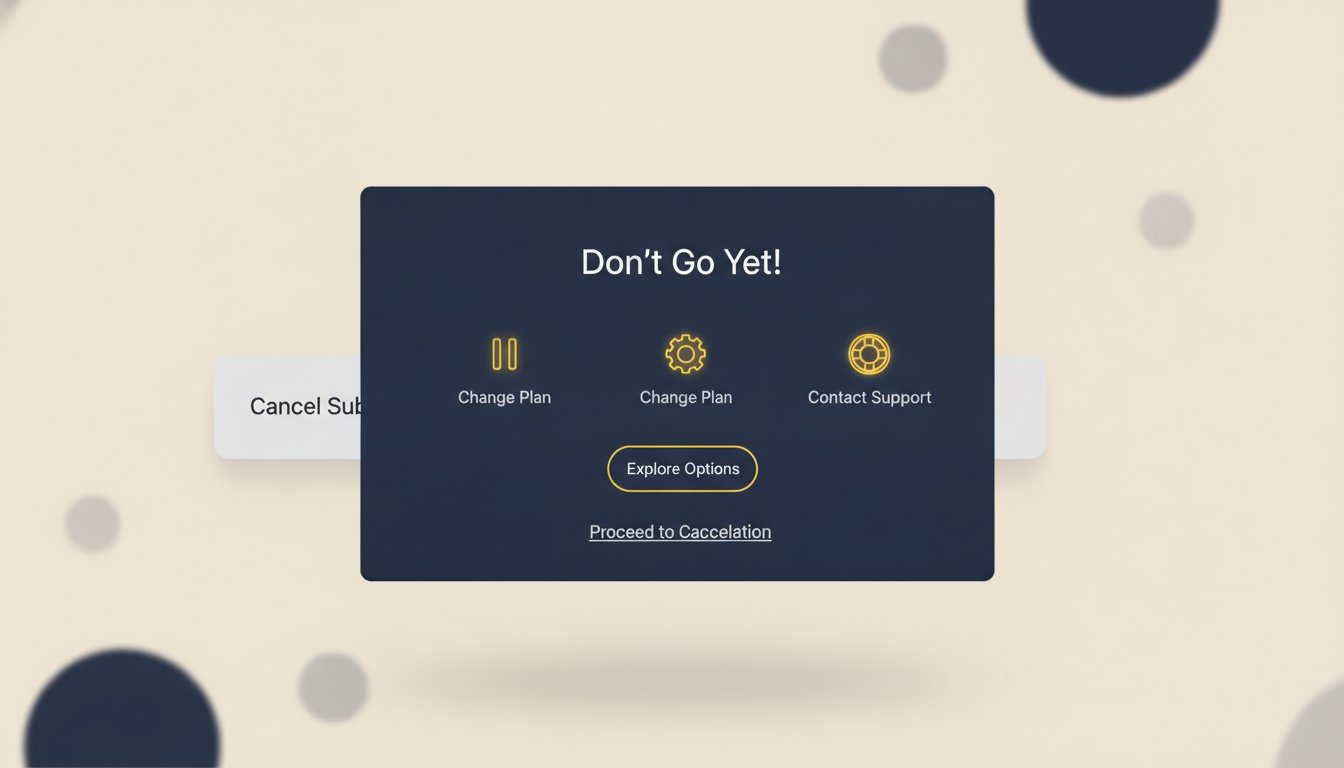
Your “Cancel” button isn’t a door closing; it’s the start of a high-stakes conversion funnel. Most SaaS leaders watch voluntary churn climb and respond with desperate, margin-killing discounts that fail to address the root cause of the exit. If you’re tired of losing revenue to a “gut-feel” retention strategy, it’s time to shift your focus to customer save rate optimization. This isn’t about begging users to stay. It’s about engineering a data-driven intervention at the exact moment of intent.
We know the frustration of maintaining a great product while watching users slip away through ineffective, generic processes. You deserve total visibility into why customers leave and a system that recovers revenue without constant manual oversight. This guide promises to help you master the mechanics of exit-intent retention to protect your subscription revenue with automated, data-driven interventions. We’ll explore how to transform cancellation flows into secondary conversion engines, leverage AI feedback analysis, and implement dynamic offers that secure long-term loyalty.
Key Takeaways
- Understand why customer save rate optimization acts as the critical last mile of retention and serves as your most direct lever for protecting monthly recurring revenue.
- Identify the essential components of a high-converting cancellation flow, including multi-step exit surveys and real-time user segmentation.
- Move beyond generic discounts by leveraging strategic alternatives like subscription pauses to maintain user habits without devaluing your brand.
- Execute a systematic 5-step framework to audit your current exit process and deploy automated, data-driven interventions that intercept cancellations.
- Protect your bottom line by integrating dynamic offers and smart retries into a seamless, high-performance revenue recovery ecosystem.
What is Customer Save Rate Optimization (SRO)?
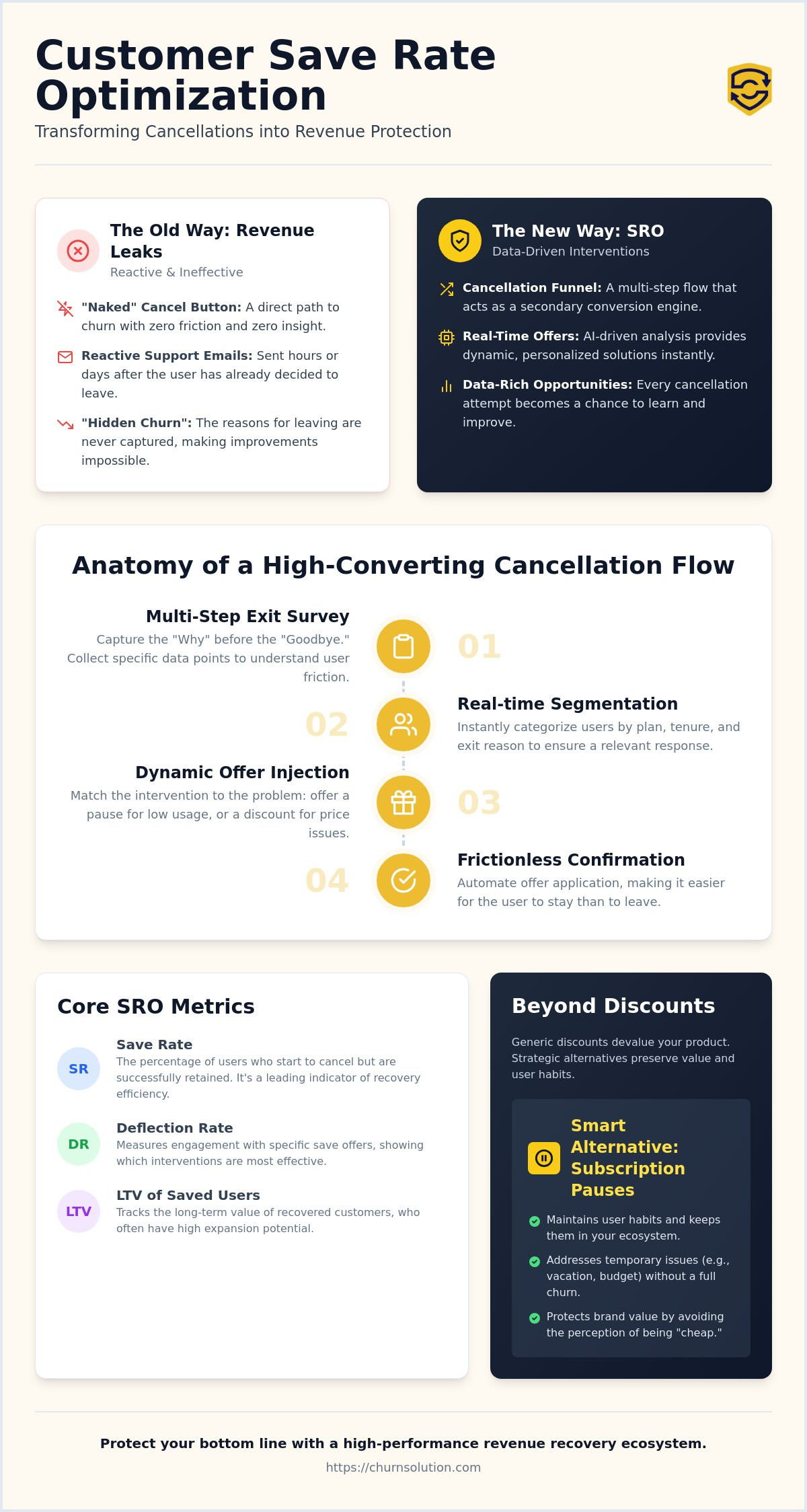
In the subscription economy, customer save rate optimization is the tactical science of converting a cancellation intent into a retained relationship. It is the systematic process of increasing the percentage of users who enter a cancellation flow but choose to remain active subscribers. While most growth teams focus on the top of the funnel, SRO targets the “last mile” of retention. It is the most direct lever you have for protecting monthly recurring revenue (MRR) because it deals with customers who have already found value in your product but are facing a specific, often solvable, friction point.
Effective Customer retention requires more than just a high quality product. It demands a sophisticated intervention at the precise second a user clicks “Cancel.” By the time a customer reaches this stage, passive retention efforts have already failed. SRO serves as your secondary conversion funnel, engineered to intercept exits and offer alternatives that align with the user’s current needs. In 2026, high performance SaaS companies no longer treat cancellations as inevitable losses. They treat them as data rich opportunities to refine their value proposition.
There is a critical distinction between save rate and churn rate. Churn rate is a lagging indicator that tells you what you have already lost. Save rate is a leading indicator of your recovery efficiency. By optimizing your save rate, you directly influence your Net Revenue Retention (NRR). High save rates indicate a resilient business model that can withstand market shifts and competitor pressure. In a landscape where regulatory bodies, such as those enforcing the California Automatic Renewal Law (ARL) and the 2026 Maryland HB0107, mandate easy cancellation paths, your save flow must be your strongest defensive asset.
The Core Metrics of Save Rate
To master customer save rate optimization, you must move beyond surface level observations. Start by calculating your Save Rate: divide your total saved customers by the total number of cancellation attempts, then multiply by 100. This number provides a baseline for your intervention success. You should also monitor your Deflection Rate, which measures how many users engaged with a specific offer before confirming their exit. Finally, analyze the LTV of saved users. Revenue recovered through a save flow often has a higher expansion potential because these users have been successfully re onboarded. Utilize advanced churn metrics to identify which segments offer the highest recovery ROI.
Why Traditional Retention Fails at the Exit
Traditional retention strategies often suffer from “Hidden Churn.” This occurs when companies rely on reactive support emails sent 24 hours after a user has already left. By then, the user’s habit is broken and their data is stale. A “naked” cancel button without a structured flow is a direct revenue leak. It provides zero visibility into why the user is leaving and offers no chance for a rebuttal. The modern standard requires a shift from reactive support to proactive, automated cancellation flows. These systems capture the “why” before the “goodbye,” allowing you to deploy dynamic offers that address specific exit reasons in real time.
The Anatomy of a High-Converting Cancellation Flow
A high-converting cancellation flow is not a single screen; it is a multi-stage logic engine designed to redirect user intent. To achieve true customer save rate optimization, you must replace the standard “Are you sure?” prompt with a structured sequence that identifies, segments, and solves the user’s underlying problem. This architecture functions as a secondary conversion funnel, moving the user from a state of exit intent to a state of renewed commitment through four critical steps.
- Step 1: The Multi-Step Exit Survey. You must capture the “Why” before the “Goodbye.” This stage collects specific data points that allow your system to understand the friction the user is experiencing.
- Step 2: Real-time Segmentation. Your system must instantly categorize the user by their subscription plan, their tenure, and the specific exit reason provided. This ensures the response is relevant rather than generic.
- Step 3: Dynamic Offer Injection. Once the pain point is identified, you must match the intervention to the problem. If the issue is price, offer a discount; if it is low usage, offer a pause or a training resource.
- Step 4: The Confirmation Logic. The “stay” option must be more frictionless than the “leave” option. Automate the application of offers so the user can resume their subscription with a single click.
By treating the exit process as a strategic interaction, you can start building your own high-converting flow today to see how these mechanics perform in real-time. This methodical approach ensures that every save is backed by data, not guesswork.
Capturing Actionable Exit Intelligence
Generic feedback is useless for revenue protection. You need granular insights to drive your retention roadmap. Using specialized exit surveys allows you to identify structural product issues that might otherwise go unnoticed. While many users select “Price” as a default, a structured flow can uncover deeper issues like “Missing Features” or “Low Usage.” When you integrate AI feedback analysis, you turn raw text into actionable intelligence. This technology categorizes thousands of responses into themes, allowing you to prioritize product updates that will have the greatest impact on your save rate.
Segmenting Your Save Strategy
Not all saves are created equal. Slashing prices for a low-value, high-maintenance user can actually hurt your long-term health. You must use sophisticated customer segmentation to protect your margins. High-value customers with long tenures deserve your most aggressive offers, such as significant extensions or dedicated account reviews. Conversely, newer users might only require a short-term “Subscription Sabbatical.” By segmenting your save strategy, you ensure that your most valuable revenue remains protected while maintaining the integrity of your pricing model.
Beyond Discounts: Strategic Alternatives for High-Value Saves
Relying solely on price cuts to prevent churn is a high-risk strategy that often backfires. While a quick discount might secure a temporary save, it frequently devalues your brand and attracts “bargain churners” who leave the moment the promotion ends. Sophisticated customer save rate optimization requires a broader repertoire of interventions that address the specific friction points identified in your exit surveys. By shifting the focus from price to value preservation, you protect your margins while maintaining a healthy, high-intent user base.
Strategic alternatives to discounts allow you to intercept cancellations without compromising your long-term pricing integrity. Consider these high-performance mechanisms:
- Pause Functionality. Offering a “Subscription Sabbatical” allows users to step away without losing their data or breaking their habit.
- Plan Downgrades. Transitioning users to a “Maintenance” or “Free” tier keeps the relationship active and ensures your product remains their default solution.
- Credit Injection. A one-time account credit can solve temporary budget constraints or compensate for a specific technical hurdle without permanently lowering your MRR.
Pause vs. Cancel: The Psychology of Commitment
The option to pause is a powerful psychological tool. Internal data suggests that up to 40% of users choose to pause instead of cancel when the option is presented correctly during the exit flow. This success is rooted in the “Endowment Effect,” where users are reluctant to lose the progress, data, and configurations they’ve built within your platform. By keeping the account active, you eliminate the “start from scratch” friction that prevents users from returning later. Implementing subscription pause functionality acts as a psychological safety net for users who are overwhelmed but not ready to end the relationship entirely.
Deploying Dynamic Retention Offers
Precision is the cornerstone of effective customer save rate optimization. Your system must trigger dynamic offers based on the specific intelligence gathered in the exit survey. A generic discount won’t save a user struggling with a complex integration; however, a targeted intervention might. Use these logic-driven examples to refine your flow:
- Scenario: Technical Issues. If a user selects “Technical Issues,” ignore the discount and offer an immediate 1-on-1 support call or a link to a specific onboarding workshop.
- Scenario: Budget Constraints. If “Budget” is the primary driver, offer two months at 50% off or a temporary three-month pause to alleviate immediate financial pressure.
This level of personalization demonstrates that you understand the user’s pain, transforming a cold cancellation attempt into a supportive, value-driven interaction. It moves the conversation away from cost and back toward the outcomes your product provides.
The 5-Step Framework for Optimizing Your Save Rate
Stop guessing and start measuring. Customer save rate optimization requires a disciplined, five-step framework to transition from reactive recovery to proactive revenue protection. This isn’t a “set and forget” feature; it’s a core business process that demands constant refinement. By following this methodical structure, you transform your exit flow from a simple “Cancel” button into a sophisticated revenue recovery engine.
- Baseline Measurement. Audit your current “naked” cancellation process. Identify exactly where users drop off and how many confirm their exit without seeing an alternative value proposition.
- Hypothesis Generation. Use granular churn metrics to pinpoint your biggest revenue leaks. Determine whether the primary friction is price, product fit, or technical complexity.
- Flow Implementation. Build your multi-step survey and offer logic. Ensure the survey captures the specific “Why” while the offer provides a logical “Instead.”
- A/B Testing. Use targeted A/B experiments to optimize every element of the experience. Test your offer copy, the length of your survey, and even the visual placement of your “Keep My Subscription” button.
- Iteration. Refine your flow based on AI-analyzed feedback. If users consistently report a specific missing feature, adjust your save offers to highlight upcoming roadmap items or offer a temporary pause until that feature launches.
To see how this framework can immediately impact your bottom line, launch your first retention experiment today and start recovering lost MRR.
Running Effective Retention Experiments
High-performance retention teams don’t just test discounts; they test commitment levels. For high-ACV customers, try testing a “Save Now” discount versus a “Speak to Support” prompt. You might find that high-value users prefer human intervention over a small price cut. It’s also vital to measure the “Re-Churn” rate of saved users. A save is only successful if the customer remains active for at least 90 days post-intervention. Finally, watch for “Offer Fatigue.” If a user sees the same 50% discount every time they visit the billing page, your pricing integrity will collapse.
Technical Implementation Considerations
A seamless user experience is non-negotiable. Your save flow must be deeply integrated with your customer portal to ensure users don’t feel like they’ve left your application. This requires a robust API handshake between your retention engine and your billing system to apply discounts or pauses instantly. Efficiency is the ultimate goal here. Save Rate ROI is defined as the recovered MRR minus the cost of the retention offers. If your recovery system is manual or clunky, you’re likely losing more in operational costs than you’re gaining in saved revenue.
Automating Revenue Protection with Churn Solution
Manual intervention is a strategic bottleneck that high-growth SaaS companies cannot afford. While the frameworks discussed earlier provide the logic for recovery, scaling those efforts requires a sophisticated, automated ecosystem. Customer save rate optimization only reaches its full potential when it functions as a self-optimizing engine that intercepts every cancellation attempt without requiring a single minute of support team time. Churn Solution provides the infrastructure to turn these theoretical saves into consistent, measurable revenue protection.
Revenue loss isn’t always a choice made by the user. To build a truly resilient business, you must address both voluntary and involuntary churn simultaneously. Your save flow handles the “Cancel” button, but your payment recovery system must handle the silent exits caused by failed transactions. By combining intelligent cancellation flows with smart retries, you create a comprehensive net that catches revenue regardless of how it attempts to leak. This dual approach ensures your retention strategy is robust enough to handle the complexities of the 2026 subscription economy.
Even the most optimized flow won’t save 100% of users at the point of exit. When a customer does choose to leave, the process shouldn’t end there. Automated reactivation campaigns take the intelligence gathered during the exit survey and use it to re-engage former users weeks or months later. If a user left because of a specific missing feature, your system should automatically notify them the moment that feature goes live. This closes the loop on the customer lifecycle, ensuring that today’s churned user remains tomorrow’s win-back opportunity.
Integrating Save Flows into Your Revenue Stack
Achieving best-in-class subscription revenue protection requires a holistic approach that connects your retention engine to your entire revenue stack. The data captured in your cancellation flows provides a direct feedback loop for your product and marketing teams. When you identify that a specific segment is leaving due to poor onboarding, you can adjust your top-of-funnel messaging or product walkthroughs accordingly. This integration doesn’t just save individual customers; it improves your overall Net Revenue Retention (NRR) and significantly increases your company’s valuation by demonstrating a predictable, defended revenue stream.
Getting Started with Churn Solution
You don’t need a month-long engineering sprint to start protecting your MRR. You can deploy your first optimized save flow in under 30 minutes by leveraging our library of high-performing exit survey templates and dynamic offer logic. These tools are built on the data-driven insights of thousands of successful save interactions, giving you an immediate head start on your customer save rate optimization journey. It’s time to stop letting revenue slip through the cracks of a “naked” cancellation button.
Start optimizing your save rate with Churn Solution today.
Secure Your Future Revenue Stream
Passive retention is a relic of the past. To maintain a competitive edge in 2026, you must treat your cancellation flow as a high-performance conversion engine. By mastering customer save rate optimization, you transition from watching revenue disappear to actively recovering it at the point of exit. You’ve learned that precision segmentation and strategic alternatives like subscription pauses are far more effective than margin-eroding discounts. These mechanics don’t just stop a single cancellation; they build a resilient foundation for long-term Net Revenue Retention.
Churn Solution empowers you to execute this strategy with technical mastery. Our platform allows you to recover up to 40% of cancelling subscribers through automated, data-driven interventions. With AI-driven feedback analysis and seamless integration with Stripe and Braintree, you can deploy a sophisticated defense system in minutes. It is time to take control of your churn metrics and transform every exit attempt into a loyalty-building opportunity.
Stop the revenue leak; deploy your automated save flow with Churn Solution. Your subscription growth starts with the users you choose to keep.
Frequently Asked Questions
What is a good customer save rate for SaaS?
A benchmark for a high-performing save rate typically falls between 15% and 30%, though this varies by industry and price point. Top performers often achieve higher rates by using precision targeting and dynamic offers. Your goal is to establish a baseline and iterate until your recovery efficiency justifies the cost of the offers provided.
How do I measure the success of a save rate optimization campaign?
Success is measured by the Net Saved Revenue, which is the total MRR recovered minus the cost of the incentives provided. You should also track the “Save Duration,” which monitors how long a saved user remains active after the intervention. High save rates are meaningless if the users churn again within a single billing cycle.
Should I offer a discount to every customer who tries to cancel?
No, you should never apply a blanket discount strategy as it devalues your brand and attracts low-quality “bargain churners.” Use real-time segmentation to reserve aggressive discounts for high-value users. For others, alternatives like subscription pauses or plan downgrades often provide better long-term unit economics and preserve your pricing integrity.
Does adding a cancellation flow increase customer frustration?
A well-designed flow reduces frustration by providing immediate solutions to the user’s specific problems. While a “naked” cancel button is faster, it leaves the customer’s issues unresolved. By offering a “Subscription Sabbatical” or a technical support bridge, you demonstrate that you value the relationship, which often improves overall brand sentiment even if they eventually leave.
How does save rate optimization impact Net Revenue Retention (NRR)?
Customer save rate optimization directly inflates NRR by preventing revenue contraction at the point of exit. Since NRR accounts for expansion revenue and churn, every saved dollar is a dollar that doesn’t need to be replaced by expensive new customer acquisition. This resilience makes your business more attractive to investors and increases overall company valuation.
Can I automate save flows for different customer segments?
Yes, automation is essential for scaling your retention efforts across diverse user groups. You can configure your system to trigger specific offers based on user tenure, plan tier, or lifetime value. This ensures that a pro-tier user receives a high-touch intervention while a basic user is offered a self-serve alternative like a temporary pause.
What happens if a saved customer churns again 30 days later?
This is categorized as “Re-Churn” and indicates that the save offer did not address the root cause of the dissatisfaction. You must analyze these instances to refine your offer logic. If users consistently re-churn after a discount, it suggests that the friction is product-related rather than financial, requiring a different intervention strategy.
How do I use exit survey data to improve my product?
Exit survey data acts as a direct roadmap for your product development team. By aggregating responses with AI feedback analysis, you can identify recurring complaints about missing features or UI friction. This allows you to prioritize engineering resources on updates that will have the most significant impact on preventing future voluntary churn.
- Key Takeaways
- Table of Contents
- What is Customer Save Rate Optimization (SRO)?
- The Anatomy of a High-Converting Cancellation Flow
- Beyond Discounts: Strategic Alternatives for High-Value Saves
- The 5-Step Framework for Optimizing Your Save Rate
- Automating Revenue Protection with Churn Solution
- Secure Your Future Revenue Stream
- Frequently Asked Questions

Churn solution that turns your customers right around.
Related Articles
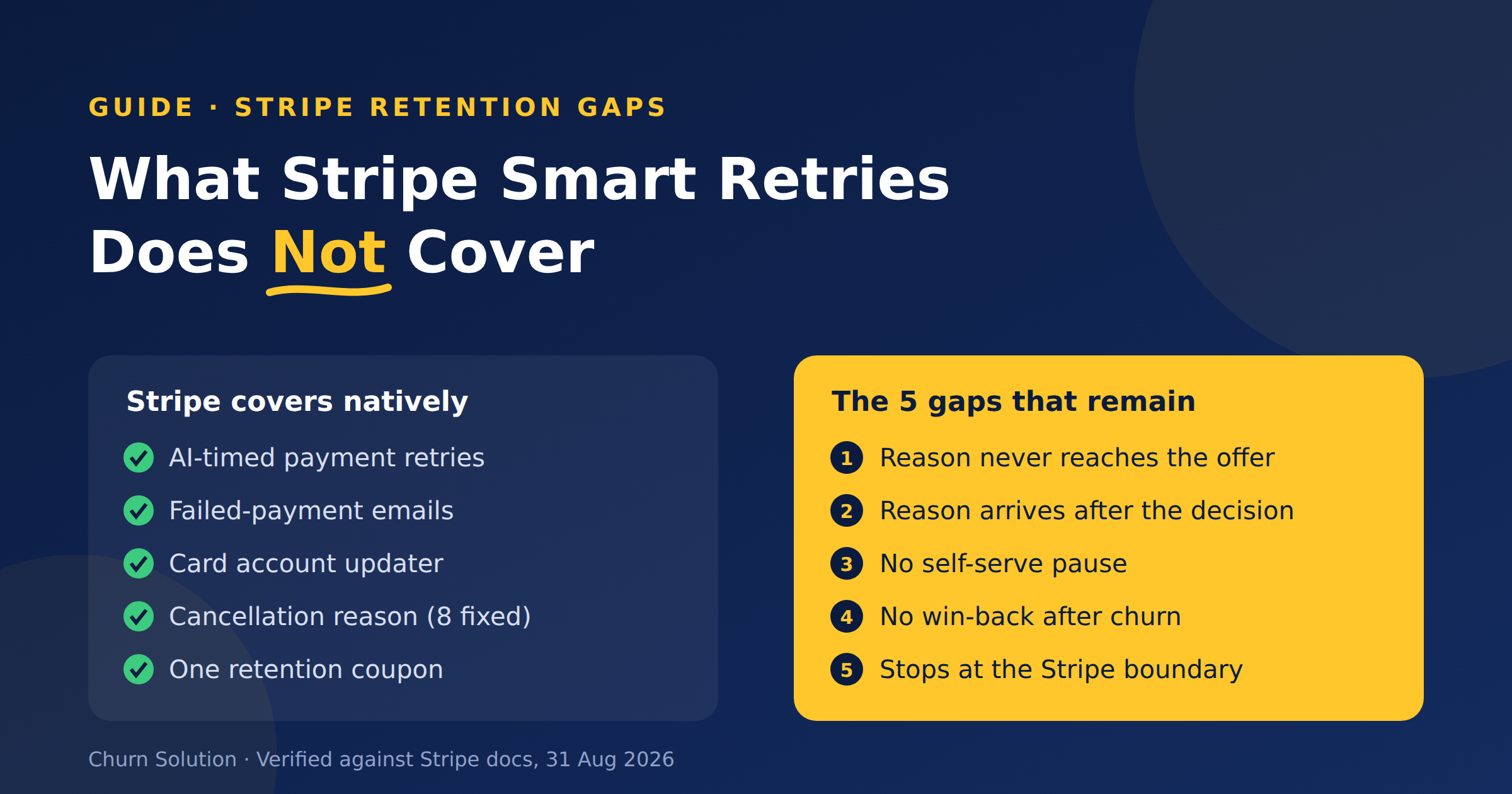
What Stripe Smart Retries Does Not Cover
Stripe Smart Retries recovers failed payments but doesn't run retention. Here are the five gaps that remain, sourced from Stripe's...

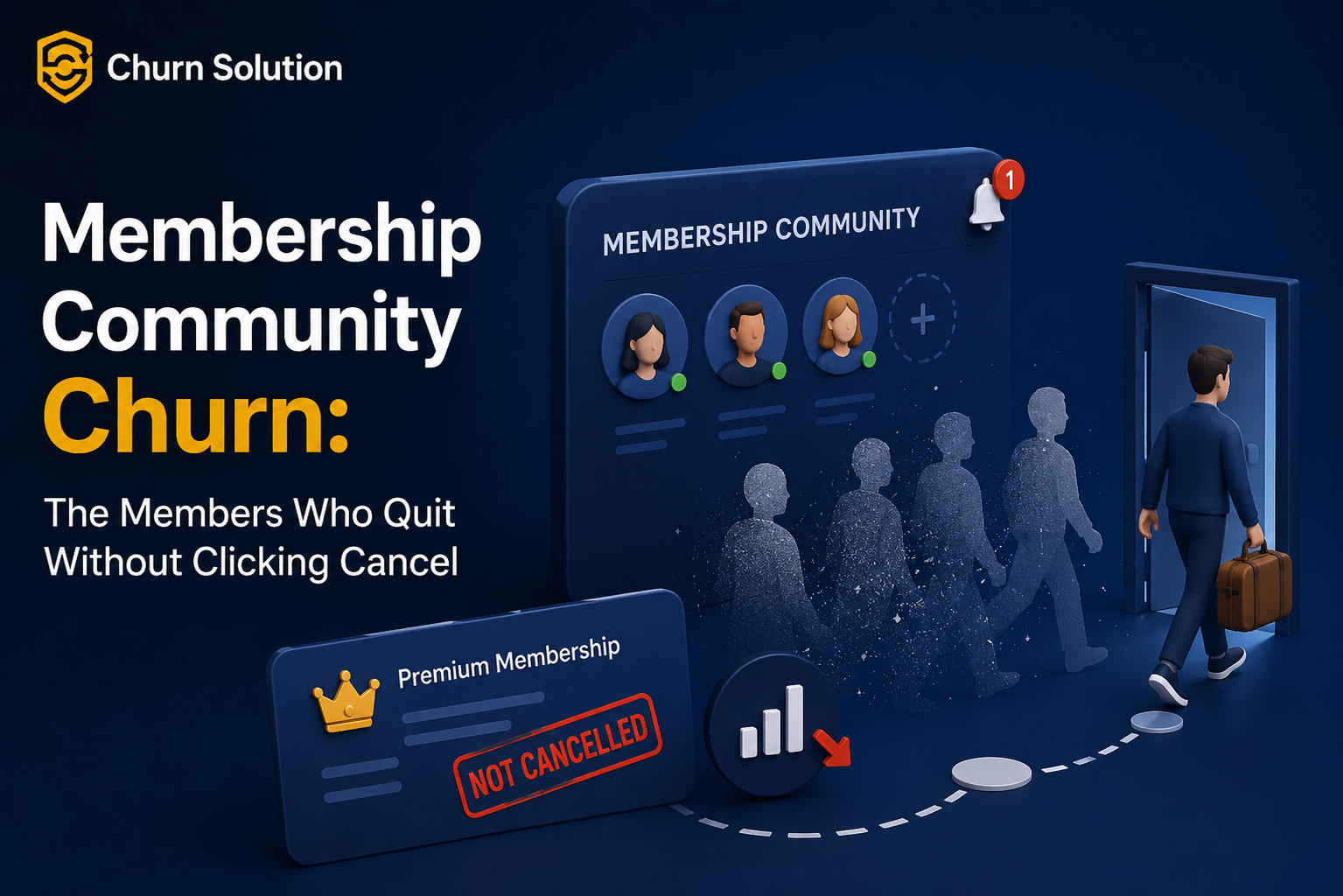
Membership Community Churn: The Members Who Quit Without Clicking Cancel
Quiet churn is the real leak: members who never clicked “cancel” at all. A card expires. A bank declines a...

Subscription Churn Dashboard: The 2026 Guide to Actionable Revenue Intelligence
Up to 40% of subscription churn is involuntary, meaning your customers aren't choosing to leave; they're being forced out by...