ARTICLE
The Definitive Guide to Automated Cancellation Flows in 2026

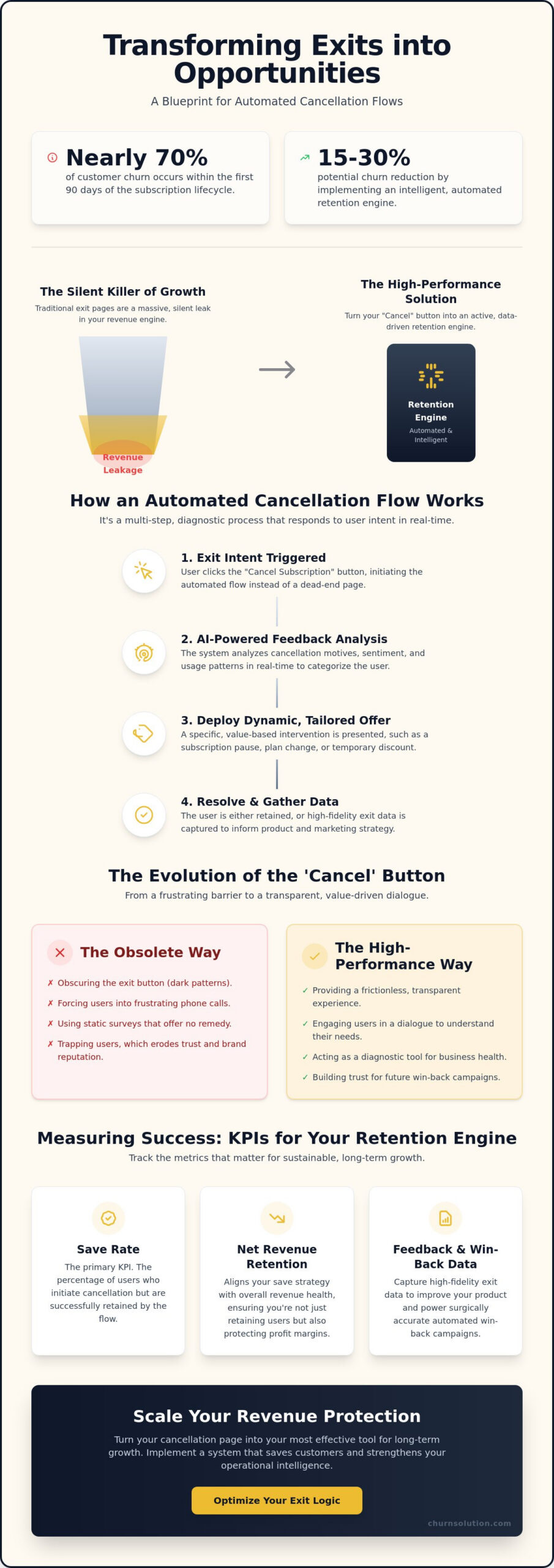
Nearly 70% of customer churn occurs within the first 90 days of the subscription lifecycle. For most scaling brands, this represents a massive, silent leak in the revenue engine that manual efforts cannot plug. You likely recognize that one-on-one retention is impossible to scale; yet, you’re still losing users without capturing the critical data needed to stop them. Implementing advanced automated cancellation flows is the only way to turn these exits into opportunities for recovery and optimization.
This guide provides the technical blueprint to transform your exit process into a high-performance revenue recovery engine using intelligent automation and AI feedback. You’ll learn how to reduce churn by 15-30% while distinguishing between saveable users and bad-fit accounts. We’ll break down the specific mechanisms for deploying dynamic offers and dunning automation that protect your bottom line. Prepare to master a system that turns the cancellation page into your most effective tool for long-term growth and strategic compliance in an evolving regulatory environment.
Key Takeaways
- Transform passive exit buttons into high-performance retention engines by using dynamic, branching logic triggered by user intent.
- Utilize AI feedback analysis to categorize cancellation motives instantly to distinguish saveable revenue from users who aren’t a strategic fit.
- Deploy automated cancellation flows that prioritize value-based interventions, such as subscription pauses, to stop churn without eroding profit margins.
- Align your retention strategy with Net Revenue Retention by using the Save Rate as a primary KPI for your cancellation infrastructure.
- Close the loop on revenue recovery by feeding exit data into automated win-back campaigns that reactivate former subscribers with surgical accuracy.
What Are Automated Cancellation Flows? Protecting Revenue at the Brink
Revenue leakage is the silent killer of subscription growth. Most brands treat the cancellation page as a graveyard for users; however, it’s actually the most critical checkpoint in the customer lifecycle. automated cancellation flows are dynamic, branching logic systems triggered by exit intent. They transform a passive “Cancel” button into an active retention engine. This isn’t a “Hail Mary” attempt; it’s a sophisticated diagnostic intervention designed to protect customer retention metrics through data-driven precision.
By 2026, the industry has shifted away from static forms toward AI-powered interventions. These systems analyze sentiment and usage patterns to deploy the right save at the right moment. The primary goal is twofold: you must retain saveable revenue while gathering high-fidelity departure data. When a user decides to leave, they provide the most honest feedback your business will ever receive. Capturing this data allows you to optimize your product and marketing for those who stay.
Implementing these flows means you’re no longer guessing why churn happens. You’re deploying a system that identifies the difference between a user who is a “bad fit” and one who is simply facing a temporary hurdle. This distinction is vital for maintaining healthy margins and high-performance growth. You don’t just want to stop people from leaving; you want to build a resilient ecosystem where every exit attempt strengthens your operational intelligence.
For eco-friendly e-commerce brands like Reset Razor, this operational intelligence is key to understanding whether a customer is leaving due to product cycles or a deeper lack of brand alignment.
The Evolution of the ‘Cancel’ Button
Dark patterns are dead. Obscuring the exit button or forcing phone calls no longer works in a transparent economy. Modern users demand a frictionless experience that respects their time while offering genuine value. High-performance brands have pivoted from barriers to dialogue. You don’t want to trap a user; you want to understand them. In 2026, a cancellation flow is not a barrier; it is a diagnostic tool for your business health. Transparency builds the trust necessary for future win-back campaigns.
Beyond the Exit Survey: The Multi-Step Save
Static surveys are obsolete because they capture grievances without offering remedies. A multi-step save flow utilizes AI feedback analysis to respond in real-time. The system captures intent, reinforces value based on usage, and presents a dynamic offer tailored to the user’s specific reason for leaving. This process distinguishes between voluntary signals and involuntary churn indicators. By matching the intervention to the user’s state, you maximize the probability of a successful save while automating the feedback loop.
The Architecture of a Retention Engine: How Automation Saves Subscribers
Building a high-performance retention system requires more than a simple exit survey. It demands a structured logic chain that reacts to user behavior in milliseconds. When a user initiates a cancellation, the system triggers a sequence: identify the segment, analyze the motive, and deploy a specific resolution. This architecture ensures that automated cancellation flows operate as a precision instrument rather than a blunt tool. It’s about architecting a path that leads the user back to value.
Seamless integration with billing engines like Stripe is non-negotiable. If the flow isn’t synchronized with your payment infrastructure, the “save” won’t stick. You need the ability to apply dynamic offers, such as a temporary discount or an immediate account pause, without manual intervention. This technical alignment is what separates a basic form from a true revenue recovery engine. You can optimize your exit logic to ensure every saved subscriber is correctly updated in your billing records.
While the federal regulatory environment is currently in flux, the principles behind the Click-to-Cancel rule continue to shape state laws and consumer expectations. Your architecture must remain transparent and helpful to avoid legal friction. By focusing on a frictionless but data-rich experience, you protect your brand’s image while maximizing the opportunity for recovery; for those needing to address harmful online mentions that could damage their standing, visit Content Removal. High-fidelity data collection at the point of exit is the foundation of long-term revenue protection.
AI-Driven Feedback Loops
AI feedback analysis finds patterns in open-text responses that human teams often miss. By processing thousands of departure comments, the system assigns a Sentiment Score to each session. This score determines the save potential and guides the AI to present the most relevant intervention. This data doesn’t just sit in a silo; it feeds directly back into your product roadmap to prevent future churn. It’s a continuous loop of learning and optimization that strengthens the entire subscription ecosystem.
Segmented Deflection Logic
You cannot treat a high-LTV VIP customer the same way you treat a low-tier trial user. Segmented deflection is the practice of matching save incentives to customer lifetime value. By leveraging behavioral data, such as a user who hasn’t logged in for 30 days, you can customize the flow to address their specific lack of engagement. This ensures you aren’t eroding margins by offering deep discounts to users who would have stayed with a simple plan downgrade. Precision segmentation protects your revenue while providing a tailored experience for every user tier.
Dynamic Offers vs. Generic Discounts: Strategic Intervention Without Margin Erosion
Slashing prices is a reactive tactic, not a strategy. Many executives fear that automated cancellation flows will simply train users to hunt for discounts, leading to unnecessary margin erosion. This fear is valid if you use a blunt, universal approach. High-performance systems avoid this by utilizing conditional logic. You only present a discount if the user explicitly identifies “price” or “budget” as their primary reason for leaving. This ensures that your financial incentives are targeted and purposeful.
For other segments, the intervention should focus on utility rather than cost. If a user cites “complexity,” a discount won’t help; they need a success call or a link to a specific technical tutorial. This precision is essential for managing customer churn without sacrificing the profitability of your remaining base. You are protecting the bottom line while simultaneously solving the user’s actual problem. By gating offers behind specific logic, you maintain the integrity of your pricing model.
The psychology of the “Pause” button is fundamentally different from the “Cancel” button. Cancellation is final and represents a total severance of the relationship. Pausing is a temporary suspension of service that keeps the user’s data and configuration intact. This distinction is vital for long-term retention. It allows the customer to step away without the cognitive load of a permanent exit, making it much easier for them to resume their subscription when their situation changes.
The Power of the Subscription Pause
The “Pause” button is a critical tool in the modern retention arsenal. According to a March 2026 report by Recurly, there was a 337% year-over-year increase in the use of “pause” options. This shift is significant because three out of four subscribers who pause eventually return to active status. Pausing preserves the user’s data and configuration, which drastically reduces the friction of reactivation. We recommend offering specific durations like 30, 60, or 90 days to give users a sense of control over their commitment without losing them forever.
Value-Based Save Tactics
Strategic interventions should extend beyond the pause. For low-usage accounts, consider a “Maintenance Plan” or a “Lurker Tier.” These tiers keep the account active at a nominal cost, ensuring the user doesn’t lose historical data while they aren’t actively using the tool. If AI feedback identifies a struggle with implementation, the flow should trigger a “Success Call” instead of a financial incentive. You can also use dynamic offers to trade a short-term discount for a long-term contract extension. This converts a potential loss into a guaranteed revenue period, effectively neutralizing the immediate cost of the save. For a comprehensive framework on deploying these tactics at scale, the automated customer save flows SaaS playbook provides actionable strategies for intercepting exit intent and recovering MRR without manual intervention.
Measuring Success: KPI Frameworks for Your Cancellation Infrastructure
Metrics drive mastery. You cannot optimize what you don’t measure; therefore, establishing a robust KPI framework is the first step toward high-performance revenue recovery. The Save Rate is your north star. It represents the percentage of users who initiate the exit process but choose to remain active after engaging with your automated cancellation flows. While simple to track, this metric only tells half the story. You must also validate the quality of those saves through rigorous post-save analysis.
True success is measured by the longevity of the recovered user. An “Offer Take Rate” might look impressive in a weekly report, but it’s meaningless if those users churn 30 days later. High-performance teams track cohort retention for at least three months post-save to ensure the intervention provided lasting value. This data allows you to distinguish between “temporary saves” that delay the inevitable and “true recoveries” that contribute to long-term Net Revenue Retention (NRR). You can analyze your save performance to identify which specific offers produce the highest lifetime value for your brand.
Deflection Rates and NRR
Gross churn is a lagging indicator; revenue saved is a proactive victory. Consider a $1M ARR business with a typical annual churn rate of 15% as seen in many B2B SaaS segments. This represents $150,000 in lost revenue. By improving your deflection rate by just 10% through optimized automated cancellation flows, you immediately recover $15,000 in annual recurring revenue. This isn’t just a one-time gain. Because these users stay in the system, their compounding lifetime value significantly outpaces the initial recovery cost. Tracking cohort retention post-save ensures your NRR remains healthy while allowing you to filter out bad-fit users who don’t contribute to growth.
A/B Testing Your Save Offers
Optimization is an iterative process. You must constantly test your assumptions to maximize the efficacy of your flows. Effective experiments often include testing “1 Month Free” against “50% off for 2 Months” to see which incentive drives better long-term behavior. You should also test the sequence of your exit survey questions; sometimes, moving the most critical diagnostic question to the start of the flow increases completion rates. Use the Churn Solution dashboard to visualize these experiments in real-time. This level of granular visibility turns your cancellation infrastructure into a laboratory for performance, ensuring every save is backed by statistical significance.
Scaling Revenue Protection with Churn Solution’s Automated Ecosystem
Fragmented tools create fragmented results. You can’t protect revenue if your retention efforts live in silos. Churn Solution provides the unified infrastructure required to turn every exit attempt into a strategic data point. By positioning yourself with an expert partner, you move beyond basic surveys and into a high-performance ecosystem where automated cancellation flows work in tandem with your entire revenue recovery stack. This is the difference between losing a customer and securing a future reactivation. You need a system that identifies the leak and provides the exact tool to plug it. Before committing to any platform, however, it’s worth evaluating the build vs buy cancellation flow decision to understand the true engineering costs and ROI implications of developing retention infrastructure in-house versus deploying a purpose-built solution.
Proactive subscription revenue protection requires a shift in perspective. You aren’t just managing churn; you’re optimizing the entire customer lifecycle. This involves a transition from reactive interventions to a structured, automated defense. By leveraging specialized intelligence, you ensure that every user interaction-even a cancellation request-contributes to your long-term growth. This categorical approach creates a sense of stability and comprehensive coverage across your entire subscriber base.
Seamless Integration with Dunning and Win-backs
Strategic alignment is the catalyst for recovery. When a user initiates a cancellation, the system must respect their current status within your billing cycle. If a user is currently in a dunning state due to a failed payment, presenting a voluntary “save” offer is counterproductive. Churn Solution ensures your flows are synchronized with dunning email automation and smart retries. If a save attempt fails, the user isn’t forgotten; they are automatically entered into a win-back sequence at the optimal time. This single-platform approach ensures that your retention interventions are timely, relevant, and focused on the bottom line.
Turning Data into Actionable Growth
Data is only valuable if it drives decision-making. Churn Solution’s AI feedback analysis summarizes thousands of open-text responses into high-level insights for your C-suite and product teams. You can identify specific feature gaps or pricing friction points that are driving churn across different segments. More importantly, the system identifies “at-risk” users before they even reach the cancellation page by analyzing usage patterns and sentiment. This allows you to deploy proactive interventions that prevent the exit attempt entirely. Protect your MRR with Churn Solution’s automated flows and transform your exit process into a competitive advantage.
Master Your Retention Infrastructure for Sustainable Growth
Passive churn management is an operational liability in the 2026 subscription economy. You’ve seen how transforming your exit process into a data-driven diagnostic tool allows you to recover revenue without eroding your brand’s value. By implementing automated cancellation flows, you transition from guessing why users leave to possessing 100% data visibility through AI-powered feedback analysis. This intelligence doesn’t just stop exits; it fuels your entire product roadmap and future win-back strategies.
SaaS clients are already achieving average save rates of 20-35% by deploying these intelligent interventions. Whether you rely on Stripe, Chargebee, or Recurly, our platform offers seamless integration to ensure your billing and retention logic remain perfectly synchronized. It’s time to stop the leak and start reclaiming your lost MRR with a system built for high-performance recovery.
Stop the revenue leak: deploy your cancellation flows today
Your business deserves a recovery engine that works as hard as your acquisition team. Start optimizing today.
Frequently Asked Questions
What is a good save rate for an automated cancellation flow?
A high-performance save rate typically ranges between 20% and 35% for SaaS organizations. This metric depends heavily on your industry segment and the relevance of your dynamic offers. Achieving these results requires a sequence that addresses the specific motive behind the exit intent rather than applying a universal discount. You must track these saves over a 90 day period to ensure they represent long-term retention rather than temporary delays.
Will an automated flow frustrate my customers who just want to leave?
Frictionless transparency is the standard for modern retention. While you must provide a clear path to exit, offering a helpful alternative like a subscription pause often resolves the user’s underlying issue without forcing a total severance. High-quality automated cancellation flows act as diagnostic tools that respect the user’s time while providing genuine value-driven options. Transparency builds the trust necessary for future win-back campaigns.
How do I prevent users from “gaming” the system for discounts?
You prevent system abuse by implementing conditional logic that gates discounts behind specific criteria. Offers should only appear if a user selects “price” as their reason and meets specific eligibility requirements, such as a minimum account age or a clean payment history. This ensures that incentives are reserved for at-risk revenue rather than opportunistic users looking for a lower rate. You protect your margins by matching the incentive to the verified need.
Can I use automated cancellation flows with Stripe Billing?
Yes, our system integrates directly with Stripe Billing to ensure that all saves and plan changes are updated in real-time. This technical alignment allows you to apply dynamic offers or account pauses without manual intervention. It’s essential that your retention infrastructure communicates seamlessly with your billing engine to maintain accurate financial records and prevent subscription errors. We also support Chargebee and Recurly for similar high-performance synchronization.
What is the difference between a cancellation flow and an exit survey?
An exit survey is a passive data collection tool that captures feedback after a user has already left. In contrast, automated cancellation flows are active retention engines that intervene during the exit process to offer immediate resolutions. While surveys provide historical data, flows provide real-time recovery opportunities by matching the intervention to the user’s stated pain point. This proactive approach turns a departure attempt into a revenue-saving conversation.
When should I offer a pause instead of a discount?
You should prioritize a subscription pause when a user indicates a temporary lack of need or a seasonal usage pattern. Pausing preserves the user’s data and configuration, which is more effective than a discount for customers who intend to return. Reserve discounts for users specifically citing budget constraints. This distinction protects your profit margins from unnecessary erosion while keeping the door open for the user’s eventual return to active status.
How long does it take to implement an automated flow?
Initial deployment usually occurs within a few business days depending on the complexity of your segmentation logic. Our platform is designed for rapid integration with your existing tech stack. Once the technical connection to your billing engine is established, you can begin A/B testing different offer sequences immediately. This allows you to start recovering lost MRR without a lengthy development cycle or extensive manual configuration.
Does AI feedback analysis actually provide better insights than manual tagging?
AI feedback analysis identifies subtle patterns and sentiment shifts in open-text responses that manual tagging often overlooks. It processes thousands of comments in real-time to provide high-fidelity data on why users are departing. This automated approach allows your product and marketing teams to act on actionable trends without the administrative burden of manual categorization. You gain 100% visibility into the “why” behind your churn metrics with surgical precision.
- Key Takeaways
- Table of Contents
- What Are Automated Cancellation Flows? Protecting Revenue at the Brink
- The Architecture of a Retention Engine: How Automation Saves Subscribers
- Dynamic Offers vs. Generic Discounts: Strategic Intervention Without Margin Erosion
- Measuring Success: KPI Frameworks for Your Cancellation Infrastructure
- Scaling Revenue Protection with Churn Solution's Automated Ecosystem
- Master Your Retention Infrastructure for Sustainable Growth
- Frequently Asked Questions

Churn solution that turns your customers right around.
Related Articles
Membership Community Churn: The Members Who Quit Without Clicking Cancel
Quiet churn is the real leak: members who never clicked “cancel” at all. A card expires. A bank declines a...

Subscription Churn Dashboard: The 2026 Guide to Actionable Revenue Intelligence
Up to 40% of subscription churn is involuntary, meaning your customers aren't choosing to leave; they're being forced out by...
Dynamic Retention Offers: The 2026 Guide to Automated Revenue Recovery
Did you know that acquiring a new customer in 2026 costs up to 25 times more than retaining an existing...